
Recursos
Exploren una amplia gama de recursos valiosos en GCED para profundizar su comprensión y promover su búsqueda, incidencia, enseñanza y aprendizaje.
3,500 resultados encontrados
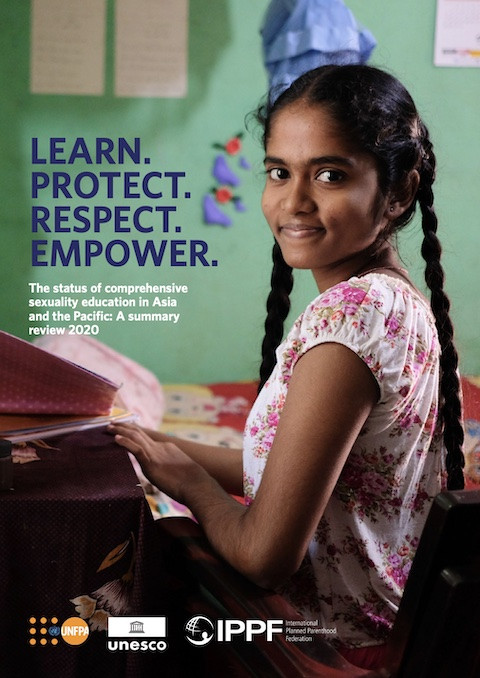 Learn, Protect, Respect, Empower: The Status of Comprehensive Sexuality Education in Asia and the Pacific; A Summary Review 2020 Año de publicación: 2021 Autor corporativo: United Nations Population Fund (UNFPA) | UNESCO | International Planned Parenthood Federation (IPPF) More than half of the world’s 1.8 billion young people aged 10–24 live in the Asia and Pacific region1 and a majority of them live in low and middle-income countries. In spite of their diverse socio-economic contexts, young people across this vast region commonly face limited access to sexual and reproductive health and rights (SRHR) information and services, including age-appropriate comprehensive sexuality education. Of the 13 million adolescent girls globally with an unmet need for contraception, approximately half live in Asia-Pacific, leading to an estimated 3.7 million births to adolescent girls in the region annually. In addition, around 82,000 young people are infected with HIV each year in the region. As adolescents transition through to adulthood, it is crucial that they are equipped with the necessary knowledge, attitudes and skills to support their health and wellbeing, regardless of age, sex, marital status, socioeconomic status, ethnicity, sexual orientation or gender identity. School-based and age-appropriate comprehensive sexuality education (CSE) is an effective means of reaching a large population of children and young people, particularly where rates of school participation are high. This overview of the status of in-school CSE in Asia and the Pacific provides a strong evidence base on the reach and impact of this across the region. Importantly, post COVID-19 we need to build back CSE programmes that are better and stronger to meet the social and emotional needs of our young people.
 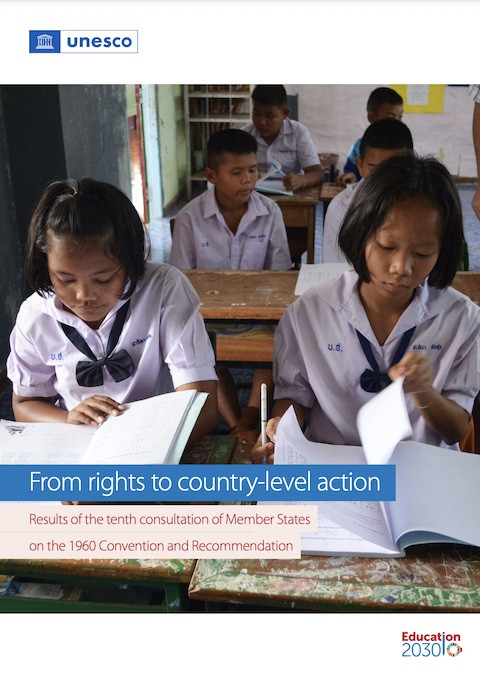 From Rights to Country-Level Action: Results of the Tenth Consultation of Member States on the 1960 Convention and Recommendation Año de publicación: 2022 Autor: Rolla Moumné | Sharlene Bianchi Autor corporativo: UNESCO The year 2020 marked a turning point for education worldwide. The impact of the COVID-19 pandemic not only amplified the difficulties and revealed existing weaknesses, but also brought the unpreparedness and lack of resilience of national education systems to the fore.The tenth consultation on the 1960 Convention against Discrimination in Education was conducted in precisely this context.Providing a valuable opportunity for States to take stock of the progress made in implementing Convention and sharing interesting national practices, the Consultation revealed continuous and new challenges the education sector faces. The unique timing of the consultation also created an opportunity to report on actions taken to faceadverse effects of the pandemic. This report analyzes and presents the Consultation findings, draws trends, and provides guidance for action. It shows how, by implementing the provisions of the Consultation, States can accelerate progress towards achieving Sustainable Development Goal 4, while invites a reflection on possibly reviewing the framework of the right to education to further respond to new challenges and put an end to increased inequalities worldwide.
 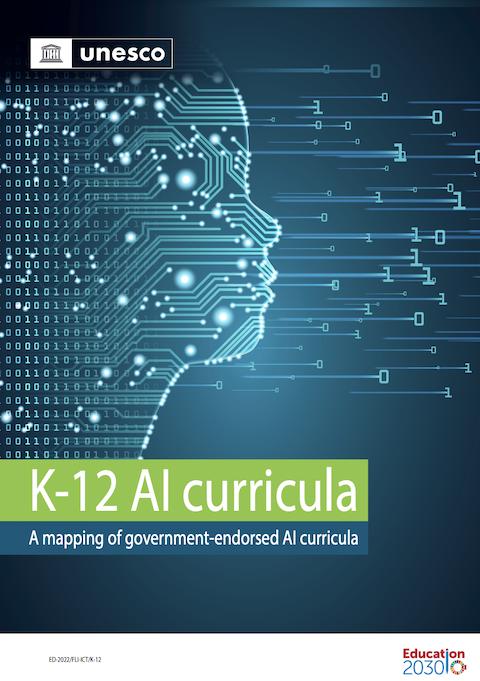 K-12 AI Curricula: A Mapping of Government-Endorsed AI Curricula Año de publicación: 2022 Autor corporativo: UNESCO Regulations on their own are insufficient to ensure AI as a common good for education and for humanity. All citizens need to be equipped with some level of AI literacy covering the values, knowledge and skills relating to AI. This report features key findings and recommendations of UNESCO’s global survey on AI curricula for K-12. It reveals that only 11 countries have developed and endorsed K-12 AI curricula and another four countries have AI curricula in development. This is a strong call for Member States to develop AI curricula for K-12 students, and to build stronger mechanisms to validate non-governmental AI curricula offered to balance the private-driven approach. The report also reveals that the learning outcomes of AI curricula need to be more focused on fostering creativity in crafting AI technologies and on contextual ethics. Teacher training is key to ensure the implementation of AI curricula, and teachers need to be trained on designing and facilitating project-based learning which is the most commonly used pedagogical methodology in existing AI curricula. The report also advises an ‘agnostic approach’ towards AI brands and products when introducing domain-specific AI technologies.
  Policy Review Report: Early Childhood Care and Education in Kazakhstan Año de publicación: 2005 Autor corporativo: UNESCO UNESCO launched a joint UNESCO/OECD Early Childhood Policy Review Project as a component of the 2004-2005 plan. The purpose is to provide selected countries with an opportunity to review their early childhood policies and identify concrete options and strategies for improvement. Four countries were chosen based on their expressed interest - Brazil, Indonesia, Kazakhstan and Kenya. This review was conducted as part of Kazakhstan's participation in the project, which is being implemented in collaboration with the OECD. Отчет по обзору политики: дошкольное воспитание и обучение в Казахстане Año de publicación: 2005 Autor corporativo: Организация Объединенных Наций по вопросам образования, науки и культуры (UNESCO) ЮНЕСКО, в качестве составного компонента плана на 2004-2005 годы, запустило совместный Проект ЮНЕСКО/ОЭСР по обзору политики в области дошкольного воспитания и обучения. Целью является предоставить выбранным странам возможность провести обзор своей политики в области дошкольного воспитания и обучения и определить конкретные варианты и стратегии по его совершенствованию. Четыре страны были выбраны на основе выраженного ими интереса – Бразилия, Индонезия, Казахстан и Кения. Настоящий обзор был проведен в рамках участия Казахстана в проекте, который реализуется в сотрудничестве с ОЭСР.
  Addressing Conspiracy Theories: What Teachers Need to Know Año de publicación: 2022 Autor corporativo: UNESCO This document is a first introduction for educators, working in and outside of formal schooling, on how to identify, prevent and address conspiracy theories in education settings. It seeks to provide educators with key definitions and essential knowledge to grasp the complexity of the phenomenon and alert learners about the key characteristics and harmful effects of conspiracy theories for a first, immediate response. To support educators in this endeavour, this document outlines strategies to prevent the belief in conspiracy theories as well as to engage with learners who already believe in them.
  اﻟﺘﺼﺪي ﻟﺨﻄﺎب اﻟﻜﺮاﻫﻴﺔ: ﻫﻞ اﻟﺘﻌﻠﻴﻢ ﻫﻮ اﻟﺤﻞ؟ Año de publicación: 2022 Autor: Nicole Fournier-Sylvester Autor corporativo: UNESCO | UN. Office on Genocide Prevention and the Responsibility to Protect هذه الورقة جزء من مجموعة أوراق المناقشة ، التي تمّ إعدادها بتكليف من اليونسكو ومكتب الأمم المتحدة للمستشار الخاص وتعتبر الأوراق مساهمة ، )OSAPG( المعني بمنع الإبادة الجماعية مباشرة في استراتيجية وخطة عمل الأمم المتحدة. في سياق منتدى أصحاب المصلحة المتعددين والمؤتمر الوزاري المعني بمعالجة خطابالكراهية من خلال التعليم في سبتمبر وأكتوبر 2021.وقد سلط تفشي جائحة كوفيد- 19 الضوء على أهمية استراتيجية وخطة عمل الأمم المتحدة ، مما أدى إلى ظهور موجة من خطاب الكراهية في جميع أنحاء العالم - مما يؤدي إلى تفاقم التعصب والتمييز تجاه مجموعات معينة وزعزعة استقرار المجتمعات والأنظمة السياسية. تسعى أوراق المناقشة إلى تفريغ القضايا الرئيسية المتعلقةبهذا التحدي العالمي واقتراح الاستجابات والتوصيات الممكنة. Addressing Hate Speech: Educational Responses Año de publicación: 2022 Autor: Nicole Fournier-Sylvester Autor corporativo: UNESCO | UN. Office on Genocide Prevention and the Responsibility to Protect This paper is part of a collection of discussion papers, commissioned and produced by UNESCO and the United Nations Office of the Special Adviser on the Prevention of Genocide (OSAPG).The papers are a direct contribution to the United Nations Strategy and Plan of Action and are published in the context of the Multistakeholder Forum and Ministerial Conference on Addressing Hate Speech through Education in September and October 2021.The outbreak of the COVID-19 pandemic has highlighted the pertinence of the United Nations Strategy and Plan of Action, generating a wave of hate speech across the world –further exacerbating intolerance and discrimination towards particular groups and destabilizing societies and political systems. The discussion papers seek to unpack key issues related to this global challenge and propose possible responses and recommendations. Afrontar el discurso de odio: respuestas educativas Año de publicación: 2022 Autor: Nicole Fournier-Sylvester Autor corporativo: UNESCO | UN. Office on Genocide Prevention and the Responsibility to Protect Este documento forma parte de una colección de documentos de discusión, encargados y producidos por la UNESCO y la Oficina del Asesor Especial para la Prevención del Genocidio de las Naciones Unidas (OSAPG). Los documentos son una contribución directa a la Estrategia y el Plan de Acción de las Naciones Unidas y se publican en el contexto del Foro Multilateral y la Conferencia Ministerial sobre Combatir los discursos de odio a través de la educación en septiembre y octubre de 2021.El estallido de la pandemia del COVID-19 ha puesto de manifiesto la pertinencia de la Estrategia y el Plan de Acción de las Naciones Unidas, generando una ola de discursos de odio en todo el mundo, exacerbando aún más la intolerancia y la discriminación hacia determinados grupos y desestabilizando las sociedades y los sistemas políticos. Los documentos de discusión tratan de desentrañar las cuestiones clave relacionadas con este reto mundial y proponer posibles respuestas y recomendaciones. Lutter contre les discours de haine : réponses éducatives Año de publicación: 2022 Autor: Nicole Fournier-Sylvester Autor corporativo: UNESCO | UN. Office on Genocide Prevention and the Responsibility to Protect Ce document fait partie d’une série de documents de synthèse commandés et produits par l’UNESCO et le Bureau du Conseiller spécial pour la prévention du génocide des Nations Unies (OSAPG). Ces documents sont une contribution directe à la stratégie et le Plan d’action des Nations Unies et sont publiés dans le cadre du Forum multipartite et de la Conférence ministérielle sur la lutte contre les discours de haine par l’éducation, en septembre et octobre 2021.L’apparition de la pandémie de COVID-19 a mis en évidence la pertinence de la Stratégie et le Plan d’action des Nations Unies, générant une vague de discours de haine dans le monde entier, exacerbant encore l’intolérance et la discrimination à l’égard de certains groupes et déstabilisant les sociétés et les systèmes politiques. Les documents de synthèse visent à analyser les questions clés liées à ce défi mondial et à proposer des réponses et des recommandations possibles.