
Recursos
Exploren una amplia gama de recursos valiosos en GCED para profundizar su comprensión y promover su búsqueda, incidencia, enseñanza y aprendizaje.
3,530 resultados encontrados
 Guía de convivencia y prácticas restaurativas Año de publicación: 2020 Autor: Juan de Vicente Abad Autor corporativo: Assembly of Cooperation for Peace Esta guía de convivencia y prácticas restaurativas quiere sumarse a este movimiento colectivo que sitúa la convivencia como eje central de la práctica docente. Cuyo objetivo es dotar al profesorado de estrategias muy prácticas y útiles para gestionar de forma eficaz la convivencia en las aulas. Es una propuesta para abordar la convivencia desde una dimensión preventiva, participativa y centrada en las personas, que concibe la convivencia no solo como un objetivo sino como un objeto de aprendizaje intencional, que percibe el conflicto como oportunidad y con una perspectiva inclusiva y reparadora, apostando por un enfoque restaurativo. En la guía se pueden encontrar actividades prácticas, cuya finalidad es orientar a los centros educativos a conocer e implementar el modelo restaurativo, a través de una serie de recursos que van desde el análisis de la convivencia hasta las conversaciones restaurativas para resolver conflictos cotidianos.
  No Fear at School: Prevention of Violence Against Children in Educational Settings; Colombia Country Report Año de publicación: 2024 Autor corporativo: Aulas en Paz | Red Papaz This report presents an overview of progress in preventing and responding to violence against children and adolescents (NNA) in educational settings in Colombia, using the framework developed by Safe to Learn. This document is part of the initiatives led by the Latin American Hub for the Prevention of Violence Against Children in Schools, in which six Latin American countries participate and which is coordinated by Aulas en Paz. Sin miedo en la escuela: Prevención de la violencia contra la niñez en entornos educativos; Informe país Colombia Año de publicación: 2024 Autor corporativo: Aulas en Paz | Red Papaz Este informe presenta el panorama respecto a los avances en la prevención y respuesta a la violencia contra niños, niñas y adolescentes (NNA) en entornos educativos en Colombia, usando el marco desarrollado por Safe to Learn. Este documento es parte de las iniciativas lideradas por el Nodo Latinoamericano de Prevención de Violencia Contra la Niñez en la Escuela, en el que participan seis países de Latinoamérica y que es coordinado por Aulas en Paz.
 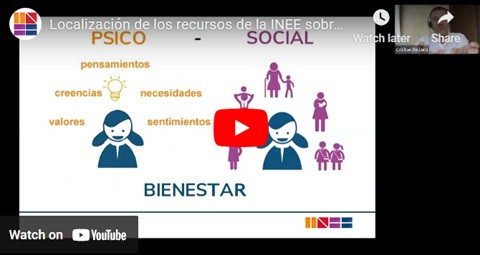 Location of INEE Resources on PSS-SEL Año de publicación: 2024 Autor corporativo: Harvard Graduate School of Education (HGSE) | Inter-agency Network for Education in Emergencies (INEE) In these workshops, participants learned how to locate INEE PSS-SEL resources, including the INEE Background Document on Psychosocial Support and Psychoeducation for Children and Youth in Emergencies, the INEE Guidance Note on PSS, the PSS-SEL Toolkit, and the Guidance Note on Teacher Well-Being in Emergencies, and how to effectively adapt them to different contexts.
  [Summary] Education Under Attack 2024 Año de publicación: 2024 Autor: Jerome Marston | Felicity Pearce Autor corporativo: Global Coalition to Protect Education from Attack (GCPEA) This study is published by the Global Coalition to Protect Education from Attack (GCPEA), formed in 2010 by organizations working in the areas of education in emergencies and conflict, higher education, protection, international human rights law and international humanitarian law, in response to the persistence of attacks on educational institutions, their students and staff in countries affected by conflict and insecurity. Attacks on Education 2024 was developed based on independent research conducted by GCPEA. The report was carried out separately from and does not necessarily reflect the views of the various member organizations that make up the GCPEA Steering Committee. [Resumen] Ataques a la educación 2024 Año de publicación: 2024 Autor: Jerome Marston | Felicity Pearce Autor corporativo: Global Coalition to Protect Education from Attack (GCPEA) Este estudio es publicado por la Coalición Global para Proteger la Educación de Ataques (Global Coalición to Protect Education from Attack, GCPEA), formada en 2010 por organizaciones dedicadas a las áreas de educación en emergencias y en contextos de conflicto, educación superior, protección, derecho internacional de los derechos humanos y derecho internacional humanitario, en respuesta ante la persistencia de los ataques contra instituciones educativas, sus estudiantes y su personal en países afectados por conflictos e inseguridad. Ataques a la educación 2024 se elaboró a partir de investigaciones independientes realizadas por GCPEA. El informe se llevó a cabo separadamente de las distintas organizaciones miembros que integran el Comité Directivo de GCPEA y no refleja necesariamente la opinión de estas.
  The “Hate Speech” Policies of Major Platforms during the COVID-19 Pandemic Año de publicación: 2021 Autor corporativo: UNESCO Montevideo This document reports an increase in so-called “hate speech” posts on Facebook, Twitter, and YouTube after the onset of the COVID-19 pandemic. Although dissimilar, such an increase can be observed in the transparency reports of the different platforms and the surge in content moderation since March 2020.During the same period—as a result of the lockdown measures adopted in most countries around the world—platforms increased the use of AI tools for content moderation. Therefore, we can’t fully say whether the interannual growth is linked to increased posts or changes in monitoring systems. Las políticas de las grandes plataformas sobre discurso de odio durante el Covid-19 Año de publicación: 2021 Autor corporativo: UNESCO Montevideo Este documento da cuenta de un aumento de posteos considerados discurso de odio a partir de la llegada de la pandemia COVID-19 en Facebook, Twitter y YouTube. Aunque dispar, ese aumento puede establecerse a partir de los informes de transparencia de las distintas plataformas y los crecimientos registrados en la moderación de esos contenidos a partir de marzo de 2020.Dado que en ese mismo período, y como consecuencia de las medidas de aislamiento tomadas ven la mayoría de los países del mundo, las plataformas tomaron la decisión de aumentar el uso de herramientas de inteligencia artificial en sus procesos de moderación no es posible asegurar a ciencia cierta que ese crecimiento se haya registrado por un aumento en la creación y publicación de mensajes o a partir de un cambio en los sistemas de detección que afectó los resultados entre un año y otro.
 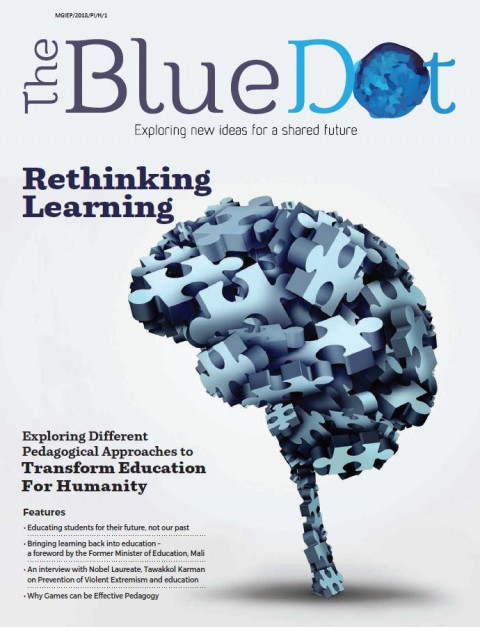 Rethinking Learning: Exploring Different Pedagogical Approaches to Transform Education for Humanity (The Blue Dot Issue 7, 2018) Año de publicación: 2018 Autor corporativo: Mahatma Gandhi Institute of Education for Peace and Sustainable Development (MGIEP) In the seventh issue of the Blue Dot, we focus on Rethinking Learning. The Issue includes a foreword by the Former Minister of Education of Mali, H.E. Adama Samassékou on how education systems need to be re-looked at to incorporate personalised learning and technology as an enabler and our Cover Story, which focuses on the importance of socio-emotional learning.Additionally, we feature opinions by specialists from academia, research, policymaking and the industry on the need to relook at education systems for the future. Amongst various experts, we hear from Andreas Schleicher, Director of Education and Skills and Special Advisor on Education Policy to the Secretary-General at the Organisation for Economic Co-operation and Development (OECD); Anneli Rautiainen from the Finnish National Agency for Education as well as Pratik Mehta, Head of Education & Skills, Microsoft India.Further, we present short blogs from the youth about what future education systems mean to them and we hear from Nobel Laureate, Ms Tawakkol Karman on the importance of education for peace.
 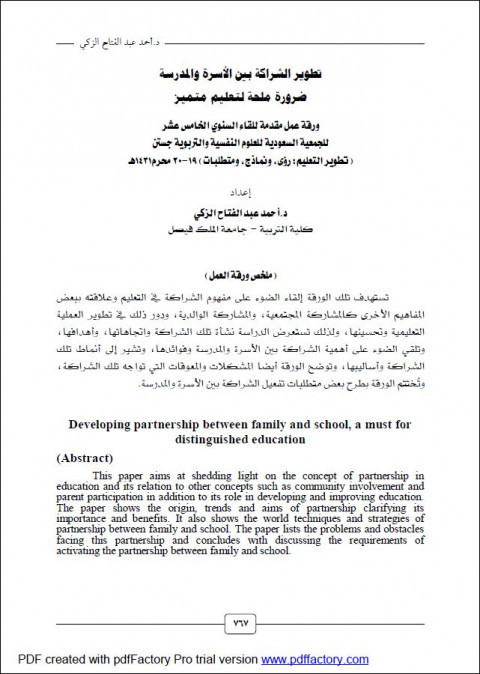 تطوير الشراكة بين الأسرة والمدرسة ضرورة ملحة لتعليم متميز Año de publicación: 2010 Autor: الزكي، أحمد عبد الفتاح Autor corporativo: King Saud University تستهدف الورقة إلقاء الضوء على مفهوم الشراكة في التعليم وعلاقته ببعض المفاهيم الأخرى كالمشاركة المجتمعية، والمشاركة الوالدية، ودور ذلك في تطوير العملية التعليمية وتحسينها، ولذلك تستعرض الدراسة نشأة تلك الشراكة واتجاهاتها، وأهدافها، وتلقي الضوء على أهمية الشراكة بين الأسرة والمدرسة وفوائدها، وتشير إلى أنماط تلك الشراكة وأساليبها، وتوضح الورقة أيضا المشكلات والمعوقات التي تواجه تلك الشراكة. وتختتم الورقة بطرح بعض متطلبات تفعيل الشراكة بين الأسرة والمدرسة.