
Recursos
Exploren una amplia gama de recursos valiosos en GCED para profundizar su comprensión y promover su búsqueda, incidencia, enseñanza y aprendizaje.
2,813 resultados encontrados
 Regional Strategy for UNESCO’s Response to the Situation of People on the Move in Latin America and the Caribbean 2019-2021: Working Document Año de publicación: 2019 Autor corporativo: UNESCO Santiago This document introduces the three priority strategic areas, defined in coherence with those analyzed in the document Background for a Regional Strategy of UNESCO, as well as the components and initiatives of each of them. In addition, the following strategic dimensions are established: coordination and implementation mechanisms, advocacy and communications, planning and financing, and finally, the consolidation of resources, tools and existing publications of UNESCO, a product of the aforementioned intersectoral consultation process. Estrategia regional de respuesta de la UNESCO a la situación de personas en contexto de movilidad en América Latina y el Caribe 2019-2021: documento de trabajo Año de publicación: 2019 Autor corporativo: UNESCO Santiago En este documento se presentan las tres áreas estratégicas prioritarias, definidas en coherencia con los analizado en el documento Antecedentes para una Estrategia Regional de la UNESCO, así como los componentes e iniciativas de cada una de ellas. Asimismo, se establecen las siguientes dimensiones estratégicas: mecanismos de coordinación e implementación, abogacía y comunicaciones, planificación y financiamiento y, finalmente, una consolidación de recursos, herramientas y publicaciones ya existentes de la UNESCO, resultado del proceso de consulta intersectorial antes mencionado.
  العولمة والمواطنة والهوية (بحث في تأثير العولمة على الانتماء الوطني والمحلي في المجتمعات) Año de publicación: 2009 Autor: Thaer Rahim Kazem Autor corporativo: Al-Qadisiyah University من أهم ثلاثة ركائز التي تقوم عليها الديمقراطية التي أتيحت الفرصة إلى قيامها في المجتمع العراقي اليوم بعد التغيرات الاجتماعية والسياسية التي برزت بعد سقوط الدولة العراقية الحديثة في 9/4/2003 فضلا عن حقوق الإنسان وحرياته ومؤسسات المجتمع المدني، والعلاقة بين المواطنة والهوية هي عملية التعزيز السياسي والقانوني لدور الفرد في المشاركة الفاعلة في البناء الاجتماعي للمجتمع العراقي. إذ إن هنالك نمطا من التوافق أو التطابق بين الهوية الاجتماعية العامة (الوطنية) التي تقوم على مجموعة من الأسس السياسية و القانونية، وبين الانتماء الجغرافي لمجتمع ما (المواطنة). بغض النظر عن الانتماءات الفرعية الأخرى لفرد في الحياة الاجتماعية كالانتماءات الاثنية أو الدينية أو غير ذلك من السمات الانثروبولوجية التي تتميز بها أشكال الهوية الاجتماعية لأفراد المجتمع أو للجماعات الاجتماعية التي يتألف منها البناء الاجتماعي، و بما أن انتماء المجتمع العراقي إلى نظام العولمة أو الاندراج فيه بات امرأ محسوما لا يعيقه سوى عامل الوقت لذا إن التعامل مع العولمة يتطلب الوعي بأهمية معرفة وأدراك تأثيراتها السلبية والايجابية على الحياة الاجتماعية في المجتمع العراقي إذ أن العولمة هي عملية توحيد واندماج للمجتمعات الإنسانية تتسم بضرورة التعايش بين هذه المجتمعات وكذلك بضرورة التعايش بين أفراده من خلال تحقيق المواطنة العالمية فهل توثر العولمة في المواطنة أن وجدت لدى أفراد المجتمع في العراق؟ بوصفهم أفرادا وجماعات؟ وهل تؤثر الانتماءات الفردية والاجتماعية من خلال مجموعة الانتماءات التي تتميز بها السمات الانثروبولوجية التي تتسم بها الجماعات الاجتماعية داخل المجتمع؟ وهل تؤثر هذه الانتماءات على المواطنة؟ وهل يمكن أن تكون هنالك علاقة من نوع معين بين العولمة والهوية الثقافية أو الدينية غير علاقة السلب أو الفقدان؟ وهل يمكن أن تقوم علاقة بين العولمة و الهوية المجتمعية أو غيرها من أنماط الهويات؟ وهل للمواطنة دور في الحفاظ أو فقدان الهوية الثقافية أو الدينية للمجتمعات الإسلامية والعربية والمجتمع العراقي منها على وجه التحديد؟ هل تهدد العولمة اليوم الهوية والمواطنة على حد سواء؟ Globalization, Citizenship and Identity (Research on the Impact of Globalization on National and Local Affiliation in Societies) Año de publicación: 2009 Autor: Thaer Rahim Kazem Autor corporativo: Al-Qadisiyah University There was a serious need to the citizenship as a psychological feeling in the Iraqi society. Because it represent the one of the most important three standards in the democratic operation as methods we must use in our social live. When we get a chance to build it in the Iraqi society. After the social and political changes that tack place after the 9 April 2003. The relationships between the citizenship and identity refer to the process by which we could strength the individual legal and political role to create the effective participate in the social live and social structure of the Iraqi society. Because there was an equalize between the general collective identity and the citizenship. We need these feelings when Iraqi society joins the globalization system under the pressure of the USA. And that required being aware in the negative effectiveness of the globalization and its positive ones. And the necessary of the living to gather in the global society. That makes the universal citizenship possible. This state creates many questions in the mind of the Arab and Moslemsre searchers. Such as could we keep our social and cultural identity? Are the citizenship help us to maintain the social and cultural identity? And other many questions that dealing with this objectives.
  "It is Very Painful to Talk About”: The Impact of Attacks on Education on Women and Girls Año de publicación: 2019 Autor: Holly Cartner Autor corporativo: Global Coalition to Protect Education from Attack (GCPEA) This report presents the key findings of GCPEA’s multi-country study on the impact of attacks on education on women and girls.10 GCPEA’s research focuses on the types and causes of abuse most typically committed against female students in the context of attacks on education, and the long-term consequences that female students may face as a result of such attacks.11 GCPEA initiated this study to contribute to a better understanding of the implications for girls and women when education is attacked and to inform our advocacy for better strategies to protect girls and women, prevent attacks and abuse, and diminish harmful consequences against them.This report relies on previous GCPEA research, including Education Under Attack 2018 and 2014, and updates, and the organization’s field research in Nigeria and the Democratic Republic of Congo, which focused specifically on the experiences of women and girls when education is attacked. In addition, the report draws from interviews with numerous country and regional experts and an extensive review of secondary data sources, including reports by United Nations (UN) agencies, development and humanitarian non-governmental organizations (NGOs), human rights organizations, government bodies, and think tanks, including numerous contributions from GCPEA’s member organizations.
  Critical Global Semiotics: Understanding Sustainable Transformational Citizenship Año de publicación: 2019 Autor: Maureen Eills Critical Global Semiotics: Understanding Sustainable Transformational Citizenship incorporates powerful unifying frameworks which make explicit a developing global consciousness. It explores transdisciplinary ‘common wealth’ through focus on multimodality, media, and metaphor, testing two universally applicable humanitarian frameworks: critical realism (CR) and systemic functional semiotics (SFS).Every day global citizens encounter an overwhelming host of genres and sub-genres, emergent semantic triangles, evolving semiotic trinity. Embodying philosophy, incorporating active engagement, this book addresses the political economy and cultural politics of diverse domains.Challenging daily drama and performative dharma, 24 analysts from 13 countries present current issues in Anthropology, Architecture, Dance, Feminism, Film, Health, Law, Management, Medicine, Music, Politics, Pharmaceuticals, Sociology, Sustainability Education, and Urban Development.The book’s integrative, unifying foundations will be of interest to researchers, academics, and post-graduate students in the fields of linguistics, semiotics, and critical realist philosophy, as well as to policy makers, curriculum developers, and civil society.
  المجتمع المدني وبناء الدولة المدنية الديمقراطية: مقاربة سياسية Año de publicación: 2016 Autor: Tareq Ziad Abu Hazeem تؤصل هذه الدراسة لمفهومي المجتمع المدني والدولة المدنية, كما تتناول بالبحث والتحليل المجتمع المدني والدولة المدنية من حيث: الوصف والهدف والسيرورة التاريخية, وطبيعة المجتمع المدني, وكذلك تطابق مقومات الدولة المدنية مع الديمقراطية. حيث يكتسب الحديث عن المجتمع المدني والدولة المدنية الديمقراطية, بما يتضمن من دراسات ونقاشات وطروحات, أهمية قصوى في بلداننا العربية, بالإضافة لسعيها إلى توضيح دور المجتمع المدني في بناء الدولة المدنية الديمقراطية. وقد استخدم الباحث منهج تحليل النظم لتبيان العلاقة بين فعالية المجتمع المدني وبناء الدولة المدنية الديمقراطية, وبعد جمع البيانات حول قضايا الدراسة وتحليلها وربطها وتفسيرها, فقد وضّحت الدراسة الصلة بين المجتمع المدني والدولة المدنية والديمقراطية, كون هذه الثلاث تمثل أهم قنوات المشاركة الشعبية, إضافة إلى أن فعالية المجتمع المدني تزيد من فرص المشاركة السياسية، وتدعم قيم الديمقراطية، وترسخ قيم المواطنة، وسيادة القانون، وهي المكونات الرئيسة للدولة المدنية. كما بينت النتائج وجود علاقة ايجابية وثيقة، وقوية، وهامة بين مقومات نشأة المجتمع المدني الفاعل، وبين قيام الدولة المدنية الديمقراطية، وإن المجتمع المدني بمؤسساته، وتنظيماته، وقدرته على التنسيق، والتنظيم الاجتماعي، يزيد من حضور، وقوة الدولة، وقوة سلطات مؤسساتها الفاعلة, ويحد من تغوُّل سلطاتها نحو الأفراد، لتصبح دولة مدنية ديمقراطية, وإن الإرادة الذاتية، والجماعية، وتهيئة الجماهير، وتوعيتهم بأهمية التحديث، والتنمية، والتطوير من جهة, وتفعيل مؤسسات المجتمع المدني من جهةٍ أخرى، يؤدي حتما إلى ترقية الدولة إلى دولة مدنية ديمقراطية. ومن أهم توصيات الدراسة ضرورة السير نحو التحرر من المفهوم الكلاسيكي الحديث للدولة كمركز أحادي، ووحيد التنظيم، والتنسيق الاجتماعي لصالح منظمات المجتمع المدني. كلمات مفتاحية: المجتمع المدني، الدولة المدنية، الديمقراطية. Civil Society and Building a Democratic Civil State: A Political Approach Año de publicación: 2016 Autor: Tareq Ziad Abu Hazeem The purpose of this study is to find a foundation for the concepts of the 'civil society' and the 'civil state'. It examines and compares both from different dimensions: description, purpose, objectives, history, the reality of the civil society and finally, to what extent they are similar. Most discussion is about civil society and civil democratic state, including studies, discussions and arguments, because of their importance in the Arab countries. In addition, this discussion seeks to clarify the role of civil society in building a democratic civil state. The researcher uses the systems analysis to point out the relationship between how active the civil society is and the establishment of the democratic civil state. After collecting and analyzing related statistics, this study has shown how much the civil society, the concept of democracy, and the state are related. The three represent the most important channels of public participation. In addition, the activeness of the civil society increases opportunities of political participation, supports the values of democracy and citizenship, and enhances the sovereignty of law.The three are the major components of the civil state. The results have revealed a number of facts: (1) there is a strong positive relation between the reasons behind the establishment of an active civil society and the establishment of the democratic civil society. Furthermore, (2) the civil society, its institutions and organized units, its ability of social coordination have created a strong state with powerful active institutions and limited the dominance of the society's powers over individuals. This has created a democratic civil state. (3) Individual and communicative will, increasing the public awareness of the importance of modernization and development, as well as stimulating the role of the active civil society lead to the development of a simple state to a democratic one. The study concludes with a major recommendation: the classical concept of the modern state as an independent uni-center of an isolated social coordination should be abandoned for the civil social organizations.
 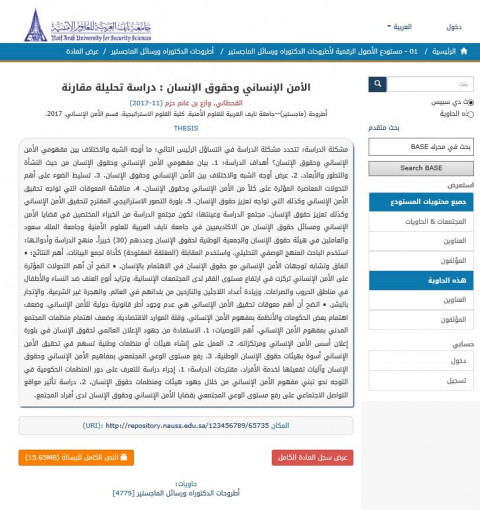 الأمن الإنساني وحقوق الإنسان : دراسة تحليلة مقارنة Año de publicación: 2017 Autor: Al-Qahtani | Wazaa bin Ghanem Autor corporativo: Naif Arab University for Security Sciences شكلة الدراسة: تتحدد مشكلة الدراسة في التساؤل الرئيس التالي: ما أوجه الشبه والاختلاف بين مفهومي الأمن الإنساني وحقوق الإنسان؟ Human Security and Human Rights: A Comparative Analytical Study Año de publicación: 2017 Autor: Al-Qahtani | Wazaa bin Ghanem Autor corporativo: Naif Arab University for Security Sciences Study Problem: The study problem is determined by the following main question: What are the similarities and differences between the concepts of human security and human rights?