
Recursos
Exploren una amplia gama de recursos valiosos en GCED para profundizar su comprensión y promover su búsqueda, incidencia, enseñanza y aprendizaje.
2,813 resultados encontrados
 Культурная идентичность таджиков и мультикультурализм Año de publicación: 2014 Autor: Khamrokhon Zarifi Статья посвящена вопросам истории, культурной идентичности и наследию таджикского народа. Обсуждаются вопросы сохранения и преемственности культурного разнообразия, а также феномен мультикультурализма.
  Tolerance of Kazakhstani society in the context of ensuring the harmony of values Año de publicación: 2013 Autor: Alma Sagyngali This article discusses the process of multinational Kazakh society searching for its cultural and civilizational identity in the framework of Kazakhstan's building of a social state and integration into the world community. Particular attention is paid to tolerance as a key cultural value. Толерантность казахстанского общества в контексте обеспечения ценностного согласия Año de publicación: 2013 Autor: Alma Sagyngali В данной статье рассматривается процесс поиска многонациональным казахстанским обществом своей культурно-цивилизационной идентичности в рамках построения Казахстаном социального государства и интеграции в мировое сообщество. Особое внимание уделяется толерантности, как ключевой культурной ценности.
 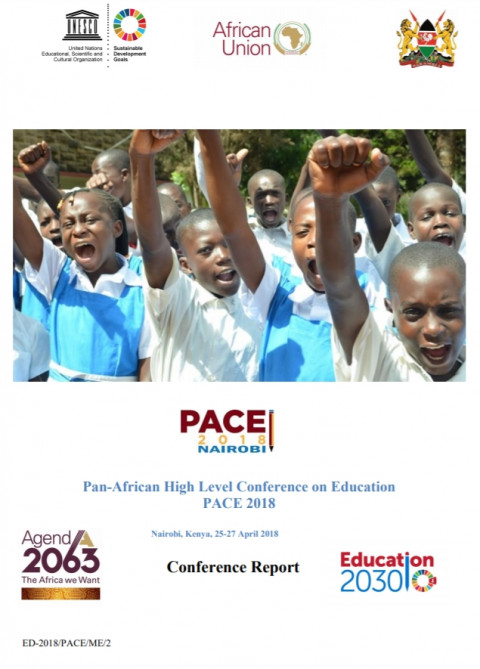 Pan-African High Level Conference on Education, PACE 2018: conference report Año de publicación: 2018 Autor corporativo: African Union | Government of the Republic of Kenya The Pan-African High-level Conference on Education (PACE 2018) was held in Nairobi, Kenya from 25th to 27th April 2018. PACE 2018 was convened by UNESCO, the Government of Kenya and the African Union, with the collaboration of the Association for the Development of Education in Africa (ADEA) and contributions from the Sustainable Development Goal 4 (SDG4) co-conveners. The initiative to organise the PACE 2018 came in the wake of a number of regional consultations organised in Sub Saharan Africa and the Arab states regions to focus attention on the way forward, following the adoption in 2015 of the United Nations’ Sustainable Development Goal 4 on Education (SDG 4) and of the African Union’s Continental Education Strategy for Africa 2016-2025 (CESA 16-25). Conférence panafricaine de haut niveau sur l'éducation, PACE 2018: rapport de la conférence Año de publicación: 2018 Autor corporativo: African Union | Government of the Republic of Kenya La Conférence panafricaine de haut niveau sur l’éducation (PACE 2018) s’est déroulée à Nairobi, au Kenya, du 25 au 27 avril 2018. Elle a été convoquée par l’UNESCO, le Gouvernement du Kenya et l’Union africaine, avec la collaboration de l’Association pour le Développement de l’Éducation en Afrique (ADEA) et des contributions des coorganisateurs de l’Objectif de développement durable 4 (ODD 4). L’initiative d’organiser la conférence PACE 2018 s’inscrit à la suite de plusieurs consultations régionales organisées dans les régions d’Afrique subsaharienne et des États arabes pour appeler l’attention sur la voie à suivre après l’adoption en 2015 de l’Objectif de développement durable 4 (ODD 4) sur l’éducation et de la Stratégie continentale de l’éducation pour l’Afrique de l’Union africaine (CESA 2016-2025) (CESA 16-25).
  Sustainable Development Goal 4: The Dubai Roadmap for Education 2030 in the Arab Region (2017-2018) Año de publicación: 2017 Autor corporativo: UNESCO Beirut SDG 4 agenda inspires us to pursue a humanistic vision of education and development based on human rights and dignity, social justice, protection, cultural diversity, and shared responsibility and accountability. Also, it is underpinned by the principle that education is a public good, a fundamental human right and a basis for guaranteeing the realization of other rights. Furthermore, it is essential for peace, human fulfillment and sustainable development. Having adopted the Arab Regional Roadmap for SDG 4 and Education 2030 (Cairo Roadmap) at ARMED I, we, Arab Member States and partners, have since commenced implementation of the Agenda as appropriate and relevant to national contexts.
 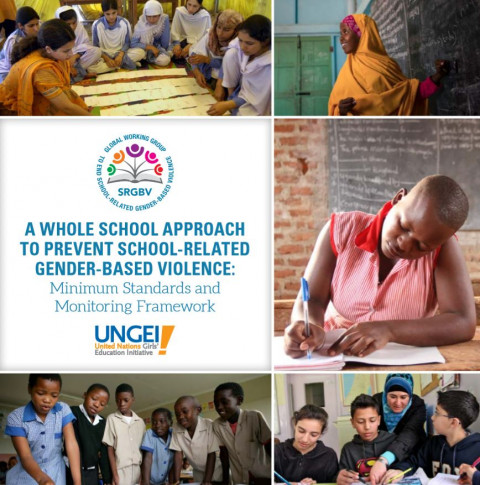 A Whole School Approach to Prevent School-Related Gender-Based Violence Año de publicación: 2016 Autor corporativo: United Nations Girls' Education Initiative (UNGEI) The limitations of data collection and monitoring mechanisms around school-related gender-based violence (SRGBV) are widely acknowledged. This guide provides a framework to guide policy makers and practitioners in designing school violence prevention programmes and strengthening response actions. The prevention model is based on eight evidence-based standards and is accompanied by a monitoring approach with a set of proposed indicators at school, district and national levels. The goal is to enable implementation strategies to be adapted and monitored in order to improve data collection and accountability around incidents of SRGBV at the school, district and national levels.
 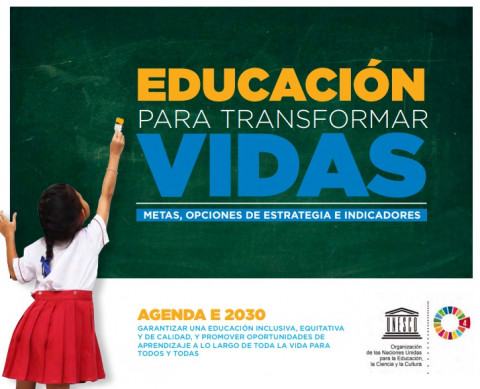 Educación para transformar vidas: metas, opciones de estrategia e indicadores Año de publicación: 2016 Autor corporativo: UNESCO Santiago La educación está en el centro de la agenda de desarrollo sostenible y es esencial para el éxito de todas estas metas. La nueva agenda de educación resumida en el Objetivo 4 es holística, ambiciosa, deseable y universal, yestá inspirada por una visión de que la educación transforma las vidas de las personas, las comunidades y las sociedades. La agenda atiende los temas no resueltos de los objetivos de la Educación para Todos (EPT) ylos ODM relacionados con la educación, al tiempo que aborda de manera efectiva los actuales y futuros desafíos de la educación a nivel mundial y nacional. Está basada en los derechos y está inspirada en una visión humanista de la educación y el desarrollo, con base en los principios de la dignidad humana, los derechos igualitarios, la justicia social, la paz, la diversidad cultural y la responsabilidad compartida. Basándose y continuando con el movimiento EPT, Educación 2030 toma en cuenta lecciones aprendidas desde 2000. Lo que es nuevo en esta agenda es su enfoque en mayores y más amplios resultados en el acceso, la equidad e inclusión, calidad y aprendizaje, además de un aprendizaje a lo largo de toda la vida.
  20 years of democratic development in Kyrgyzstan: internal and external perspectives Año de publicación: 2012 Autor corporativo: Friedrich Ebert Foundation This publication comprises an analysis and assessment of the political, regulatory, legal, public and economic reforms that took place in Kyrgyzstan over the last two decades. It discusses the problems that are arise from the current situation and possible options for the KR’s future development - both in case of a success of the modernization approach and in case of its failure, with resulting stagnation and regress. 20 лет демократического развития в Кыргызстане: взгляд изнутри и извне Año de publicación: 2012 Autor corporativo: Friedrich Ebert Foundation Издание включает в себя анализ и оценку политических, управленческих, правовых, общественных, экономических реформ, происходивших в Кыргызстане за последние два десятилетия, а также рассматривает проблематику текущей ситуации и возможные варианты развития КР, как в случае успеха модернизационного подхода, так и в случае его провала или реализации вариантов стагнации и регресса.