
Recursos
Exploren una amplia gama de recursos valiosos en GCED para profundizar su comprensión y promover su búsqueda, incidencia, enseñanza y aprendizaje.
2,813 resultados encontrados
 Comprendre l’instrumentation des questions de citoyenneté dans les politiques d’éducation et de jeunesse : une typologie des dispositifs d’action publique Año de publicación: 2018 Autor: Valérie Becquet Autor corporativo: Lien social et Politiques Que ce soit au niveau européen qu’au niveau national, les enjeux relatifs à la citoyenneté des jeunes sont présents dans les débats publics et donnent lieu à la mise en place de dispositifs spécifiques. L’ancienneté et la récurrence de la mise à l’agenda de cette question invitent à réfléchir sur les dynamiques de l’action publique. Cet article propose une typologie des dispositifs progressivement développés dans deux secteurs publics qui interviennent auprès des jeunes : l’éducation et la jeunesse. En mobilisant une approche par les instruments d’action publique, il met en évidence que les choix opérés par les décideurs publics pour traiter des questions de citoyenneté conduisent à une multiplication et à une diversification des dispositifs. Cette prolifération interroge la lisibilité de l’action publique : si les dispositifs peuvent apparaître complémentaires et constituer une opportunité pour les jeunes, ils peuvent aussi entrer en tension. Dans un contexte de renouvellement générationnel du corps électoral, elle invite également à réfléchir sur les conséquences sur les pratiques des jeunes et sur la construction de leur représentation de la citoyenneté.
  How Networking Can Help Build Global Citizenship in Japan Año de publicación: 2015 Autor: Hideki Maruyama Autor corporativo: Éducation des Adultes et Développement The article explains and outlines some of the challenges facing schools in Japan when teaching about sustainable development. These challenges are many and diverse. Concrete examples are given, and some proposals for action are presented.
  Fortunoff Video Archive for Holocaust Testimonies of the Yale University Library In the 1970s the Holocaust Survivors Film Project began videotaping Holocaust survivors and witnesses in New Haven. Since then, the Fortunoff Archive has worked to record, collect and preserve Holocaust witness testimonies, and to make its collection available to researchers, educators and the general public. The Fortunoff Archive currently holds more than 4,400 testimonies, which are comprised of over 10,000 recorded hours of videotape. The Fortunoff Archive and its affiliates recorded the testimonies of willing individuals with first-hand experience of the Nazi persecutions, including those in hiding, survivors, bystanders, resistants and liberators. Testimonies are recorded in whatever language the witness prefers, and range in length from one-half hour to over 40 hours. Fortunoff Archive vidéo pour l'Holocauste Témoignages de la bibliothèque de l'Université Yale Dans les années 1970, le projet de film survivants de l'Holocauste a commencé l'enregistrement vidéo des survivants et des témoins de l'Holocauste à New Haven. Depuis lors, les Archives Fortunoff a travaillé pour enregistrer, recueillir et conserver les témoignages de la Shoah, et de rendre sa collection aCECssible aux chercheurs, les éducateurs et le grand public. Les Archives Fortunoff détient actuellement plus de 4.400 témoignages, qui sont composées de plus de 10.000 heures enregistrées de la bande vidéo. Les Archives Fortunoff et ses filiales ont enregistré les témoignages de personnes qui veulent une expérience de première main des persécutions nazies, y compris ceux dans la clandestinité, les survivants, les spectateurs, les résistants et libérateurs. Les témoignages sont enregistrés dans la langue du témoin préfère, et la gamme de longueur d'une demi-heure à plus de 40 heures. Vancouver Holocaust Education Centre The Vancouver Holocaust Centre Society was founded in 1983 by survivors of the Holocaust. The founders’ goal was to leave a permanent legacy in the form of the Vancouver Holocaust Education Centre devoted to the Holocaust and based on anti-racism education. Online, teachers have access to practical guides for teachers and activities with discovery kits for primary and secondary pupils.
  Quick Guide to Education Indicators for SDG 4 Año de publicación: 2018 Autor corporativo: UNESCO Institute for Statistics (UIS) This guide serves as a quick reference on how to monitor progress towards Sustainable Development Goal 4 (SDG 4) on quality education. It provides basic explanations of SDG 4 targets, their indicators, how they are created and where to find the information needed for these indicators.
  Transferring findings from genocide education research into strategies for teaching and learning about genocide in schools In recent years interest in schools outreach and academic enrichment has increased dramatically, reflecting a greater social conscience and awareness of the impact that universities can have on the wider community. The transferable skills that academics bring to schools need to be honed for this new learning environment, as delivery methods and success benchmarks are radically different in a schools context. This collection addresses the numerous issues raised when arts and humanities academics become involved with schools, bringing together practitioners from a broad range of fields within the arts and humanities to share experiences and insights. (By the author)
 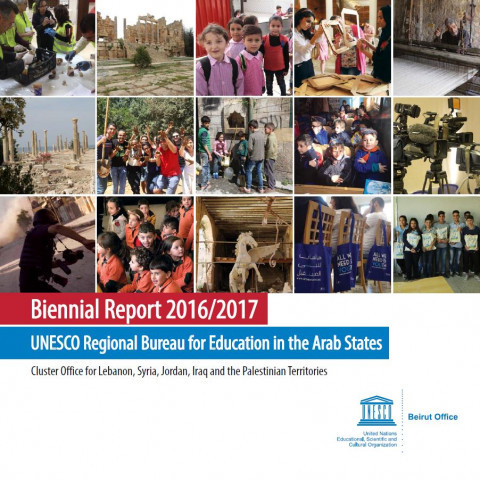 Biennial Report 2016/2017: UNESCO Regional Bureau for Education in the Arab States Año de publicación: 2018 Autor corporativo: UNESCO Beirut As Regional Bureau for Education, UNESCO Beirut is the lead coordinator for SDG 4 in the Arab Region. We strive to provide tangible support for each Member State in the region, taking into account national needs and priorities, thereby employing nationally relevant approaches. More specifically, our work aims to address both the humanitarian and development aspects brought about by the protracted crisis in Syria through bridging the learning gaps for the youth, both for Syrian refugees and vulnerable youth in host communities. Our response also targets teachers, mentors and facilitators as well as Ministries’ technical officials. The crisis in Syria has created a need for specific support in education in emergencies and quality education to which we actively engage from both, upstream analytical and capacity building and downstream operational levels. UNESCO Beirut has also strengthened its leadership to respond to the deliberate destruction of cultural heritage, illicit trafficking, and attacks against individuals on religious or cultural grounds. We raise the alarm to protect heritage in danger, assessing damages to World Heritage sites in conflict. We also raise awareness among the public about the values of cultural heritage and the need to protect it for future generations. In today’s diverse societies, the Organization’s fundamental humanist mission guides us to support people, especially the youth, in understanding each other and working together to build lasting peace and enables people to create and use knowledge for just and inclusive societies. We continue to advocate free, independent and pluralistic media in print, broadcast and online to enhance freedom of expression as a contributor to peace, sustainability, poverty eradication and human rights. This biennial report summarizes the work and achievements accomplished between 2016 and 2017 by our office.
 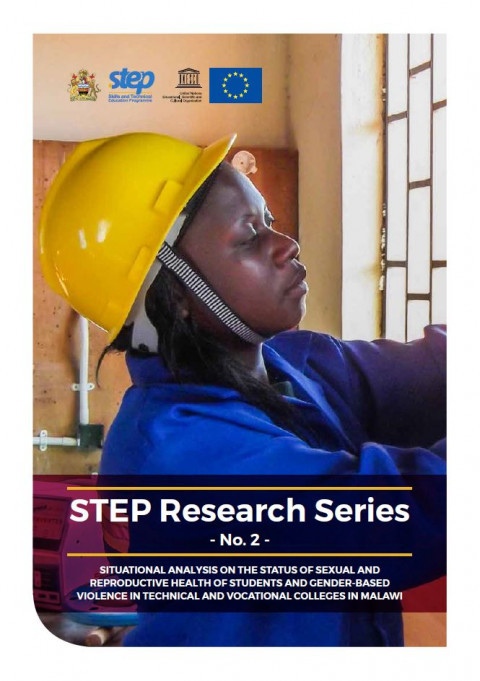 Situational Analysis on the Status of Sexual and Reproductive Health of Students and Gender-based Violence in Technical and Vocational Colleges in Malawi (STEP Research Series No. 2) Año de publicación: 2017 Autor corporativo: Skills and Technical Education Programme (STEP) Funded by the EU and implemented by UNESCO in collaboration with the Government of Malawi, the Skills and Technical Education Programme (STEP) is dedicated to reinforcing Technical, Entrepreneurial and Vocational Education and Training (TEVET) in Malawi.The programme will run from 2016-2020 and aims to improve TEVET at post-secondary level with a focus on equal access to enrolment, with particular emphasis on female learners; improving quality in the sector; and the establishment of clear governance structures. The STEP Research Series presents the highlights of the research undertaken by the programme.The situational analysis on the status of sexual and reproductive health of students and gender-based violence in technical and vocational colleges in Malawi is the second report in the STEP Research Series. Enseigner l'histoire et la prévention des génocides - Peut on prévenir les crimes contre l'humanité ? The question of barbarism dominates remembrance issues. The study of the prevention of crimes against humanity constitutes another major challenge. But these sensitive and complex debates are problematic. All fields are concerned : history, memory, law, philosophy, politics. How can schools tackle them ? Two solutions : opting for a comparative study of genocides, particularly the Holocaust and the Tutsis in Rwanda; and using the "universal/particular" dialectic, institutions and individuals. Recollections of the past and edification of the future, this book gives meaning to education and presents a sensitive reflection of the challenges of history and the contemporary world. (By the author - Translation)