
Recursos
Exploren una amplia gama de recursos valiosos en GCED para profundizar su comprensión y promover su búsqueda, incidencia, enseñanza y aprendizaje.
2,813 resultados encontrados
 Rapport mondial des Nations Unies sur la mise en valeur des ressources en eau: Les solutions fondées sur la nature pour la gestion de l’eau Año de publicación: 2018 Autor corporativo: UNESCO World Water Assessment Programme (WWAP) L'édition 2018 du Rapport mondial sur le développement de l'eau (WWDR 2018) vise à informer la politique et les décideurs, qu’ils soient parties prenante de la communauté de l’eau ou non, sur le potentiel des solutions fondées sur la nature (SfN) pour répondre aux défis contemporains de gestion de l'eau dans tous les secteurs, notamment en ce qui concerne l'eau pour l'agriculture, les villes durables, la réduction des risques de catastrophe liées à l'eau et la qualité de l'eau. Les SfN utilisent ou imitent les processus naturels pour améliorer la disponibilité de l'eau (par exemple, rétention de l'humidité du sol, recharge des eaux souterraines), améliorer la qualité de l'eau (par exemple, zones humides naturelles et construites, bandes riveraines tampons) et réduire les risques associés aux catastrophes liées à l’eau et au changement climatique (par exemple, restauration d'une plaine d'inondation, toits verts).Le WWDR2018, intitulé « Les solutions fondées sur la nature pour la gestion de l’eau », démontre comment les solutions basées sur la nature (SfN) offrent un moyen essentiel de répondre à de nombreux défis mondiaux liés à l'eau, tout en offrant simultanément des avantages supplémentaires essentiels à tous les aspects du développement durable.Actuellement, la gestion de l'eau reste fortement dominée par une infrastructure devenue habituelle, construite par l'homme (c'est-à-dire « grise ») et l'énorme potentiel des SfN reste sous-utilisé. Les SfN comprennent une infrastructure « verte » qui peut remplacer, compléter ou agir en parallèle avec une infrastructure grise de manière rentable. L'objectif est de trouver la combinaison la plus appropriée d'investissements verts et gris pour maximiser les avantages et l'efficacité du système tout en minimisant les coûts et les compromis.Les SfN pour l'eau sont essentielles à la réalisation du Programme de développement durable à l'horizon 2030, car elles génèrent des avantages sociaux, économiques et environnementaux, qui soutiennent notamment la santé humaine et les moyens de subsistance, la sécurité alimentaire et énergétique, la croissance économique durable, les emplois décents, la réhabilitation et l’entretien des écosystèmes, ainsi que la biodiversité. Bien que les SfN ne soient pas une panacée, elles joueront un rôle essentiel dans l'économie circulaire et dans la construction d'un futur plus équitable pour tous.Travailler avec la nature améliore la gestion des ressources en eau, contribue à la sécurité de l'eau pour tous et soutient les aspects fondamentaux du développement durable.Le Rapport mondial sur la mise en valeur des ressources en eau a été présenté lors du 8e Forum mondial de l'eau, à Brasilia (Brésil), le 19 mars. URL: http://www.unesco.org/new/en/natural-sciences/environment/water/wwap/wwdr/2018-nature-based-solutions/
  What Makes a Quality Curriculum?: In-Progress Reflection No.2 on Current and Critical Issues in Curriculum and Learning Año de publicación: 2016 Autor: Philip Stabback Autor corporativo: UNESCO International Bureau of Education (IBE) Sustainable Development Goal Four has to do with education in the post-2015 development agenda. It aims to “ensure inclusive and equitable quality education and promote lifelong learning opportunities for all”.Given the essential role of curriculum in enabling quality learning and in articulating and supporting education that is relevant to holistic development, our purpose in this paper is to identify what makes a quality curriculum, so as to support curricular innovation in UNESCO Member States to the end of the realization of Sustainable Development Goal Four.In this we are assuming that curriculum, given its essential role in the provision of quality learning for all children and young people, and in articulating and supporting education that is relevant to holistic development, is critical in the realization of SDG 4. It is the curriculum that determines to a large extent whether education is inclusive, thus playing a significant role in ensuring that provision is equitable. It is the curriculum that provides the structure for the provision of quality learning, especially where teachers might be under-qualified and inexperienced, their classrooms under-resourced, and their students lacking the prior frameworks within which to situate their learning. And it is the curriculum that articulates both the competencies necessary for lifelong learning and the competencies needed for holistic development.We thus argue that curriculum lies at the crossroads of these four key aspects of SDG 4: that education should be (1) inclusive and equitable, (2) characterized by quality learning, (3) promoting lifelong learning, and (4) relevant to holistic development. Curriculum, in other words, provides the bridge between education and development – and it is the competencies associated with lifelong learning and aligned with development needs, in the broadest, holistic sense of the term, that span that bridge.
  Global Citizenship in the English Language Classroom Año de publicación: 2008 Autor: Susan Hillyard | Elena Tarasheva | Clarissa Jordão | Francisco Fogaça | Esperanza Revelo Jiménez | Sabiha Khuram | Telma Gimenez | Vanessa Andeotti Autor corporativo: British Council This booklet contains a collection of papers on global citizenship in language education around the world. It provides theoretical frameworks and practical applications in different contexts.Following on from Audrey Osler and Hugh Starkey’s 'Citizenship and Language Learning: international perspectives', published in 2005, this collection aims at offering ideas and practical suggestions on how teachers around the world have tackled the teaching of English within a citizenship education perspective. There are seven chapters, from authors working in different parts of the world, such as Argentina, Bulgaria, Brazil, Colombia, and Pakistan.There are five report style chapters that deal with courses, teaching materials, research and curriculum innovation. The two remaining contributions can be seen as proposals for implementation of a global citizenship perspective in English language classrooms.The diverse interpretations teachers of English around the world have been giving to the task of promoting global citizenship in their classrooms are reflected in this collection with understandings that range from a more prescriptive approach to a transformational one. They bring the potential for new approaches to be tried out in different contexts. The aim is to inspire teachers to experiment and evaluate the results.
  Moral Disengagement and Building Resilience to Violent Extremism: An Education Intervention Año de publicación: 2014 Autor: Anne Aly | Elisabeth Taylor | Saul Karnovsky Autor corporativo: Taylor & Francis This article reports on the development of an education intervention, the Beyond Bali Education Resource funded by the Australian Governments’ Building Community Resilience Grants of the Federal Attorney General's Department, that applies a conceptual framework grounded in moral disengagement theory. The theory of moral disengagement has been applied to the study of radicalization to violent extremism to explain how individuals can cognitively reconstruct the moral value of violence and carry out inhumane acts. Moral Disengagement and Building Resilience to Violent Extremism: An Education Intervention Año de publicación: 2014 Autor: Anne Aly | Elisabeth Taylor | Saul Karnovsky Autor corporativo: Taylor & Francis Dans cet article, il est question du développement d'une approche éducative, the « Beyond Bali Education Resource » financée par « l’Australian Governments’ Building Community Resilience Grants of the Federal Attorney General's Department ». Cette approche utilise un cadre conceptuel fondé sur la théorie du désengagement moral. La théorie du désengagement moral a été appliquée à l'étude de la radicalisation à l'extrémisme violent en vue d’expliquer comment les individus peuvent, du point de vue cognitif, reconsidérer la violence comme une valeur morale et commettre des actes inhumains.
  Addressing Anti-semitism through Education: Guidelines for Policymakers Año de publicación: 2018 Autor corporativo: OSCE. Office for Democratic Institutions and Human Rights (ODIHR) A new UNESCO and OSCE co-publication takes up the challenge of educating learners to resist contemporary anti-Semitism at a time when the issue is becoming ever more crucial around the world. It suggests concrete ways to address anti-Semitism, counter prejudice and promote tolerance through education, by designing programmes based on a human rights framework, global citizenship education, inclusiveness and gender equality.It also provides policymakers with tools and guidance to ensure that education systems build the resilience of young people to anti-Semitic ideas and ideologies, violent extremism and all forms of intolerance and discrimination, through critical thinking and respect for others. Prévenir l’antisémitisme par l’éducation: Lignes directrices à l’intention des décideurs politiques Año de publicación: 2018 Autor corporativo: OSCE. Office for Democratic Institutions and Human Rights (ODIHR) Cette nouvelle publication UNESCO/OSCE relève le défi de l’antisémitisme contemporain à un moment où la question devient de plus en plus cruciale dans le monde entier. Elle propose des moyens concrets pour combattre l’antisémitisme, lutter contre les préjugés et promouvoir la tolérance par l’éducation, sur la base de programmes fondés sur les droits humains, l’éducation à la citoyenneté mondiale, l’inclusion et l’égalité des sexes. Elle fournit également aux décideurs politiques des outils et des recommandations pour garantir que les systèmes éducatifs renforcent la résilience des jeunes aux idées et idéologies antisémites, à l’extrémisme violent et à toutes les formes d’intolérance et de discrimination, par l’acquisition d’une pensée critique et le respect des autres. Addressing Anti-semitism through Education: Guidelines for Policymakers Año de publicación: 2018 Autor corporativo: OSCE. Office for Democratic Institutions and Human Rights (ODIHR) A new UNESCO and OSCE co-publication takes up the challenge of educating learners to resist contemporary anti-Semitism at a time when the issue is becoming ever more crucial around the world. It suggests concrete ways to address anti-Semitism, counter prejudice and promote tolerance through education, by designing programmes based on a human rights framework, global citizenship education, inclusiveness and gender equality.It also provides policymakers with tools and guidance to ensure that education systems build the resilience of young people to anti-Semitic ideas and ideologies, violent extremism and all forms of intolerance and discrimination, through critical thinking and respect for others.
 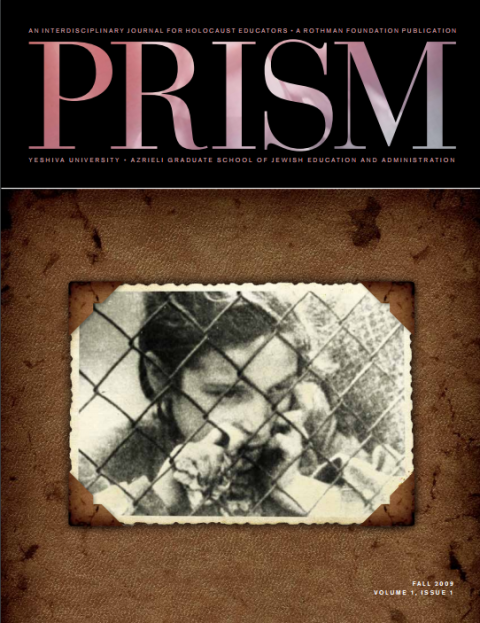 The necessity of darkness. The pedagogic imperative to teach about the death camps How much knowledge about the Holocaust is too much for students? How early is too early to begin to teach about the event? How do we find the correct balance between teaching about the atrocities and teaching about Jewish agency? The Azrieli Graduate School of Jewish Education and Administration debate these and other pedagogical questions in these pages. (By the publisher)
  Strategies in Facing Antisemitism : An educational resource guide This resource guide from Yad Vashem and the Simon Wisenthal Center is divided into two parts. First, it assesses antisemitism today. Then it proposes a few articles on ways to sensitize the public to antisemitism : how to broach the topic in the classroom, how to deal with antisemitism on internet...