
Recursos
Exploren una amplia gama de recursos valiosos en GCED para profundizar su comprensión y promover su búsqueda, incidencia, enseñanza y aprendizaje.
2,813 resultados encontrados
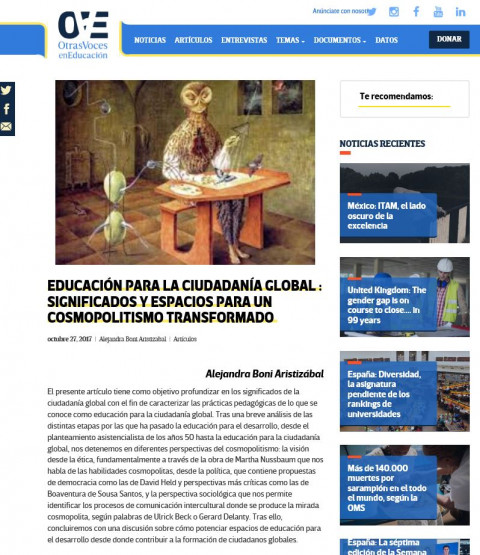 Education for Global Citizenship: Meanings and Practices for a Transformative Cosmopolitism Año de publicación: 2017 Autor: Alejandra Boni Aristizabal According to the author: "The article aims to analyze in depth the meanings of global citizenships in order to characterize the pedagogical practices of what is known as education for global citizenship. After a brief analysis of the different stages that education for development has gone through, from the assistencialist approach of the 50s to education for global citizenship, we study different perspectives of cosmopolitanism: a vision from the field of ethics, mainly from Martha Nussbaum's perspective that talks about cosmopolitan abilities, from politics, that has democratic proposals such as David Held's, critical perspectives as Boaventura de Souza Santos' ones, and the sociological perspective that allows us to identify intercultural communicative processes where the cosmopolitan view is produced, according to Ulrick Beck's or Gerald Delanty's words. After this, we conclude with a discussion about how to encourage education for develpment spaces that foster global citizenship." Educación para la Ciudadanía Global: Significados y espacios para un cosmopolitismo transformado Año de publicación: 2017 Autor: Alejandra Boni Aristizabal Según la autora: "El presente artículo tiene como objetivo profundizar en los significados de la ciudadanía global con el fin de caracterizar las prácticas pedagógicas de lo que se conoce como educación para la ciudadanía global. Tras una breve análisis de las distintas etapas por las que ha pasado la educación para el desarrollo, desde el planteamiento asistencialista de los años 50 hasta la educación para la ciudadanía global, nos detenemos en diferentes perspectivas del cosmopolitismo: la visión desde la ética, fundamentalmente a través de la obra de Martha Nussbaum que nos habla de las habilidades cosmopolitas, desde la política, que contiene propuestas de democracia como las de David Held y perspectivas más críticas como las de Boaventura de Sousa Santos, y la perspectiva sociológica que nos permite identificar los procesos de comunicación intercultural donde se produce la mirada cosmopolita, según palabras de Ulrick Beck o Gerard Delanty. Tras ello, concluiremos con una discusión sobre cómo potenciar espacios de educación para el desarrollo desde donde contribuir a la formación de ciudadanos globales"
 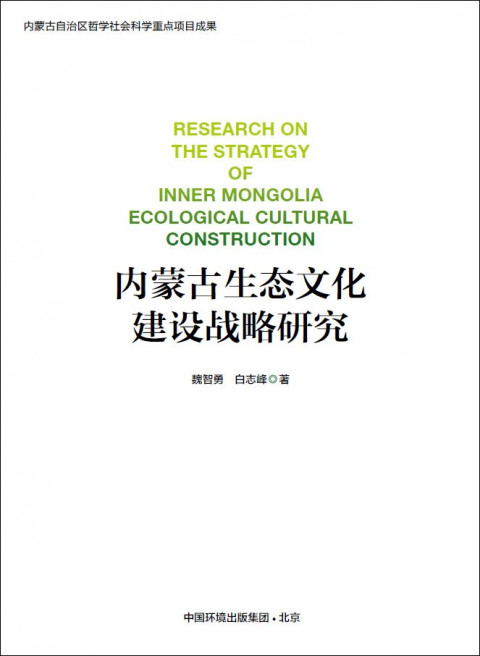 Research on the Strategy of Inner Mongolia Ecological Cultural Construction Año de publicación: 2019 Autor: WEI Zhiyong | BAI Zhifeng Autor corporativo: China Environment Publishing Group Focusing on the Ecological Civilization of Inner-Mongolia, China, this book presents to readers the backgroud and history of the ecological civilization development in the area. By analyzing the relevant policies, introducing the available resouces and typical cases, it showcases how the concept of harmonized development between man and nature evolving into the core of ecological cultural development in Inner-Mongolia. It summarizes the experiences and lessons learnt during the process, presents challenges faced and proposed practical suggestions and solutions. It also introduced some successful cases from the international experiences.
 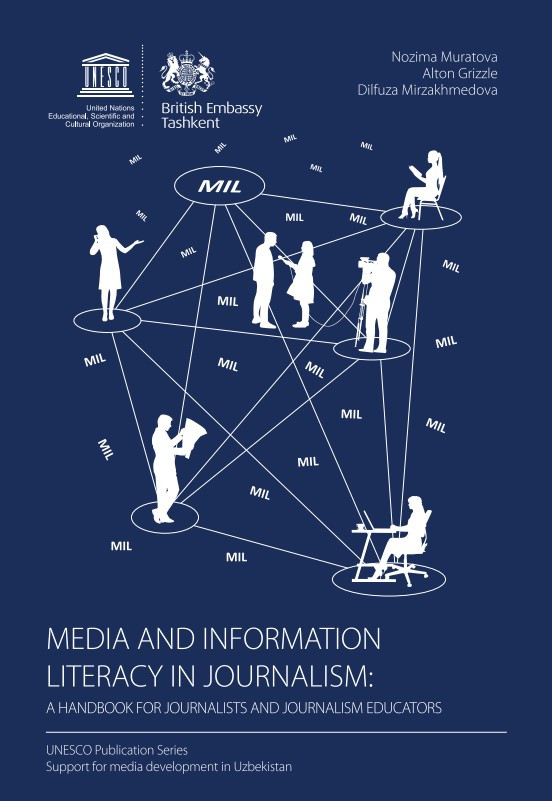 Media and Information Literacy in Journalism: A Handbook for Journalists and Journalism Educators Año de publicación: 2019 Autor: N. Muratova | A. Grizzle | D. Mirzakhmedova Autor corporativo: UNESCO Tashkent This handbook aims at being an important and practical tool for journalists in fulfilling their professional activities and mainly in media information literacy (MIL).The first three parts of the Handbook include theoretical material and are accompanied with exercises and case studies; the last part consists entirely of practical tools and exercises that aim to ensure that the material was understood. The Handbook deals with "fake news" and disinformation, provides a conceptual framework for media and information literacy, shows its importance, and explores principles and role of the MIL in journalism education. Also, the Handbook covers topics such as ethics on the Internet, human rights and work with sources, journalistic skills in collecting and processing information, ways to verify and provide reliable information, and the identification of fakes that may adversely affect the public. Медиа- и информационная грамотность в журналистике: Пособие для журналистов и преподавателей журналистики Año de publicación: 2019 Autor: N. Muratova | A. Grizzle | D. Mirzakhmedova Autor corporativo: UNESCO Tashkent Данное руководство нацелено на то, чтоб стать важным и практичным инструментом журналистов в осуществлении их профессиональной деятельности и главным образом в овладении медиа информационной грамотностью (МИГ).Первые три части книги включают в себя теоретический материал и сопровождены заданиями и кейсами по теме, последняя часть всецело состоит из практического инструментария и упражнений, которые направлены на закрепление изученного материала. В пособии рассматривается работа с «фэйковыми новостями» и дезинформацией, приведёна концептуальная основа, на которой строится медийная и информационная грамотность, показана ее важность, исследованы принципы и роль МИГ в журналистском образовании. Кроме этого в пособии рассмотрены такие темы, как этика в интернете, права человека и работа с источниками, мастерство журналиста в сборе и обработке информации, способы проверки и предоставления достоверных сведений, выявление фейков, которые могут отрицательно повлиять на общественность.
 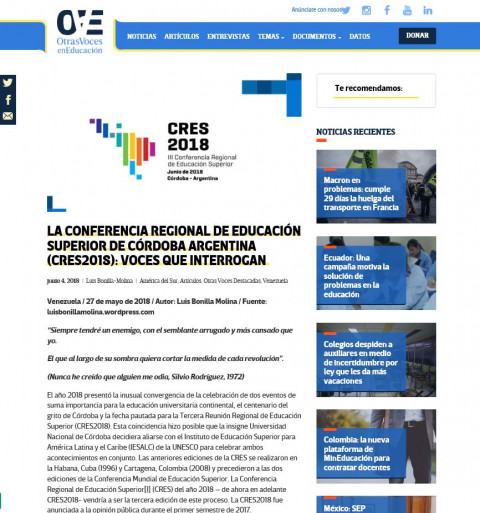 The Regional Conference on Higher Education of Córdoba Argentina (CRES2018): Voices That Question Año de publicación: 2018 Autor: Luis Bonilla-Molina The report is about the Regional Conference on Higher Education (CRES2018), where the Universidad Nacional de Córdoba partnered with the Intenational Institute for Higher Education in Latin America and the Caribbean (IESALC) from the UNESCO. During the event seven main areas concerning Higher Education in Latin America were debated from a critical perspective. Regarding globalization, according to the author, during the event "the effects of the cultural 'worldization'" were analyzed, and it was stated that "planetary citizenship is a blurred topic" that can promote cultural homogenization, and that therefore, there was a need of the promotion of a critical intercultural approach. La Conferencia Regional de Educación Superior de Córdoba Argentina (CRES2018): Voces que interrogan Año de publicación: 2018 Autor: Luis Bonilla-Molina El reporte habla de la celebración de la Tercera Reunión Regional de Educación Superior (CRES2018) donde la Univ. Nacional de Córdoba se alió con el Instituto de Ed. Superior para América Latina y el Caribe (IESALC) de la UNESCO. Durante ese evento hubieron siete ejes de debates que analizaban la Ed. Superior en América Latina desde una perspectiva crítica. En cuanto a la globalización, según el autor, durante el encuentro se problematizaron "los efectos de la mundializaciòn cultural", y se aseguró que la "ciudadanía planetaria aparece como un tema difuso" que puede promover homogeneización cultural por lo que se planteó la necesidad de un enfoque basado en un interculturalismo crítico.
  Guide pratique sur l’éducation à la citoyenneté mondiale : Concepts et methodologies en matière d’éducation à la citoyenneté mondiale à l’usage d’éducateurs et de responsables politiques Año de publicación: 2008 Autor: Alicia Cabezudo | Christos Christidis | Miguel Carvalho da Silva | Valentina Demetriadou-Saltet | Franz Halbartschlager | Georgeta-Paula Mihai Autor corporativo: North-South Centre of the Council of Europe Ce guide pratique sur l’éducation à la citoyenneté mondiale a émané du besoin exprimé par les praticiens du réseau de la Semaine de l’éducation à la citoyenneté mondiale du Centre Nord Sud (CNS), de disposer d’un instrument commun, façonné à la lumière de l’expérience acquise par le réseau et d’autres partenaires, qui pourrait aider les éducateurs à comprendre et à mener à bien des initiatives en matière d’éducation à la citoyenneté mondiale.En offrant des points de vue sur l’éducation à la citoyenneté mondiale ainsi que les méthodes et les critères d’évaluation qui s’y appliquent, notamment en termes d’échange de pratiques, d’outils et de ressources, ce guide pratique étoffe le travail de fond en matière d’ECM. Il apporte, par ailleurs, une aide aux praticiens opérant dans les secteurs formels et non formels de l’éducation : premièrement, en introduisant des éléments primaires que ces premiers peuvent développer au gré de leurs besoins et de leur propre expérience ; deuxièmement, en identifiant des approches et des pratiques déjà en œuvre en matière d’éducation à la citoyenneté mondiale ; troisièmement, en les invitant à réfléchir et à devenir plus conscients de leurs propres activités dans ledit domaine ; quatrièmement, en amplifiant l’échange de pratiques et en créant des synergies entre les parties prenantes ; cinquièmement, en contribuant à la définition des politiques éducationnelles au niveau local, régional, national et international.
 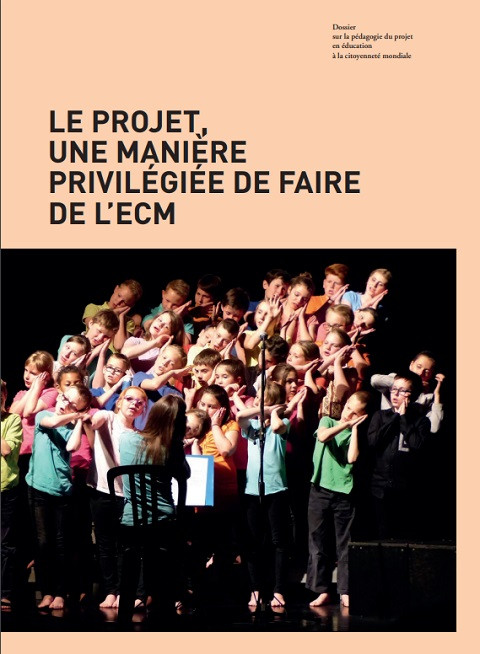 Le projet, une manière privilégiée de faire de l’ECM : Dossier sur la pédagogie du projet en éducation à la citoyenneté mondiale Año de publicación: 2019 Autor corporativo: Annoncer la Couleur (ALC) | Enabel Ce dossier montre les avantages de faire de l’éducation à la citoyenneté mondiale par la mise en projet. Cela donne aussi les bonnes méthodes pédagogiques pour adopter l’enseignement par projet génère une nouvelle dynamique dans la pratique de l’enseignant. Intéressé∙e par les thèmes de l’éducation à la citoyenneté mondiale, il ou elle les intégrera, en tout ou en partie, dans son cours à condition d’y trouver des avantages.
  Policy Brief: Education for Sustainable Development in Central Asia Año de publicación: 2019 Autor corporativo: UNESCO Almaty Education for Sustainable Development(ESD) is crucial to reaching all 17 Sustainable Development Goals (SDGs). Both ESD and Global Citizenship Education (GCED) are explicitly stated in the seventh target of SDG4 and promoted by UNESCO as two complimentary approaches. This requires teaching and learning objectives that enable learners to acquire the knowledge, skills, attitudes and values for sustainable development as part of cognitive, socio-emotional and behavioural domains. This policy brief explores the challenges, promising practices, and policy recommendations when it comes to mainstreaming ESD in Central Asia’s education systems.