
Recursos
Exploren una amplia gama de recursos valiosos en GCED para profundizar su comprensión y promover su búsqueda, incidencia, enseñanza y aprendizaje.
2,813 resultados encontrados
 New Trends in Intercultural Dialogue in the Context of Regional Geopolitics Año de publicación: 2013 Autor: Munzifa Babadjanova Intercultural and inter-religious dialogue between civilizations is the beginning of a new path to a better future. The dialogue on international issues, on various issues of cultures and civilizations determines the elimination of misunderstandings, brings together positions and creates the basis for greater protection of the rights of nations and states by establishing equality and peace in the international arena. Of particular relevance is the spread of cultural standards, the preservation of ethnocultural diversity and distinctive traditions, combined with the development of dialogue and contacts.
  Éducation à la citoyenneté mondiale (ÉCM): Définitions, critiques et postures Año de publicación: 2017 Autor: Carine Nassif-Gouin | Philippe Tousignant Autor corporativo: Association québécoise des organismes de coopération internationale (AQOCI) La plupart des organismes de coopération internationale (OCI) se sont engagés dans un long processus d’information, de sensibilisation, d’engagement et d’éducation du public. Ce document cherche à soutenir la réflexion quant à l’approche émergente de l’éducation à la citoyenneté mondiale (ÉCM) et la question suivante : en quoi l’ÉCM est-elle nouvelle ou différent de l’engagement du public ou, par exemple, de l’éducation aux droits humains ? Les OCI mettent à la disposition des apprenants (stagiaires, coopérants, bénévoles, salariés, jeunes en milieu scolaire ou communautaire, entreprises, etc.) de l’information, des formations, des ateliers, des documents voire des trousses, et bien plus encore, qui favorisent l’autonomisation et la responsabilisation des individus. Ces activités sont souvent de nature pédagogique, mais elles peuvent également être d’une toute autre nature. Les OCI ont des pratiques riches et variées en éducation, formation, mobilisation, sensibilisation, etc. Certaines pratiques ont fait leurs preuves et nous encouragent à nous en inspirer ou encore à les adopter. Parmi les facteurs contribuant à la réussite de l’ÉCM, le choix de la définition, la qualité, la précision d’un cadre de références commun jouent un rôle crucial. Ainsi, ce guide tente d’offrir un certain nombre d’informations essentielles à la réalisation et la réussite de l’ÉCM. Du fait qu’il y ait très peu de littérature consacrée à l’éducation à la citoyenneté mondiale au Québec, nous nous sommes beaucoup tourné vers celle qui est issue d’autres pays et contextes. Ce document est conçu à l’intention de toutes les personnes qui souhaitent comprendre ce qu’est l’ÉCM pour en développer des activités et s’approprier ses définitions et contenus. Il faut reconnaître d’emblée que chaque organisme, chaque programme présente des spécificités et qu’il n’est pas souhaitable ou même possible d’uniformiser les guides ou de les rendre conformes à un modèle particulier. Il faut surtout garder à l’esprit que nous tenons à offrir à chacun des acteurs une information de qualité et préparer avec tout le soin nécessaire un guide clair et nourrissant. Ce guide est composé de six (6) parties et d’une note de synthèse. Ainsi, chacun pourra y puiser les informations et ressources ou encore les outils de références souhaités.
  Raising Awareness and Promoting Global Citizenship to Realize the 2030 Agenda Año de publicación: 2019 Autor: Laurel Wayne-Nixon | Tanya Wragg-Morris | Anjali Mishra | Dawson Markle | Shannon Kindornay Autor corporativo: British Columbia Council for International Cooperation (BCCIC) | Conseil canadien pour la coopération internationale (CCCI) Socializing the 2030 Agenda for Sustainable Development among citizens, parliamentarians, government institutions, civil society, academia, the private sector, trade unions and others provides a basis for stakeholders to identify their priorities and contribute to sustainable development as global citizens. Based on a review of good practices emerging from around the world, this policy brief offers recommendations on how governments can raise awareness of the 2030 Agenda and support global citizenship. Sensibilisation et promotion de la citoyenneté mondiale pour réaliser le Programme 2030 au Canada Año de publicación: 2019 Autor: Laurel Wayne-Nixon | Tanya Wragg-Morris | Anjali Mishra | Dawson Markle | Shannon Kindornay Autor corporativo: British Columbia Council for International Cooperation (BCCIC) | Conseil canadien pour la coopération internationale (CCCI) Faire connaître le Programme de développement durable à l’horizon 2030 aux citoyens, aux parlementaires, aux institutions gouvernementales, à la société civile, au milieu universitaire, au secteur privé, aux syndicats et à d’autres acteurs constitue une base pour les parties prenantes afin de déterminer leurs priorités et contribuer au développement durable en tant que citoyens du monde. Fondée sur un examen des bonnes pratiques émergentes du monde entier, la présente note d’information contient une série de recommandations sur les façons dont les gouvernements peuvent accroître la sensibilisation au Programme 2030 et soutenir la citoyenneté mondiale.
  Global Citizenship Education at the Crossroads: Globalization, Global Commons, Common Good, and Critical Consciousness (Prospects; Vol.48) Año de publicación: 2020 Autor: Carlos Alberto Torres | Emiliano Bosio Autor corporativo: Springer Nature This article-dialogue addresses current criticisms of global citizenship and challenges frequent misinterpretations of Global Citizenship Education (GCE), while discussing what it means to educate for critical global citizenry in an increasingly multicultural world. It starts by considering the phenomena of globalization and the UN Global Education First Initiative (GEFI), which aims at furthering global citizenship, to highlight the relationship between GCE, “global-peace”, global commons, and common good. Building on the assumption that GCE should be about learners’ emancipation toward critical consciousness, the dialogue concludes drawing a parallel between the “mission” of GCE in contemporary educational institutions and Paulo Freire’s notion of critical consciousness.
 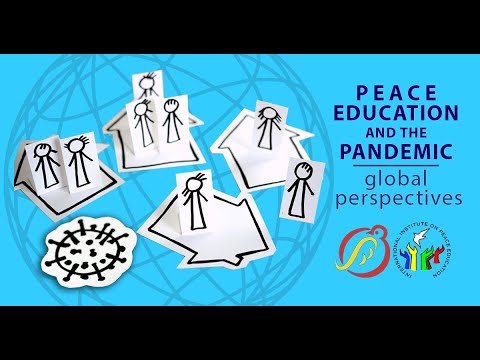 Peace Education and the Pandemic: Global Perspectives Año de publicación: 2020 Autor corporativo: International Institute on Peace Education (IIPE) This April 13 webinar, co-organized by the International Institute on Peace Education and Global Campaign for Peace Education, is an opportunity to learn, hear, and share with and from peace educators from around the world about how they are responding, adapting, and rethinking urgent agendas for peace education revealed by the global coronavirus pandemic.
 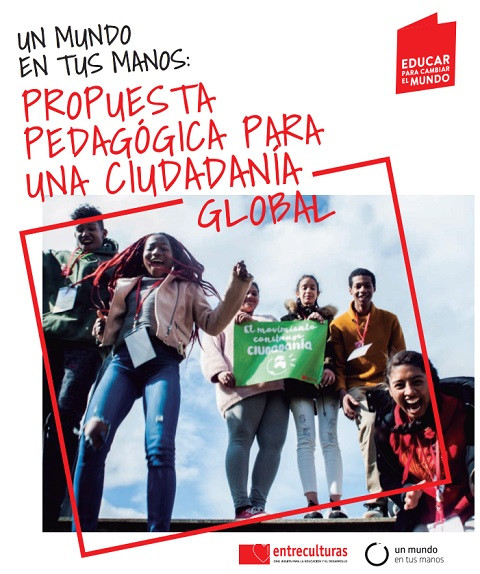 Un Mundo en tus Manos: Propuesta Pedagógica para una Ciudadanía Global Año de publicación: 2019 Autor: Jessica García Fernández | Irene Ortega Guerrero | Davinia de Ramón Felguera | Encarna Duran Costell | Alberto Medina Bravo | Clara Maeztu Gomar | Yénifer López Ramos Autor corporativo: Fundación Entreculturas Este documento es una propuesta pedagógica de Entreculturas para educar en Ciudadanía Global. Cubre la metodología, recursos y ejemplos de cómo Entreculturas viene trabajado con adolescentes, jóvenes y educadores y educadoras durante los últimos años.
 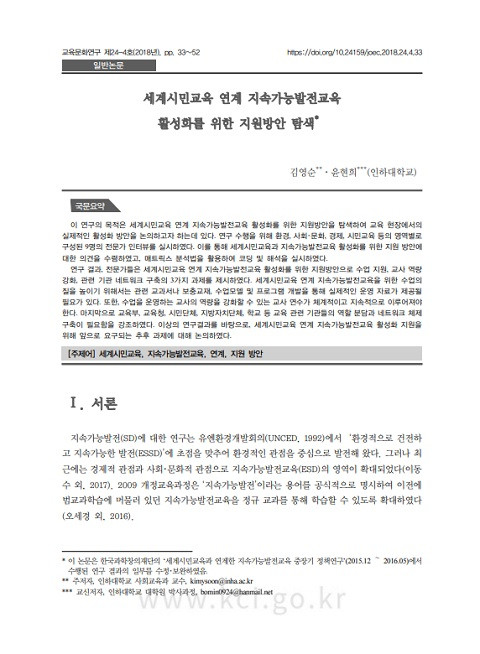 A Study on the Support Methods of Education for Sustainable Development in Connection with Global Citizenship Education (Journal of Education & Culture; Vol.24, No.4) Año de publicación: 2018 Autor: Youngsoon Kim | Hyunhee Yoon Autor corporativo: Inha University. Education Research Institute The purpose of this study is to explore supportive measures for revitalizing education for sustainable development linked to global citizenship education and to discuss the practical ways of activation in educational field. The researchers interviewed nine experts on global citizenship education and education for sustainable development for the project. It also collected opinions on how to promote sustainable development education linked to global citizenship education. As a result of the research, experts have presented three tasks as a support measure for promoting sustainable development programs associated with global citizenship education. It was to provide classroom support, enhance teacher skills, and establish a network of related institutions. To improve the quality of the classes, practical operational materials are required, such as textbooks, supplementary materials, and the development of class models and programs. In addition, systematic and continuous training is required to enhance the capabilities of teachers. Lastly, it is necessary to share roles of education-related organizations, such as the Education Ministry, education office, civic groups, local governments and schools, and to establish a network system. Based on the above research results, the Commission discussed future tasks required to support the promotion of sustainable development programs related to international citizens ' education. 세계시민교육 연계 지속가능발전교육활성화를 위한 지원방안 탐색 (교육문화연구; Vol.24, No.4) Año de publicación: 2018 Autor: 김영순 | 윤현희 Autor corporativo: 인하대학교 교육연구소 이 연구의 목적은 세계시민교육 연계 지속가능발전교육 활성화를 위한 지원방안을 탐색하여 교육 현장에서의실제적인 활성화 방안을 논의하고자 하는데 있다. 연구 수행을 위해 환경, 사회・문화, 경제, 시민교육 등의 영역별로구성된 9명의 전문가 인터뷰를 실시하였다. 이를 통해 세계시민교육과 지속가능발전교육 활성화를 위한 지원 방안에대한 의견을 수렴하였고, 매트릭스 분석법을 활용하여 코딩 및 해석을 실시하였다.연구 결과, 전문가들은 세계시민교육 연계 지속가능발전교육 활성화를 위한 지원방안으로 수업 지원, 교사 역량강화, 관련 기관 네트워크 구축의 3가지 과제를 제시하였다. 세계시민교육 연계 지속가능발전교육을 위한 수업의질을 높이기 위해서는 관련 교과서나 보충교재, 수업모델 및 프로그램 개발을 통해 실제적인 운영 자료가 제공될필요가 있다. 또한, 수업을 운영하는 교사의 역량을 강화할 수 있는 교사 연수가 체계적이고 지속적으로 이루어져야한다. 마지막으로 교육부, 교육청, 시민단체, 지방자치단체, 학교 등 교육 관련 기관들의 역할 분담과 네트워크 체제구축이 필요함을 강조하였다. 이상의 연구결과를 바탕으로, 세계시민교육 연계 지속가능발전교육 활성화 지원을위해 앞으로 요구되는 추후 과제에 대해 논의하였다.
  한반도의 평화를 말하다: 여섯 가지 주제로 살펴본 한반도 평화의 의미와 이해 Año de publicación: 2019 Autor: 김병곤 | 서보혁 | 이동선 | 정재관 | 정성윤 | 정욱식 Autor corporativo: 통일교육원 평화'라는 주제로 통일교육원에서 발간하는 첫 번째 평화 교재이다. 6명의 학자 및 평화활동가가 평화의 이해에서부터 시민사회의 평화운동에 이르기까지 살펴본 한반도의 평화 이야기이다.