
Recursos
Exploren una amplia gama de recursos valiosos en GCED para profundizar su comprensión y promover su búsqueda, incidencia, enseñanza y aprendizaje.
2,768 resultados encontrados
 ارشادات استخدام الذكاء الاصطناعي التوليدي في التعليم والبحث Año de publicación: 2023 Autor: Fengchun Miao | Wayne Holmes Autor corporativo: UNESCO تهدف هذه الإرشادات إلى دعم تخطيط اللوائح والسياسات وبرامج تنمية القدرات البشرية المناسبة ً لضمان أن يصبح الذكاء الاصطناعي التوليدي أداة تفيد المعلمين والمتعلمين والباحثين وتمكنهم حقا. وهو يشرح تقنيات الذكاء الاصطناعي التي يستخدمها الذكاء الاصطناعي التوليدي ويرسم قائمة بنماذج ً المحولات التوليدية المدربة مسبقا المتاحة للجمهور، خاصة تلك التي تخضع لترخيص مفتوح المصدر. كما ً ً حول ظهور نماذج المحولات التوليدية التعليمية المدربة مسبقا - التي يتم تدريبها باستخدام يفتح نقاشا بيانات محددة لخدمة الأغراض التعليمية. علاوة على ذلك، فهو يلخص بعض الخلافات الرئيسية حول ً الذكاء الاصطناعي التوليدي، بدءا من تفاقم الفقر الرقمي إلى تجانس ً الآراء، ومن التزييف العميق إلى قضايا حقوق الطبع والنشر. واستنادا إلى رؤية إنسانية، تقترح الإرشادات خطوات أساسية لتنظيم أدوات الذكاء الاصطناعي التوليدي، بما في ذلك فرض حماية خصوصية البيانات ووضع حد عمري للمحادثات المستقلة مع منصات الذكاء الاصطناعي التوليدي. ً لتوجيه الاستخدام السليم للأدوات في التعليم والبحث، تقترح هذه الإرشادات نهج ً ا مناسبا للعامل البشري والعمر للتحقق من الصحة الأخلاقية وعمليات التصميم التربوي. Guidance for Generative AI in Education and Research Año de publicación: 2023 Autor: Fengchun Miao | Wayne Holmes Autor corporativo: UNESCO This Guidance aims to support the planning of appropriate regulations, policies and human capacity development programmes to ensure that generative artificial intelligence (GenAI) becomes a tool that genuinely benefits and empowers teachers, learners and researchers. It explains the Al techniques used by GenAI and maps out a list of GPT models that are made publicly available, especially those under open-source licences. It also opens a discussion on the emergence of EdGPT - GenAI models that are trained with specific data to serve educational purposes. Furthermore, it summarizes some of the key controversies around GenAI, from worsening digital poverty to the homogenization of opinions, and from deeper deepfakes to issues of copyright. Based on a humanistic vision, the Guidance proposes key steps for the regulation of GenAI tools, including mandating the protection of data privacy and setting an age limit for independent conversations with GenAI platforms. To guide the proper use of the tools in education and research, this Guidance proposes a human-agent and age-appropriate approach to the ethical validation and pedagogical design processes.
  World Programme for Human Rights Education, Fourth Phase: Plan of Action Año de publicación: 2022 Autor corporativo: Organización de las Naciones Unidas para la Educación, la Ciencia y la Cultura (UNESCO) | UN. Office of the Secretary-General’s Envoy on Youth | UN. Office of the United Nations High Commissioner for Human Rights (UN. OHCHR) Human rights education for youth, in both formal and non-formal settings, promotes a shared sense of humanity and fosters a common understanding that all human beings are equally deserving of dignity, respect and justice. It empowers youth to fulfil their role as active citizens, to take action and uphold their human rights and those of others, and to participate meaningfully in public affairs and democratic decision-making processes.In recognition of this, the United Nations Member States launched the fourth phase (2020–2024) of the World Programme for Human Rights Education to advance human rights education programming for youth at the national level. This focus also contributes to the achievement of the 2030 Agenda for Sustainable Development, particularly Goal 4 on Education and target 4.7, which touches upon the aims of education.
  2017 International Conference on Education and the Holocaust: Progress Report and Follow-up Año de publicación: 2018 Autor corporativo: UNESCO | United States Holocaust Memorial Museum (USHMM) From December 4-8 2017, UNESCO and the United States Holocaust Memorial Museum (USHMM) jointly organized the second International Conference on Education and the Holocaust (ICEH) in Washington, DC. The conference brought together 26 participants from 10 countries with the goal of strengthening their capacities to advance education about the Holocaust and genocide in their respective countries. Of great importance was the relevance of this education within the teams’ national contexts. The conference ultimately led to the development of 10 country-specific initiatives. The 2017 ICEH cohort comprises representatives of institutions from Argentina, Colombia, India, Indonesia, Kenya, Mexico, Namibia, South Africa, Tunisia and Ukraine.
 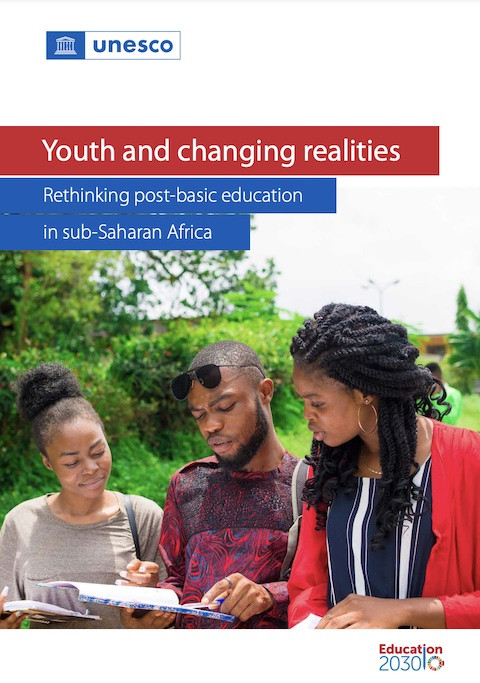 Youth and Changing Realities: Rethinking Post-basic Education in Sub-Saharan Africa Año de publicación: 2022 Autor corporativo: Организация Объединенных Наций по вопросам образования, науки и культуры (UNESCO) Education should empower young people for full participation in their societies and education systems should be responsive to their voices, aspirations and actions. At this time of upheaval, it is more important than ever that youth voices are heard. This synthesis report analyses the perspectives of post-basic education of some young people from 20 countries in sub-Saharan Africa. Their voices express diverse experiences, aspirations and expectations. They describe ‘changing realities’ in which education and training opportunities often seem unable to meet their aspirations and new demands of the world of work and society. It focusses on four crucial themes for post-basic education, with reference to youth’s experiences: financing, socio-cultural barriers, skills for work and life, and educators’ capacities.The Education 2030 Framework for Action calls for youth, learners and their organizations to be full partners in the realization of SDG4; to encourage governments and other stakeholders to develop education programmes in consultation with young people; and to help shape policies for relevant and responsive education systems. This synthesis report makes an important contribution towards rethinking post-basic education in sub-Saharan Africa.
 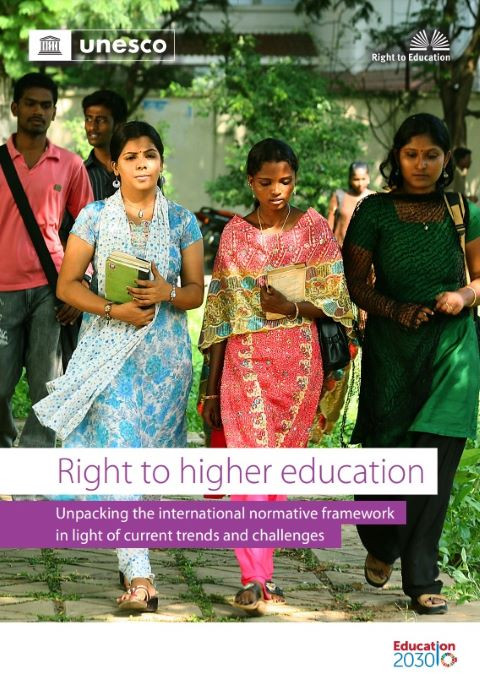 Right to Higher Education: Unpacking the International Normative Framework in Light of Current Trends and Challenges Año de publicación: 2022 Autor corporativo: UNESCO | Right to Education Initiative (UK) The right to higher education is well-established in international human rights law. It requires states to progressively introduce free higher education and ensure that all have access on the basis of capacity. Yet, access to education is unequal from the very early years, which together with deep-rooted discrimination in education as well as differences in upbringing, often result in unfair admission procedures when reaching higher education. Drastic changes worldwide, due to rising inequalities, human movement, growing digitalization and the effects of the COVID-19 pandemic, are further challenging how this right can be concretely implemented. This publication seeks to bring clarity not only to existing obligations and rights, but also to unravel what aspects of the right to higher education might require further explanation in light of new contexts and challenges. It provides policy recommendations to guide states in their endeavour to ensure effective equal opportunities to higher education for all.
 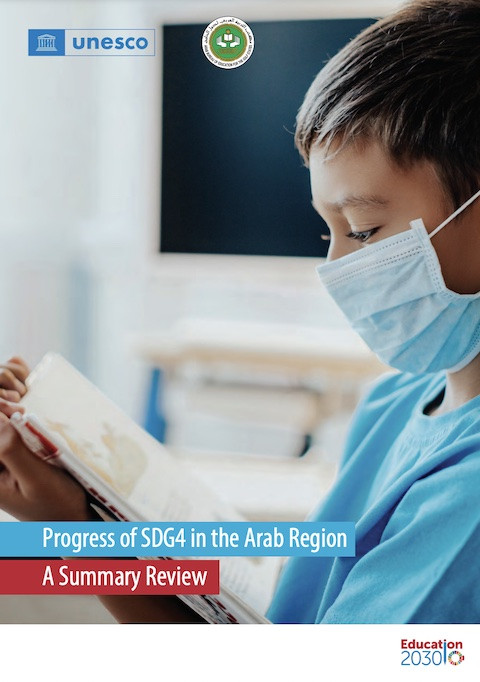 Progress of SDG4 in the Arab Region: A Summary Review Año de publicación: 2022 Autor corporativo: UNESCO This report is a snapshot review of the progress of SDG 4 in the Arab region, based upon the national reports of the countries of the region and the valuable inputs from the regional education institutes of the region. In this review, SDG 4 is looked at as an essential part of an interconnected whole of all SDGs. However, it focuses on selected targets and indicators of SDG 4 because of difficulties of accessing consistent data pertaining to the region covering the period from 2010 to 2020. Therefore, internationally comparable data from various sources have been taken into consideration, highlighting at the same time the overall pictures as revealed by the country reports and flagging their selected best practices.
 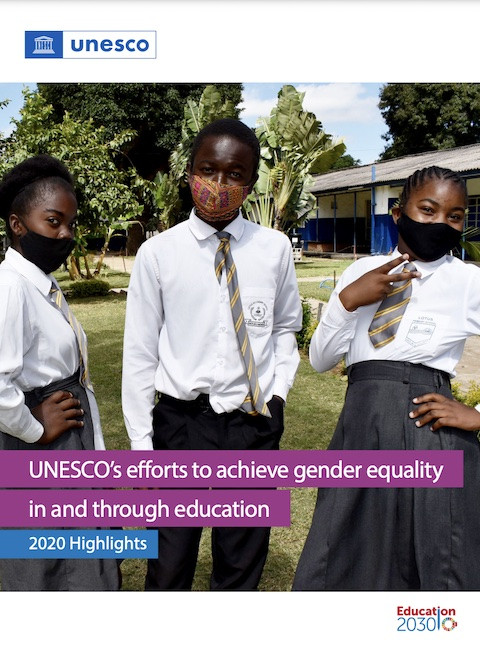 UNESCO’s Efforts to Achieve Gender Equality in and Through Education: 2020 Highlights Año de publicación: 2022 Autor corporativo: UNESCO This report presents highlights of UNESCO’s work in 2020 to advance gender equality in and through education.UNESCO's work in this area is guided by the UNESCO strategy for gender equality in and through education 2019–2025, and supported by Her Education, Our Future, which was launched in parallel with the strategy, to leverage political and financial commitments, cooperation and joint action for girls’ and women’s education.
 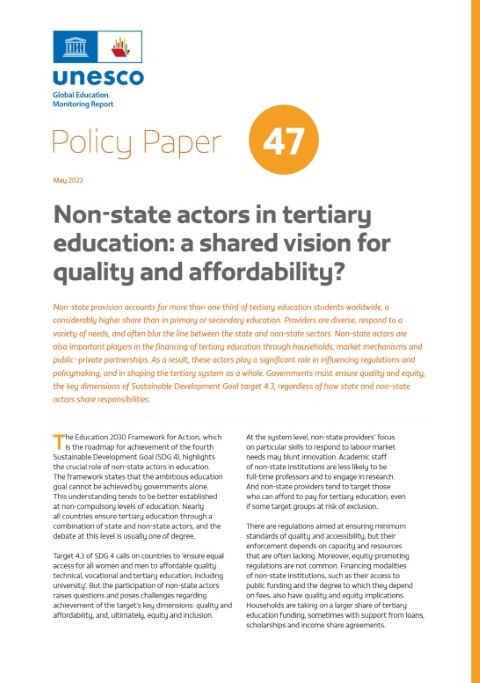 Los actores no estatales en la educación superior: ¿Una visión compartida de la calidad y la asequibilidad? (Policy Paper 47) Año de publicación: 2022 Autor corporativo: UNESCO Los actores no estatales acogen a más de un tercio del alumnado de educación superior en todo el mundo, un porcentaje considerablemente más elevado que en la educación primaria o secundaria. Los proveedores son diversos y responden a una variedad de necesidades, y a menudo no hay una división clara entre los sectores estatal y no estatal. Los actores no estatales son además protagonistas importantes en la financiación de la educación superior a través de los hogares, los mecanismos de mercado y las alianzas público-privadas. A raíz de ello, estos actores desempeñan un papel significativo e influyen en la elaboración de normativas y políticas, así como en la configuración del sistema de educación superior en su conjunto. Los gobiernos deben garantizar la calidad y equidad —las dimensiones clave de la meta 4.3 de los Objetivos de Desarrollo Sostenible (ODS)—, independientemente del modo en que los actores estatales y no estatales compartan responsabilidades.
  Transforming Education Summit 2022: Futures of Education Briefing Notes Año de publicación: 2022 Autor corporativo: UNESCO National consultations that aim at developing a shared vision, commitment, and alignment of action across constituencies are one of the key TES workstreams. The Reimagining our futures together report is proposed as a framework for examining how education systems need to change to better serve learners and societies into the future.A series of briefing notes have been prepared in alignment with the summit's five action tracks:o Inclusive, equitable, safe and healthy schoolso Learning and skills for life, work and sustainable developmento Teachers, teaching and the teaching professiono Digital learning and transformationo Financing of education