
Recursos
Exploren una amplia gama de recursos valiosos en GCED para profundizar su comprensión y promover su búsqueda, incidencia, enseñanza y aprendizaje.
2,768 resultados encontrados
 Course: Dialogue and Dialogue Etiquette Año de publicación: 2017 Autor: Fath Omar Autor corporativo: Majmaah University The course includes two topics of dialogue and disagreement. It seeks to form the Muslim to be a tactful interlocutor and able to manage the conflict between him and his society and his counterparts. The course deals with one of the important pillars of global citizenship issues, which is dialogue. مقرر دراسي: الحوار وآداب الحوار Año de publicación: 2017 Autor: Fath Omar Autor corporativo: Majmaah University يتضمن المقرر موضوعي الحوار والخلاف. ويسعى لتشكيل المسلم ليكون محاوراً لبقاً، وقادراً على إدارة الخالف بينه ، وبين مجتمعه ومناظريه. المقرر يتعرض لأحد الركائز المهمة من مواضيع المواطنة العالمية وهو الحوار.
  Dialogue for Prevention Año de publicación: 2025 Autor corporativo: UNESCO In an era where geopolitical power struggles disrupt traditional peacebuilding, where identity and misinformation fuel divisions, and where trust in institutions is eroding, UNESCO’s Intercultural Dialogue for Conflict Transformation briefs series presents an adaptable, culturally grounded, and people-centred approach to peacebuilding. With 1.5 billion people living in contexts with low intercultural dialogue where global challenges such as absolute poverty, terrorism and forced displacement are more prevalent, this four-part series draws on firsthand experience, country case studies, and expert analysis to demonstrate the transformative potential of dialogue in fragile and conflict-sensitive settings. The Dialogue for Prevention brief, developed with the Auschwitz Institute for the Prevention of Genocide and Mass Atrocities, explores the powerful role intercultural dialogue can play in preventing large-scale identity-based violence, particularly in the upstream and downstream phases of conflict. Grounded in the idea that dialogue can bridge divides and foster mutual understanding, the brief argues that enabling environments for intercultural dialogue—marked by stability, inclusive governance, freedom of expression, horizontal equality, and social cohesion—also mitigate key risk factors for atrocity violence. Drawing on diverse examples from Cambodia, Colombia, Italy, and Kenya, it showcases creative, context specific applications of dialogue. Through practical guidance, the brief equips policymakers, practitioners and civil society seeking to embed dialogue into prevention strategies.
  Dialogue for Social Cohesion Año de publicación: 2025 Autor: Isaure Vicarini | Euan Mackway-Jones Autor corporativo: UNESCO In an era where geopolitical power struggles disrupt traditional peacebuilding, where identity and misinformation fuel divisions, and where trust in institutions is eroding, UNESCO’s Intercultural Dialogue for Conflict Transformation briefs series presents an adaptable, culturally grounded, and people-centred approach to peacebuilding. With 89% of conflicts worldwide occurring in countries with limited capacity for intercultural dialogue, this four-part series draws on firsthand experience, country case studies, and expert analysis to demonstrate the transformative potential of dialogue in fragile and conflict-sensitive settings. The Dialogue for Social Cohesion brief—developed in collaboration with the Berghof Foundation and Search for Common Ground—bridges theory and practice to explore the horizontal (community-to-community) and vertical (citizen-to-state) dimensions of social cohesion and highlights how inclusive dialogue can support both. Case studies from Afghanistan, Germany, Somalia, and South Sudan illustrate how dialogue—whether through theatre, education, local governance, or environmental peacebuilding—can cultivate mutual understanding and trust, bridge identity-based divides, and restore, step by step, the social fabric in fractured societies. Through actionable recommendations, this brief equips practitioners, policymakers, and civil society with the essential guidance needed to tailor and embed dialogue in their respective contexts, helping to ensure that peace processes are inclusive, locally driven, and enduring.
 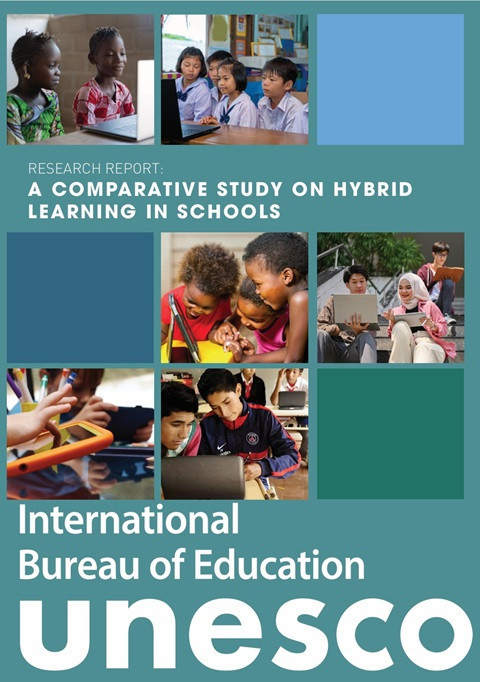 Research Report: A Comparative Study on Hybrid Learning in Schools Año de publicación: 2024 Autor corporativo: UNESCO International Bureau of Education (IBE) During the COVID-19 lockdown, policymakers and educators faced an unprecedented challenge disrupting all levels of education. The initial optimism about replacing physical classes with virtual lessons diminished as complex interconnected issues emerged. To address the need for continuous and sustainable learning, school systems implemented variations of hybrid learning during the pandemic, seeking to integrate physical and virtual classes. These approaches prompted this comparative study led by UNESCO-IBE. The initial phase of this study involved collecting and analysing data on hybrid strategies from six countries. The research aimed to examine factors influencing hybrid learning implementation during the lockdown, with a subsequent focus on developing and validating a practical Hybrid Learning Framework for Schools. The cross-case analysis was designed not to rank or compare, but to understand and connect different scenarios and contexts. Phase I focuses on current hybrid learning practices and influencing factors, while Phases II and III will concentrate on using the information gathered to create and validate a Hybrid Learning Framework for Schools. Hybrid learning is not just a response to pandemics but also serves as a viable solution for other scenarios where full school attendance is difficult. Aligned with UNESCO-IBE’s overarching vision of a comprehensive, personalized, and democratized curriculum accessible to all, hybrid learning facilitates inclusive education across diverse regions, overcoming geographical and temporal limitations. The approach aims to unlock the unique potential of every learner, fostering a more flexible educational environment.Published in February 2024 by the UNESCO International Bureau of Education (IBE) with support from the European Union.
  UNESCO Women for Ethical AI: Outlook Study on Artificial Intelligence and Gender Año de publicación: 2024 Autor corporativo: UNESCO The gender chapter of the UNESCO Recommendation on the Ethics of AI is a concrete commitment by 194 Member States to advance gender equality in the AI ecosystem. To track progress in the implementation of the gender provisions of UNESCO’s Recommendation, and to assess the impacts of AI on gender equality, the UNESCO Women for Ethical AI (W4EAI) Platform has been established. This report advances the workstream through evidence-based insights in three critical areas: women’s participation in AI development and deployment, the inclusion of gender equality concerns in AI governance and the impact of AI on gender equality. It highlights the significant underrepresentation of women in AI, the lack of gender-disaggregated data, and the compounded challenges women face in the field. The report also addresses the neglect of gender dimensions in AI policy, the risks posed by AI systems to women, and the need for responsible and ethical AI governance to promote gender equality. Finally, it outlines actionable recommendations to enhance gender equality through and in AI, emphasizing the importance of comprehensive data collection, targeted interventions, and inclusive policy-making.
  Fostering Women's Leadership Año de publicación: 2024 Autor: Mariagrazia Squicciarini | Anna Rita Manca | Garance Sarlat Autor corporativo: UNESCO No (leadership) share no gain (for societies and economies)! Leveraging UNESCO’s unique Gender-Based Resilience Framework, this report explores the role of women in leadership positions in both decision-making and high-tech, including in artificial intelligence-related innovations. It further highlights progress towards the G20 Brisbane Target, aimed to accelerate progress on gender equality by reducing the gender gap in labour market participation rates by 25% by 2025. Women remain underrepresented in decision-making, holding only about 26% of seats in national parliaments worldwide on average. In the world of work, female labour participation continues to lag behind men’s, at 47% for women against 72% for men on average. Despite progress by G20 members towards the Brisbane Target, a 2% average gap in absolute terms remained to be filled in 2022. In the high-tech world, women make up only 30% of AI professionals, and even less of leaders. Female inventors in AI account for about 37% of patents filed in 2022-23.
  환경 시민과 함께하는 2022 대한민국 환경교육 Año de publicación: 2022 Autor corporativo: 대한민국 환경부 이 발행물은 국민들에게 환경교육 정책과 사업을 알리고 정책의 발전을 함께 고민하고자 하는 목적으로 발행한 홍보물로 대한민국 환경교육 현황과 주요 국가의 초·중·고등학교와 일반인을 대상으로 하는 환경교육 사업을 조사하여 설명하고 있습니다.
  Environmental Science Course Año de publicación: 2021 Autor: Ula Madwer | Sakher Ajouz | Ali Alsahyouni Autor corporativo: University of Hama This document provides an explanation of the initial practical session in the environment science course. The practical part of the environment science course contains a set of practical exercises. It includes the following objectives: Familiarize students with the tools and equipment of the environmental laboratory Determine the types and sources of environmental pollution Air quality standards and measurement units Measurement of carbon dioxide concentration مقرر علم البيئة Año de publicación: 2021 Autor: Ula Madwer | Sakher Ajouz | Ali Alsahyouni Autor corporativo: University of Hama يقدم المستند توضيحا للجلسة العملية الأولي في مقرر علم البيئة. ويحتوي الجزء العملي من مقرر علم البيئة على مجموعة من التدريبات العملية. وتتضمن الأهداف التالية: التعرف على أدوات وأجهزة المختبر البيئي تحديد أنواع ومصادر التلوث البيئي معايير جودة الهواء ووحدات القيا س قياس تركيز ثاني أوكسيد الكربون