
Recursos
Exploren una amplia gama de recursos valiosos en GCED para profundizar su comprensión y promover su búsqueda, incidencia, enseñanza y aprendizaje.
2,813 resultados encontrados
 Strengthening Social and Emotional Learning in Hybrid Modes of Education: Building Support for Students, Teachers, Schools and Families; A UNESCO-IBE Discussion Paper Año de publicación: 2024 Autor corporativo: UNESCO International Bureau of Education (IBE) The COVID-19 pandemic intensified existing educational disparities globally, prompting a reevaluation of school curricula to include Social and Emotional Learning (SEL). This shift recognized the holistic needs of learners, teachers, and families, emphasizing competencies beyond traditional knowledge acquisition. Despite SEL's increasing global recognition, it is often absent from formal curricula, prompting the UNESCO-IBE to address this gap. This Discussion Paper explores the crucial role of SEL in the broader transformation of global education, particularly in the post-COVID-19 era. It highlights six key topics, presenting diverse experiences in integrating SEL into education. Experts from various fields contribute insights, focusing on socio-emotional and hybrid learning advancements worldwide. The report aims to inspire global change-makers, advocating for robust policies aligned with UNESCO's Futures of Education framework. This call to action aligns with the UNESCO-IBE's HELA initiative, promoting flexible hybrid learning models for crisis response and sustainable educational strategies in line with the UN Transforming Education Summit's vision.
  Особенности обучения русскому языку студентов из Центральной Азии на современном этапе: вызовы и решения (Вестник ПНИПУ. Проблемы языкознания и педагогики; № 3. ) Año de publicación: 2023 Autor: Ильина Наталья Олеговна Autor corporativo: Вестник Пермского национального исследовательского политехнического университета (ПНИПУ) Рассматривается актуальная в настоящий момент проблема обучения русскому языку студентов из Центральной Азии, количество которых заметно увеличивается в университетах Российской Федерации. Более предметно в статье рассматриваются проблемы академической адаптации студентов из Туркменистана, обосновывается необходимость особого подхода к преподаванию русского языка для данного контингента учащихся.
  Research on the Cultivation of Normal Students’ Information Teaching Ability (Vocational Education; Vol.11, No.2) Año de publicación: 2022 Autor: 左航 With the increasing emphasis on the deep integration of information technology and education teaching in the field of education, information teaching ability has become a necessary comprehensive quality for teachers in the 21st century. In process of cultivating normal students’ teaching ability, normal universities constantly improve the original traditional education mode, innovate and break through the cultivation of information-based teaching ability, ensure that normal students master the necessary information-based teaching ability for teachers, and adapt to the needs of social development for teaching ability after entering their career. This paper summarizes the information teaching ability, and analyzes the problems and deficiencies in the cultivation of information teaching ability of normal students in normal universities, and puts forward some suggestions to improve the training of information teaching ability of normal students, which will bring some reference significance to normal teaching and research personnel. 师范生信息化教学能力培养的研究 (职业教育; Vol.11, No.2) Año de publicación: 2022 Autor: 左航 随着教育领域对信息技术与教育教学深度融合的愈发重视,信息化教学能力已成为21世纪教师的必备综合素养。师范类院校在师范生教学能力培养的过程中,对原有传统教育模式进行不断地改进,对信息化教学能力培养进行创新与突破,确保师范生掌握成为教师必备的信息化教学能力,并在步入职业生涯后适应社会发展对教学能力的需求。本文对信息化教学能力进行概述,在此基础上分析当前师范类院校师范生信息化教学能力培养过程中出现的问题与不足,提出改进培养师范生信息化教学能力的建议,为师范类教研人员带来一定的借鉴意义。
  Les Outils TICE - L'actualité des outils numériques pour l'éducation Autor: Fidel Navamuel Les outils Tice est un site de références dans son domaine.Créé par un journaliste, il recense, chaque semaine l’actualité des sites et des outils utilisant les Technologies de l’Information et de la Communication dans l’Education (TICE). Chaque ressource est présentée et analysée. Les ressources sont classées par catégorie et une newsletter permet de recevoir chaque semaine les dernières nouveautés. Les outils Tice is a reference site in its field.Created by a journalist, it provides weekly news on sites and tools using Information and Communication Technologies in Education.(ICTE). Each resource is presented and analyzed. Resources are classified by category, and a weekly newsletter keeps you up to date with the latest news.
  New Challenges and Approaches to Regional and Global Security in Central Asia Año de publicación: 2020 Autor corporativo: Organization for Security and Co-operation in Europe (OSCE) On 26 October 2018 in Nur-Sultan, the OSCE Programme Office in Nur-Sultan jointly with the Friedrich Ebert Foundation and the Kazakhstan Council on International Relations, with support from the Institute of Diplomacy under the Academy of Public Administration and the Public Opinion Research Institute co-organized an international conference entitled “New Challenges and Approaches to Regional and Global Security in Central Asia”. This compendium, which includes presentations given at the conference by both Kazakhstan’s and foreign participants, explores main regional security threats in Central Asia and ways to address these problems, as well as regional co-operation issues in responding to contemporary challenges. The edition will be of interest to political scientists, international relations experts, civil servants, scholars, educators, university-level students, and broad sections of the public interested in the contemporary development of the region. The edition is published in Russian and English. The paper of Mr. Pal Dunay is written in the English language in the original, the rest of the reports are in Russian. All reports have been translated and edited with the support of the OSCE Program Office in Nur Sultan. Any opinions and recommendations expressed in the materials arising from the conference are those of the authors and do not necessarily reflect the views of the conference organizers. Новые вызовы и подходы по регионально и глобальной безопасности в Центральной Азии Año de publicación: 2020 Autor corporativo: Organization for Security and Co-operation in Europe (OSCE) 26 октября 2018 г. Офисом программ ОБСЕ в Нур-Султане совместно с Фондом им. Фридриха Эберта и Казахстанским советом по международным отношениям при поддержке Института дипломатии Академии государственного управления и Исследовательского института «Общественное мнение» была организована международная конференция «Новые вызовы и подходы по регионально и глобальной безопасности в Центральной Азии». В данный сборник материалов включены доклады казахстанских и зарубежных участников конференции, раскрывающие основные угрозы безопасности в регионе Центральной Азии и пути решения возникающих проблем, а также актуальные вопросы регионального сотрудничества в реагировании на современные вызовы. Издание предназначено для политологов, экспертов-международников, государственных служащих, научных работников, преподавателей и студентов высших учебных заведений, а также для широкого круга читателей, интересующихся современным развитием региона. Издание публикуется на русском и английском языках. Доклад господина Пал Дунай написан на английском языке в оригинале, остальные доклады на русском языке. Все доклады переведены и отредактированы при содействии Офиса программ ОБСЕ в Нур-Султане. Мнения и рекомендации авторов докладов в рамках конференции принадлежат авторам и не обязательно отражают точку зрения организаторов конференции.
 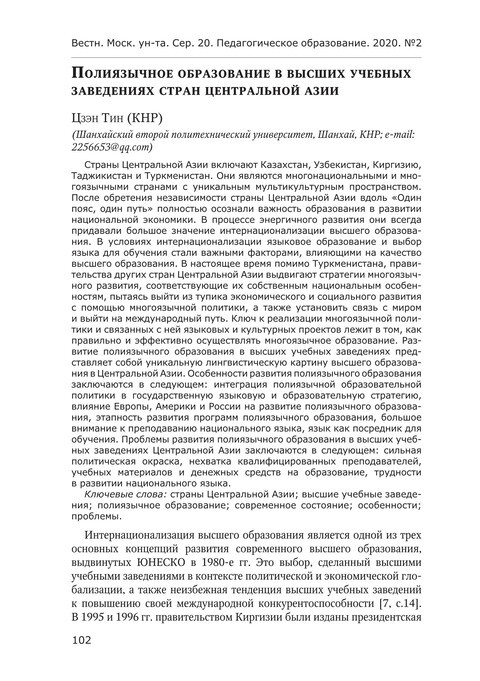 Multilingual Education in Central Asian Institutions of Higher Education (Journal of Moscow University. Series 20. Pedagogical Education; No.2, 2020) Año de publicación: 2020 Autor: Цзэн Тин In the context of internationalization, language education and the choice of language for teaching have become important factors affecting the quality of higher education. Currently, in addition to Turkmenistan, the Governments of other Central Asian countries are putting forward strategies for multilingual development that correspond to their own national characteristics. The problems of the development of multilingual education in higher educational institutions of Central Asia are as follows: strong political coloring, lack of qualified teachers, educational materials and funds for education, difficulties in the development of the national language. Полиязычное образование в высших учебных заведениях стран Центральной Азии (Вестник Московского университета. Серия 20. Педагогическое образование; No.2, 2020) Año de publicación: 2020 Autor: Цзэн Тин В условиях интернационализации языковое образование и выбор языка для обучения стали важными факторами, влияющими на качество высшего образования. В настоящее время помимо Туркменистана, правительства других стран Центральной Азии выдвигают стратегии многоязычного развития, соответствующие их собственным национальным особенностям. Проблемы развития полиязычного образования в высших учебных заведениях Центральной Азии заключаются в следующем: сильная политическая окраска, нехватка квалифицированных преподавателей, учебных материалов и денежных средств на образование, трудности в развитии национального языка.
 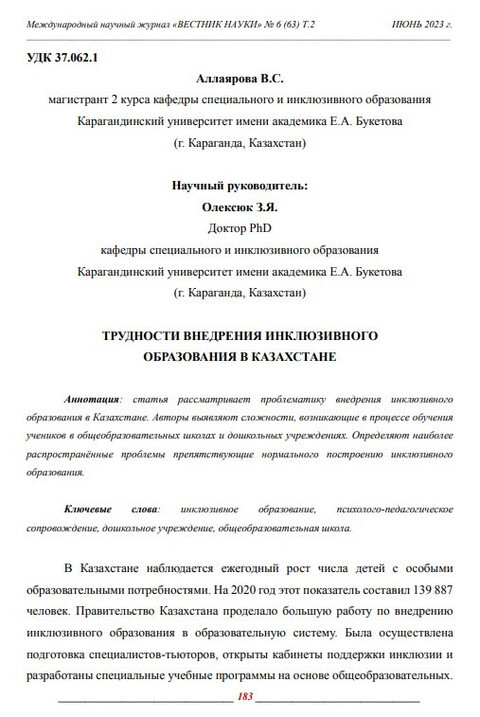 Difficulties of Implementing Inclusive Education in Kazakhstan (Bulletin of Science; Vol.2, No.6) Año de publicación: 2023 Autor: Аллаярова В.С. | Олексюк З.Я. The article examines the problems of the introduction of inclusive education in Kazakhstan. The authors identify the difficulties that arise in the process of teaching students in general education schools and preschool institutions. Identify the most common problems that hinder the normal construction of inclusive education.