
Recursos
Exploren una amplia gama de recursos valiosos en GCED para profundizar su comprensión y promover su búsqueda, incidencia, enseñanza y aprendizaje.
2,813 resultados encontrados
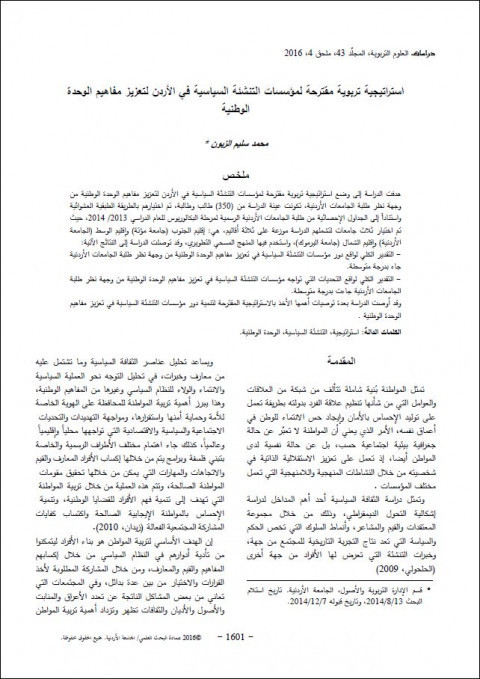 إستراتيجية تربوية مقترحة لمؤسسات التنشئة السياسية في الأردن لتعزيز مفاهيم الوحدة الوطنية Año de publicación: 2016 Autor corporativo: University of Jordan هدفت الدراسة إلى وضع استراتيجية تربوية مقترحة لمؤسسات التنشئة السياسية في الأردن لتعزيز مفاهيم الوحدة الوطنية من وجهة نظر طلبة الجامعات الأردنية. تكونت عينة الدراسة من (350) طالب وطالبة، تم اختيارهم بالطريقة الطبقية العشوائية من طلبة الجامعات الأردنية الرسمية لمرحلة البكالوريوس للعام الدراسي 2013 /2014 ...تم اختيار ثلاث جامعات لتشملهم الدراسة موزعة على ثلاثة أقاليم، هي: إقليم الجنوب (جامعة مؤتة) والوسط (الجامعة الأردنية) والشمال (جامعة اليرموك)، واستخدم فيها المنهج المسحي التطويري. وقد توصلت الدراسة إلى النتائج الآتية: - التقدير الكلي لواقع دور مؤسسات التنشئة السياسية في تعزيز مفاهيم الوحدة الوطنية من وجهة نظر طلبة الجامعات الأردنية جاء بدرجة متوسطة. - التقدير الكلي لواقع التحديات التي تواجه مؤسسات التنشئة السياسية في تعزيز مفاهيم الوحدة الوطنية من وجهة نظر طلبة الجامعات الأردنية جاءت بدرجة متوسطة. وقد أوصت الدراسة بعدة توصيات أهمها الأخذ بالاستراتيجية المقترحة لتنمية دور مؤسسات التنشئة السياسية في تعزيز مفاهيم الوحدة الوطنية . A Proposed Strategy for Educational Institutions of Political Socialization in Jordan to Promote National Unity Concepts Año de publicación: 2016 Autor corporativo: University of Jordan This study aimed to develop an educational proposed strategy for the institutions of political socialization in Jordan to promote national unity concepts from the perspective of Jordanian university students. The study sample consisted of 350 male and female students, were chosen in a stratified random students way from Jordanian public universities for undergraduate for the academic year 2013/2014...the three universities were selected for the study were spread over three regions: southern Region (Muta University), the central Region (The University of Jordan) and the North Region (Yarmouk University)... The study found the following results: -The overall appreciation of the reality of the role of political education institutions in the promotion of national unity concepts from the perspective of Jordanian university students came moderate. -The overall appreciation of the reality of the challenges facing political education institutions in the promotion of national unity concepts from the point of Jordanian university students was moderate...Of the most important recommendations: the introduction of the proposed strategy for developing the role of the political education institutions in the promotion of national unity concepts.
 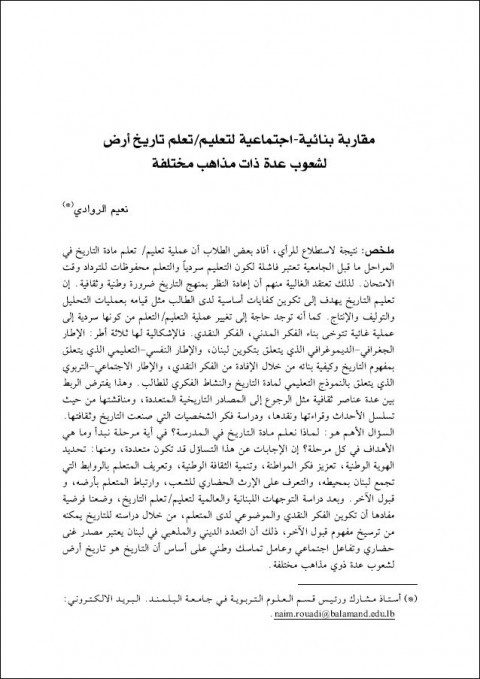 مقاربة بنائية-اجتماعية لتعليم/تعلم أرض لشعوب عدة ذات مذاهب مختلفة Año de publicación: 2012 Autor corporativo: University of Balamand نتيجة لاستطلاع للرأي، أفاد بعض الطلاب أن عملية تعليم/ تعلم مادة التاريخ في المراحل ما قبل الجامعية تعتبر فاشلة لكون التعليم سردياً والتعلم محفوظات للترداد وقت الامتحان. لذلك تعتقد الغالبية منهم أن إعادة النظر بمنهج التاريخ ضرورة وطنية وثقافية. إن تعليم التاريخ يهدف إلى تكوين كفايات أساسية لدى الطالب مثل قيامه بعمليات التحليل والتوليف والإنتاج. كما أنه توجد حاجة إلى تغيير عملية التعليم/التعلم من كونها سردية إلى عملية غائية تتوخى بناء الفكر المدني، الفكر النقدي. فالإشكالية لها ثلاثة أطر: الإطار الجغرافي-الديموغرافي الذي يتعلق بتكوين لبنان، والإطار النفسي-التعليمي الذي يتعلق بمفهوم التاريخ وكيفية بنائه من خلال الإفادة من الفكر النقدي، والإطار الاجتماعي-التربوي الذي يتعلق بالنموذج التعليمي لمادة التاريخ والنشاط الفكري للطالب. وهذا يفترض الربط بين عدة عناصر ثقافية مثل الرجوع إلى المصادر التاريخية المتعددة، ومناقشتها من حيث تسلسل الأحداث وقراءتها ونقدها، ودراسة فكر الشخصيات التي صنعت التاريخ وثقافتها. السؤال الأهم هو: لماذا نعلم مادة التاريخ في المدرسة؟ في أية مرحلة نبدأ وما هي الأهداف في كل مرحلة؟ إن الإجابات على هذا التساؤل قد تكون متعددة، ومنها: تحديد الهوية الوطنية، تعزيز فكر المواطنة، وتنمية الثقافة الوطنية، وتعريف المتعلم بالروابط التي تجمع لبنان بمحيطه، والتعرف على الإرث الحضاري للشعب، وارتباط المتعلم بأرضه، و قبول الآخر. وبعد دراسة التوجهات اللبنانية والعالمية لتعليم/تعلم التاريخ، وضعنا فرضية مفادها أن تكوين الفكر النقدي والموضوعي لدى المتعلم، من خلال دراسته للتاريخ يمكنه من ترسيخ مفهوم قبول الآخر، ذلك أن التعدد الديني والمذهبي في لبنان يعتبر مصدر غنى حضارياً وتفاعلاً اجتماعيا وعامل تماسك وطني على أساس أن التاريخ هو تاريخ أرض لشعوب عدة ذوي مذاهب مختلفة. Teaching/Learning the History of a Land with Diverse Socio-religious Groups: A Socio-constructivist Approach Año de publicación: 2012 Autor corporativo: University of Balamand A survey of the opinions of some students indicated that they viewed the teaching/learning of history they had undergone in pre-university levels of education as a wasted effort. The teaching consisted of narration, while the learning took the form of memorization of contents to be recited at the time of the examination. The majority considered a revision of the method of teaching history to be a national and cultural necessity. Given that the teaching of history has in view the acquisition by the student of basic skills, such as analysis, synthesis and composition, there is a need to change the teaching/learning process from narration to a targeted development of civic consciousness and critical thinking. The problem is posed within three frameworks: The geographic-demographic framework relating to the composition of the Lebanon; the psychological-educative framework relating to the understanding of history and how it is constructed. through the utilization of critical thinking; the social-educational framework relating to the educational paradigm to be used in the teaching of history and the intellectual activity of the student. This requires the intertwining of several educational elements such as the utilization of the various historical sources, discussing the sequence of events therein and reading them critically, while at the same time studying the thinking of the personalities who influenced the historical developments, and their cultural backgrounds. The main questions here is: Why do we teach history in schools? At which level do we start? What are the targets in each level? The answers to these questions can be many: Defining the national identity; strengthening civic thinking; developing a national culture; making the student aware of what ties the Lebanon to the surrounding region; acquainting ourselves with the cultural heritage of the people; strengthening the attachment with the land; teaching to learn to accept the other. Following an investigation of the Lebanese directives for the teaching of history, as well as the international ones, a hypothesis was proposed: the development of objective critical thinking through the study of history would consolidate the concept of the acceptance of the other. Indeed, the religious and sectarian pluralism of the Lebanon constitutes a source of cultural wealth. It is a factor of national cohesion. The history is a history of a land of many peoples with differing religious persuasions.
 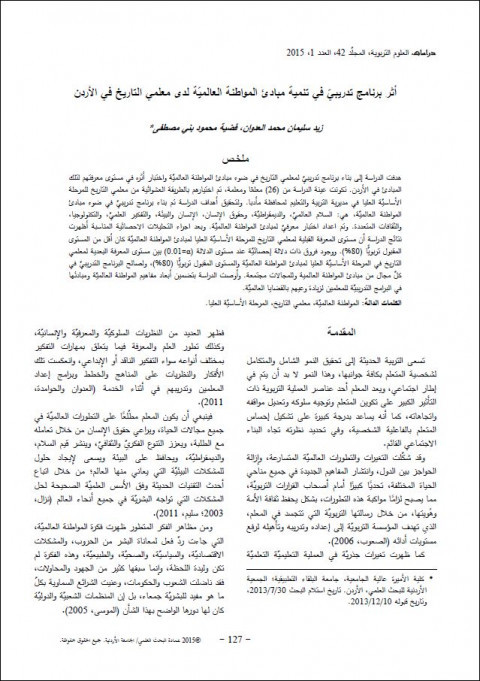 أثر برنامج تدريبي في تنمية مبادئ المواطنة العالمية لدى معلمي التاريخ في الأردن Año de publicación: 2015 Autor: Zaid Suleiman Autor corporativo: University of Jordan هدفت الدارسة إلى بناء برنامج تدريبيّ لمعلمي التاريخ في ضوء مبادئ المواطنة العالميّة واختبار أثره في مستوى معرفتهم لتلك المبادئ في الأردن. تكونت عينة الد ا رسة من ( 26 ) معلمًا ومعلمة، تم اختيارهم بالطريقة العشوائية من معلمي التاريخ في المرحلة الأساسيّة العليا في مديرية التربية والتعليم لمحافظة مأدبا. ولتحقيق أهداف الدارسة تم بناء برنامج تدريبيّ في ضوء مبادئ المواطنة العالميّة، هي: السلام العالميّ، والديمقراطيّة، وحقوق الإنسان، الإنسان والبيئة، التفكير العلميّ، التكنولوجيا، الثقافات المتعددة. وتم اعداد اختبار معرفيّ لمبادئ المواطنة العالميّة. وبعد اجراء التحليلات الاحصائية المناسبة أظهرت نتائج الدرارسة أن مستوى المعرفة القبْلية عند معلمي التاريخ في المرحلة الأساسيّة العليا لمبادئ المواطنة العالميّة كان أقل من المستوى المقبول تربويًّا ( % 80)، ووجود فروق ذات دلالة إحصائيّة عند مستوى الدلالة ( α= 0.01 ) بين مستوى المعرفة البَعدية عند معلمي التاريخ في المرحلة الأساسيّة العليا لمبادئ المواطنة العالميّة والمستوى المقبول تربويًّا (80 %)، ولصالح البرنامج التدريبيّ في كلّ مجال من مبادئ المواطنة العالمية وللمجالات مجتمعة. وأوصت الدراسة بتضمين أبعاد مفاهيم المواطنة العالميّة ومبادئها في البرامج التدريبيّة للمعلمين لزيادة وعيهم بالقضايا العالميّة. The Effect of a Training Program on Developing the Global Citizenship Principles of the History Teachers in Jordan Año de publicación: 2015 Autor: Zaid Suleiman Autor corporativo: University of Jordan This study aimed at building a training program for the history teachers in the light of the global citizenship principles and at testing its effect on their knowledge level of those principles, in Jordan. Study sample consisted of (26) male and female teachers randomly selected from the history teachers for the higher of Basic Education, in the education Directorate of the Ma'daba Governorate.To achieve the study goals, a training program was developed in the light of the global citizenship principles, which are: global peace, democracy, human rights, humans and the environment, scientific thinking, technology, and multicultures. and a cognitive test of the global citizenship's principles was prepared. After performing the relevant statistical analysis, the results revealed that the pre-knowledge level of the history among those teachers of the global citizenship principles was lower than the educationally accepted level (80%), and the presence of differences with statistical significance (α=0.01) between the post-knowledge level among the history teachers at the higher stage of basic education about the global citizenship principles and the educationalyl accepted level (80%), in favor of the training program in each domain of the global citizenship's principles and the domains collectively. The study recommended the inclusion of the global citizenship principles and concepts in the teachers training programs in order to increase their awareness in the global issues.
 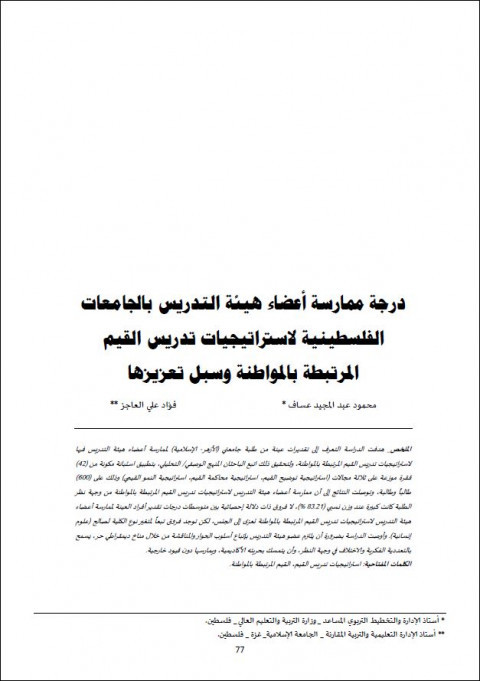 درجة ممارسة أعضاء هيئة التدريس بالجامعات الفلسطينية لاستراتيجيات تدريس القيم المرتبطة بالمواطنة وسبل تعزيزها Año de publicación: 2017 Autor: Fuad Ali Autor corporativo: Islamic University of Gaza هدفت الدراسة إلى التعرف إلى تقديرات عينة من طلبة جامعتي الأزهر والإسلامية في غزة) لممارسة أعضاء هيئة التدريس فيها استراتيجيات تدريس القيم المرتبطة بالمواطنة. ولتحقيق ذلك اتبع الباحثان المنهج الوصفي -التحليلي بتطبيق استبانة مكونة من 42 فقرة موزعة على ثلاثة مجالات (استراتيجية توضيح الفهم، استراتيجية محاكمة القيم، استراتيجية النمو القيمي) وذلك على 600 طالب وطالبة. توصلت النتائج إلى أن ممارسة أعضاء هيئة التدريس لاستراتيجيات تدريس القيم المرتبطة بالمواطنة من وجهة نظر الطلبة كانت كبيرة عند وزن نسبي هو 83,21 %، لا فروق ذات دلالة إحصائية (بين متوسط درجات تقدير أفراد العينة لممارسة أعضاء هيئة التدريس لاستراتيجيات تدريس القيم المرتبطة بالمواطنة) تعزى إلى الجنس، لكن توجد فروق تبعا لمتغير نوع الكلية لصالح العلوم الإنسانية. وأوصت الدراسة بضرورة أن يلتزم عضو هيئة التدريس باتباع أسلوب الحوار والمناقشة من خلال مناخ ديمقراطي حر، يسمح بالتعددية الفكرية والاختلاف في وجهات النظر، وأن بتمسك بحريته الأكاديمية، ويمارسها دون قيود خارجية. The Degree of Practice the Faculty Members in Palestinian Universities for Strategies of Teaching Values Related to Citizenship and Ways to Enhance It Año de publicación: 2017 Autor: Fuad Ali Autor corporativo: Islamic University of Gaza The study aimed to identify the estimates of a sample of the students of the two universities (Al-Azhar - Islamic) to practice the members of the teaching staff to the strategies of teaching the values associated with citizenship, and to achieve this followed the researcher’s descriptive / analytical approach. A questionnaire consisting of (42) items were distributed in three areas (the strategy of clarifying the values, the strategy for the trial of values, the strategy of value growth), on (600) students. The results showed that the practice of the teaching staff to the strategies of teaching values related to citizenship from the students'' perspective was significant at a relative weight (83.21%). There were no statistically significant differences between the average scores of the sample members for practicing the teaching strategies of the values related to citizenship attributed to sex, but there are differences depending on the variable type of college in favor of (human sciences). The study recommended that the member of the faculty should adhere to the method of dialogue and discussion through a free democratic environment, which allows for intellectual pluralism and differences of opinion, and that he upholds his academic freedom and practices it without external restrictions.
  درجة ممارسة عضو هيئة التدريس قيم المواطنة من وجهة نظر طلبة جامعة طيبة فرع العلا Año de publicación: 2014 Autor: أحمد حسن Autor corporativo: Taibah University هدفت الدراسة إلى التعرف على درجة ممارسة عضو هيئة التدريس في جامعة طيبة، فرع العلا، لقيم المواطنة من وجهة نظر الطلبة، والوقوف على الفروق الإحصائية بين استجابات أفراد عينة الدراسة باختلاف متغيراتهم (الجنس، التخصص). وقد استخدم الباحث المنهج الوصفي التحليلي وتم توزيع استبانة مكونة من 40 فقرة، موزعة على أربعة مجالات رئيسة، على عينة تألفت من 641. وأظهرت نتائج الدراسة أن درجة ممارسة عضو هيئة التدريس لقيم المواطنة جاءت بدرجة متوسطة وبمتوسط حسابي مقداره 3.13 وانحراف معياري 0.47، كما جاءت قيم الولاء والانتماء بالرتبة الأولى، ثم قيم الشورى والمشاركة، فقيم العمل المهني والإنتاج، وأخيرا وبالرتبة الرابعة، جاءت قيم المساواة والعدل. وأظهرت النتائج أيضاً عدم وجود فروق ذات دلالة إحصائية (في درجة ممارسة عضو هيئة التدريس لقيم المواطنة) تعزى لمتغير الجنس، ووجود فروق ذات دلالة إحصائية تعزى لمتغير التخصص ولصالح الكليات الإنسانية. The Degree of a Faculty Member for the Values of Citizenship from the Perspective of Students Año de publicación: 2014 Autor: أحمد حسن Autor corporativo: Taibah University The study aimed to identify the degree to which a faculty member at the University of AL - Oula branch practices the values of citizenship - as seen from the perspective of students.It also aims to identify the statistical differences between the responses from the study sample according to variables (sex, specialization). The researcher used the descriptive analytical method and a questionnaire consisting of 40 items in four key areas distributed to a sample of 641 persons. The results showed that the degree of a faculty member for the values of citizenship were moderate with a mean of 3.13 and standard deviation of 0.47. The values of loyalty and belonging came first, followed by the values of consultation and participation, values of professional work and production, and finally by the values of equality and justice. The results also showed: a lack of statistically significant differences in the exercise by a faculty member of the values of citizenship due to the sex variable, and the presence of statistically significant differences attributed to the variable of specialization in favor of humanities faculties.