
Recursos
Exploren una amplia gama de recursos valiosos en GCED para profundizar su comprensión y promover su búsqueda, incidencia, enseñanza y aprendizaje.
2,813 resultados encontrados
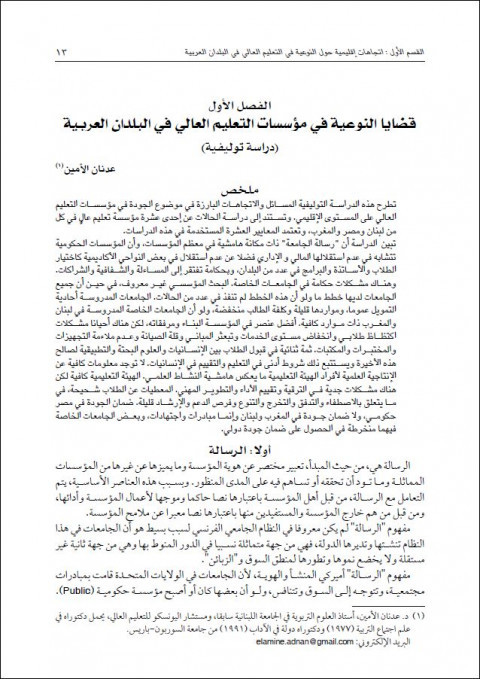 اتجاهات إقليمية حول النوعية في التعليم العالي في البلدان العربية: قضايا النوعية في مؤسسات التعليم العالي في البلدان العربية Año de publicación: 2014 Autor: الأمين،عدنان Autor corporativo: Lebanese Association for Educational Studies (LAES) تطرح هذه الدراسة التوليفية المسائل والاتجاهات البارزة في موضوع الجودة في مؤسسات التعليم العالي على المستوى الإقليمي. وتستند إلى دراسة الحالات عن إحدى عشرة مؤسسة تعليم عالٍ في كل من لبنان ومصر والمغرب، وتعتمد المعايير العشرة المستخدمة في هذه الدراسات. تبين الدراسة أن "رسالة الجامعة" ذات مكانة هامشية في معظم المؤسسات، وأن المؤسسات الحكومية تتشابه في عدم استقلالها المالي والإداري فضلا عن عدم استقلال في بعض النواحي الأكاديمية كاختيار الطلاب والأساتذة والبرامج في عدد من البلدان، وبحكامة تفتقر إلى المساءلة والشفافية والشراكات. وهناك مشكلات حكامة في الجامعات الخاصة. البحث المؤسسي غير معروف، في حين أن جميع الجامعات لديها خطط ما ولو أن هذه الخطط لم تنفذ في عدد من الحالات. الجامعات المدروسة أحادية التمويل عموما، ومواردها قليلة وكلفة الطالب منخفضة، ولو أن الجامعات الخاصة المدروسة في لبنان والمغرب ذات موارد كافية. أفضل عنصر في المؤسسة البناء ومرفقاته، لكن هناك أحيانا مشكلات اكتظاظ طلابي وانخفاض مستوى الخدمات وتبعثر المباني وقلة الصيانة وعدم ملاءمة التجهيزات والمختبرات والمكتبات. ثمة ثنائية في قبول الطلاب بين الإنسانيات والعلوم البحتة والتطبيقية لصالح هذه الأخيرة ويستتبع ذلك شروط أدنى في التعليم والتقييم في الإنسانيات. لا توجد معلومات كافية عن الإنتاجية العلمية لأفراد الهيئة التعليمية ما يعكس هامشية النشاط العلمي. الهيئة التعليمية كافية لكن هناك مشكلات جدية في الترقية وتقييم الأداء والتطوير المهني. المعطيات عن الطلاب شحيحة، في ما يتعلق بالاصطفاء والتدفق والتخرج والتنوع وفرص الدعم والإرشاد قليلة. ضمان الجودة في مصر حكومي، ولا ضمان جودة في المغرب ولبنان وإنما مبادرات واجتهادات، وبعض الجامعات الخاصة فيهما منخرطة في الحصول على ضمان جودة دولي. Quality Issues in Higher Education Institutions in Arab Countries: Synthesis Study Año de publicación: 2014 Autor: الأمين،عدنان Autor corporativo: Lebanese Association for Educational Studies (LAES) This synthesis study addresses outstanding issues and trends concerning quality in higher education institutions at the regional level. It is based on case studies from eleven higher education institutions in Lebanon, Egypt and Morocco and on the ten standards used in these studies.The study shows that "the mission of the university" has a marginal position in most institutions; that government institutions are similar in their lack of financial and administrative independence; that there is a lack of independence in some academic respects such as the selection of students, faculty and programs in a number of countries; and that governance is lacking accountability, transparency and partnerships. Indeed, there are governance problems in private universities. Institutional research is not evidently known while all universities have some relevant plans even though these plans have not been implemented in a number of cases.The universities that are under study are generally unilaterally funded, their resources are scarce and the cost per student is low, however; private universities that were subject to this study in Lebanon and Morocco have sufficient resources. The most satisfactory element of the institution is the buildings and annexes thereto.However, at times, there are problems in terms of student overpopulation, poor level of services, scattered buildings, lack of maintenance and inadequate equipment, laboratories and libraries. There is a duality in student admission between Humanities and the Physical and Applied Sciences disciplines in favor of the latter which causes lower conditions in the education and assessment of the Humanities discipline.There is not enough information about the scientific productivity of faculty members, which reflects the marginality of scientific activity. The number of faculty staff is sufficient but there are serious problems regarding their promotion, performance assessment and professional development. Data on students are scarce in terms of students’ selection, influx, graduation and diversity; and support and guidance opportunities remain scarce.Quality assurance in Egypt is a governmental responsibility and there is no such thing in Morocco and Lebanon instead there are some initiatives and attempts. Some private universities in Morocco and Lebanon are engaged in obtaining quality assurance from international bodies.
  The State of Global Education in Europe 2018 Año de publicación: 2018 Autor corporativo: Global Education Network Europe (GENE) The State of Global Education in Europe reports on policy, strategy and funding for Global Education in European countries, based primarily on information submitted by the ministries, agencies and national coordinating bodies that participate in GENE (Global Education Network Europe). This third edition of the report identifies thematic trends and crosscutting issues and explores funding levels for Global Education across Europe. It also includes a chapter outlining some of the work done on evaluation across GENE, and concludes with a selection of highlights from the network. There are examples of national policy and practice throughout the report. This report on the State of Global Education in Europe has been developed to provide an overview of current key issues, policy priorities, funding trends and activities in Global Education in Europe. It draws on the expertise and information provided by organisations that participate in Global Education Network Europe – GENE. These comprise Ministries of Foreign Affairs, Ministries of Education, and their respective national agencies, and other bodies with responsibility for policymaking, support or coordination of Global Education in European countries.
  Botswana National Implementation Plan for Sustainable Development Goal (SDG) 4 - Education 2030 Año de publicación: 2018 Autor corporativo: Botswana National Commission for UNESCO The Sustainable Development Goal (SDG) 4 is an ambitious and specific goal to drive the education development agenda from 2016 – 2030 and a means through which all the seventeen (17) SDGs will be achieved. The SDGs aim among others, to end poverty, hunger and inequality, take action on climate change and the environment, improve access to health and education, and build strong institutions and partnerships.To ensure adequate attention to the different thematic areas of education, SDG 4 has been broken down into seven targets and three means of implementation. The targets and the means of implementation are crafted in such a way that all the critical areas of education, both emerging and the unfinished Education for All (EFA) business could be addressed in some way through the global education agenda.This publication presents Botswana’s National Strategy for the Implementation of SDG 4 – Education 2030, which was developed with guidance from the Incheon Declaration on Education 2030. The Incheon Declaration on Education 2030 is a guide to Member States on the implementation of SDG 4. It provides an outline on how to translate the agenda into national priorities and further proposes some strategies and thematic indicators for measuring success on the different SDG 4 targets.
  Education à la citoyenneté en RDCONGO : Quelles strategies et pour quelle éducation à la démocratie en R.D.C? Año de publicación: 2008 Autor: Abbé Louis Mpala Cette brochure se veut une introduction générale à toutes les brochures qui seront consacrées à chaque type d'éducation proposé. Ce projet ne peut être réalisé que si Dieu le permet et si je trouve un mécène.Cet écrit peut servir d'un instrument de travail à toute personne soucieuse de voir notre pays avoir des fils dont le cour est circoncis. Comme tout travail humain, ma brochure a des limites. A vous de la parfaire. Destiné à être exposé aux journées scientifiques organisées par l'Institut Supérieur Pédagogique de Lubumbashi (I.S.P.), ce texte est mis à la disposition de tout éducateur. Cet écrit a mes empreintes d'agrégé de l'Enseignement Secondaire Degré Supérieur (E.S.D.S.)pour le cours de philosophie. Voilà qui justifie mon souci de voir les objectifs éducationnels opérationnels.A vous lectrice et lecteur engagés dans un groupe d'encadrement familial, politique ,scolaire, socio-culturel etc., je confie ma brochure.
  지속가능발전목표 4 Año de publicación: 2018 Autor corporativo: 유네스코한국위원회 이 소책자는 2018년 10-12월 동안 유네스코한국위원회에서 연재한 SDG 4 카드뉴스 시리즈를 바탕으로 제작된 것으로 지속가능발전목표 4(SDG 4)에 대해 쉽게 설명하고 각 목표 달성을 위한 한국교육의 과제와 역할에 대해 다루고 있다. 모두가 함께 달성해가는 SDG 4 SDG 4 달성을 위해 대한민국이 하는 일 한국 교육과 SDG 4.1: 양질의 초등교육과 중등교육 보장 한국 교육과 SDG 4.2: 영유아 발달 교육 및 취학 전 교육 한국 교육과 SDG 4.3: 양질의 고등교육 제공 한국 교육과 SDG 4.4: 전문기술 및 직업기술을 지닌 청년과 성인의 수 향상 한국 교육과 SDG 4.5: 교육 형평성 한국 교육과 SDG 4.6: 문해력과 수리력 성취 한국 교육과 SDG 4.7: 지속가능발전과 세계시민의식 SDG 4 달성을 위한 정보통신기술(ICT)의 역할 SDG 4 달성을 위한 교육지표 개발과 모니터링
  Inspiring Citizenship: Ontario's Careers/Civics Curriculum Año de publicación: 2009 Autor corporativo: Ontario Student Trustees' Association This publication is the culmination of over a year's work in research and collaboration on the part of student leaders from across Ontario. It seeks to celebrate the past years that the civics and careers curriculum has in the province while also challenging the system to do more.As the only province in Canada that has a recognized curriculum devoted to civic education system for responding to the need to nurture active, engaged citizens to tomorrow today. However, while implementation is one matter, delivery is another - and the two must go hand-in-hand. Stimuler la citoyenneté: Le curriculum de l'Ontario, le cours de Carrières/Citoyenneté Año de publicación: 2009 Autor corporativo: Ontario Student Trustees' Association Cette publication est l'aboutissement de plus d'un an de travail de recherche et de collaboration de la part d'élèves leaders à travers l'Ontario. Elle cherche à célébrer les années précédentes au cours desquelles le curriculum de carrières et citoyenneté a existé dans la province, tout en stimulant le système d'aller un peu plus loin.
 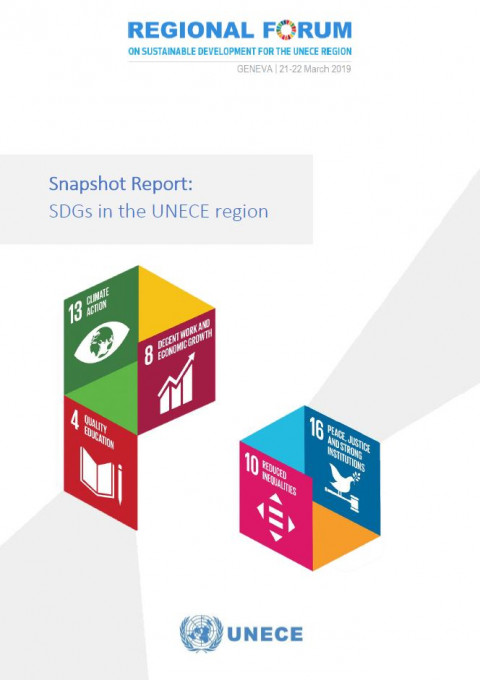 Snapshot Report: SDGs in the UNECE Region Año de publicación: 2019 Autor corporativo: United Nations Economic Commission for Europe (UNECE) This document provides a brief snapshot of some aspects of SDG performance in the UNECE region. It covers the SDGs that will be discussed at the 2019 Regional Forum on Sustainable Development for the UNECE region but it does not attempt to provide an exhaustive assessment. It only uses the available information in the UN SDG Global Database and the sources referenced there to illustrate a selected number of SDG issues. In a very few cases, when no data is available from this database and associated sources, information from other international organizations is used to provide some context to the discussions.
  Global Education Digest 2015-2017: Compiled by the Development Education Research Centre Año de publicación: 2018 Autor corporativo: Development Education Research Centre (DERC) This is the first edition the Global Education Digest, a bibliography of recent published academic and research material relevant to the field of global education. This Digest has been compiled by Development Education Research Centre (DERC) on behalf of Global Education Network Europe (GENE) in the framework of ANGEL activities. ANGEL (Academic Network on Global Education & Learning) is the academic network of global education researchers and academics. The Digest is divided into eight themes/ areas of work, and within each we have identified policy reports, books, academic articles and doctoral research related to global education. Items for inclusion were found through keyword searches of Scopus, Web of Science, Google Scholar, and British Library (including ETHOS and Proquest) databases, as well as through informal discussions with colleagues in the field. The core focus of the Digest is on literature on global education. Selected literature with a focus on related concepts, such as global citizenship, environmental education, and education for sustainable development, has also been included where these have clear links to concerns in global education.