
Recursos
Exploren una amplia gama de recursos valiosos en GCED para profundizar su comprensión y promover su búsqueda, incidencia, enseñanza y aprendizaje.
1,951 resultados encontrados
 2022년 평생교육통계 자료집 Año de publicación: 2022 Autor corporativo: 대한민국 교육부 | 한국교육개발원 「2022 평생교육통계 자료집」은 17개 시도, 4,869개의 평생교육기관을 조사하여 우리나라의 평생교육시설을 진단할 수 있는 기초자료를 종합하였습니다.본 저작물은 교육부에서 2022년 작성하여 공공누리 제3유형으로 개방한 '2022년 평생교육통계 자료집'을 이용하였으며, 해당 저작물은 교육부 누리집(https://www.moe.go.kr/)과 교육통계 서비스 누리집(https://kess.kedi.re.kr/index) 에서 무료로 내려받으실 수 있습니다.
  2022 한국 성인의 평생학습실태 Año de publicación: 2022 Autor: 최성부 | 이혜진 | 배효진 | 김별라 | 임소현 | 강성국 | 정동철 | 박미현 | 김경남 | 김나정 | 안윤정 | 라다애 | 장훈민 | 박초아 Autor corporativo: 대한민국 교육부 | 한국교육개발원 「2022년 한국 성인의 평생학습 실태」자료집은 평생학습개인실태조사 결과를 평생학습 전문가 뿐 아니라 일반독자들이 이해할수 있도록 지표 중심으로 구성한 자료집입니다. 본 자료집은 정책 담당자뿐만 아니라 연구자 및 일반 독자들이 쉽게 이해할 수 있도록 만25~79세 우리나라 성인의 전 생애단계별 평생학습 참여 실태를 지표 중심으로 구성하였습니다.본 저작물은 교육부에서 2022년 작성하여 공공누리 제3유형으로 개방한 '2022 한국 성인의 평생학습실태'를 이용하였으며, 해당 저작물은 교육부 누리집(https://www.moe.go.kr/)과 교육통계 서비스 누리집(https://kess.kedi.re.kr/index) 에서 무료로 내려받으실 수 있습니다.
 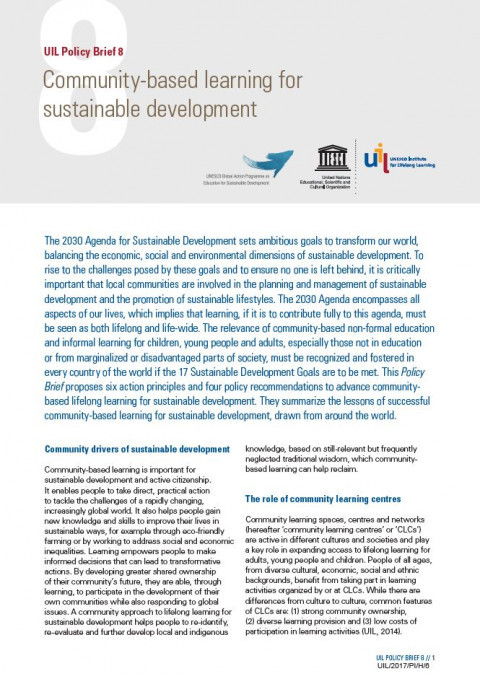 Community-based Learning for Sustainable Development (UIL policy brief 8) Año de publicación: 2017 Autor corporativo: UNESCO Institute for Lifelong Learning (UIL) The 2030 Agenda for Sustainable Development sets ambitious goals to transform our world, balancing the economic, social and environmental dimensions of sustainable development. To rise to the challenges posed by these goals and to ensure no one is left behind, it is critically important that local communities are involved in the planning and management of sustainable development and the promotion of sustainable lifestyles. The 2030 Agenda encompasses all aspects of our lives, which implies that learning, if it is to contribute fully to this agenda, must be seen as both lifelong and life-wide. The relevance of community-based non-formal education and informal learning for children, young people and adults, especially those not in education or from marginalized or disadvantaged parts of society, must be recognized and fostered in every country of the world if the 17 Sustainable Development Goals are to be met. This Policy Brief proposes six action principles and four policy recommendations to advance community-based lifelong learning for sustainable development. They summarize the lessons of successful community-based learning for sustainable development, drawn from around the world. L’apprentissage communautaire pour le développement durable (Note d’orientation n° 8 de l’UIL) Año de publicación: 2017 Autor corporativo: UNESCO Institute for Lifelong Learning (UIL) Le Programme de développement durable à l’horizon 2030 définit des objectifs universels ambitieux pour transformer notre monde, qui visent à équilibrer les dimensions économiques, sociales et environnementales du développement durable. Pour relever les défis que posent ces objectifs et veiller à ce que personne ne soit laissé pour compte, il est crucial d’impliquer les communautés locales dans la planification et la gestion du développement durable ainsi que dans la promotion de modes de vie durables. Afin que l’apprentissage réalise son potentiel et contribue pleinement à un Programme qui englobe tous les aspects de notre vie, il doit être considéré comme un processus tout au long de la vie et dans tous les aspects de la vie. Si nous voulons atteindre les 17 objectifs pour le développement durable, il nous faut reconnaître la pertinence de l’éducation communautaire non formelle et de l’apprentissage informel pour les enfants, les jeunes et les adultes, en particulier ceux qui ne sont pas scolarisés ou qui sont issus des secteurs marginalisés ou défavorisés de la société, et encourager cette éducation et cet apprentissage dans tous les pays du monde.La présente note d’orientation propose six principes d’action et formule quatre recommandations politiques pour faire progresser l’apprentissage communautaire tout au long de la vie en vue du développement durable. Ces principes et recommandations tirent les leçons du succès de l’apprentissage communautaire pour le développement durable à partir d’études de cas recueillies dans le monde entier. El aprendizaje basado en la comunidad para el desarrollo sostenible (Notas sobre Política del UIL Nº 8) Año de publicación: 2017 Autor corporativo: UNESCO Institute for Lifelong Learning (UIL) La Agenda 2030 para el Desarrollo Sostenible 2030 establece metas ambiciosas y universales para transformar el mundo, que mantienen el equilibrio entre las dimensiones económica, social y ambiental del desarrollo sostenible. Para superar los desafíos que suponen esas metas y asegurarse de que no se excluye a nadie, es primordial que las comunidades locales participen en la planificación y gestión del desarrollo sostenible y en la promoción de estilos de vida sostenibles. La Agenda 2030 comprende todos los aspectos de la vida, lo que supone que para sacar el máximo provecho de las posibilidades que brinda el aprendizaje y que contribuya plenamente a la Agenda, debe entenderse como un proceso permanente a lo largo de toda la vida. Para que se cumplan los 17 Objetivos de Desarrollo Sostenible, debe reconocerse y fomentarse en todos los países del mundo la importancia de la educación no formal basada en la comunidad y del aprendizaje informal para los niños, los jóvenes y los adultos, especialmente de los que no participan en la educación o forman parte de colectivos marginados o vulnerables de la sociedad. En las presentes Notas sobre política se proponen seis principios de actuación y se formulan cuatro recomendaciones para la adopción de políticas, con el propósito de impulsar el aprendizaje basado en la comunidad para el desarrollo sostenible. Se resumen asimismo las lecciones extraídas en todo el mundo a partir de experiencias fructíferas de ese tipo de aprendizaje. Обучение местных сообществ для устойчивого развития (Бюллетень UIL №8) Año de publicación: 2017 Autor corporativo: UNESCO Institute for Lifelong Learning (UIL) Повестка Устойчивого Развития 2030 ставит перед собой амбициозные цели по преобразованию нашего мира, уравновешивая экономические, социальные и экологические аспекты устойчивого развития. Для решения проблем, проистекающих из этих целей, а также для обеспечения того, чтобы не было отстающих, крайне важно, чтобы местные сообщества участвовали в планировании и управлении устойчивым развитием и поощрении устойчивого образа жизни.Повестка 2030 охватывает все аспекты нашей жизни, подразумевая, что обучение, если оно должно вносить свой вклад в эту повестку, должно рассматриваться и как обучение на протяжении всей жизни, и как обучение на всю жизнь. Актуальность неформального образования на уровне сообществ и неформального обучения для детей, молодежи и взрослых, особенно тех, которые не имеют отношения к образованию, или являются представителями уязвимых слоев общества, или находятся в неблагоприятном положении, должна быть признана и поощряться во всех странах мира, если будут достигнуты 17 целей стойчивого развития.В этой сводке предлагается шесть принципов действий и четыре рекомендации по политике, направленные на то, чтобы продвинуть обучение на протяжении всей жизни для устойчивого развития. Они обобщают уроки успешного обучения на уровне местных сообществ для устойчивого развития во всем мире.
  Recommendation on Adult Learning and Education, 2015 Año de publicación: 2016 Autor corporativo: UNESCO | UNESCO Institute for Lifelong Learning (UIL) The Recommendation on Adult Learning and Education was adopted at the 38th Session of the UNESCO General Conference in November 2015. The Recommendation supports the Education 2030 Framework for Action, reflects global trends, and will guide the transformation and expansion of equitable learning opportunities for youth and adults. The 2015 Recommendation takes a comprehensive and systematic approach to ALE, defining three key domains of learning and skills: literacy and basic skills; continuing education and vocational skills; as well as liberal, popular and community education and citizenship skills.It also describes five transversal areas of action: policy; governance; financing; participation, inclusion and equity; and quality. These areas of action were already introduced to the international community in the Belém Framework for Action, adopted at CONFINTEA in 2009 as a means of guiding Member States in improving ALE. This integrative and consistent approach to ALE will help Member States to ensure inclusive and equitable quality education and promote lifelong learning opportunities for all (Sustainable Development Goal 4).
  Trends in Adult Learning and Education in the Arab States: Findings from the Fourth Global Report on Adult Learning and Education Año de publicación: 2020 Autor corporativo: UNESCO Institute for Lifelong Learning (UIL) This report reveals that adult learning and education in the region is strongly focused on literacy, with less attention given to other areas of adult learning, such as continuing education and professional development, and citizenship education. This suggests that, while further progress is needed in achieving basic education for all, the other dimensions of adult learning need to be given adequate attention to ensure provision that is comprehensive and relevant to the diverse needs of adult and youth learners. Furthermore, the report suggests that good governance, supportive political will and adequate funding are key to fully realizing the potential of adult learning and education for economic, social, technological, and societal transformation. It is hoped that this report can provide some benchmarks and be a source of inspiration for policy-makers and stakeholders in Arab countries to further enhance the provision, quality and relevance of adult learning and education in order to build a sustainable and resilient future. الكبار وتعليمهم يف الدول العربية : اتجاهات يف تعل َصة من التقرير العاملي نتائج مستخل الرابع بشأن تعلم الكبار وتعليمهم Año de publicación: 2020 Autor corporativo: UNESCO Institute for Lifelong Learning (UIL) يكشف التقرير أن تركيز دول المنطقة ّ العربية ينصب ّ في المقام األو ّ ل على مجال »القرائية/محو األمية والمهارات األساسية« ، في حين تحظى مجاالت أخرى ذات صلة، مثل »التعليم المستمر والتطوير المهني«، و« تعليم المواطنة«، بدرجة أقل من االهتمام. لذلك، ومع وجود حاجة إلى إحراز ّق بتوفير التعليم األساسي للجميع ّ مزيد من التقدم فيما يتعل ّصلة ، يظلّ من الضروري إيالء اهتمام أكبر لألبعاد األخرى المت ّم الكبار وتعليمهم، بما يضمن توفير التعليم على نحو شامل بتعل ّمين من الكبار والشباب. ّ ومالئم لالحتياجات المتنوعة للمتعل ّ عالوة على ذلك، يشير التقرير إلى أن الحوكمة الرشيدة واإلرادة ّ السياسية الداعمة والتمويل الكافي تشكل عوامل أساسية لضمان ّم الكبار وتعليمهم االستفادة الكاملة من اإلمكانات التي يتيحها تعل ّ لتعزيز التحول االقتصادي واالجتماعي والتكنولوجي والمجتمعي المنشود. وأخيرا، أملنا أن يوفّر هذا التقرير بعض النقاط المرجعية وأن ّ يشكل مصدر إلهام لصانعي السياسات ولجميع الجهات المعنية ّم الكبار وتعليمهم من حيث توفير البرامج وضمان الجودة وتحقيق ّ في البلدان العربية، من أجل المضي قدما في تعزيز تعل ُه االستدامة ُ ِ سهم في بناء مستقبل أفضل سمت ّ الجدوى، مما ي والقدرة على الصمود
  Why RAMAA Is Important for Literacy: Testimonies From Participating Countries; Action Research on Measuring Literacy Programme Participants’ Learning Outcomes (RAMAA) Año de publicación: 2016 Autor corporativo: UNESCO Institute for Lifelong Learning (UIL) The RAMAA action research, launched at the initiative of the UNESCO Institute for Lifelong Learning (UIL), and piloted in partnership with local UNESCO offices, responds to this vital need to assess the quality of literacy programmes by taking the learning effectively acquired by the beneficiaries at the end of their training as an objective variable.The first phase of RAMAA involved five countries, now twelve countries are participating in the second phase of RAMAA – Benin, Burkina Faso, Cameroon, Côte d'Ivoire, Central African Republic, Democratic Republic of Congo, Morocco, Mali, Niger, Senegal, Chad and Togo. The countries’ commitment throughout the implementation of the second phase of RAMAA and the integration of the results into the national systems are key to the project.