
Recursos
Exploren una amplia gama de recursos valiosos en GCED para profundizar su comprensión y promover su búsqueda, incidencia, enseñanza y aprendizaje.
1,951 resultados encontrados
 Literacy and the Promotion of Citizenship: discourses and effective practices Año de publicación: 2008 Autor corporativo: UNESCO Institute for Lifelong Learning (UIL) The UNESCO Institute for Lifelong Learning and its partners, the Agence Nationale de Lutte Contre L’Illettrisme (ANLCI) and the UNESCO French National Commission, organized a Regional Meeting on “Literacy and the Promotion of Citizenship: The Challenge of Learning” from 2-5 April 2005 in Lyon, France. Participants from 38 countries of what UNESCO considers to be the European Region (i.e. Europe, Canada, Israel and the United States of America) reviewed pertinent policies and shared good practices.By focusing on the theme of citizenship, the meeting sought to establish a link between literacy and the empowerment of citizens. This publication brings together the main presentations from that meeting, and as such documents the diversity of literacy-related thinking and practice in the region.
  Embracing a Culture of Lifelong Learning: Contribution to the Futures of Education Initiative Año de publicación: 2020 Autor corporativo: UNESCO Institute for Lifelong Learning (UIL) This report, a contribution to UNESCO's Futures of Education initiative, reflects on the potential contribution of lifelong learning both in transforming the field of education and in creating a more sustainable, healthy and inclusive future. Drawing on the insights of 12 distinguished experts from different disciplines and countries, the report presents a compelling vision for lifelong learning and the values and principles that must underpin it. It calls on the international community to acknowledge the social and private dimensions of education, and to recognize lifelong learning as a new human right. Realizing this vision, it argues, requires adopting a transdisciplinary approach that can effectively grasp the complex, multidimensional nature of the challenges faced by humanity. The report outlines the main features of the ‘enabling environment’ needed to make lifelong learning the governing principle of education policy and to offer people opportunities to learn throughout life, whatever their background or context. It concludes with a set of key messages, complemented by specific action points and a discussion of selected policy measures.
  Addressing Global Citizenship Education in Adult Learning and Education; Summary Report Año de publicación: 2019 Autor: Christiana Nikolitsa-Winter | Werner Mauch | Philippe Maalouf Autor corporativo: UNESCO Institute for Lifelong Learning (UIL) | APCEIU The Asia-Pacific Centre of Education for International Understanding (APCEIU) has published the summary report on Addressing Global Citizenship Education in Adult Learning and Education (ALE) in partnership with UNESCO Institute for Lifelong Learning (UIL). In regard to GCED in ALE the publication looks at the developments, gaps and challenges in Finland, Mauritania, the Republic of Korea, South Africa, and Uruguay and highlights a number of good practices in the field. As the role of ALE and GCED has been emphasized in realizing the 2030 Sustainable Development Agenda, it aims to raise awareness of the significance of GCED in ALE and to inspire various stakeholders to develop and strengthen this field of education. ForewordIntroduction Part I: Thematic Studies Global citizenship education(GCED): Conceptual considerationsRealizing the 2030 Sustainable Development Agenda: The role of GCED in ALEALE’s contribution to fostering GCED - ALE as GCEDLiteracy: The foundation of ALE and GCED - Contribution of adult literacy programmes to GCED outcomes - GCED in ALE: Global trends and outcomesProfessionalization of adult educators in GCED - Competency framework for adult educators in GCED - Curriculum framework for adult educators in GCED - Examples of curricula for adult educatorsConclusion on the thematic studies Part II: Case Studies GCED in ALE: Case studies from the five UNESCO regions - State of the art of ALE in the five countries - Legal frameworks and discourse - Selected ALE programmes and mechanisms that touch on GCED in the case studies - Professionalizing ALE educators as a means of fostering GCED in ALE: examples - Key outcomes of the country case studies - Addendum: GCED in ALE as a response to acute need - The BEF Alpha programme Conclusion and way forwardBibliography
 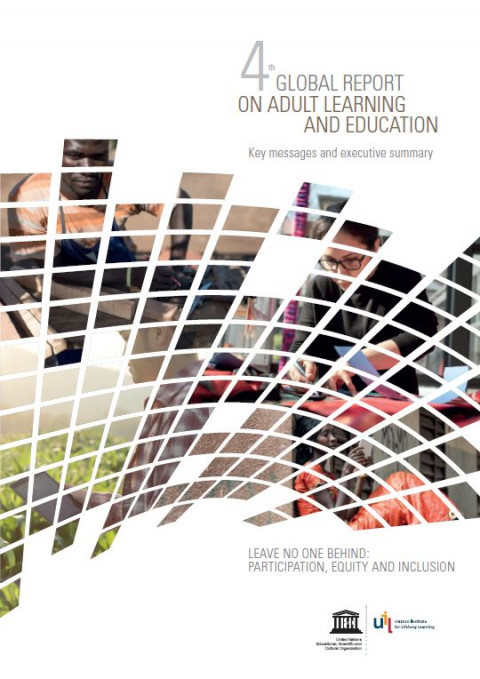 [Summary] 4th Global Report on Adult Learning and Education: Leave No One Behind: Participation, Equity and Inclusion; Key Messages and Executive Summary Año de publicación: 2020 Autor corporativo: UNESCO Institute for Lifelong Learning (UIL) The fourth Global Report on Adult Learning and Education (GRALE 4) argues that achieving SDG 4, and realizing its cross-cutting contribution to the other 16 goals, demands a much more integrated and comprehensive approach to education, with adult learning and education at its heart. GRALE 3, published in 2016, showed that adult learning and education produces significant benefits across a range of policy areas. Countries reported a positive impact on health and well-being, employment and the labour market, and social, civic and community life. GRALE 4, while reinforcing the message that the benefits of participation in ALE are substantial, shows that they remain unevenly distributed. [요약문] 제4차 유네스코 성인학습 및 교육에 관한 글로벌 보고서: 참여, 형평 및 포용을 통해 그 누구도 소외되지 않는 세상; 주요 결과 및 요약 Año de publicación: 2020 Autor corporativo: UNESCO Institute for Lifelong Learning (UIL) 제4차 유네스코 성인학습 및 교육에 관한 글로벌 보고서(GRALE IV)는 SDG 4의 달성 및 이를 통한 나머지 16개 목표에 대한 범분야적 기여 실현에 있어 성인학습 및 교육을 중심으로 교육에 대해 훨씬 더 통합적이고 포괄적인 접근이 요구된다고 주장한다. 본 보고서의 주요내용은 대부분의 회원국이 능동적 시민성 함양을 위한 성인학습 및 교육(ALE for active citizenship)의 가능성을 인정하고 있음에도 불구하고 여전히 정책우선순위에서 밀려나 있다는 것이다. 이러한 정책 흐름을 바꾸지 않는 이상, SDG 4의 다양한 세부 목표를 이행할 수 없으며 교육분야 목표가 달성되지 못하면 다른 목표 역시 달성되지 못할 위험에 빠질 것이라고 강조한다. GRALE IV는 성인학습 및 교육 참여가 가져오는 다양한 이점을 강조함과 동시에 이러한 이점들이 고르지 않게 분배되어 있음을 보여준다.
 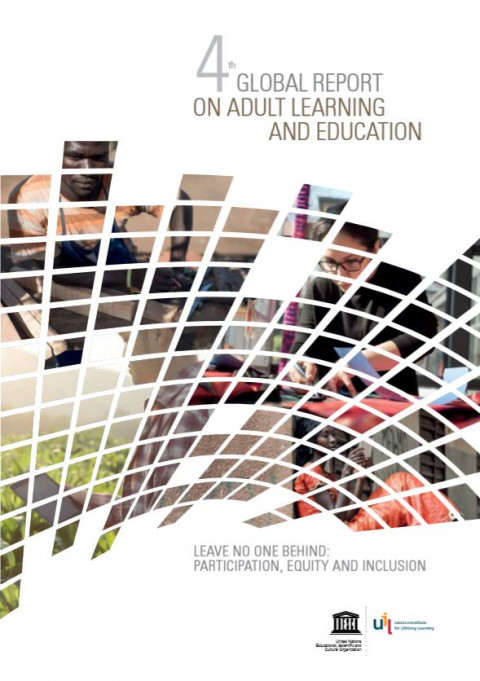 4th Global Report on Adult Learning and Education: Leave No One Behind: Participation, Equity and Inclusion Año de publicación: 2019 Autor corporativo: UNESCO Institute for Lifelong Learning (UIL) This report demonstrates the important role participation in adult learning and education can play in achieving the Sustainable Development Goals, highlights the distance we have to travel, and offers clear guidance on how to move forward. As the report clearly also shows, it is only by prioritizing ALE, and rebalancing resources accordingly, that can we ensure that the commitment of the 2030 Agenda to ‘leave no one behind’ in the pursuit of equitable, inclusive and sustainable development is fully and fairly realized. 4e rapport mondial sur l’apprentissage et l’éducation des adultes: ne laisser personne pour compte: participation, équité et inclusion Año de publicación: 2019 Autor corporativo: Institut de l’UNESCO pour l’apprentissage tout au long de la vie (UIL) Le présent rapport démontre le rôle crucial que la participation à l’apprentissage et à l’éducation des adultes peut jouer dans la réalisation des objectifs de développement durable, souligne la distance qu’il nous reste à parcourir pour y parvenir et propose des orientations claires sur la manière d’aller de l’avant. Il ressort clairement du GRALE 4 que, ce n’est qu’en accordant la priorité à l’apprentissage et à l’éducation des adultes et en rééquilibrant les ressources en conséquence, que nous réussirons à réaliser pleinement et justement l’engagement à travers le Programme de développement durable à l’horizon 2030 de « ne laisser personne pour compte » dans notre quête d’un développement équitable, inclusif et durable.
  Adult Education and the Challenge of Exclusion: UIL Policy Brief 10 Año de publicación: 2020 Autor corporativo: UNESCO Institute for Lifelong Learning (UIL) The fourth Global Report on Adult Learning and Education (G RALE 4) shows that raising participation in adult learning and education (ALE) is pivotal for achieving not only Sustainable Development Goal (SDG) 4 on education, but also the other goals of the 2030 Agenda, spanning issues from climate change to poverty reduction. This places an onus on countries to review ALE policies and progress in the light of evidence on participation, and to invest in sustainable provision that is accessible to all learners, throughout their lives and in all the different contexts in which adults learn. L’éducation des adultes face au défi de l’exclusion : Note d’orientation de l’UIL n° 10 Año de publicación: 2020 Autor corporativo: UNESCO Institute for Lifelong Learning (UIL) Le quatrième Rapport mondial sur l’apprentissage et l’éducation des adultes (GRALE, Global Report on Adult Learning and Education) révèle qu’il est crucial d’accroître la participation à l’apprentissage et à l’éducation des adultes (AEA) pour atteindre non seulement l’objectif 4 des objectifs de développement durable (ODD) sur l’éducation, mais aussi les autres objectifs de ce Programme, qui vont du changement climatique à la réduction de la pauvreté. Cela impose aux pays d’évaluer leurs politiques en matière d’apprentissage et d’éducation des adultes, de progresser à la lumière des données factuelles sur la participation, ainsi que d’investir dans une offre durable accessible à tous les apprenants, tout au long de la vie et dans les différents contextes d’apprentissage. La educación de adultos y el desafío de la exclusion : Informe de políticas del UIL 10 Año de publicación: 2020 Autor corporativo: UNESCO Institute for Lifelong Learning (UIL) El cuarto Informe Mundial sobre el Aprendizaje y la Educación de Adultos (GRALE 4) muestra que aumentar la participación en el aprendizaje y la educación de adultos (AEA) es fundamental para alcanzar no solo el Objetivo de Desarrollo Sostenible (ODS) 4 sobre educación, sino también los otros objetivos de la Agenda 2030, que abarcan temas que van desde el cambio climático hasta la reducción de la pobreza. Esto exige que los países revisen las políticas y los progresos del AEA de acuerdo con los datos sobre participación e inviertan en una oferta sostenible que sea accesible a todos los educandos, a lo largo de su vida y en todos los diferentes contextos en los que los adultos aprenden.