
Recursos
Exploren una amplia gama de recursos valiosos en GCED para profundizar su comprensión y promover su búsqueda, incidencia, enseñanza y aprendizaje.
1,951 resultados encontrados
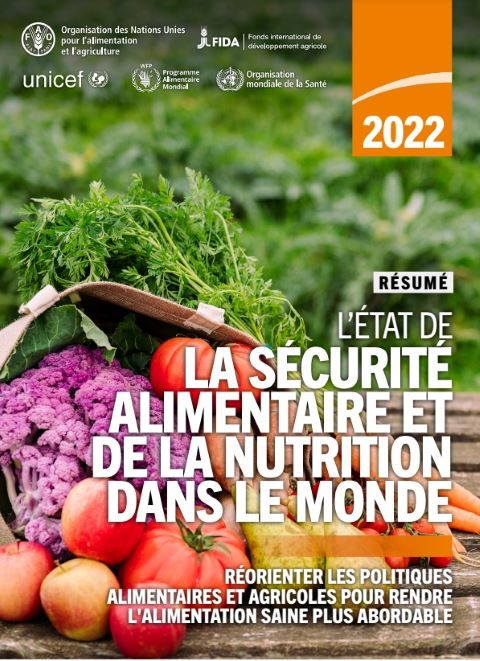 La Securite Alimentaire Et De La Nutrition Dans Le Monde Año de publicación: 2022 Autor corporativo: Food and Agriculture Organization of the United Nations (FAO) Le présent rapport met en lumière de manière récurrente l’intensification des principaux facteurs d’insécurité alimentaire et de malnutrition: les conflits, les phénomènes climatiques extrêmes et les chocs économiques, dont les effets se conjuguent à ceux de l’accroissementdes inégalités. L’enjeu n’est pas de savoir si d’autres épreuves sont à venir ou non; il s'agit plutôt de prendre les choses en main avec plus de courage et de renforcer la résilience face aux chocs futurs.
 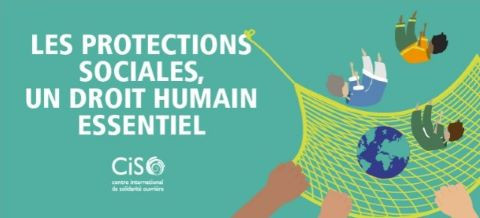 Campaign "Social Protections, an Essential Human Right!" Año de publicación: 2021 Autor corporativo: International Labour Solidarity Centre Around the world, the COVID-19 pandemic has highlighted the inequalities in the individual and collective protection measures that societies had access to face the crisis. Unsurprisingly, we found that not everyone was equal in the face of the pandemic, quite the contrary. Countries with higher rates of social coverage and labor formalization have seen their populations much better prepared and equipped to deal with the aftermath. In contrast, places, where a large number of workers worked in precarious situations, suffered from an increase in the unemployment rate and a much higher rate of contagion.It is therefore with the current pandemic context in mind that the CISO has decided to set up the annual campaign under the theme of social protection for all, to raise awareness among the Quebec public about the precariousness of work. in the South and the North and the importance of social protection floors to protect the most vulnerable workers. Through this campaign, we want to present social protections not as a privilege but as an essential human right for all. Campagne « Les protections sociales, un droit humain essentiel! » Año de publicación: 2021 Autor corporativo: International Labour Solidarity Centre Partout dans le monde, la pandémie de COVID-19 a mis en lumière les inégalités dans les mesures de protections individuelles et collectives auxquelles les sociétés avaient accès pour faire face à la crise. Sans surprise, nous avons constaté que toutes et tous n’étaient pas égales et égaux face à la pandémie, bien au contraire. Les pays avec de plus hauts taux de couverture sociale et de formalisation du travail ont vu leur population beaucoup mieux préparée et outillée à faire face aux contrecoups. Par opposition, les endroits où un grand nombre de travailleuses et travailleurs oeuvraient dans des situations de précarité ont souffert d’une augmentation du taux de chômage et d’un taux de contagion beaucoup plus élevé.C’est donc en gardant en tête le contexte pandémique actuel que le CISO a décidé de mettre en place la campagne annuelle sous le thème des protections sociales pour toutes et tous, et ce dans le but de sensibiliser le public québécois à la précarisation du travail au Sud et au Nord et à l’importance des socles de protection sociale pour protéger les travailleuses et travailleurs les plus vulnérables. Par cette campagne, nous souhaitons présenter les protections sociales non comme un privilège mais bien comme un droit humain essentiel pour toutes et tous.
 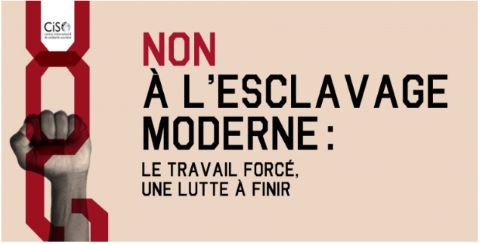 2018-2019: NO to Modern Slavery: Forced Labor, a Struggle to End Año de publicación: 2019 Autor corporativo: International Labour Solidarity Centre The CISO has embarked with its partners on a three-year campaign against forced labour. In 2017-2018, he called for the ratification of ILO Convention 189 on the rights of domestic workers and publicized the violations of their rights here and elsewhere in the world. This year, it is tackling the task of making known the existence of forced labor in the agri-food and electronics sector in order to promote greater and effective mobilization against this scourge which offends the conscience and the rights of all workers in the world. 2018-2019: NON à l’esclavage moderne : le travail forcé, une lutte à finir Año de publicación: 2019 Autor corporativo: International Labour Solidarity Centre Le CISO a entrepris avec ses partenaires une campagne de trois ans contre le travail forcé. En 2017-2018, il a ainsi demandé la ratification de la Convention 189 de l’OIT sur les droits des travailleuses domestiques et fait connaître les violations de leurs droits ici et ailleurs dans le monde. Cette année, il s’attèle à la tâche de faire connaître l’existence du travail forcé dans le secteur agroalimentaire et de l’électronique afin de favoriser une mobilisation plus grande et efficace contre ce fléau qui heurte la conscience et les droits de l’ensemble des travailleuses et travailleurs dans le monde.
  “Racism, Sexism, Homophobia, Which Card do You Want?” The Post-Migration Experience of Northern LGBTQ People Global and Global South Año de publicación: 2021 Autor: Barbara Andrade de Sousa | Line Chamberland Autor corporativo: Alterstice This article examines the life stories of seven LGBTQ immigrants, from the Global North and South, who live in Montreal. The research on immigration has long been carried out according to a framework heteronormative, which sets aside a whole series of questions relating to the impact of sexual orientation and non-normative gender identity on the migratory experience. Societies impose distinct constraints on LGBTQ people. Once settled in the host society, these subjects can experience more sexual possibilities. However, their origin can become a marker that places them inside a relationship of power with the majority group. This article aims to shed light on how LGBTQ immigrants construct their life stories in a context where their experience is crossed by the interweaving of several aspects of identities such as sexual orientation, gender identity, ethnicity, and religion, to name a few. The intersectional approach makes it possible to identify the systems of binding powers which participants face daily. The thematic analysis gave us allowed to listen to individuals to know the categories of power and the systems of oppression they talk about — the goal being to position respondents as knowledgeable subjects, not mere study objects. Analysis of the interviews shows that LGBTQ individuals who express a diverse combination of identities face specific challenges linked to the migratory route. « Racisme, sexisme, homophobie, quelle carte tu veux ? » L’expérience post-migratoire des personnes LGBTQ du Nord global et du Sud global Año de publicación: 2021 Autor: Barbara Andrade de Sousa | Line Chamberland Autor corporativo: Alterstice Cet article examine l’histoire de vie de sept immigrants ou immigrantes LGBTQ, originaires du Nord et du Sud global, qui habitent à Montréal. Les recherches sur l’immigration ont longtemps été réalisées selon un cadrage hétéronormatif, ce qui met à l’écart toute une série de questions relatives à l’impact de l’orientation sexuelle et de l’identité de genre non normative sur l’expérience migratoire. Les sociétés imposent des contraintes distinctes vis-à-vis des personnes LGBTQ. Une fois installées dans la société d’accueil, ces sujets peuvent expérimenter plus de possibilités sur le plan sexuel ; néanmoins leur origine peut devenir un marqueur qui les place à l’intérieur d’un rapport de pouvoir avec le groupe majoritaire. Notre article vise à mettre en lumière la manière dont les immigrants LGBTQ construisent leurs histoires de vie dans un contexte où leur vécu est traversé par l’imbrication de plusieurs aspects identitaires comme l’orientation sexuelle, l’identité de genre, l’ethnicité et la religion, pour n’en nommer que quelques-uns. L’approche intersectionnelle rend possible l’identification des systèmes de pouvoirs contraignants auxquels les participants font face quotidiennement. L’analyse thématique nous a permis d’être à l’écoute des individus afin de connaître les catégories de pouvoir et les systèmes d’oppression dont ils parlent — le but étant de positionner les répondants comme des sujets connaissants, et non de simples objets d’étude. L’analyse des entrevues montre que les individus LGBTQ qui expriment une combinaison variée d’identités affrontent des défis spécifiques liés au parcours migratoire.
 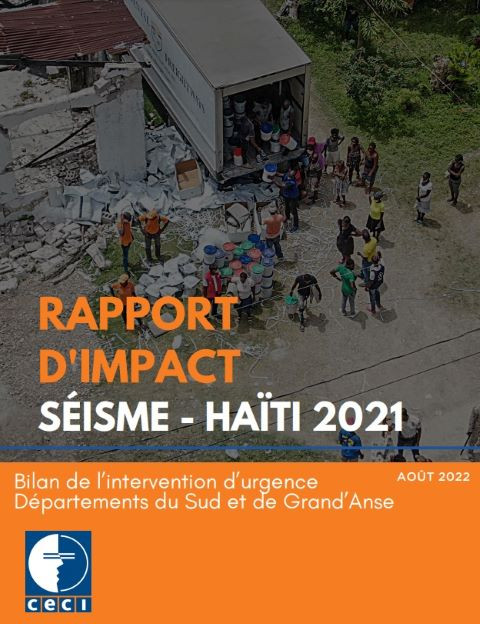 Impact Report-Earthquake-Haiti 2021 Año de publicación: 2022 Autor corporativo: Centre for International Cooperation and Study (CECI) On August 14, 2021, a magnitude 7.2 earthquake struck the Great South of Haiti with full force, causing nearly of 2,300 dead and considerable material damage. This new natural disaster has come to worsen an already difficult socio-economic situation for families in this region of Haiti, which was barely within the devastating aftermath caused by Hurricane Matthew in 2016. From the first hours following the earthquake, CECI-Haiti, which was already carrying out 6 development in the departments of Grand-Anse and Sud, mobilized its teams to support government authorities, assess the needs of the population, in particular those of families and women, take stock of the damage and establish an action plan for recovery. The cities the most affected in the eastern region of the Grand'Anse department were the municipalities of Camp-Perrin, Roseaux, Coral, Beaumont, and Pestel.For the first emergency, the following priorities had been identified: Need for water supply; Need for drugs and agricultural inputs; Need for food and milk for the children; Need for tents and tarpaulins for temporary shelters; Need for sanitary products and clothing, portable toilets, etc.; Need for psychosocial support;To provide a rapid and significant response to urgent needs, CECI received funds from the public Canadian and obtained funding from the Ministry of International Relations and La Francophonie of the Government of Quebec. Rapport d'impact: SÉISME - HAÏTI 2021 Año de publicación: 2022 Autor corporativo: Centre for International Cooperation and Study (CECI) Le 14 août 2021, un séisme de magnitude 7,2 a frappé de plein fouet le Grand Sud d’Haïti causant près de 2 300 morts et des dégâts matériels considérables. Cette nouvelle catastrophe naturelle est venue aggraver une situation socio-économique déjà difficile pour les familles de cette région d’Haïti qui se relevaient à peine des conséquences dévastatrices causées par l'ouragan Matthew en 2016.Dès les premières heures ayant suivi le passage du séisme, le CECI-Haïti qui menait déjà 6 projets de développement dans les départements de la Grand-Anse et du Sud, a mobilisé ses équipes pour appuyer les autorités gouvernementales, évaluer les besoins de la population, en particulier ceux des familles et des femmes, dresser un bilan des dégâts et établir un plan d’action pour le relèvement. Les communes les plus touchées dans la région Est du département de la Grand’Anse ont été les communes de Camp-Perrin, Roseaux, Corail, Beaumont et Pestel. Pour la première urgence, les priorités suivantes avaient été identifiées: Besoin d’approvisionnement en eau ; Besoin en médicaments et intrants agricoles ; Besoin en nourriture et lait pour les enfants ; Besoin en tentes et bâches pour des abris provisoires ; Besoin en produits hygiéniques et vêtements, toilettes portatives, etc. ; Besoin en appui psychosocial ;Pour apporter une réponse rapide et significative aux besoins urgents, le CECI a reçu des fonds du public canadien et obtenu un financement du ministère des Relations Internationales et de la Francophonie du gouvernement du Québec.
  Advocacy Note: The Role of Cross-Border Trade in Security Food in Border Areas During Periods of COVID-19 Pandemic Año de publicación: 2022 Autor corporativo: Centre for International Cooperation and Study (CECI) The Role of Cross-Border Trade in Security food in border areas during periods of COVID-19 pandemic To limit the spread of Covid-19, the governments of Burkina Faso and Senegal have decided to close the borders in March 2020, thus limiting the movement of goods and people and cross-border exchanges. Faced with the measures taken and faced with the absolute necessity of survival, the Traders in cross-border areas bypass official checkpoints to continue trade. cross-border exchanges, necessary for their survival and food security, despite the risks of gender-based violence (GBV). In the event of a pandemic, for countries with still fragile economies such as Burkina Faso and Senegal, selective sanitary measures should rather be applied to enable formal trade and the movement of food across borders.