
Recursos
Exploren una amplia gama de recursos valiosos en GCED para profundizar su comprensión y promover su búsqueda, incidencia, enseñanza y aprendizaje.
1,951 resultados encontrados
 Recommandation sur l’éducation pour la paix, les droits de l’homme et le développement durable: un guide de mise en oeuvre Año de publicación: 2025 Autor corporativo: UNESCO Il n’y a pas de paix sans éducation. Face à la multiplication des conflits sur de nombreux fronts, jamais la nécessité d’une éducation transformée, orientée vers la construction et le maintien de la paix, n’a été aussi pressante. La Recommandation sur l’éducation pour la paix et les droits de l’homme, la compréhension internationale, la coopération, les libertés fondamentales, la citoyenneté mondiale et le développement durable, adoptée en 2023 par l’ensemble des 194 États membres de l’UNESCO, exprime une vision humaniste et transformatrice de l’éducation, capable de répondre aux défis actuels et futurs à la paix. Ces défis vont de la résurgence de conflits alimentés par les inégalités et injustices systémiques, à la montée et la diffusion des discours de haine, du racisme et de la discrimination – notamment en ligne – en passant par les effets négatifs des technologies numériques et la menace existentielle que constitue le changement climatique. L’UNESCO a élaboré le présent Guide comme le premier d’une série d’outils destinés à aider les États membres à comprendre et à mettre pleinement en œuvre la Recommandation de 2023. Le Guide développe son contenu, en intégrant la perspective transdisciplinaire de la Recommandation afin de relier concepts et enjeux clés. Il propose également des pistes concrètes et des ressources sélectionnées pour 2 milliards de personnes – un quart de l’humanité – vivent dans des zones touchées par des conflits l’action à différents niveaux et dans divers types d’éducation, tout en appelant à une approche multi-acteurs et à l’échelle de la société, qui inclut toutes et tous et s’appuie sur les efforts positifs déjà entrepris. Le Guide constitue une ressource collective opportune pour mettre pleinement en œuvre la Recommandation de 2023 et promouvoir une éducation véritablement transformatrice au service d’un monde plus juste et pacifique.
  Recomendación sobre la educación para la paz, los derechos humanos y el desarrollo sostenible: guía de implementación Año de publicación: 2026 Autor corporativo: UNESCO Sin educación no hay paz. Una educación transformadora, orientada a la construcción y el mantenimiento de la paz es más urgente que nunca, dado el aumento de los conflictos en diversos frentes.La Recomendación sobre la Educación para la Paz y los Derechos Humanos, la Comprensión Internacional, la Cooperación, las Libertades Fundamentales, la Ciudadanía Mundial y el Desarrollo Sostenible, que fue adoptada por los 194 Estados Miembros de la UNESCO en 2023, articula la visión humanista y transformadora de la educación que ayuda a abordar los actuales y futuros agravios a la paz. Estos desafíos abarcan desde el resurgimiento de conflictos impulsados por desigualdades e injusticias sistémicas, el auge y la propagación del discurso de odio, el racismo y la discriminación—especialmente en línea—, hasta los efectos adversos de las tecnologías digitales y la amenaza existencial del cambio climático.La UNESCO ha elaborado esta Guía como la primera de varias herramientas que ayudarán a los Estados miembro a comprender e implementar plenamente la Recomendación de 2023. Su contenido ha sido desarrollado integrando la perspectiva transdisciplinaria para conectar conceptos y cuestiones clave de la Recomendación de 2023. Además, proporciona ideas concretas y recursos seleccionados para la acción en distintos niveles y tipos de educación. Asimismo, promueve un enfoque multisectorial que parte de las iniciativas positivas ya en marcha y busca la inclusión de todas las personas.Esta Guía es una incorporación oportuna al conjunto de recursos colectivos disponibles para implementar plenamente la Recomendación de 2023 y promover así una educación transformadora para un mundo justo y pacífico.
  Sub-Regional Study on Transforming TVET in Ensuring Learning and Skills to Support School-to Work Transitions in Southeast Asian Countries Año de publicación: 2023 Autor: Jann Hidajat Tjakraatmadja | Hary Febriansyah | Yorga Permana | Lala Nurfitria | Farenza Fadil Autor corporativo: UNESCO Jakarta Technical and Vocational Education and Training (TVET) and the transition from school to work are critical for young individuals to be prepared for entering the job market. The school-to-work transition signifies the transition from education to professional work and involves stages such as finding a job, applying theoretical knowledge and adapting to work expectations. In line with SDG-4, there is a need to improve the relevance of TVET systems, equipping individuals with the necessary skills for employment, entrepreneurship and lifelong learning. Three strategic priorities include promoting lifelong learning opportunities, fostering skills for an inclusive and sustainable economy, and ensuring inclusive and resilient communities. UNESCO supports Member States to address current and future challenges in the field of TVET, including the transition from school to work. Recognising the significant role of TVET in achieving SDG-4, UNESCO works closely with countries like Brunei Darussalam, Indonesia, Malaysia, the Philippines, and Timor-Leste to enhance the relevance and effectiveness of their TVET systems. These countries have demonstrated a strong commitment to improving the quality of education and equipping individuals with the necessary skills for employment, entrepreneurship, and lifelong learning. In the discussion of innovations and trends in TVET systems, there is a need to respond to rapidly changing labour markets through leveraging labour market data, tracer studies, and employer insights, expanding work-based learning to support the transition from school to work, modernising TVET curricula with new skills and competencies, strengthening TVET through private sector and community engagement. TVET is important for the transition from school to work in the sub-region of Southeast Asia, in line with SDG-4. Standardised practices are needed for better employability and mobility. Challenges include labour market mismatches and negative perceptions, but there are opportunities to partner with industry, update curricula, promote inclusivity and gender equality, and adapt to changing labour markets. Using labour market data, expanding work-based learning, and engaging the private sector and local communities are critical. TVET can transform individuals and contribute to sustainable development in the subregion of South-East Asia, creating prosperous and inclusive societies.
  Transforming Education Conference for Humanity: TECH 2017, December 16-18, 2017; Post Event Report Año de publicación: 2018 Autor corporativo: Mahatma Gandhi Institute of Education for Peace and Sustainable Development (MGIEP) The three-day Transforming Education Conference for Humanity (TECH) 2017 organised by UNESCO Mahatma Gandhi Institute of Education for Peace and Sustainable Development (MGIEP) was held at Novotel Varun Beach, Visakhapatnam City, State of Andhra Pradesh, India from December 16 – 18, 2017. The first edition of TECH focused on digital pedagogies for building peaceful and sustainable societies through 21st century skills, schools and policies, towards achieving the United Nations Sustainable Development Goal 4, Target 7.TECH 2017 was attended by over 1,700 registered participants (including teachers, educators, learners, policy-makers, technology and gaming experts, amongst others) from 75 countries and witnessed highly engaging deliberations on the future of education, particularly on the innovative methods of teaching using technology.The Conference was generously supported by the State Government of Andhra Pradesh, India and the Ministry of Human Resource Development, Government of India and sponsored by Microsoft India (Education Technology Partner), Samsung India, Dassault Systems, Veative (Immersive Learning Partner) and McGraw Hill (Learning Science Partner). The Knowledge Partners of the Conference included NMIMS, Ubisoft, Quebec Government, ISTE, Social Alpha, EDB and IYC.TECH will be held annually over the next five years with a long term aim of affecting global policy change on the usage of digital pedagogies to render quality and inclusive education for all.
  How Digital is Transforming the Lives of Young People in Small Island Developing States Año de publicación: 2024 Autor corporativo: United Nations Development Programme (UNDP) Young people represent a sizeable and vital population in Small Island Developing States (SIDS). For them, digital technologies are more than just tools; they are gateways to new horizons. Digital is creating fresh opportunities, opening doors to unconventional careers, and redefining how knowledge is acquired and shared. Young people are using digital to start new businesses, explore new opportunities, learn new knowledge and skills, and to build global connections. However, young people are also cautious about digital – and they recognise risks and issues posed by digital channels, tools, and technologies. ‘How Digital is Transforming the Lives of Young People in SIDS’ explores these opportunities and challenges by hearing from young people – in their own words. Through a bespoke survey chatbot, running on messaging platforms most used by young people living in SIDS, more than 5,000 respondents from over 30 countries discuss how they’re using digital to transform their lives and livelihoods. And the barriers and challenges that they are facing on their digital journeys.
 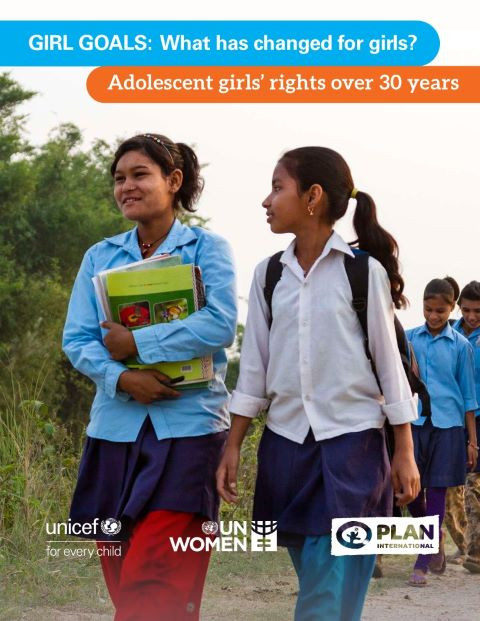 Girl Goals: What has Changed for Girls? Adolescent Girls’ Rights over 30 Years Año de publicación: 2025 Autor corporativo: United Nations Children's Fund (UNICEF) | United Nations Entity for Gender Equality and the Empowerment of Women (UN Women) | Plan International This report makes three key recommendations on action we can take now to advance adolescent girls’ rights at scale, in ways that account for fiscally constrained contexts and multiple competing priorities: 1. Ensure tangible and actionable support for adolescent girls’ voices, advocacy and action. The current generation of girls are raising their voices to be heard and are already at the forefront of making change around the world. With the right support, resources and seats at the table, adolescent girls can help transform the world for the better, shaping better policy outcomes for themselves and everyone. This is not about girls’ voices above all others, or endless consultation, but about specific, meaningful actions that ensure girls get the support they need and are heard on policy issues that matter to them. 2. Establish and track explicit targets for change for adolescent girls, who are too often invisible and sidelined Setting explicit targets to monitor outcomes for adolescent girls is key to making progress. Context-specific prioritization will be necessary, but there are some issues that stand out globally. Gaps in progress (such as child marriage gains accruing disproportionately to wealthier households) demonstrate the need forprogrammes that address poverty and economic realities alongside harmful social norms. The disproportionate number of adolescent girls not in education, employment or training, not entering the labour market as young women, and left behind when it comes to digital skills, is a threat to the gains made for girls and to economic growth that will benefit everyone. Stagnation on issues like underweight also stand out. Country- specific priorities supported by data- driven accountability mechanisms and investments are needed to translate policy commitments into change on the ground. 3. Resource and deliver smartly to unlock the social and economic dividend Governments and partners should invest in solutions proven to change outcomes across multiple SDGs at scale – for example, investing in education and skills, cash transfers and economic empowerment programmes designed to support girls. Existing systems, from maternal health care to school curricula, should be adapted to meet girls’ needs rather than creating small- scale, separate projects. Streamlined, evidence-based ‘add-ons’ – such as adding parenting support to existing maternal health-care programmes – can be cost effective and accelerate outcomes if well designed. Change is possible, and this report shows that great gains have been made. Smart investments now can transform the world for girls, families, communities and national economies. It is time to act.
  Education, Extremism and Terrorism: What should be Taught in Citizenship Education and Why Año de publicación: 2012 Autor: Dianne Gereluk Should educators be exploring terrorism and extremism within their classrooms? If so, what should they be teaching, and how? Dianne Gereluk draws together the diverging opinions surrounding these debates, exploring and critiquing the justifications used for why these issues should be addressed in schools. She goes on to consider the ways in which educators should teach these topics, providing practical suggestions. Education, Extremism and Terrorism: What should be Taught in Citizenship Education and Why Año de publicación: 2012 Autor: Dianne Gereluk Les enseignants doivent-il aborder les questions du terrorisme et de l'extrémisme au sein des salles de classe ? Dans ce cas, que doivent-ils enseigner, et comment ? Dianne Gereluk réunit au sein d'un même ouvrage les opinions divergentes autour de ces débats, elle explore et interroge les arguments mis en avant pour démontrer de l’importance du traitement de ces thèmes par les écoles. Elle envisage la façon dont ces sujets devraient être enseignés, et propose quelques conseils pratiques.
  Homegrown terrorism and transformative learning: an interdisciplinary approach to understanding radicalization Año de publicación: 2010 Autor: Alex S. Wilner | Claire-Jehanne Dubouloz Since 2001, a preponderance of terrorist activity in Europe, North America and Australia has involved radicalized Westerners inspired by Al Qaeda. Described as ‘homegrown terrorism’, perpetrators are citizens and residents born, raised, and educated within the countries they attack. While most scholars and policy-makers agree that radicalization plays a central role in persuading Westerners to embrace terrorism, little research properly investigates the internal and cognitive processes inherent to radicalization. Transformative learning theory, developed from the sciences in education, health and rehabilitation, provides an unconventional and interdisciplinary way to understand the radicalization process. The theory suggests that sustained behavioural change can occur when critical reflection and the development of novel personal belief systems are provoked by specific triggering factors. Homegrown terrorism and transformative learning: an interdisciplinary approach to understanding radicalization Año de publicación: 2010 Autor: Alex S. Wilner | Claire-Jehanne Dubouloz Depuis 2001, une grande partie de l'activité terroriste en Europe, en Amérique du Nord et en Australie a impliqué des Occidentaux radicalisés inspirés par Al Qaïda. Décrite comme un « terrorisme venant de l’intérieur », leurs auteurs sont des citoyens et des résidents qui sont nés, ont grandi et ont été éduqués dans les pays qu'ils attaquent. Alors que la plupart des chercheurs et des décideurs conviennent que la radicalisation joue un rôle central pour convaincre les Occidentaux d'embrasser le terrorisme, peu de recherche étudie d’une manière adéquate les processus internes et cognitifs inhérents à la radicalisation. La théorie de la pédagogie transformative, développée à partir des sciences de l'éducation, de la santé et de la réadaptation, fournit une manière peu commune et interdisciplinaire de comprendre le processus de radicalisation. Cette théorie suggère que le changement de comportement de manière durable peut se produire lorsque la réflexion critique et le développement de nouveaux systèmes de croyance personnelle sont provoqués par des facteurs déclencheurs spécifiques.