
Recursos
Exploren una amplia gama de recursos valiosos en GCED para profundizar su comprensión y promover su búsqueda, incidencia, enseñanza y aprendizaje.
948 resultados encontrados
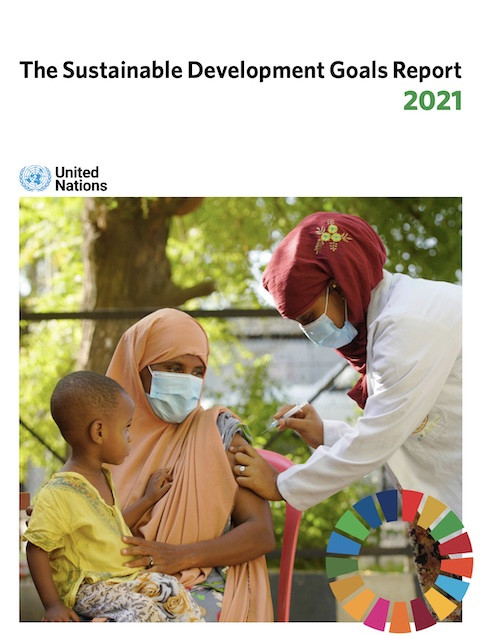 The Sustainable Development Goals Report 2021 Año de publicación: 2021 Autor corporativo: United Nations (UN) As the pandemic continues to unfold, The Sustainable Development Goals Report 2021 outlines some significant impacts in many areas that are already apparent. The global extreme poverty rate rose for the first time in over 20 years, and 119 to 124 million people were pushed back into extreme poverty in 2020. There is a risk of a generational catastrophe regarding schooling, where an additional 101 million children have fallen below the minimum reading proficiency level, potentially wiping out two decades of education gains. Women have faced increased domestic violence, child marriage is projected to rise after a decline in recent years, and unpaid and underpaid care work is increasingly and disproportionately falling on the shoulders of women and girls, impacting educational and income opportunities and health. Notwithstanding the global economic slowdown, concentrations of major greenhouse gases continue to increase. With the global average temperature reaching about 1.2°C above pre-industrial levels, the climate crisis has well and truly arrived, and its impacts are being felt across the world. The pandemic has also brought immense financial challenges, especially for developing countries – with a significant rise in debt distress and dramatic decreases in foreign direct investment and trade. Yet, with a surge in global solidarity and leadership from the highest political level, countries can still deliver on the 2030 Agenda and the 2015 Paris Agreement on Climate Change. A global vaccination plan, designed and implemented by the countries that can produce vaccines today or will be able to do so if properly supported, is an urgent first step in that direction. A recommitment by Governments, cities, businesses, and industries to ensure that the recovery reduces carbon emissions, conserves natural resources, creates better jobs, advances gender equality and tackles growing poverty and inequalities is a further imperative. Rapport sur les objectifs de développement durable 2021 Año de publicación: 2021 Autor corporativo: United Nations (UN) Le Rapport sur les objectifs de développement durable pement durable 2021 décrit certains effets importants qui se manifestent déjà dans de nombreux domaines. Le taux mondial d’extrême pauvreté a augmenté pour la première fois en plus de 20 ans, et entre 119 et 124 millions de personnes ont basculé dans l’extrême pauvreté en 2020. Un risque de catastrophe générationnelle se dessine en matière de scolarisation, alors que 101 millions d’enfants de plus sont passés sous le seuil minimum de compétence en lecture, ce qui pourrait réduire à néant deux décennies de progrès scolaires. Les femmes ont été confrontées à une hausse de la violence conjugale, le mariage d’enfants devrait augmenter après des années de baisse, et le travail domestique non rémunéré et sous-payé repose de plus en plus et de façon disproportionnée sur les femmes et les filles, avec des répercussions sur leurs possibilités d’édu- cation et de revenu et leur santé. Malgré le ralentissement économique mondial, la concentration des principaux gaz à effet de serre continue d’augmenter. La température moyenne mondiale s’établissant à environ 1,2 °C au-dessus des niveaux préindustriels, la crise climatique est bel et bien là et ses effets se font sentir partout dans le monde. La pandémie a également engendré d’immenses défis financiers, en particulier pour les pays en développement, avec une augmentation significative du surendettement et une baisse spectaculaire de l’investissement étranger direct et du commerce.Pourtant, avec un élan de solidarité mondiale et un leadership au plus haut niveau politique, les pays peuvent encore réaliser le Programme 2030 et l’Accord de Paris sur les changements climatiques adopté en 2015. Un plan mondial de vaccination, conçu et mis en œuvre par les pays qui peuvent aujourd’hui produire des vaccins ou qui le pourront dans le futur avec le soutien adéquat, est une première étape urgente pour y parvenir.Il est également impératif que les gouvernements, les villes, les entreprises et les industries s’engagent de nouveau à assurer une reprise qui prises et les industries s’engagent de nouveau à assurer une reprise qui réduise les émissions de carbone, préserve les ressources naturelles, crée de meilleurs emplois, fasse progresser l’égalité entre les sexes et fasse reculer la pauvreté et les inégalités croissantes.
  SDG 4 Data Digest 2020: Using Household Survey Data to Monitor SDG 4 Año de publicación: 2020 Autor corporativo: UNESCO Institute for Statistics (UIS) The 2020 edition of the SDG 4 Data Digest by the UNESCO Institute for Statistics focuses on household surveys as an important and underutilized tool to collect the data needed to track progress towards Sustainable Development Goal 4 and to ensure that no one is left behind. The Digest describes existing survey programmes and offers advice on the design and implementation of new surveys. The Digest identifies a number of advantages to using household surveys and describes the categories of indicators best suited for monitoring with survey data. Data from household surveys complement administrative data collected in schools and can be disaggregated to a greater extent than administrative data to facilitate the monitoring of exclusion in education. The definitions and calculation methods of selected indicators are laid out and the combination of household survey data with data from other sources is explained. This issue of the Digest is aimed at government officials, national planners, donors and others who make decisions about the implementation of nationally representative household surveys. It describes the requirements for conducting a household survey and the steps that must be followed from questionnaire design to data collection and analysis, and it gives advice on presentation of the findings. A section on COVID-19 summarizes the impact of the current pandemic on data collection. Additional resources, with suggested survey questions for the collection of education data through household surveys, are also included. Compendio de Datos sobre el ODS 4: Cómo utilizar datos de encuestas de hogares para monitorear el ODS 4 Año de publicación: 2020 Autor corporativo: UNESCO Institute for Statistics (UIS) La edición 2020 del Compendio de Datos sobre el ODS 4 del Instituto de Estadística de la UNESCO se centra en las encuestas de hogares como una importante e infrautilizada herramienta para la recolección de los datos necesarios para rastrear el progreso hacia el Objetivo de Desarrollo Sustentable 4 y para garantizar que nadie quede en el camino. El Compendio describe los programas de encuestas existentes y brinda consejos para el diseño y la implementación de nuevas encuestas. El Compendio identi ca una serie de ventajas en el uso de las encuestas de hogares y describe las categorías de indicadores más adecuados para el monitoreo con datos de encuestas. Los datos de encuestas de hogares complementan los datos administrativos recolectados en las escuelas y pueden ser desglosados a un grado mayor que los datos administrativos, facilitando el monitoreo de la exclusión en la educación. Se han expuesto las de niciones y métodos de cálculo de los indicadores seleccionados y se ha explicado cómo se combinan los datos de encuestas de hogares con los datos de otras fuentes. Esta edición del Compendio está dirigida a los funcionarios de gobierno, plani cadores nacionales, contribuyentes y quienes tomen decisiones sobre la implementación de las encuestas de hogares nacionalmente representativas. Describe los requisitos para la ejecución de una encuesta de hogares y los pasos que deben seguirse desde el diseño del cuestionario hasta la recolección y análisis de datos, además de dar consejos sobre cómo presentar los hallazgos. Una sección sobre el COVID-19 resume el impacto que tiene la actual pandemia sobre la recolección de datos. También se han incluido recursos adicionales, con preguntas de encuestas sugeridas para la recolección de datos educativos mediante las encuestas de hogares. Rapport sur les données de l’ODD 4: Utiliser les données des enquêtes auprès des ménages pour le suivi de l’ODD 4 Año de publicación: 2020 Autor corporativo: UNESCO Institute for Statistics (UIS) L’édition 2020 du Rapport sur les données de l’ODD 4 de l’Institut de statistique de l’UNESCO met l’accent sur les enquêtes auprès des ménages comme un outil important et sous-utilisé pour collecter les données nécessaires au suivi des progrès réalisés sur la voie de l’Objectif du développement durable 4 et pour s’assurer que personne n’est laissé pour compte. Le Rapport décrit les programmes d’enquêtes existants et offre des conseils sur la conception et la mise en œuvre de nouvelles enquêtes. Le Rapport identi e un certain nombre d’avantages à utiliser les enquêtes auprès des ménages et décrit les catégories d’indicateurs les mieux adaptées au suivi avec des données d’enquête. Les données issues des enquêtes auprès des ménages complètent les données administratives recueillies dans les écoles et peuvent être ventilées dans une plus large mesure que les données administratives a n de faciliter le suivi de l’exclusion dans l’éducation. Les définitions et les méthodes de calcul des indicateurs sélectionnés sont présentées et la combinaison des données des enquêtes sur les ménages avec les données provenant d’autres sources est expliquée. Ce numéro du Rapport s’adresse aux responsables gouvernementaux, aux plani cateurs nationaux, aux donateurs et aux autres personnes qui prennent des décisions concernant la mise en œuvre d’enquêtes sur les ménages représentatives au niveau national. Il décrit les conditions requises pour mener une enquête auprès des ménages et les étapes à suivre depuis la conception du questionnaire jusqu’à la collecte et l’analyse des données, et il donne des conseils sur la présentation des résultats. Une section sur le COVID-19 résume l’impact de la pandémie actuelle sur la collecte de données. Des ressources supplémentaires, avec des suggestions de questions d’enquête pour la collecte de données sur l’éducation par le biais d’enquêtes auprès des ménages, sont également incluses.
  Innovation for Sustainable Development: Review of Kyrgyzstan Año de publicación: 2019 Autor: Anders Jönsson | Christopher Athey | Slavo Radosevic Autor corporativo: United Nations Economic Commission for Europe (UNECE) The practical work on the Innovation for Sustainable Development Review of Kyrgyzstan began in December 2016 with a preparatory mission to Bishkek by representatives of the UNECE secretariat to establish contact and discuss the structure and content of the Review with the national Government institutions and other stakeholders. The main project mission took place from 30 March to 7 April 2017 with the participation of a team that included representatives of the UNECE secretariat as well as international and national experts. This Review reflects the outcome of a series of consultations and discussions between the Review team and policymakers, Government officials, representatives of academic institutions and the business community, and other innovation stakeholders of Kyrgyzstan.This report presents a thematic regional analysis of unpaid work in Eastern Europe and Central Asia (EECA) and the resulting empowerment women gain when their responsibility for such work is reduced. The report focuses on Albania, Azerbaijan, Bosnia & Herzegovina, Georgia, Kazakhstan, Kyrgyzstan, Kosovo, Montenegro, North Macedonia, Republic of Moldova, Serbia, Turkey, Ukraine and Uzbekistan.Apart from three country case studies (on Kyrgyzstan, Republic of Moldova and Serbia) the other reports in the series cover the 56 UNECE member States, including the countries of Europe and countries in North America (Canada and United States), Central Asia (Kazakhstan, Kyrgyzstan, Tajikistan, Turkmenistan and Uzbekistan) and Western Asia (Israel). Инновации для устойчивого развития: Обзор Кыргызстана Año de publicación: 2019 Autor: Anders Jönsson | Christopher Athey | Slavo Radosevic Autor corporativo: United Nations Economic Commission for Europe (UNECE) Практическая работа над документом «Инновации для устойчивого развития: Обзор по Кыргызской Республике» началась в декабре 2016 года с подготовительного визита в г. Бишкек группы представителей секретариата ЕЭК ООН для установления контактов и обсуждения структуры и содержания Обзора с национальными органами госуправления и другими заинтересованными сторонами. Основной визит в рамках проекта состоялся с 30 марта по 7 апреля 2017 года при участии авторской группы, в состав которой вошли представители секретариата ЕЭК ООН, а также международные и национальные эксперты. Данный Обзор отражает итоги серии консультаций и дискуссий авторской группы с представителями правительственных структур, государственными должностными лицами, представителями научных учреждений и бизнес-сообщества и другими участниками инновационного процесса Кыргызской Республики.
 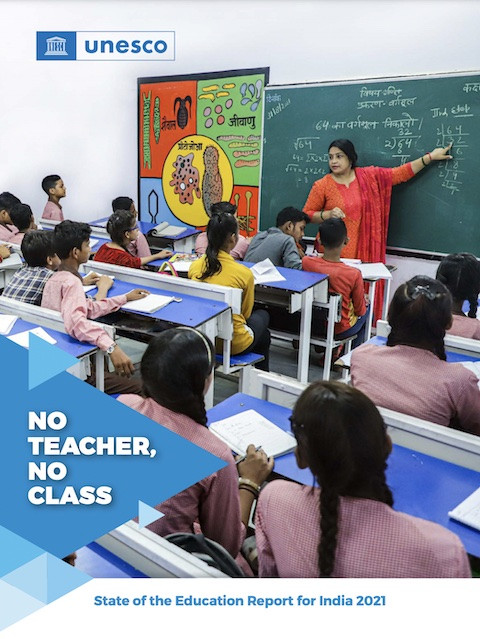 No Teacher, No Class: State of the Education Report for India, 2021 Año de publicación: 2021 Autor: Padma M. Sarangapani | Bindu Thirumalai | Anusha Ramanathan | Ruchi Kumar | Mythili Ramchand Autor corporativo: UNESCO New Delhi This report attempts to provide an understanding of key aspects of the teaching profession and workforce in India – nearly 9.7 million teachers in 2019/20 – the complex work that they do, and their professional development, through the filters of policy debates, choices, pushes and pulls. It looks at the questions that create core tensions in the sector and affect teacher quality and availability. It presents evidence wherever possible, and identifies gaps. The analytical framework of this report draws from important contextual and sectoral aspects including India’s social and political context — especially its federal structure – and social characteristics of gender, caste, rural-urban divide and the government-private divide. This report, prepared during the ongoing COVID-19 pandemic, and constrained by prevailing conditions, is primarily based on analysis of secondary data and review of policies, reports and research literature. Chapters explore specific themes and present key findings.
 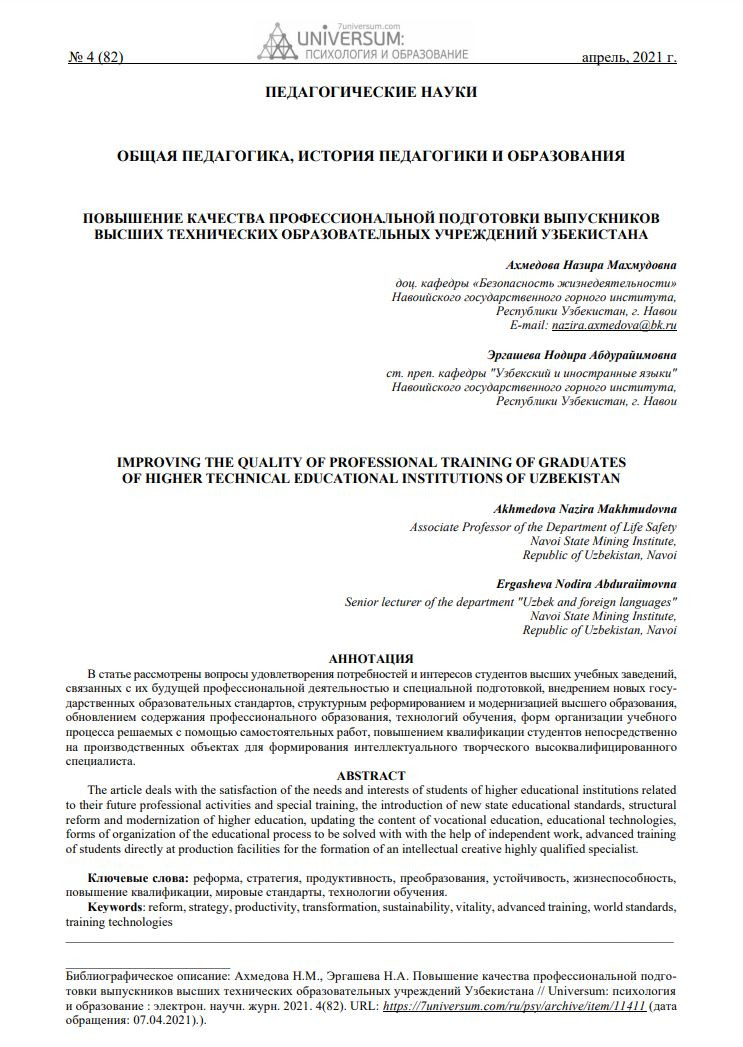 Improving the Quality of Professional Training of Graduates of Higher Technical Educational Institutions of Uzbekistan Año de publicación: 2021 Autor: Nazira Akhmedova | Nodira Ergasheva The article deals with the satisfaction of the needs and interests of students of higher educational institutions related to their future professional activities and special training, the introduction of new state educational standards, structural reform and modernization of higher education, updating the content of vocational education, educational technologies, forms of organization of the educational process to be solved with with the help of independent work, and advanced training of students. Повышение качества профессиональной подготовки выпускников высших технических образовательных учреждений Узбекистана Año de publicación: 2021 Autor: Nazira Akhmedova | Nodira Ergasheva В статье рассмотрены вопросы удовлетворения потребностей и интересов студентов высших учебных заведений, связанных с их будущей профессиональной деятельностью и специальной подготовкой, внедрением новых государственных образовательных стандартов, структурным реформированием и модернизацией высшего образования, обновлением содержания профессионального образования, технологий обучения, форм организации учебного процесса решаемых с помощью самостоятельных работ, повышением квалификации студентов непосредственно на производственных объектах для формирования интеллектуального творческого высоквалифицированного специалиста.