
Recursos
Exploren una amplia gama de recursos valiosos en GCED para profundizar su comprensión y promover su búsqueda, incidencia, enseñanza y aprendizaje.
948 resultados encontrados
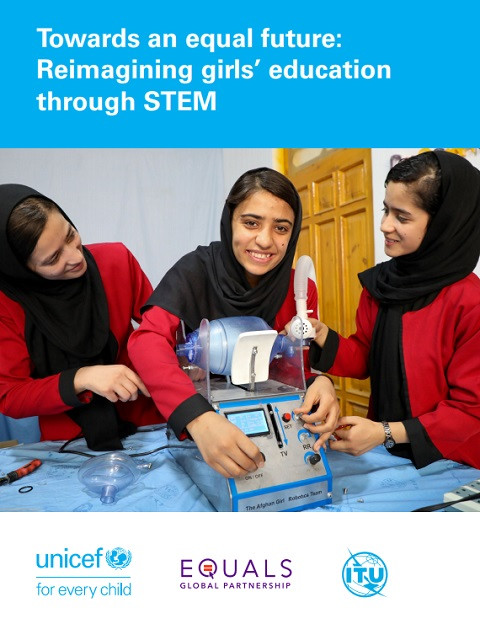 Towards an Equal Future: Reimagining Girls’ Education Through STEM Año de publicación: 2020 Autor corporativo: United Nations Children's Fund (UNICEF) | International Telecommunication Union (ITU) This document seeks to call attention to the potential of STEM education to transform gender norms in the education system, to improve quality learning opportunities for girls, and to highlight key actions that can accelerate girls’ transition between education and technical expert jobs in STEM industries. Critically, STEM education also has the potential to contribute to personal empowerment, transformation of communities and nations, and building economies for the future.The evidence presented here provides a foundation for a call to action for global, national and regional actors. All stakeholders are called to work together to dismantle the barriers that girls face to develop the skills they need to become users, shapers and creators of scientific knowledge and new technologies. This will allow girls to choose the skills they want to learn and how to apply them, empowering them to contribute to a gender-equal world.
  Education at a Glance 2020: OECD Indicators Año de publicación: 2020 Autor corporativo: Organisation for Economic Co-operation and Development (OECD) Education at a Glance is the authoritative source for information on the state of education around the world. It provides data on the structure, finances and performance of education systems across OECD countries and a number of partner economies. More than 100 charts and tables in this publication – as well as links to much more available on the educational database – provide key information on the output of educational institutions; the impact of learning across countries; access, participation and progression in education; the financial resources invested in education; and teachers, the learning environment and the organisation of schools.The 2020 edition includes a focus on vocational education and training, investigating participation in vocational education and training at various levels of education, the labour market and social outcomes of vocational graduates as well as the human and financial resources invested in vocational institutions. Two new indicators on how vocational education and training systems differ around the world and on upper secondary completion rate complement this topic. A specific chapter is dedicated to the Sustainable Development Goal 4, and investigates the quality and participation in secondary education.
  The Impact of COVID-19 on Education: Insights From Education at a Glance 2020 Año de publicación: 2020 Autor: Andreas Schleicher Autor corporativo: Organisation for Economic Co-operation and Development (OECD) OECD Director for Education and Skills Andreas Schleicher gives his insights and interpretations from the OECD’s Education at a Glance 2020 report – the go-to source for information on the state of education around the world. This brochure focuses on a selection of indicators from Education at a Glance, selected for their particular relevance in the current context. Their analysis enables the understanding of countries’ response and potential impact from the COVID-19 containment measures.
  Национальный добровольный обзор достижений Целей устойчивого развития в Кыргызской Республике 2020 Año de publicación: 2020 Autor corporativo: Kyrgyzstan. Ministry of Economy | United Nations (UN) Данный добровольный обзор содержит в себе информацию по выполнению Кыргызской Республикой целей устойчивого развития 2030, задачи и направления дальнейшей деятельности. Отдельное внимание уделено ЦУР 4 "Образование", где приоритетом является повышение качества и охвата образованием на всех уровнях, а также развитие системы непрерывного образования. Voluntary National Review on the Implementation of the Sustainable Development Goals in the Kyrgyz Republic 2020 Año de publicación: 2020 Autor corporativo: Kyrgyzstan. Ministry of Economy | United Nations (UN) This voluntary review contains information on the implementation of the 2030 Sustainable Development Goals by the Kyrgyz Republic, objectives and directions for further activities. Special attention is paid to SDG 4 "Education", where the priority is to improve the quality and coverage of education at all levels, as well as the development of the lifelong education system.
  The State of Global Education in Europe 2019 Año de publicación: 2020 Autor corporativo: Global Education Network Europe (GENE) | European Union (EU) This fourth edition of the State of Global Education in Europe has been developed to provide an updated account of current key issues, policy priorities, funding trends and activities inGlobal Education in Europe, among the Ministries and Agencies that participate in GENE. This report explores key trends, policy themes and budgetary information for Global Education in European countries, drawing on information provided by GENE member Ministries and Agencies during 2018 and 2019.
  Uzbekistan: Country Gender Assessment Update Año de publicación: 2018 Autor corporativo: Asian Development Bank (ADB) This Country Gender Update Report, prepared by ADB in close collaboration with Uzbekistan Women Committee, provides an analysis of the socio-economic dimensions of gender equality in Uzbekistan. It embraces a wide a range of issues related to the empowerment of women by increasing their economic activity in various sectors. Recommendations from the assessment can be used in the development of a long-term strategy of KJU and ADB, including programs aimed at increasing the employment and income of women, supporting their entrepreneurial initiatives, combating traditional gender stereotypes to further enhance the role and status of women in the country as a whole. Узбекистан: Обновленная гендерная оценка по стране Año de publicación: 2018 Autor corporativo: Asian Development Bank (ADB) Настоящий отчет по Обновленной гендерной оценке по стране, подготовленный АБР в тесном сотрудничестве с Комитетом женщин Узбекистана (КЖУ), содержит анализ социально-экономических аспектов гендерного равенства в Узбекистане. В нем охвачен широкий круг вопросов, связанных с расширением возможностей женщин путем повышения их экономической активности в различных секторах. Рекомендации, выработанные по результатам проведенной оценки, могут быть использованы при разработке долгосрочной стратегии КЖУ и АБР, включая программы, направленные на повышение уровня занятости и доходов женщин, поддержку их предпринимательских инициатив, борьбу с традиционными гендерными стереотипами для дальнейшего повышения роли и статуса женщин в целом по стране.
 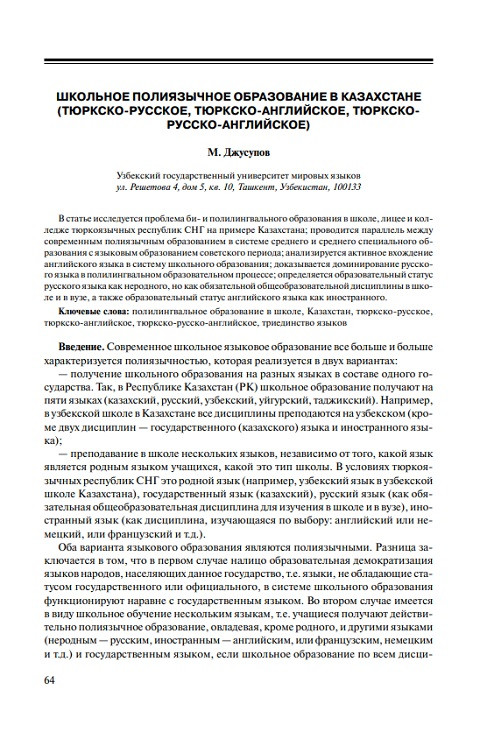 School Polylingual Education in Kazakhstan (Turkic-Russian, Turkic-English, Turkis-Russian-English) Año de publicación: 2015 Autor: Dzhusupov M. This article deals with a problem of bilingual and polylingual education at school, lyceum and college of Turkic Republic of CIS on the illustration of Kazakhstan; it is drawn an analogy (parallel) between modern polylingual education of — Soviet period; active ingress of English language in a system of school polylingual education has been analyzed; the domination of Russian language in polylingual educational process has been proved, it is determined an educational status of Russian language not as adoptive, but as obligatory general subject at school and in the institute of higher education and educational status of English language as foreign, i.e. as an alternative (optional) subject. Школьное полиязычное образование в Казахстане (тюркско-русское, тюркско-английское, тюркско-русско-английское) Año de publicación: 2015 Autor: Dzhusupov M. В статье исследуется проблема би- и полилингвального образования в школе, лицее и колледже тюркоязычных республик СНГ на примере Казахстана; проводится параллель между современным полиязычным образованием в системе среднего и среднего специального образования с языковым образованием советского периода; анализируется активное вхождение английского языка в систему школьного образования; доказывается доминирование русского языка в полилингвальном образовательном процессе; определяется образовательный статус русского языка как неродного, но как обязательной общеобразовательной дисциплины в школе и в вузе, а также образовательный статус английского языка как иностранного.