
Recursos
Exploren una amplia gama de recursos valiosos en GCED para profundizar su comprensión y promover su búsqueda, incidencia, enseñanza y aprendizaje.
980 resultados encontrados
 Strengthening Democracy Is the Key to Preventing Far-Right Extremism Año de publicación: 2021 Autor: Cynthia Miller-Idriss This article emphasizes that disinformation, misinformation and propaganda undermine democratic practices in ways that should be fought not only by trying to shrink or contain the extremist fringe, but also by strengthening democratic values and practices within the mainstream. It also highlights that it is critical to engage proactively and consistently in order to prevent further escalations in far-right extremism and interrupt violent radicalisation at early stages.
  Explained: What is False Information? Año de publicación: 2020 With so much information at our fingertips it can be easy to come across something online that isn’t quite as accurate or reliable as it should be. This kind of information is often called Fake News but a better description might be false information because it affects more than news stories. This animation, explaining false information, supports the education resource Connected - an introduction to digital media literacy.
  Rethinking Pedagogy: Exploring the Potential Of Digital Technology In Achieving Quality Education Año de publicación: 2019 Autor: Lorena Alemán de la Garza | Alessandra Anichini | Péter Antal | Aurélie Beaune | Éric Bruillard | Diane Burke | Pedro Henrique Cacique Braga | Ruma Chakravarti | Sriya Chakravarti | Deng Chen | Lidiya Chikalova | Helen Crompton | Ilana De Almeida Souza Concilio | William Cope | Lorenz Denks | Matthew Farber | Giovanni Fonseca | Pintér Gergely | Marcela Georgina Gómez Zermeño | Russell Hazard | Laura Hosman | Mary Kalantzis | Kojanitz László | Xavier Levoin | Kristen Linzy | Arnab Mandal | Yoko Mochizuki | Ariam Mogos | Tünde-Lengyel Molnár | Matthew Montebello | Sadaqat Mulla | Sandra Gudiño Paredes | Christelle Pauty-Combemore | Boyka Parfitt | Réka Racsko | Irais Monserrat Santillán Rosas | Khitam Shraim | Jisoo Song | Avgoustos Tsinakos Autor corporativo: Mahatma Gandhi Institute of Education for Peace and Sustainable Development (MGIEP) With the exponential growth of digitally mediated communication, digital media and gaming, the landscape of what we understand as learning environments is changing significantly. Today the use of digital technology in education is attracting considerable public and policy attention as
well as private investment. With a rise in discourses both heralding and cautioning against the use of digital technology in education, there is a need to pool the expertise and experience on the use of technology in education from around the world to advance public debate and evidence-informed policymaking. Based on the literature review, mapping of digital education resources in circulation, and examples of implementation of digital education initiatives from around the world, this report aims to provide insights that would help lead to the wise, innovative and ethical use of digital technology in education as a new dimension in achieving SDG 4 — inclusive and equitable quality education and lifelong learning opportunities for all. By so doing, it also attempts to contribute to a rethink of teaching and learning in the face of enormous opportunities and challenges brought about by digital technology in the times of change and turmoil.
Rethinking Pedagogy: Exploring the Potential Of Digital Technology In Achieving Quality Education Año de publicación: 2019 Autor: Lorena Alemán de la Garza | Alessandra Anichini | Péter Antal | Aurélie Beaune | Éric Bruillard | Diane Burke | Pedro Henrique Cacique Braga | Ruma Chakravarti | Sriya Chakravarti | Deng Chen | Lidiya Chikalova | Helen Crompton | Ilana De Almeida Souza Concilio | William Cope | Lorenz Denks | Matthew Farber | Giovanni Fonseca | Pintér Gergely | Marcela Georgina Gómez Zermeño | Russell Hazard | Laura Hosman | Mary Kalantzis | Kojanitz László | Xavier Levoin | Kristen Linzy | Arnab Mandal | Yoko Mochizuki | Ariam Mogos | Tünde-Lengyel Molnár | Matthew Montebello | Sadaqat Mulla | Sandra Gudiño Paredes | Christelle Pauty-Combemore | Boyka Parfitt | Réka Racsko | Irais Monserrat Santillán Rosas | Khitam Shraim | Jisoo Song | Avgoustos Tsinakos Autor corporativo: Mahatma Gandhi Institute of Education for Peace and Sustainable Development (MGIEP) With the exponential growth of digitally mediated communication, digital media and gaming, the landscape of what we understand as learning environments is changing significantly. Today the use of digital technology in education is attracting considerable public and policy attention as
well as private investment. With a rise in discourses both heralding and cautioning against the use of digital technology in education, there is a need to pool the expertise and experience on the use of technology in education from around the world to advance public debate and evidence-informed policymaking. Based on the literature review, mapping of digital education resources in circulation, and examples of implementation of digital education initiatives from around the world, this report aims to provide insights that would help lead to the wise, innovative and ethical use of digital technology in education as a new dimension in achieving SDG 4 — inclusive and equitable quality education and lifelong learning opportunities for all. By so doing, it also attempts to contribute to a rethink of teaching and learning in the face of enormous opportunities and challenges brought about by digital technology in the times of change and turmoil. 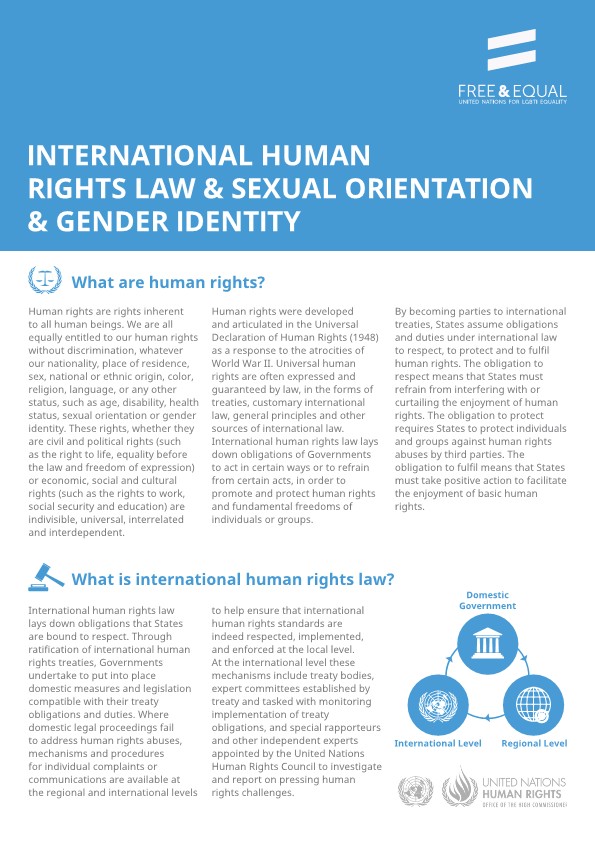 International Human Rights Law & Sexual Orientation & Gender Identity Año de publicación: 2017 Autor corporativo: UN. Office of the United Nations High Commissioner for Human Rights (UN. OHCHR) | United Nations Free & Equal What are human rights?Human rights are rights inherent to all human beings. We are all equally entitled to our human rights without discrimination, whatever our nationality, place of residence, sex, national or ethnic origin, color, religion, language, or any other status, such as age, disability, health status, sexual orientation or gender identity. These rights, whether they are civil and political rights (such as the right to life, equality before the law and freedom of expression) or economic, social and cultural rights (such as the rights to work, social security and education) are indivisible, universal, interrelated and interdependent.Human rights were developed and articulated in the Universal Declaration of Human Rights (1948) as a response to the atrocities of World War II. Universal human rights are often expressed and guaranteed by law, in the forms of treaties, customary international law, general principles and other sources of international law. International human rights law lays down obligations of Governments to act in certain ways or to refrain from certain acts, in order to promote and protect human rights and fundamental freedoms of individuals or groups.By becoming parties to international treaties, States assume obligations and duties under international law to respect, to protect and to fulfil human rights. The obligation to respect means that States must refrain from interfering with or curtailing the enjoyment of human rights. The obligation to protect requires States to protect individuals and groups against human rights abuses by third parties. The obligation to fulfil means that States must take positive action to facilitate the enjoyment of basic human rights.What is international human rights law? International human rights law lays down obligations that States are bound to respect. Through ratification of international human rights treaties, Governments undertake to put into place domestic measures and legislation compatible with their treaty obligations and duties. Where domestic legal proceedings fail to address human rights abuses, mechanisms and procedures for individual complaints or communications are available at the regional and international levels to help ensure that international human rights standards are indeed respected, implemented, and enforced at the local level. At the international level these mechanisms include treaty bodies, expert committees established by treaty and tasked with monitoring implementation of treaty obligations, and special rapporteurs and other independent experts appointed by the United Nations Human Rights Council to investigate and report on pressing human rights challenges.Is it ever legal to discriminate against lesbian, gay, bisexual, transgender or intersex people?No. The right to equality and non-discrimination are core principles of human rights, enshrined in the United Nations Charter, The Universal Declaration of Human Rights (UDHR) and human rights treaties. The opening words of the Universal Declaration of Human Rights are unequivocal: “All human beings are born free and equal in dignity and rights.”The equality and non-discrimination guarantee provided by international human rights law applies to all people, regardless of sex, sexual orientation and gender identity or “other status.” There is no fine print, no hidden exemption clause, in any of our human rights treaties that might allow a State to guarantee full rights to some but withhold them from others purely on the basis of sexual orientation and gender identity.Moreover, United Nations human rights treaty bodies have confirmed that sexual orientation and gender identity are included among prohibited grounds of discrimination under international human rights law. This means that it is unlawful to make any distinction of people’s rights based on the fact that they are lesbian, gay, bisexual or transgender (LGBT), just as it is unlawful to do so based on skin color, race, sex, religion or any other status. This position has been confirmed repeatedly in decisions and general guidance issued by several treaty bodies, such as the United Nations Human Rights Committee, the Committee on Economic, Social and Cultural Rights, the Committee on the Rights of the Child, the Committee against Torture, and the Committee on the Elimination of Discrimination against Women.What are some of the most common forms of human rights violations affecting LGBT people? The UN human rights office has documented a wide range of human rights violations committed against individuals on the basis of their sexual orientation and gender identity.These include:Violent attacks, ranging from aggressive verbal abuse and psychological bullying to physical assault, beatings, torture, kidnapping and targeted killings.Discriminatory criminal laws, often used to harass and punish LGBT people, including laws criminalizing consensual same-sex relationships, which violate rights to privacy and to freedom from discrimination.Discriminatory curbs on free speech and related restrictions on the exercise of rights to freedom of association and assembly, including laws banning dissemination of information on same-sex sexuality under the guise of restricting the spread of so-called LGBT “propaganda.”Discriminatory treatment, which can take place in a range of everyday settings, including workplaces, schools, family homes and hospitals. Without national laws prohibiting discrimination by third parties on grounds of sexual orientation and gender identity, such discriminatory treatment continues unchecked, leaving little recourse to those affected. In this context, lack of legal recognition of same-sex relationships or of a person’s gender identity can also have a discriminatory impact on many LGBT individuals. What have the UN General Assembly and Human Rights Council said on this subject?The United Nations General Assembly, in a series of resolutions, has called on States to ensure the protection of the right to life of all persons under their jurisdiction and to investigate promptly and thoroughly all killings including those motivated by the victim’s sexual orientation and gender identity (see, for example, resolution A/RES/67/168).In June 2011, the United Nations Human Rights Council became the first UN intergovernmental body to adopt a wide-ranging resolution on human rights, sexual orientation and gender identity. Resolution 17/19 expressed the Council’s “grave concern” at violence and discrimination against individuals based on their sexual orientation and gender identity, and commissioned a study on the scope and extent of these violations and the measures needed to address them.The requested study, prepared by the Office of the High Commissioner for Human Rights, was released in December 2011. It pointed to a pattern of violence and discrimination directed at individuals because of their sexual orientation and gender identity. Its findings and recommendations formed the basis of a panel discussion that took place at the Council in March 2012 – the first time a formal intergovernmental debate on the subject had been taken place at the United Nations.
 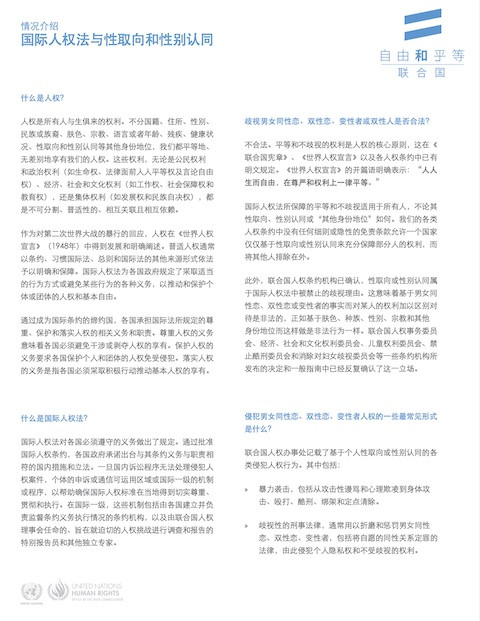 国际人权法与性取向和性别认同 Año de publicación: 2017 Autor corporativo: UN. Office of the United Nations High Commissioner for Human Rights (UN. OHCHR) | United Nations Free & Equal 什么是人权?什么是国际人权法?歧视男女同性恋、双性恋、变性者或双性人是否合法?侵犯男女同性恋、双性恋、变性者人权的一些最常见形式是什么?联合国大会及人权事务委员会对该主题有何表述?各国在尊重男女同性恋、双性恋和变性者方面有哪些法律义务?
  The Digital Skills Toolkit 2018 Año de publicación: 2018 Autor: Chris Coward Autor corporativo: International Telecommunication Union (ITU) This toolkit provides stakeholders with guidance on developing a digital skills strategy. It is intended for policymakers, along with partners in the private sector, non-governmental organizations, and academia. Its overarching aim is to facilitate the development of a comprehensive digital skills strategy at country level. It is also possible to use this guide to focus on selected priorities that require a fresh approach. Kit pratique sur les compétences numériques Año de publicación: 2018 Autor: Chris Coward Autor corporativo: International Telecommunication Union (ITU) Ce kit pratique donne des indications aux parties prenantes sur l’élaboration d'une stratégie dans le domaine des compétences numériques. Il est destiné aux décideurs de même qu’aux partenaires du secteur privé, des organismes non-gouvernementaux et des milieux universitaires. Son objectif prio- ritaire consiste à promouvoir le développement d’une stratégie globale en matière de compétences numériques au niveau des pays. Il est également possible d’utiliser ce kit pratique pour se concentrer sur certaines priorités qui nécessitent une nouvelle approche. Portada de Conjunto de herramientas para las habilidades digitales Año de publicación: 2018 Autor: Chris Coward Autor corporativo: International Telecommunication Union (ITU) Este conjunto de herramientas proporciona a las partes interesadas directrices para el desarrollo de una estrategia de habilidades digitales. Se dirige a las instancias decisorias, a los asociados del sector privado, las organizaciones no gubernamentales y los sectores académicos. Su propósito general es facilitar el desarrollo de una estrategia de habilidades digitales de amplio alcance a nivel de país. También puede utilizarse esta guía para centrarse en determinadas prioridades que exigen un reno- vado planteamiento. Комплект материалов по цифровым навыкам Año de publicación: 2018 Autor: Chris Coward Autor corporativo: International Telecommunication Union (ITU) Настоящий комплект материалов предоставляет заинтересованным сторонам руководящие указания по разработке стратегии в области цифровых навыков Он предназначен для директивных органов наряду с партнерами в частном секторе, неправительственными и академическими организациями. Его всеобъемлющая цель заключается в содействии разработке всесторонней стратегии в области цифровых навыков на уровне страны. Кроме того, данное руководство можно использовать для ориентации на избранные приоритеты, требующие свежего взгляда на вещи. 数字技能工具包 Año de publicación: 2018 Autor: Chris Coward Autor corporativo: International Telecommunication Union (ITU) 本工具包为利益相关方的数字技能战略制定提供指导,适用于政策制定者及私营部 门、非政府组织和学术界合作伙伴,其总目标是从国家层面上促进数字技能战略的全面 发展。该指南亦可用于关注选定的需要新方法的优先事项。