
Recursos
Exploren una amplia gama de recursos valiosos en GCED para profundizar su comprensión y promover su búsqueda, incidencia, enseñanza y aprendizaje.
2,255 resultados encontrados
 Los jóvenes: Protagonistas de la transformación democrática Año de publicación: 2024 Autor corporativo: Organización de Estados Iberoamericanos para la Educación, la Ciencia y la Cultura (OEI) La implicación de los jóvenes en la democracia es esencial para el desarrollo y la sostenibilidad de nuestras sociedades. Reconociendo el valor de su contribución como agentes de cambio, el proyecto Academia Ciudadana en Panamá lanzó el curso "El Rol de la Juventud en la Democracia". Este instrumento educativo se ofrece de manera gratuita a través de la plataforma www.academiaciudadana.org. La iniciativa, impulsada por la Organización de Estados Iberoamericanos (OEI), es resultado de una colaboración con el Tribunal Electoral, Fundamorgan y la Asociación Panameña de Debate (Aspade), tiene como objetivo fomentar una sociedad más justa y equitativa mediante la educación cívica de las nuevas generaciones. Daniela Hidalgo, es coordinadora institucional de Aspade, y nos explica cómo se busca transformar la participación juvenil en la vida democrática del país centroamericano.
  An intercultural program from a Balkan perspective Año de publicación: 2003 Autor: Emilia Ilieva The author focuses on the particular case of the Bosporus International Network as an intercultural program. Bosporus International Network is a network of five independent and registered NGOs in Germany, Bulgaria, Romania, Greece and Turkey and four local groups in Albania, Macedonia/FYROM, Slovenia and Hungary that share the same name, goals and aims. The goal of the network can best be described as “building bridges" between cultures.
  Preventing Violent Extremism through Sport: Technical Guide; Criminal Justice Handbook Series Año de publicación: 2020 Autor corporativo: UN. Office on Drugs and Crime (UNODC) The Technical Guide on Preventing Violent Extremism through Sport, developed in consultation with international experts, recognizes the importance of promoting the well-being of children and youth. It applies an approach that encourages prosocial behaviour and good safeguarding and welfare practices, with particular emphasis on educational and social development measures in line with the United Nations Guidelines for the Prevention of Crime.The guide, addressed mainly to policy makers and implementing organizations, has been carefully designed to support effective integration of sport-based learning in primary prevention frameworks. By adopting a five-zone approach to prevent violent extremism namely safe space, empowerment, resilience, social inclusion and education, it supports informed policy development and a Theory of Change that can shape curriculum design and content. To further support global efforts in preventing violent extremism, UNODC is also developing an e-learning module and a practical tool for trainers that will be published soon and will complement this technical guide.
  Belonging to the Homeland and Its Impact on Protecting Young People from Delinquency Año de publicación: 2018 Autor: Alla Aldeen Mohammed Autor corporativo: Imam Mohammad Ibn Saud Islamic University The file is a paper on belonging to the homeland and its impact on protecting young people from delinquency. This paper was presented at the conference entitled "The Role of Saudi Universities and Its Impact on Protecting Young People from Groups, Parties and Deviance". الانــتماء إلى الــوطن وأثــره في حمايــة الــشباب مــن الانحراف Año de publicación: 2018 Autor: Alla Aldeen Mohammed Autor corporativo: Imam Mohammad Ibn Saud Islamic University الملف عبارة عن ورقة عن الانــتماء إلى الــوطن وأثــره في حمايــة الــشباب مــن الانحراف. تم عرض هذه الورقة في المؤتمر المعنون ب "دور الجامعات السعودية وأثرها في حماية الشباب من الجماعات والأحزاب والانحراف.
  The Role of Kuwaiti Satellite Channels in Promotion of Citizenship among Kuwaiti Youth Año de publicación: 2012 Autor: Hassan Al Gharbi Autor corporativo: Middle East University The focus of the problem that the research dealt with was on the following question: Have public and private Kuwaiti satellite channels contributed to enhancing the concept of citizenship among young Kuwaitis? The researcher adopted a definition of the concept of citizenship among the multiple definitions of this concept, which was tainted by some uncertainty and disagreement. Citizenship in this study "is the awareness of belonging to a geographical area of a specific political and social goals and shared one common culture and political system." دور الفضائيات الكويتية الرسمية و الخاصة في تعزيز المواطنة لدى الشباب الكويتي Año de publicación: 2012 Autor: Hassan Al Gharbi Autor corporativo: Middle East University تركزت المشكلة التي تناولها البحث على التساؤل التالي: هل ساهمت القنوات الفضائية الكويتية العامة والخاصة في تعزيز مفهوم المواطنة بين الشباب الكويتي؟ واعتمدت الباحثة تعريفاً لمفهوم المواطنة من بين التعاريف المتعددة لهذا المفهوم ، والذي شابه بعض عدم اليقين والاختلاف. المواطنة في هذه الدراسة "هي الوعي بالانتماء إلى منطقة جغرافية لأهداف سياسية واجتماعية محددة ومشتركة في ثقافة ونظام سياسي واحد".
 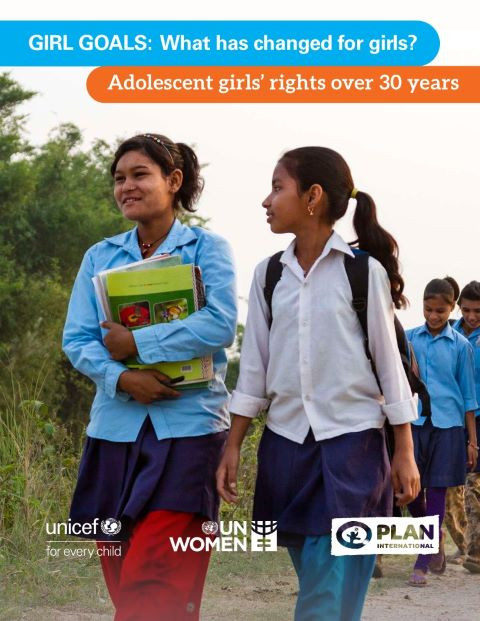 Girl Goals: What has Changed for Girls? Adolescent Girls’ Rights over 30 Years Año de publicación: 2025 Autor corporativo: United Nations Children's Fund (UNICEF) | United Nations Entity for Gender Equality and the Empowerment of Women (UN Women) | Plan International This report makes three key recommendations on action we can take now to advance adolescent girls’ rights at scale, in ways that account for fiscally constrained contexts and multiple competing priorities: 1. Ensure tangible and actionable support for adolescent girls’ voices, advocacy and action. The current generation of girls are raising their voices to be heard and are already at the forefront of making change around the world. With the right support, resources and seats at the table, adolescent girls can help transform the world for the better, shaping better policy outcomes for themselves and everyone. This is not about girls’ voices above all others, or endless consultation, but about specific, meaningful actions that ensure girls get the support they need and are heard on policy issues that matter to them. 2. Establish and track explicit targets for change for adolescent girls, who are too often invisible and sidelined Setting explicit targets to monitor outcomes for adolescent girls is key to making progress. Context-specific prioritization will be necessary, but there are some issues that stand out globally. Gaps in progress (such as child marriage gains accruing disproportionately to wealthier households) demonstrate the need forprogrammes that address poverty and economic realities alongside harmful social norms. The disproportionate number of adolescent girls not in education, employment or training, not entering the labour market as young women, and left behind when it comes to digital skills, is a threat to the gains made for girls and to economic growth that will benefit everyone. Stagnation on issues like underweight also stand out. Country- specific priorities supported by data- driven accountability mechanisms and investments are needed to translate policy commitments into change on the ground. 3. Resource and deliver smartly to unlock the social and economic dividend Governments and partners should invest in solutions proven to change outcomes across multiple SDGs at scale – for example, investing in education and skills, cash transfers and economic empowerment programmes designed to support girls. Existing systems, from maternal health care to school curricula, should be adapted to meet girls’ needs rather than creating small- scale, separate projects. Streamlined, evidence-based ‘add-ons’ – such as adding parenting support to existing maternal health-care programmes – can be cost effective and accelerate outcomes if well designed. Change is possible, and this report shows that great gains have been made. Smart investments now can transform the world for girls, families, communities and national economies. It is time to act. Engaging and Educating Women and Girls in the Prevention of Violent Conflict and Violent Extremism Año de publicación: 2014 Autor: Kathleen Kuehnast Autor corporativo: United States Institute of Peace (USIP) Dr. Kathleen Kuehnast, director of the Center for Gender and Peacebuilding at the U.S. Institute of Peace, testified on the importance of engaging and educating women and girls in conflict zones in order to prevent and mitigate violent conflict and violent extremism. Engaging and Educating Women and Girls in the Prevention of Violent Conflict and Violent Extremism Año de publicación: 2014 Autor: Kathleen Kuehnast Autor corporativo: United States Institute of Peace (USIP) Dr. Kathleen Kuehnast, directrice du Centre pour le genre et la construction de la paix (Center for Gender and Peacebuilding) à l’Institut américain pour la paix (United States Institute of Peace), témoigne de l'importance d'impliquer et d'éduquer les femmes et les jeunes filles dans les zones de conflit afin de prévenir et de contenir les conflits violents et l'extrémisme violent.