
Recursos
Exploren una amplia gama de recursos valiosos en GCED para profundizar su comprensión y promover su búsqueda, incidencia, enseñanza y aprendizaje.
2,275 resultados encontrados
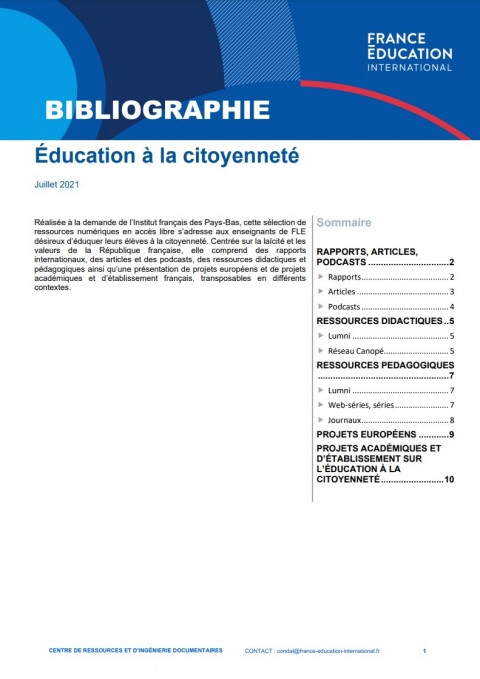 Bibliography: Citizenship Education Año de publicación: 2021 Autor corporativo: France Education International Prepared at the request of the French Institute of the Netherlands, this selection of freely accessible digital resources is aimed at French as a Foreign Language (FLE) teachers who wish to educate their students about citizenship. Focused on secularism and the values of the French Republic, it includes international reports, articles and podcasts, didactic and pedagogical resources, as well as presentations of European projects and French academic and school projects that can be adapted to various contexts. Bibliographie: Éducation à la citoyenneté Año de publicación: 2021 Autor corporativo: France Education International Réalisée à la demande de l’Institut français des Pays-Bas, cette sélection de ressources numériques en accès libre s’adresse aux enseignants de FLE désireux d’éduquer leurs élèves à la citoyenneté. Centrée sur la laïcité et les valeurs de la République française, elle comprend des rapports internationaux, des articles et des podcasts, des ressources didactiques et pédagogiques ainsi qu’une présentation de projets européens et de projetsacadémiques et d’établissement français, transposables en différents contextes.
 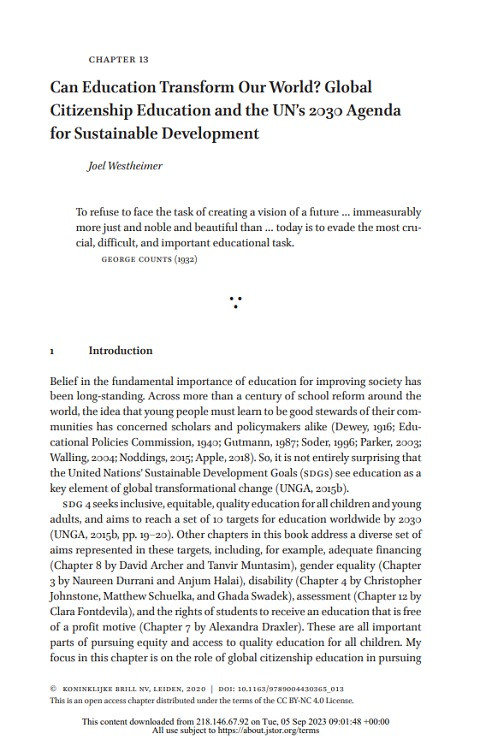 “Can Education Transform Our World?: Global Citizenship Education and the UN’s 2030 Agenda for Sustainable Development” Año de publicación: 2020 Autor: Joel Westheimer Autor corporativo: Brill This book chapter is taken from the book Grading Goal Four: Tensions, Threats, and Opportunities in the Sustainable Development Goal on Quality Education, which aims to support the immplementation of Sustainable Development Goal 4 by exploreing various tensions, threats, and opportunities. This chapter specifically focuses on the role of eucation in fostering global citizenship and how educational systems and policies can be improved to facilitate creating a sustainable society and contribute to the 2030 SDG Agenda.
 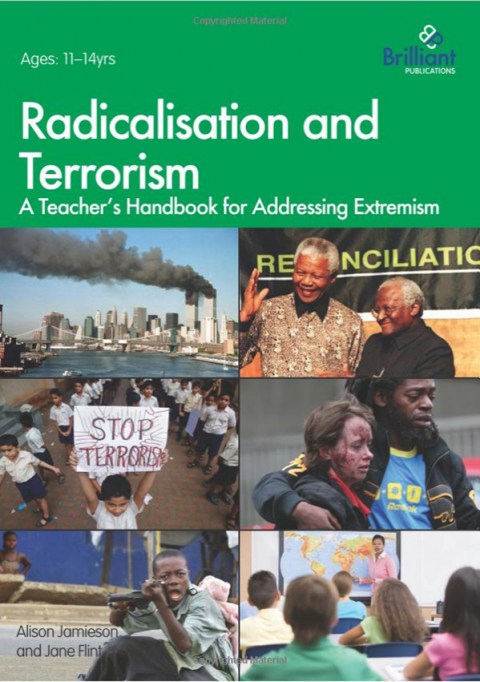 Radicalisation and Terrorism: A Teacher's Handbook for Addressing Extremism Año de publicación: 2015 Autor: Alison Jamieson | Janet Flint This practical handbook provides a reliable and objective resource to enable lower secondary school teachers to tackle the complex subjects of terrorism and radicalization with confidence. The text covers issues of citizenship, human rights and respect, civil and political engagement, the nature of identity and how we identify with others. It examines different forms of violence from bullying to the most recent examples of 21st century terrorism. Historical precedent is used to illustrate a variety of contexts in which political violence has occurred, from Assassins through Suffragettes to militancy in South Africa, Europe, the Middle East and Oceania. Radicalisation and Terrorism: A Teacher's Handbook for Addressing Extremism Año de publicación: 2015 Autor: Alison Jamieson | Janet Flint Cet outil pratique constitue une ressource fiable et objective, permettant aux professeurs de collège d’aborder les sujets complexes du terrorisme et de la radicalisation tout en étant préparés. Cet ouvrage parcourt les thèmes de la citoyenneté, des droits de l’homme et du respect, de l’engagement civique et politique, les fondements de l’identité et comment on s’identifie à l’autre. Il revient sur les différentes formes de violence : du harcèlement scolaire au phénomène plus récent de terrorisme tel que pratiqué au XXIème siècle. L’auteur s’appuie sur l’histoire pour illustrer la diversité des contextes dans lesquels la violence politique est apparue, des Nizârites aux Suffragettes, sans oublier le militantisme sud-africain, européen, du Moyen-Orient et d’Océanie.
 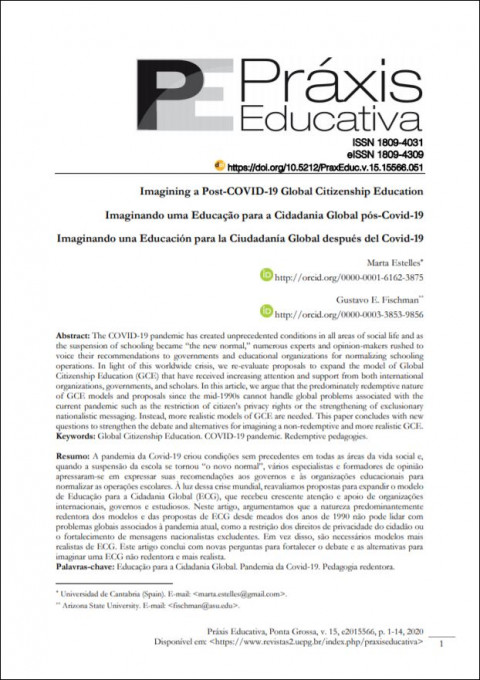 Imagining a Post-COVID-19 Global Citizenship Education Año de publicación: 2020 Autor: Marta Estelles | Gustavo E. Fischman Autor corporativo: State University of Ponta Grossa The COVID-19 pandemic has created unprecedented conditions in all areas of social life and as the suspension of schooling became “the new normal,” numerous experts and opinion-makers rushed to voice their recommendations to overnments and educational organizations for normalizing schooling operations. In light of this worldwide crisis, we re-evaluate proposals to expand the model of Global Citizenship Education (GCE) that have received increasing attention and support from both international organizations, governments, and scholars.In this article, we argue that the predominately redemptive nature of GCE models and proposals since the mid-1990s cannot handle global problems associated with the current pandemic such as the restriction of citizen’s privacy rights or the strengthening of exclusionary nationalistic messaging. Instead, more realistic models of GCE are needed. This paper concludes with new questions to strengthen the debate and alternatives for imagining a non-redemptive and more realistic GCE. Imaginando una educación para la ciudadanía global después del Covid-19 Año de publicación: 2020 Autor: Marta Estelles | Gustavo E. Fischman Autor corporativo: State University of Ponta Grossa La pandemia del Covid 19 ha creado condiciones sin precedentes en todas las áreas de la vida. A medida que la suspensión de las actividades escolares se ha convertido en "la nueva normalidad", numerosos expertos y formadores de opinión se han apresurado a lanzar sus recomendaciones a gobiernos y organizaciones educativas para normalizar las operaciones escolares. En este contexto novedoso, analizamos las propuestas para expandir el modelo de Educación para la Ciudadanía Global (ECG) que está siendo cada vez más apoyada por organizaciones internacionales, gobiernos y académicos.En este artículo, sostenemos que la orientación redentora que los modelos y propuestas de ECG han desarrollado en las últimas décadas resulta muy limitada para entender y resolver problemas actuales como la restricción de derechos de privacidad de la ciudadanía o el fortalecimiento de los nacionalismos excluyentes. En cambio, se necesitan modelos más realistas de ECG. Este documento concluye con nuevas preguntas para robustecer el debate y las alternativas para imaginar una ECG realista y no redentora. Palabras clave: Educación para la ciudadanía global. Pandemia de Covid-19. Pedagogía redentora.
 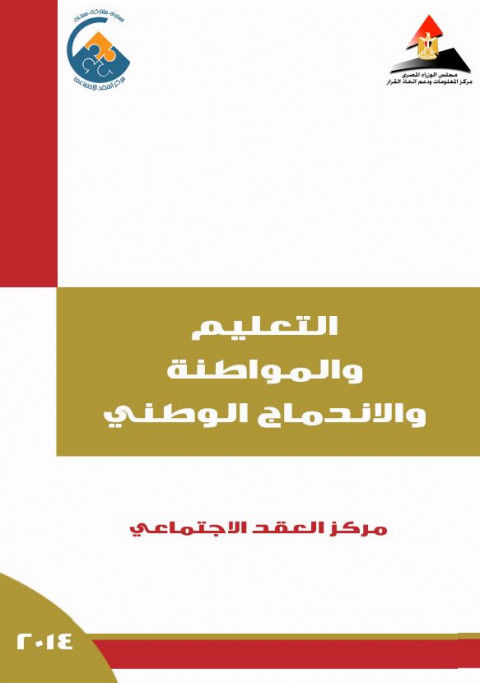 Education, Citizenship and National Integration Año de publicación: 2014 Autor: Radwa Ammar Autor corporativo: Social Contract Center This research paper is an introduction that explains the role of citizenship education as a basis for building a cohesive society capable of facing challenges. The paper reviews various international concepts and experiences to shed light on the importance of conducting in-depth field studies to discuss the relationship between citizenship education and national integration among members of society. It also aims to identify the most important topics, and ways of offering that It is compatible with the targeted communities by these educational programs, and to develop a strategy for educational institutions in the country to adopt this type of studies. التعليم والمواطنة والاندماج الوطني Año de publicación: 2014 Autor: Radwa Ammar Autor corporativo: Social Contract Center تعتبر هذه الورقة البحثية مقدمة توضح دور تعليم المواطنة كأساس لبناء مجتمع متماسك قادر على مواجهة التحديات من خلال استعراض مفاهيم وتجارب دولية مختلفة لإلقاء الضوء على أهمية إجراء دراسات متعمقة ميدانية لبحث العلاقة بين تعليم المواطنة والاندماج الوطني بين أفراد المجتمع، وتحديد أهم الموضوعات، وسُبل الطرح التي تتوافق مع المجتمعات المستهدفة من قبل هذه البرامج التعليمية، ووضع استراتيجية للمؤسسات التعليمية في الدولة لكي تتبنى هذا النوع من الدراسات.ولا تتعرض هذه الورقة بالرصد والتحليل للواقع المصري لأن أي دراسة وصفية دون البحث الميداني في الوقت الراهن لن تعرض سوى آراء مبنية بالأساس على انطباعات لا تُمكِّن من التصدي للأزمات التي يواجهها الواقع في ظل غياب دراسات متعمقة تتناول العلاقة بين تعليم المواطنة والتغييرات التي شهدها المجتمع مؤخرًا، وسُبل مواجهة التحديات.
 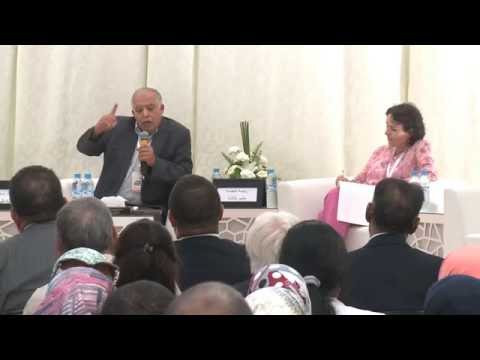 Education and Citizenship: Summer University 2016 Año de publicación: 2016 Autor: Abdullah Saaf Autor corporativo: General Delegation for Prison Administration and Reintegration (DGAPR) This video is a lecture given to women prisoners in Morocco, and it is a rehabilitation program. The lecture by Dr. Abdullah Sa`f talks about citizenship and inclusion in society, and discusses the relationship between education and citizenship.