
Recursos
Exploren una amplia gama de recursos valiosos en GCED para profundizar su comprensión y promover su búsqueda, incidencia, enseñanza y aprendizaje.
2,255 resultados encontrados
 التعليم في أفريقيا: إدماج الإنصاف في صميم السياسات التعليمية; ملخص تنفيذي Año de publicación: 2023 Autor corporativo: UNESCO Dakar | Union Africaine Ce rapport fait suite à la demande formulée par les États membres de l'Union Africaine au cours de la Conférence panafricaine de haut niveau sur l’éducation de 2018. Il vise à soutenir les efforts entrepris par les pays africains afin d’accélérer la réalisation des cibles et des objectifs stratégiques fixés dans le Programme 2030 et la Stratégie continentale de l’éducation pour l’Afrique (CESA). Ce premier rapport met en lumière la nécessité d’accorder une place centrale à l’équité, sans laquelle les efforts d’amélioration de l’accès à l’éducation et de sa qualité pourraient involontairement creuser les inégalités existantes. This report follows the request made by the Member States of the African Union during the 2018 Pan-African High-Level Conference on Education. It aims to support the efforts undertaken by African countries to accelerate the achievement of the targets and strategic objectives set out in the 2030 Agenda and the Continental Education Strategy for Africa (CESA). This first report highlights the need to place equity at the heart of efforts to improve access to and the quality of education, without which efforts to improve access to and the quality of education could inadvertently widen existing inequalities.
  Mapping of Media Information Literacy in Jordan Año de publicación: 2018 Autor corporativo: UNESCO Amman This study has come out as results of conducting a regional mapping exercise in Jordan to identify organizations that operate in the field of MIL to:understand the general landscape of MIL in Jordan to pinpoint areas in which UNESCO should intervene,identify different stakeholders that operate in the field of MIL and understand the scope of their work in terms of activities, region and target,determine the areas of MIL that are considered priorities by organizations,identify the key skills covered by the different initiatives and the nature of these activities,determine the challenges organizations are facing in implementing MILThe results of the study revealed that organizations exhibit considerable enthusiasm for the field of MIL and consider the competencies that fall within its scope as paramount in building a society that is empowered to successfully navigate the increasingly complex media sphere and use this knowledge to further contribute to the societal, cultural, educational and scientific development.
  Gender and Rural Development in Eastern Europe and Central Asia: Key Issues Año de publicación: 2016 Autor corporativo: Food and Agriculture Organization of the United Nations (FAO) This report provides a brief overview and description of the critical issues affecting the situation of rural women in the region. This overview has been compiled with the aim of informing all stakeholders and using this information in public campaigns and to achieve greater impact of interventions for development.
  Гендер и развитие сельских районов в Восточной Европе и Центральной Азии: Основные проблемы Año de publicación: 2016 Autor corporativo: Продовольственная и сельскохозяйственная организация Объединённых Наций (ФАО) В данном отчете представлен краткий обзор и описание важнейших вопросов, оказывающих влияние на положение женщин в сельских районах в регионе. Данный обзор составлен с целью информирования всех заинтересованных сторон и использования этой информации в общественных кампаниях и для достижения большей результативности интервенций по развитию.
 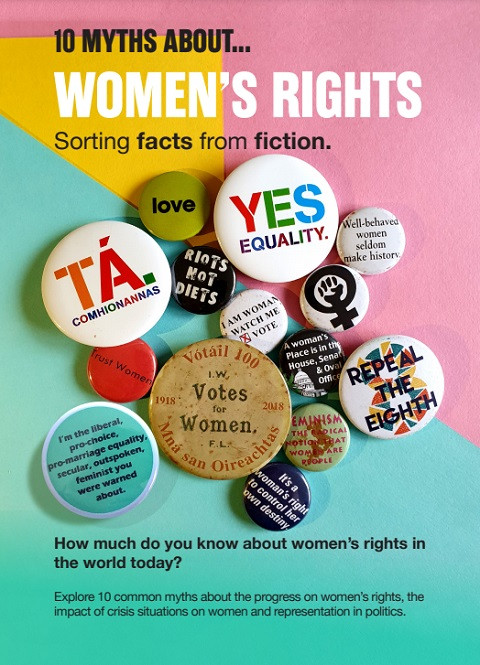 10 Myths About Women’s Rights: Sorting Facts From Fiction Año de publicación: 2020 Autor: Toni Pyke | Colm Regan Autor corporativo: DevelopmentEducation.ie Gender-based inequality is one of the most enduring and deep-seated discriminations. It affects all regions, classes and sectors. In most countries, it is maintained and defended in most of the same ways. One key component of that maintenance is a set of myths that are repeated time and time again.This pocket-size booklet includes:Why thinking about women’s rights matters10 short myths about progress on equality, who benefits from feminism, the realities of women’s health and the impact of COVID-19.Links to the Sustainable Development GoalsReferences per each myth following a fact or fiction approach and an explainerThe 10 Myths About…. series looks to sort facts from fiction on key global development, human rights and justice issues.Download 10 Myths About Women’s Rights PDFTest your knowledge and take the 10 Myths About Women’s Rights quiz or share with your group / class / friends For the latest fact checks and factsheets more on the fact checking project and development ideas, issues and debates, visit our What The Fact? project.
  Gender-Based Hate Crime Año de publicación: 2021 Autor corporativo: Organization for Security and Co-operation in Europe (OSCE) Gender-based hate crimes are a consequence of gender inequalities and disproportionately affect women, as well as anyone perceived as not complying with prevailing gender norms. Gender-based hate crimes often seek to intimidate and suppress ways of life or expressions of identity that are perceived as not complying with traditional gender norms. They have a significant, long-lasting impact on the victims, and undermine security and social cohesion by perpetuating gender inequalities. The existence of such crimes also underscores wider trends of intolerance towards other groups. Everyone has a role to play in countering this and all forms of intolerance.
  Education in a Post-COVID World: Additional Considerations (In-Progress Reflection; No.43, 2021) Año de publicación: 2021 Autor: Renato Opertti Autor corporativo: UNESCO International Bureau of Education (IBE) This discussion document analyses some implications of the ideas proposed in the seminal UNESCO document “Education in a post-COVID world: Nine ideas for public action” (2020). Based on the work of the International Commission on the Futures of Education, the documents’ contributors included prominent figures with a wide range of professional and policy experience who hail from various regions of the world. The set of nine interconnected ideas illuminates the way forward toward the transformation of education and education systems and a reimagined future seen through a progressive lens. On one hand, it reaffirms basic principles, understandings, and commitments with regard to education as a global common good and universal human right; it also articulates the need to both reinvent multilateralism for a new global order and, crucially, to mobilize ideas and funding for transforming education. On the other hand, the document advocates for a comprehensive educational agenda, including the following critical issues: (i) visualizing educators as decision-makers in educational systems; (ii) appreciating students as active actors with rights; (iii) recognizing the value and specificity of the school space; (iv) addressing the dilemmas around technology’s ability to serve as an equalizer of opportunities; and (v) revisiting educational content for the sustainability of younger generations. L’éducation dans un monde post-Covid: considérations supplémentaires (Réflexion en cours; No. 43, 2021) Año de publicación: 2021 Autor: Renato Opertti Autor corporativo: UNESCO International Bureau of Education (IBE) Ce document de discussion analyse certaines implications des idées proposées dans le document initial « L’éducation dans un monde post-COVID : Neuf idées pour l’action publique » (2020) produit par la Commission internationale sur les futurs de l’éducation. Parmi les contributeurs de ce document figurent des experts éminents ayant une large expérience professionnelle et politique, provenant de diverses régions du monde. L’ensemble de ces neuves idées interconnectées éclaire la voie à suivre pour transformer l’éducation et les systèmes éducatifs et concevoir l’avenir dans une optique progressiste. D’une part, il réaffirme les principes de base, la compréhension et les engagements concernant l’éducation en tant que bien commun mondial et droit de l’homme universel ; il exprime également la nécessité de réinventer le multilatéralisme pour un nouvel ordre mondial et, surtout, de mobiliser des idées et des fonds pour transformer l’éducation. D’autre part, le document plaide en faveur d’un programme éducatif global, incluant les questions critiques suivantes: (i) visualiser les éducateurs comme des décideurs dans les systèmes éducatifs ; (ii) considérer les étudiants comme des acteurs actifs ayant des droits ; (iii) reconnaître la valeur et la spécificité de l’espace scolaire ; (iv) aborder les dilemmes autour de la capacité de la technologie à combler les inégalités ; et (v) revoir les contenus d’enseignement pour la durabilité des jeunes générations. Educación en un mundo post-COVID: consideraciones adicionales (Reflexiones en Progreso; No.43, 2021) Año de publicación: 2021 Autor: Renato Opertti Autor corporativo: UNESCO International Bureau of Education (IBE) Este documento de discusión analiza algunas implicaciones de las ideas propuestas en el documento seminal “Educación en un mundo post-COVID: Nueve ideas para la acción pública” (2020) producido por la Comisión Internacional sobre el Futuro de la Educación. Entre los colaboradores del informe se encuentran destacadas figuras con una amplia experiencia profesional y política procedentes de diversas regiones del mundo. El conjunto de nueve ideas interconectadas ilumina el camino a seguir hacia la transformación de la educación y los sistemas educativos y hacia un futuro reinventado visto a través de una lente progresista. Por un lado, reafirma los principios, entendimientos y compromisos básicos con respecto a la educación como bien común global y derecho humano universal. También, articula la necesidad tanto de reinventar el multilateralismo para un nuevo orden global como, fundamentalmente, de movilizar ideas y financiación para transformar la educación. Por otro lado, el documento aboga por una agenda educativa integral que incluya los siguientes aspectos críticos: (i) visualizar a los educadores como tomadores de decisiones en los sistemas educativos; (ii) valorar a los estudiantes como agentes activos con derechos; (iii) reconocer el valor y la especificidad del espacio escolar; (iv) abordar los dilemas en torno a la capacidad de la tecnología para servir como igualadora de oportunidades; y (v) revisar los contenidos educativos para la sostenibilidad de las generaciones más jóvenes.
  Потенциал будущего сотрудничества между республикой Узбекистан и Шанхайской организацией сотрудничества (ШОС) (XXI Век: Наука и образование; Том1; №1, 2024) Año de publicación: 2024 Autor: Феруза Назарова | Этибор Султонова Autor corporativo: Ташкентский государственный институт востоковедения В статье рассматривается значение инициатив для сотрудничества между Республикой Узбекистан и Шанхайской организацией сотрудничества (ШОС) и ключевые аспекты этого сотрудничества, а также перспективы дальнейшего роста. В статье предлагается несколько путей укрепления этого сотрудничества, включая расширение торгово-экономических связей, обмен технологиями и опытом, а также реализацию совместных инициатив и проектов, способствующих устойчивому развитию региона.