
Recursos
Exploren una amplia gama de recursos valiosos en GCED para profundizar su comprensión y promover su búsqueda, incidencia, enseñanza y aprendizaje.
2,255 resultados encontrados
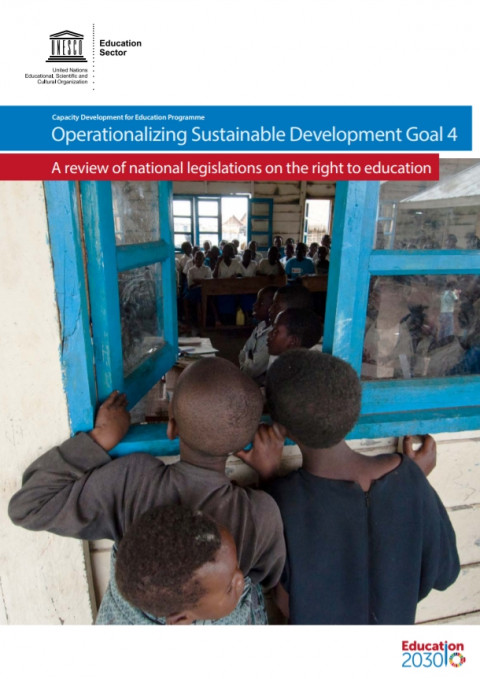 Opérationnaliser l'Objectif de développement durable 4: examen des législations nationales sur le droit à l'éducation Año de publicación: 2017 Autor: Santini, Delphine Autor corporativo: UNESCO Dans le cadre du Programme de développement des capacités pour l’éducation (CapED) sur l’opérationnalisation de l’ODD 4 au niveau des pays, ce document examine le rôle déterminant de la législation relative au droit à l’éducation en vue d’atteindre les cibles de l’ODD 4 dans les pays les moins avancés. Les cadres juridiques nationaux relatifs au droit à l’éducation dans 11 pays sont passés en revue, tout en suggérant quelques recommandations de portée plus globale, à la fois pour l’élaboration de politiques et le renforcement du travail normatif.
  [Video] Education Transforms Lives Año de publicación: 2017 Autor corporativo: UNESCO Education transforms lives every day and in every corner of society. This video explores the power of education and UNESCO’s role in leading and coordinating the Education 2030 Agenda, which is part of a global movement to eradicate poverty through 17 Sustainable Development Goals by 2030.Education is the right of every woman, man and child. Together, we are shaping the global citizens of tomorrow, empowered on the path of education to build a more sustainable future.UNESCO's campaign "Education transforms lives" supports the effort to build peace in the minds of men and women. [Видео] Образование меняет жизни Año de publicación: 2017 Autor corporativo: Организация Объединенных Наций по вопросам образования, науки и культуры (UNESCO) Образование преображает жизнь людей каждый день во всех слоях общества. Ролик повествует о важности образования и роли ЮНЕСКО в ведении и координации Повестки дня «Образование-2030», которая является частью глобального движения для искоренения бедности посредством достижения 17 Целей устойчивого развития до 2030 года.Каждая женщина, каждый мужчина и каждый ребенок имеют право на образование. Вместе мы создаем мировых сограждан завтрашнего дня и даем им силу образования для построения более устойчивого будущего.Кампания ЮНЕСКО "Образование преображает жизнь людей" направлена на то, чтобы нести мир в сознание мужчин и женщин.
 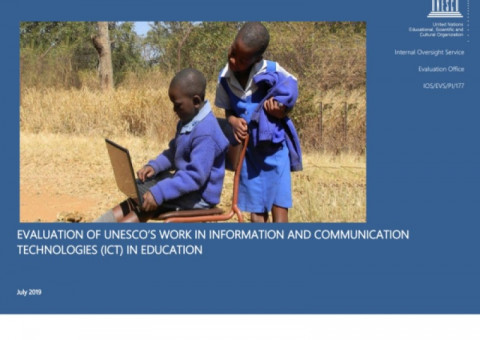 Evaluation of UNESCO's work in information and communication technologies (ICT) in education Año de publicación: 2019 Autor: Seán Ó Siochru and Graham Attwell Autor corporativo: UNESCO ICT in Education is a fast-growing area globally that offers many strategic opportunities. As the leader and coordinator of the SDG 4 – Education 2030 with the aim to “Ensure inclusive and equitable quality education and promote lifelong learning opportunities for all”, UNESCO has the mandate and expertise needed to strategically position itself as a world leader in this field. UNESCO’s work in ICT in Education aims at enhancing the quality and relevance of learning and at strengthening inclusion. While technology can facilitate wider access to education and bridge learning divides, can advance gender equality and inclusion as well as digital skills development, the rapidly changing technologies and work processes require the development of new pedagogies, both for the use of ICT for teaching and learning in the classroom and through open access and distance learning. Compared to other players, UNESCO leverages its comparative strengths in its ICT in Education interventions - especially its impartiality, convening power, and policy expertise - through an inclusive and humanistic approach to achieving quality education in coherence with Sustainable Development Agenda 2030. Its expertise across all levels of Education and its multidisciplinary potential of working across its Programme Sectors are also considered among UNESCO’s specific strengths. The evaluation revealed that UNESCO achieved important results, at the level of the learning environment, at the policy level and in institutional capacity building, but it also showed that UNESCO still needs to strengthen its positioning and visibility within the wider landscape of ICT in Education. For example, UNESCO has to continue positioning itself for producing forward-looking knowledge on ICT in Education and as a laboratory of ideas for future-oriented thinking. While the evaluation came across various specific interventions successfully addressing the needs of disadvantaged groups, the evaluation found that considerations of inclusion and gender equality were not consistently mainstreamed into policy-related and capacity building interventions. Other challenges are mainly linked to the current dispersion of resources and fragmentation of expertise across different entities within the Organization, which also leads to reduced visibility. While the key entities active in this area recognize that they are working within a common theme, collaboration and coordination still needs to be improved. The strategic measures proposed by the evaluation towards an overall organizational framework for ICT in Education aim at establishing an enabling environment for inter- and multidisciplinary approaches and greater coherence and collaboration.
  Facing the facts: the case for comprehensive sexuality education Año de publicación: 2019 Autor: Global Education Monitoring Report Team Autor corporativo: UNESCO Comprehensive sexuality education is an essential part of a good quality education that helps prepare young people for a fulfilling life in a changing world. It improves sexual and reproductive health outcomes, promotes safe and gender equitable learning environments, and improves education access and achievement. This paper, produced jointly with the Section for Health and Education at UNESCO, discusses how governments can overcome social resistance and operational constraints to scale up these programmes as part of their commitment to SDG 4, the global education goal. Regarder la réalité en face: pourquoi faut-il promouvoir l'éducation complète à la sexualité Año de publicación: 2019 Autor: Global Education Monitoring Report Team Autor corporativo: Organisation des Nations Unies pour l'éducation, la science et la culture (UNESCO) L'éducation complète à la sexualité est un élément indispensable d'une éducation de qualité qui aide les jeunes à s'épanouir dans un monde en mutation. Elle améliore les résultats en matière de santé sexuelle et reproductive, crée les conditions d'un apprentissage sûr et équitable du point de vue du genre, élargit l'accès à l'éducation et améliore les résultats scolaires. Ce document d'orientation, préparé avec la section de la santé et de l'éducation de l'UNESCO, explique comment les gouvernements peuvent surmonter les résistances sociales et les contraintes opérationnelles pour amplifier ces programmes, conformément à leur engagement envers l'ODD 4, l'objectif mondial d'éducation. Encarar los hechos: el caso de la educación integral en sexualidad Año de publicación: 2019 Autor: Global Education Monitoring Report Team Autor corporativo: Organización de las Naciones Unidas para la Educación, la Ciencia y la Cultura (UNESCO) La educación integral en sexualidad forma parte esencial de una educación de buena calidad que ayude a preparar a las y los jóvenes para llevar una vida plena en un mundo en evolución. Dicha educación mejora la salud sexual y reproductiva, promueve entornos de aprendizaje seguros y equitativos en cuanto al género y favorece el acceso a la educación y el rendimiento escolar. En este documento, elaborado conjuntamente con la Sección de la Salud y la Educación de la UNESCO, se analiza cómo los gobiernos pueden superar la resistencia social y las limitaciones operativas para ampliar estos programas en el marco de su compromiso con el ODS 4, el objetivo mundial relativo a la educación.
  4th Meeting of the SDG-Education 2030 Steering Committee, Paris, 28 February-02 March 2018: meeting report Año de publicación: 2018 Autor corporativo: UNESCO This report summarizes the deliberations, the main recommendations adopted, and the decisions made at the 4th meeting of the SDG-Education 2030 Steering Committee (Paris, 28 February - 2 March 2018).The objectives of the meeting were: To define positions and recommendations of the SDG-Education 2030 Steering Committee on key strategic areas. To agree on a strategy for global review, monitoring and reporting process, in view of HLPF 2018 and the 2019 Reviews. To refine the advocacy, communication and outreach strategy of the SDG-Education 2030 Steering Committee To define next steps for the SDG-Education 2030 Steering Committee (next meeting, rotation of members, and the Global Education Meeting 2018). Quatrième Réunion du Comité directeur ODD-Education 2030, Paris, 28 février-02 mars 2018: rapport de la reunion Año de publicación: 2018 Autor corporativo: Organisation des Nations Unies pour l'éducation, la science et la culture (UNESCO) Le présent rapport résume les débats qui ont eu lieu lors de la quatrième réunion du Comité directeur ODD – Éducation 2030 (Paris, 28 février – 2 mars 2018) et reprend les principales recommandations et décisions adoptées.La réunion s’était fixé les objectifs suivants : Définir les positions et les recommandations du Comité directeur ODD – Éducation 2030 dans des domaines stratégiques clés. Convenir d’une stratégie globale portant sur le processus d’examen, de suivi et d’établissement de rapports en vue de l’examen du HLPF 2018 et 2019. Affiner la stratégie du Comité directeur ODD – Éducation 2030 en matière de plaidoyer, de communication et de sensibilisation. Définir les prochaines étapes du Comité directeur ODD – Éducation 2030 (prochaine réunion, renouvellement des membres et Réunion mondiale sur l’éducation 2018).
  Making evaluation work for the achievement of SDG 4 target 5: equality and inclusion in Education Año de publicación: 2019 Autor corporativo: UNESCO The adoption of the Sustainable Development Goals (SDGs) and the Education 2030 Framework for Action has placed gender parity, equality and inclusion in education at the heart of the international development agenda and is specifically formulated in SDG 4 Target 5. Now, as never before, relevant and contextualised evidence, driven in part by robust evaluation data, is needed to track and strengthen progress on educational equity. To this end, a group of international organisations, led by UNESCO, have combined efforts to explore how their education evaluations can better support Member States to strengthen progress on gender parity, equality and inclusion in education. The following report synthesises evidence from publicly available independent evaluations from 13 organisations, highlighting evidence gaps and summarising ‘what works’ for whom and in what contexts for advancing gender equality and equity for vulnerable groups. The study also reports on responses to the synthesis from national stakeholders in five countries: Ghana, Guatemala, Lebanon, Nepal and Peru. The report culminates in a discussion and recommendations, which outline the need for greater coordination and collaboration in four key areas to further enhance the contribution of evaluations to global and country level progress on SDG 4 Target 5.