
Recursos
Exploren una amplia gama de recursos valiosos en GCED para profundizar su comprensión y promover su búsqueda, incidencia, enseñanza y aprendizaje.
2,255 resultados encontrados
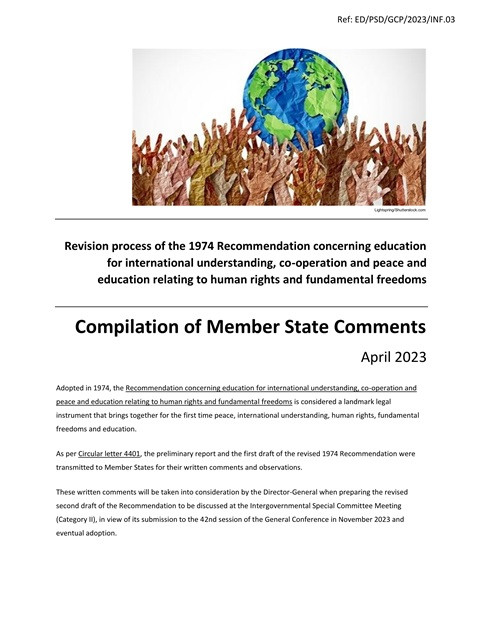 Revision Process of the 1974 Recommendation concerning Education for International Understanding, Co-operation and Peace and Education relating to Human Rights and Fundamental Freedoms: Compilation of Member State Comments Año de publicación: 2023 Autor corporativo: UNESCO Adopted in 1974, the Recommendation concerning education for international understanding, co-operation and peace and education relating to human rights and fundamental freedoms is considered a landmark legal instrument that brings together for the first time peace, international understanding, human rights, fundamental freedoms and education. As per Circular letter 4401, the preliminary report and the first draft of the revised 1974 Recommendation were transmitted to Member States for their written comments and observations. These written comments were taken into consideration by the Director-General when preparing the revised second draft of the Recommendation to be discussed at the Intergovernmental Special Committee Meeting (Category II), in view of its submission to the 42nd session of the General Conference in November 2023 and eventual adoption.
  UNESCO Futures of Education Report Explained by Members of the International Commission Año de publicación: 2022 Autor corporativo: UNESCO Initiated by UNESCO, the International Commission on the Futures of Education has prepared a new report on how education can best shape the future of humanity and the planet. In this video, members of the Commission and its chair explain the main recommendations and defining features of their report, Reimagining our futures together: A new social contract for education. The report is part of UNESCO’s Futures of Education initiative which aims to rethink education and shape the future. The initiative is catalyzing a global debate on how knowledge, education and learning need to be reimagined in a world of increasing complexity, uncertainty, and precarity.
  The Impact of Climate Displacement on the Right to Education Año de publicación: 2020 Autor corporativo: UNESCO Ce rapport tente d'expliquer les conséquences du réchauffement climatique sur l'éducation des populations, vouées à se déplacer pour fuir la dégradation de leur environnement, ce qui empêche les enfants de suivre une scolarisation complète et de qualité. This report attempts to explain the consequences of global warming on the education of populations, who are forced to move to escape the degradation of their environment, preventing children from receiving a complete, quality education. Los efectos del desplazamiento climático sobre el derecho a la educación Año de publicación: 2020 Autor corporativo: UNESCO Ce rapport tente d'expliquer les conséquences du réchauffement climatique sur l'éducation des populations, vouées à se déplacer pour fuir la dégradation de leur environnement, ce qui empêche les enfants de suivre une scolarisation complète et de qualité. This report attempts to explain the consequences of global warming on the education of populations, who are forced to move to escape the degradation of their environment, preventing children from receiving a complete, quality education. L’impact du déplacement climatique sur le droit à l’éducation Año de publicación: 2020 Autor corporativo: UNESCO Ce rapport tente d'expliquer les conséquences du réchauffement climatique sur l'éducation des populations, vouées à se déplacer pour fuir la dégradation de leur environnement, ce qui empêche les enfants de suivre une scolarisation complète et de qualité. This report attempts to explain the consequences of global warming on the education of populations, who are forced to move to escape the degradation of their environment, preventing children from receiving a complete, quality education.
 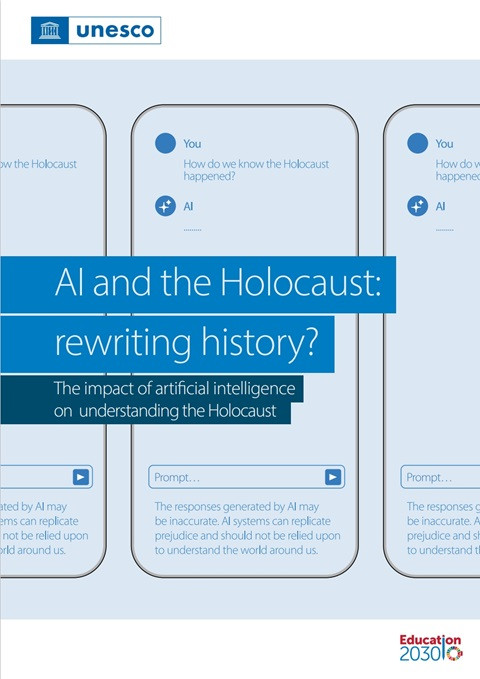 AI and the Holocaust: Rewriting History?; The Impact of Artificial Intelligence on Understanding the Holocaust Año de publicación: 2024 Autor: Mykola Makhortykh | Heather Mann Autor corporativo: UNESCO The threats associated with AI on safeguarding the record of the Holocaust are manifold, including the potential for manipulation by malicious actors, the introduction of falsehoods or dissemination of biased information, and the gradual erosion of public trust in authentic records. This paper provides a warning of what is at stake for the preservation of historical truth in a digital era increasingly mediated by AI. It highlights five major concerns:1. AI automated content may invent facts about the Holocaust2. Falsifying historical evidence: Deepfake Technology3. AI models can be manipulated to spread hate speech4. Algorithmic bias can spread Holocaust denial5. Oversimplifying history While there are some benefits to be gained, such as enhanced engagement and interaction opportunities for learners, as well as more efficient data processing capabilities for researchers, to navigate these challenges and capitalize on the benefits, it’s essential for AI designers, policymakers, educators, and researchers to collaborate closely. Only AI systems equipped with robust safeguards and human rights assessments, coupled with an increased focus on developing digital literacy skills, can uphold the integrity of historical truth and ensure the responsible use of artificial intelligence.
  The Price of Inaction: The Global Private, Fiscal and Social Costs of Children and Youth Not Learning Año de publicación: 2024 Autor: Giorgio Brunello | Lorenzo Rocco | Matthias Eck Autor corporativo: UNESCO | Organisation for Economic Co-operation and Development (OECD) | Commonwealth Secretariat Despite efforts by countries, the number of out-of-school children remains significant, with 128 million boys and 122 million girls excluded from schooling. Educational skills deficits are also immense – 57 per cent of the world’s children have not gained basic skill levels. UNESCO, OECD and the Commonwealth Secretariat have developed the first global report to illustrate the monetary costs to economies around the world of leaving children and youth behind in education. Using available evidence, the report calculates the costs, globally and by region, of children and youth that are not in school or gaining basic skills. Calculations are also provided for twenty selected countries in which there are gender disparities in education at either girls’ or boys’ expense. If governments were to increase efforts so that every child was in school and achieving basic skills, the future world GDP would raise by more than US$6.5 trillion annually, not to mention eliminating the social costs of failure. This publication offers the evidence and insights that show that for economic development to accelerate, so must prioritizations and investments in education and gender-transformative action.
  [Summary] The Price of Inaction: The Global Private, Fiscal and Social Costs of Children and Youth Not Learning Año de publicación: 2024 Autor corporativo: UNESCO | Organisation for Economic Co-operation and Development (OECD) | Commonwealth Secretariat Education is a fundamental human right for all. The United Nations Sustainable Development Goal (SDG) 4 on education has received considerable attention since its adoption in 2015. But more than halfway through the implementation period, achieving the ambitious agenda of inclusive and equitable quality education for all by 2030 remains a significant challenge for countries around the globe. As this report shows, the US$10 trillion social cost of failing to educate all the world’s children is just too high. This is the summary of The Price of Inaction: The Global Private, Fiscal and Social Costs of Children and Youth Not Learning. [Resumen] El precio de la inacción: el costo global privado, fiscal y social de que los niños, niñas y jóvenes no aprendan Año de publicación: 2024 Autor corporativo: UNESCO | Organisation for Economic Co-operation and Development (OECD) | Commonwealth Secretariat La educación es un derecho humano fundamental para todas y todos. El Objetivo de Desarrollo Sostenible (ODS) 4 de las Naciones Unidas sobre educación ha recibido una atención considerable desde su adopción en 2015. Sin embargo, a más de la mitad del periodo de implementación, la consecución de la ambiciosa agenda de una educación de calidad inclusiva y equitativa para todos en 2030 sigue siendo un desafío considerable para los países del mundo entero. Como muestra este estudio, el costo social de 10 billones de dólares de no educar a todas las niñas y todos los niños del mundo es demasiado elevado. [Résumé] Le prix de l’inaction : les coûts privés, fiscaux et sociaux à l’échelle mondiale des enfants et des jeunes qui n’apprennent pas Año de publicación: 2024 Autor corporativo: UNESCO | Organisation for Economic Co-operation and Development (OECD) | Commonwealth Secretariat L'éducation est un droit humain fondamental pour tous. L'objectif de développement durable (ODD) 4 des Nations Unies sur l'éducation a suscité une attention considérable depuis son adoption en 2015. Cependant, à plus de la moitié de la période de mise en œuvre, atteindre l'ambitieux objectif d'une éducation de qualité, inclusive et équitable pour tous d'ici 2030 reste un défi majeur pour les pays du monde entier. Comme le montre ce rapport, le coût social de 10 000 milliards de dollars américains lié à l'échec de l'éducation de tous les enfants dans le monde est tout simplement trop élevé.