
Recursos
Exploren una amplia gama de recursos valiosos en GCED para profundizar su comprensión y promover su búsqueda, incidencia, enseñanza y aprendizaje.
1,852 resultados encontrados
 全球公民社会与全球公民教育 Año de publicación: 2014 Autor: Feng Jianjun 全球化时代产生全球公民社会,全球公民社会需要全球公民。全球公民不仅生活在全球化时代,更要具有全球意识和人类关怀,并愿意为世界的和平与人类的发展、全球的公平与正义、人与自然的可持续发展采取积极的行动。培养负责任的全球公民,是全球化时代赋予公民教育的新使命。全球公民教育,就是培养具有全球意识并愿意为全球和人类的发展而积极行动的负责任的公民的教育,包括人权和人道主义教育、全球意识和全球责任教育、环境和可持续发展教育、国际理解教育与多元文化教育。
  The Concept, Values and Implementation Models of GCED Año de publicación: 2013 Autor: Lu Lihua, Jiang Junhe “Global Citizenship education” aims to cultivate global citizens with an international perspective and global awareness. At present, there are more and more countries focusing on developing the core education value including” equity and justice”, “survival and development” and “democracy and rationality” and builds the global citizenship education network. “全球公民”教育基本内涵、价值诉求与实践模式 Año de publicación: 2013 Autor: Lu Lihua, Jiang Junhe “全球公民”教育旨在培养具有国际视野和全球意识的世界公民。当前,世界各国逐渐确立了以“公平与正义”、“生存与发展”、“民主与理性”为核心的“全球公民”教育价值诉求,实施“全球公民”教育的立体化教育网络也正在一些国家和地区悄然形成。
 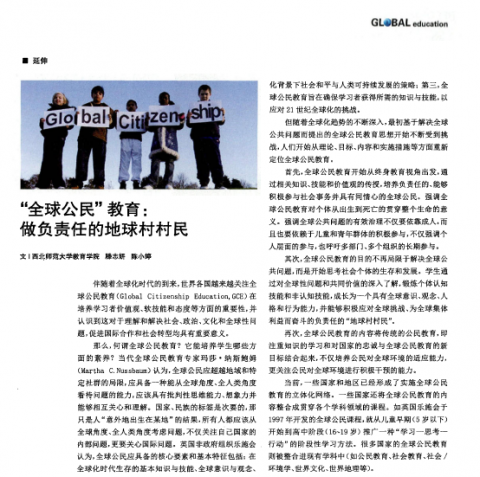 GCED towards Responsible villagers of the Global Village Año de publicación: 2015 Autor: Teng Zhiyan, Chen Xiaoting Global citizenship education has attracted an increasing attention in global era. This essay briefly introduce the definition of global citizenship education and how to develop it in today's society. This article believe that cultivating global citizens not only is a trend, but also is an important result of globalization. “全球公民”教育做负责任的地球村村民 Año de publicación: 2015 Autor: Teng Zhiyan, Chen Xiaoting 在全球化时代,全球公民教育得到了越来越多的关注。本文简单介绍了全球公民教育的定义以及当今社会如何发展全球公民教育。文章认为培养全球公民不仅是一种趋势,更是全球化的重要产物。
  Research on the Thought of Global Citizenship Education Año de publicación: 2006 Autor: Chen Yicang Based on the literature review, the thesis tries to expound the thought of global citizenship education, by ascending to the its origin and development, exploring the characteristics of the conceptions of global citizenship and education for global citizenship, and examining its influences.The paper is comprised of a preface and four parts. Part 1 mainly examines the origin and development of the thought of global citizenship education. The characteristcs of the thought in different stages are analyzed according to the threestage division of the history: pre-modern times, mordern times and post-modern times. Part2 explores into the characteristics of the conception of global citizenship after analyzing the features of modern citizenship, examining the challenges of globalization for the modern citizenship.Part3 mainly examines and analuzes the conception of education for global citizenship.Part4 provides a brief evaluation of the thought of education for citizenship on the basis of summarizing the characteristics of the thought of education for global citizenship, and examining the effect of the thought upon the educational theory and practice. 全球公民教育思潮研究 Año de publicación: 2006 Autor: Chen Yicang 通过教育使个体成为一个合格的公民,这是每个民族国家对成员个体发展的基本期望,也是教育最基本的目标之一。正是由于这样的背景,公民资格和公民教育理论,不断得到发展。然而自20世纪80年尤其是90年代以来,随着全球化趋势的增强以及全球化论的兴起,公民的定位、现代公民资格理论以及公民教育理论不断受到了挑战。全球公民教育教育思想就是在这样的背景形成了一股思潮。这一思潮在发达国家的教育实践中已经有所体现。我国已经加入了世界贸易组织,与国际交往日益扩大和加深。因此,在全球化的浪潮中,我国的公民教育怎样应对全球化的挑战,是一个必须面对的课题。因此,研究全球公民教育思潮,其意义是不言而喻的。本文主要基于文献研究,考察与分析全球公民教育思潮,追溯其历史渊源和发展历程,探讨全球公民资格观和全球公民教育观的特征及其影响。本文共由绪论和正文四个部分组成。第一部分主要是追溯全球公民教育思想的历史渊源和发展历程,按照前现代时期、现代时期和后现代时期这一历史分期,考察和分析了全球公民教育思想在每个阶段的特征。第二部分在分析了现代公民资格观的特征、全球化对现代公民资格观的挑战之后,探讨了全球公民资格观的内涵。第三部分主要分析和考察了全球公民教育观的主要内容。第四部分在归纳和总结了全球公民教育思潮的特征和考察了全球公民教育思潮的理论和实践性影响的基础上,对其作了简短的评价。
  A Review of Neo-liberal Global Citizenship Education in Western Societies Año de publicación: 2016 Autor: Zhou Xiaoyong Global citizenship education has become an increasingly dominant discourse among western societies. However, practices of global citizenship education assume plural forms, among which neo-liberal global citizenship education is an important one. Neo-liberalism competitiveness emphasizes personal choice based on cometition and access to global competitiveness and global cultural capital guided by competence. If this marked-oriented competition continues to ignore question of power and access, global citizens of this kind will take it for granted that the privilege they enjoyed is a natural result and a symbol of personal success. For people in developing countries, this is an obviously unfair situation. 西方新自由主义全球公民教育述评 Año de publicación: 2016 Autor: Zhou Xiaoyong 全球公民教育日益成为国际社会的显性话语,但西方社会的全球公民教育实践呈现出多元化现象,新自由主义全球公民教育是其中重要的一个分支。新自由主义强调基于竞争的个人选择,以能力为导向全球竞争力或全球文化资本的获得,但如果任由市场主导的自由竞争发展而不关注权力和机会,新自由主义式的全球公民会想当然地认为他们所享有的特权是自然的结果和成功的象征,这对发展中国家而言,明显是不公平的。
  Interrupting Extremism by Creating Educative Turbulence Año de publicación: 2014 Autor: Lynn Davies Autor corporativo: Curriculum Inquiry This article begins from the premise that it is important to explore how people unlearn, as well as learn, specifically in terms of extremist or violent attitudes. Three different country examples are given of intergroup encounters that interrupt rigidities in attitudes: working across ethnic groups in Sri Lanka, tackling religious divides in Northern Ireland through shared classes, and initiatives to prevent violent extremism in the United Kingdom. Pedagogical implications of unlearning involve working with the four Ds of deradicalization, debiasing, disengagement and desistence.