
Recursos
Exploren una amplia gama de recursos valiosos en GCED para profundizar su comprensión y promover su búsqueda, incidencia, enseñanza y aprendizaje.
1,851 resultados encontrados
 Meeting commitments: are countries on track to achieve SDG 4? Año de publicación: 2019 Autor corporativo: Global Education Monitoring Report Team | UNESCO Institute for Statistics (UIS) The world is a third of the way towards the deadline of the 2030 Agenda for Sustainable Development, which includes the fourth Sustainable Development Goal on education, SDG 4. But it is behind on its commitments. This joint publication by the UNESCO Institute for Statistics and the Global Education Monitoring Report for the 2019 High-level Political Forum on Sustainable Development captures concisely how far the world is from achieving its education targets. This is the year that the generation of students that should finish secondary school by 2030 should be entering school for the first time. Yet, in low-income countries, only 60% of children complete primary school, while in some regions the percentage of students who achieve minimum proficiency in reading is even falling. There is no denying that the world is off track. It is time to put an end to complacency. The international community relies on data to report on the SDG 4 monitoring framework to assess progress. While clear improvements have been made in data collection, data gaps remain a major concern. This publication makes a call for countries and their international development partners to coordinate and finance the collection of data to monitor and deliver on SDG 4. Respecter les engagements: les pays sont-ils en bonne voie d'atteindre l'ODD 4? Año de publicación: 2019 Autor corporativo: Global Education Monitoring Report Team | UNESCO Institute for Statistics (UIS) Le monde a parcouru un tiers du chemin vers l’échéance de l’Agenda de développement durable 2030, qui inclut le quatrième Objectif de développement durable (ODD 4), mais il est en retard sur la réalisation de ses engagements. Cette publication conjointe de l’Institut de statistique de l’UNESCO et du Rapport mondial de suivi sur l’éducation pour le Forum politique de haut niveau sur le développement durable 2019 expose de manière concise le retard dans la réalisation des cibles de l’éducation. Cette année est celle où la génération d’élèves qui terminera l’enseignement secondaire d’ici 2030 doit commencer l’école pour la toute première fois. Pourtant, dans les pays à revenu faible, seuls 60 % des enfants achèvent l’enseignement primaire, tandis que dans certaines régions, le pourcentage d’élèves qui possèdent les compétences minimales en lecture est même en baisse. On ne peut nier le fait que le monde est en retard. Il est temps de cesser ce laxisme. La communauté internationale dépend des données pour établir les rapports sur le cadre de suivi de l’ODD 4 afin d’évaluer les progrès accomplis. Des améliorations ont clairement été accomplies en matière de collecte de données mais les déficits de données demeurent une préoccupation majeure. Cette publication exhorte les pays et leurs partenaires internationaux du développement à coordonner et à financer la collecte de données pour suivre et réaliser l’ODD 4. Cumplir los compromisos: ¿van los países por el buen camino para alcanzar el ODS 4? Año de publicación: 2019 Autor corporativo: Global Education Monitoring Report Team | UNESCO Institute for Statistics (UIS) El mundo ya ha recorrido un tercio del camino hacia la fecha límite para el cumplimiento de la Agenda 2030 para el Desarrollo Sostenible, que incluye el Objetivo de Desarrollo Sostenible 4, relativo a la educación, pero aún está muy atrasado en el cumplimiento de sus compromisos. Esta publicación conjunta del Instituto de Estadística de la UNESCO y el Informe de Seguimiento de la Educación en el Mundo para el Foro Político de Alto Nivel sobre el Desarrollo Sostenible de 2019 refleja de manera concisa lo lejos que está el mundo de alcanzar sus objetivos en materia de educación. Este es el año en que la generación de estudiantes que debería finalizar la educación secundaria en 2030 tendría que ingresar a la escuela. Sinembargo, en los países de ingresos bajos, solo el 60% de los niños terminan la educación primaria, mientras que en algunas regiones el porcentaje de estudiantes que alcanzan un nivel mínimo de competencia en lectura está incluso en disminución. No se puede negar que el mundo no está bien encaminado. Ya es hora de que cese la apatía. La comunidad internacional se apoya en los datos para informar al marco de seguimiento del ODS 4 con el fin de evaluar los progresos realizados. Si bien se han realizado claras mejoras en la producción de datos, los faltantes de información siguen siendo motivo de gran preocupación. En esta publicación se hace un llamado a los países y a sus asociados internacionales para que coordinen y financien la producción de datos para el seguimiento y a la consecución del ODS 4.
  Let's work together: education has a key role in helping achieve the Sustainable Development Goals Año de publicación: 2019 Autor corporativo: Global Education Monitoring Report Team This publication has been produced on the occasion of the 2019 High-level Political Forum by the Global Eduation Monitoring Report. It draws upon findings from reports produced since 2015, showing the importance of education for the other goals in the 2030 agenda for sustainable development and calling for sectors to work together to achieve their aims.
  Exploring ICCS 2016 to measure progress toward target 4.7 Año de publicación: 2018 Autor: Sandoval-Hernández.Andrés, Miranda.Daniel Autor corporativo: Global Education Monitoring Report Team The objective of this report is to analyse data from the last cycle of the International Civic and Citizenship Study (ICCS 2016) (Schulz et al., 2017)in order to demonstrate its potential for monitoring specific aspects of the SDG target 4.7. Furthermore, given the theme of the 2019 Global Education Monitoring (GEM) Report, this document will pay special attention to those questions addressed to students, teachers and school principals that are directly related to immigration.
  Setting Commitments: National SDG 4 Benchmarks to Transform Education Año de publicación: 2022 Autor corporativo: Global Education Monitoring Report Team | UNESCO Institute for Statistics (UIS) This publication provides an overview of the transformative agenda being established by countries, as they set SDG 4 benchmarks for education progress to take ownership of the 2030 Agenda for Sustainable Development. Inspired by the UN Secretary-General’s 2014 call for countries to embrace ‘a culture of shared responsibility’ based on ‘benchmarking for progress’, paragraph 28 of the Education 2030 Framework for Action also called on countries to establish ‘appropriate intermediate benchmarks for addressing the accountability deficit associated with longer-term targets’. This report outlines the steps taken by countries to set these commitments for 2025 and 2030 against seven indicators and is timed to feed into the second review of SDG 4 at the High-level Political Forum.The SDG 4 benchmark values now defined for almost nine in ten countries lay out their nationally determined contributions to the common education goal, using a concept embraced by the climate change sector. Twelve countries’ experiences of approaching the challenge of setting benchmarks based on their education sector plans are included, serving as inspiration for other countries to reflect on their own contributions and the task of developing appropriate policy responses in line with their own ambitions for the next decade, especially in the context of recovery from COVID-19.This publication proposes a way forward for monitoring progress towards the national SDG 4 benchmarks. This way of monitoring will be context-specific, recognizing countries’ starting points, helping link their national with regional and global education agendas.The benchmarks could be a basis for a compact in which countries commit to increasing their ambition, and, in return, the international community offers a program of support. In other words, a system of political accountability associated to political commitments with a support mechanism to accomplish the task.
 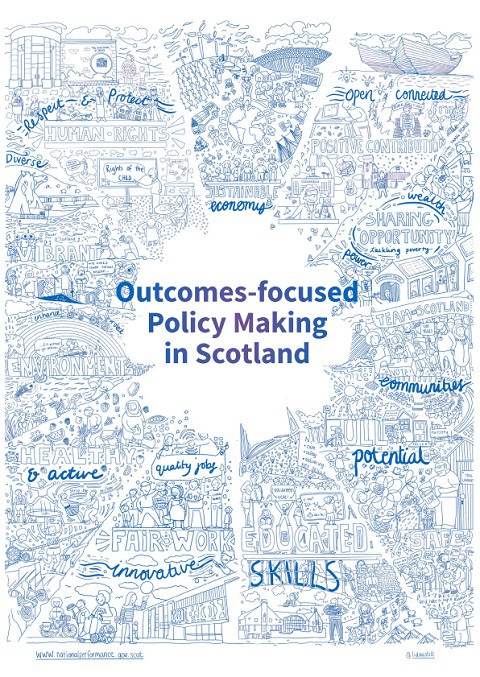 Outcomes-Focused Policy Making in Scotland Año de publicación: 2021 Autor corporativo: Government of Scotland | Scotland's International Development Alliance | SDG Network Scotland | Oxfam Scotland | International Development Education Association Scotland (IDEAS) | Bridge 47 Scotland’s International Development Alliance has co-created a new Scottish policy making guide focused on the Sustainable Development Goals (SDGs) and the National Performance Framework (NPF). The guide supports holistic policy making that reflects our interconnected world & addresses the need to better navigate its complexities.The resource is the result of a partnership between the Scottish Government’s National Performance Framework team, the International Development Education Association of Scotland (IDEAS) Network, Scotland’s International Development Alliance, the SDG Network Scotland and Oxfam Scotland. The partnership was initiated, supported and funded by the Bridge 47 – Building Global Citizenship project and special thanks go to Northern Star Associates for their work developing the content.What is the resource?The National Performance Framework (NPF) is Scotland’s way of localising the Sustainable Development Goals (SDGs). The 17 different goals and 11 NPF National Outcomes are key measures of how Scotland can move towards a more just and sustainable future. The resource has two main parts. The first half features a general overview of the United Nations Sustainable Development Goals (SDGs), Scotland’s National Performance Framework (NPF) and how the two are interlinked. The second half provides practical, interactive activities to explore how to apply the NPF and SDGs in the policy making process.Why is this resource important?Policy is a mechanism for creating change. Ensuring that the policy produced in Scotland is inclusive and takes a holistic view of systemic problems will have a positive impact for both people and planet.This resource comes at a critical juncture. The Covid-19 pandemic has emphasised local-global interconnections and the difficulties posed by complex global problems. They require us to be holistic in our policy making and understand we are part of a bigger system, where the decisions we make and the actions we take have an impact on others locally and globally, now and in the future.How was the resource created?The guide was co-created by a partnership between the NPF team at the Scottish Government and civil society stakeholders including the SDG Network Scotland, Scotland’s International Development Alliance and the EU project, Bridge 47. The development of the resource was funded through the Bridge 47 – Building Global Citizenship project, which is based at the International Development Education Association of Scotland (IDEAS) network. As a project, Bridge 47 supports building partnerships across different sectors with the aim of raising awareness of the SDGs and the transformative power of education as outlined in SDG Target 4.7.
  Gender, migration and non-formal learning for women and adolescent girls Año de publicación: 2019 Autor: Amy North Autor corporativo: Global Education Monitoring Report Team Processes of international migration and displacement are highly gendered. Who migrates, and how they experience migration and displacement, is affected by gender norms and relations in both in countries of origin and countries of settlement, the gendered dynamics of conflict and violence, and the gendered nature of global and local labour markets. These gendered dynamics of migration both affect and are affected by education in often complex ways, as education may both facilitate processes of migration, and be enabled or limited by them, and as gendered engagements with education prior to and during migration and settlement may have a significant influenced on how these processes are experienced. This paper is concerned with exploring this gender-migration- education nexus through a focus on the educational engagements and experiences of migrant and refugee women and adolescent girls. It first considers the wider body of research that has explored the relationship between gender, migration and displacement, particularly in relation to the experiences of migrant women and girls, before drawing out some of the key conceptual ideas from this, considering their implications for education, and presenting a conceptual diagram to represent this relationship. It then focuses more specifically on experiences of non-formal education for women and adolescent girls in refugee contexts and in host countries. Finally it identifies a number of key issues and recommendations emerging from this research.
  Education Finance Watch 2024 Año de publicación: 2024 Autor corporativo: Global Education Monitoring Report Team | UNESCO Institute for Statistics (UIS) | World Bank The Education Finance Watch (EFW) is a collaborative effort between the World Bank, the GEM Report, and the UNESCO Institute for Statistics (UIS). The EFW aims to provide an analysis of trends, patterns, and issues in education financing around the world. The EFW uses various sources of education, economic, and financial data from the World Bank, UIS, the International Monetary Fund, and the Organization of Economic Co-operation and Development (OECD).
  Global Education Monitoring Report 2024/5: Leadership in Education; Lead for Learning Año de publicación: 2024 Autor corporativo: Global Education Monitoring Report Team Leadership matters in education. Strong leaders are needed to help institutions, systems and societies change for the better. Strong leaders work in collaboration with other actors towards the same goals. At the school level, they are the principals but also those who surround them, in the school and in the community, in positions of responsibility. At the system level, they are civil servants working as district officers, supervisors or planners. At the societal level, they are political leaders, as well as a very broad range of actors who help shape education goals, from unions and researchers to civil society and the media.Entitled Lead for learning, this report argues that, in pursuing specific goals, education leaders are more than just managers. They are change agents, who need the time, trust and support to focus on setting a vision and developing the people they serve and work with. The report calls for investment in and empowerment of school and system leaders. There should be fair hiring processes and growth opportunities that recognize the full scope of leaders’ roles. Moreover, leadership works best when it is shared, empowering others to lead as they can within their roles.There is no one leadership style that works. Different contexts, capacities and personalities mean that styles vary, and rightfully so. This, combined with the different goals that each leader is trying to achieve, means that their impact is hard to fully assess. Yet, all research points towards the critical need for strong leaders to continuously improve education quality. School leaders are second only to teachers for transforming student outcomes. Meanwhile, politicians wield huge influence in making equitable and inclusive education a national priority.Supporting this seventh Global Education Monitoring Report is a new series of country profiles on PEER, an online resource supporting policy dialogue and describing policies and regulations on school principal selection, preparation and development in the world’s education systems.