
Recursos
Exploren una amplia gama de recursos valiosos en GCED para profundizar su comprensión y promover su búsqueda, incidencia, enseñanza y aprendizaje.
1,851 resultados encontrados
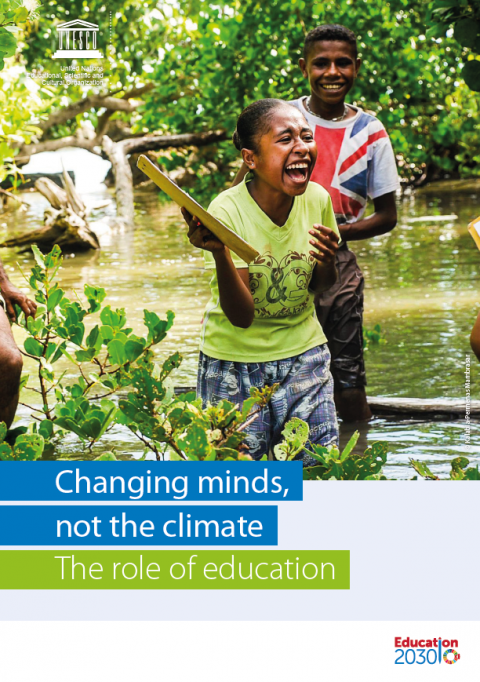 Changeons les esprits, pas le climat: le rôle de l’éducation Año de publicación: 2017 Autor corporativo: UNESCO L’éducation est fondamentale afin de préparer les sociétés aux défis mondiaux que pose le changement climatique. Elle offre aux individus, aux communautés et au monde en général la compréhension, les compétences et les attitudes nécessaires pour construire des sociétés à faibles émissions, plus vertes et résilientes. L’éducation au développement durable (EDD) n’est pas un « supplément » mais plutôt une partie intégrante de toute stratégie visant à lutter contre les effets du changement climatique, à mettre en pratique un accord mondial et à atteindre les objectifs de développement durable (ODD). Elle permet de sensibiliser les personnes, favorise une prise de décision éclairée et donc le changement des comportements des individus. Cambiemos las mentalidades, no el clima: la función de la educación Año de publicación: 2017 Autor corporativo: UNESCO La educación es la herramienta más eficaz para preparar a las sociedades para los desafíos globales que plantea el cambio climático, ya que proporciona a las personas, a las comunidades y al mundo en general los conocimientos, las competencias y las actitudes que se necesitan para construir unas sociedades sostenibles, de bajas emisiones y resilientes al cambio climático.La educación para el desarrollo sostenible (EDS) no es un “extra”, sino un componente esencial de cualquier estrategia para combatir los efectos del cambio climático, poner en práctica un acuerdo mundial y alcanzar los Objetivos de Desarrollo Sostenible (ODS). La EDS contribuye a concienciar y cambiar comportamientos y actitudes y permite a las personas tomar decisiones informadas sobre su vida.
 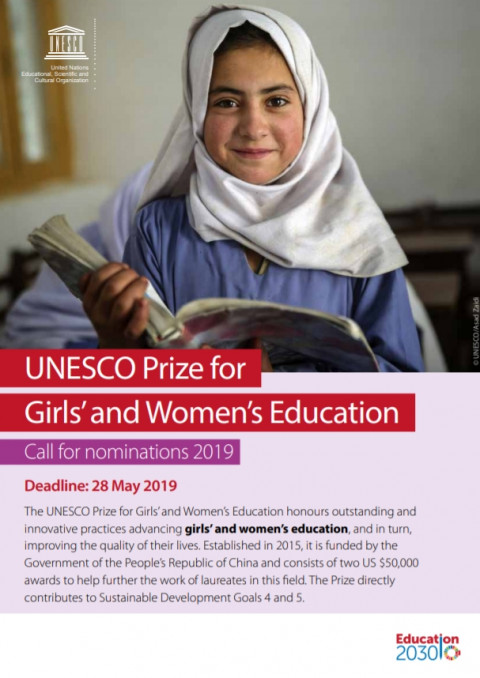 UNESCO Prize for Girls' and Women's Education: call for nominations 2019 Año de publicación: 2019 Autor corporativo: UNESCO The UNESCO Prize for Girls’ and Women’s Education honours outstanding and innovative practices advancing girls’ and women’s education, and in turn, improving the quality of their lives. Established in 2015, it is funded by the Government of the People’s Republic of China and consists of two US $50,000 awards to help further the work of laureates in this field. The Prize directly contributes to Sustainable Development Goals 4 and 5. Prix UNESCO pour l’éducation des filles et des femmes: appel à candidatures 2019 Año de publicación: 2019 Autor corporativo: Organisation des Nations Unies pour l'éducation, la science et la culture (UNESCO) Le Prix UNESCO pour l’éducation des filles et des femmes met en avant les pratiques exemplaires et novatrices qui font progresser l’éducation des filles et des femmeset, par conséquent, améliorent la qualité de leur vie. Crée en 2015, il est financé par le gouvernement de la République Populaire de Chine et consiste de deux prix de 50 000 dollars des États-Unis afin d’aider les lauréats à poursuivre leur travail dans ce domaine. Le prix contribue directement aux objectifs de développement durable 4 et 5. Premio UNESCO de educación de las niñas y las mujeres: convocatoria de candidaturas 2019 Año de publicación: 2019 Autor corporativo: Organización de las Naciones Unidas para la Educación, la Ciencia y la Cultura (UNESCO) El premio UNESCO de educación de las niñas y las mujeres recompensa las prácticas sobresalientes e innovadoras que promueven la educación de las niñas y las mujeres y, a su vez, mejoran su calidad de vida. Este premio, que se creó en 2015 y es financiado por el gobierno de la República Popular China, está dotado con dos cuantías de 50 000 dólares estadounidenses destinadas a fomentar la labor de los galardonados en este ámbito. El premio contribuye directamente a los Objetivos de Desarrollo Sostenible 4 y 5.
 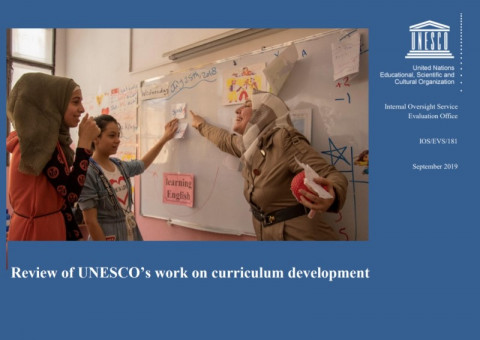 Review of UNESCO’s work on curriculum development Año de publicación: 2019 Autor corporativo: UNESCO In response to a request from the UNESCO Executive Board in Spring 2019, the UNESCO Internal Oversight Service (IOS) Evaluation Office has undertaken this Review to provide a mapping and analysis of UNESCO’s activities in curriculum; to provide an overview of the roles typically played by other national, regional and international actors in the field of curriculum, and to assess the demand for services from UNESCO Member States and donors in the area of curriculum. The review found that curriculum is widely considered as the foundational building block of the education system, resulting from a pedagogical and political consensus with regard to what is important in learning and why, according to both the learner’s needs and societal visions. In light of challenges of the 21st century and the need to strengthen the role of the humanities in a context dominated by technology and data, the redefinition of curriculum has become one of the main concerns of national education authorities around the world. It is also widely accepted that quality curricula can support the attainment of Sustainable Development Goal 4 (SDG 4). The review concluded that curriculum, particularly curriculum development and reform processes, should remain an area of UNESCO’s education programme as it addresses a clear need from Member States. As curriculum implies both technical and political dimensions, UNESCO can act as a neutral broker, to facilitate informed and inclusive policy dialogue. It also has a long-term tradition in facilitating complex curriculum processes in often difficult and sensitive contexts. In addition, UNESCO has the capacity to serve as a platform for international exchanges and comparative research, including through networks such as UNESCO Chairs, and coordinating knowledge hubs and communities of practice. To address curriculum with added value in the future, UNESCO should focus on providing methodological technical assistance, capacity development, standard-setting and policy advice to support the curriculum processes, products and competences in Member States while ensuring a coordinated and holistic perspective. Complementary to work on curriculum from a methodological point of view, thematic Sections at Headquarters should continue elaborating content on specific crosscutting topics. Looking to the future, the review recommends (i) maintaining a specialized category 1 institute as a lead entity on curriculum development; (ii) refining the offer of technical assistance and capacity development to Member States on curriculum development and reform; (iii) developing and maintaining a knowledge base of materials and a roster of experts on curriculum; (iv) providing a platform for policy dialogue and exchange of experience among Member States; and (v) systematizing the inclusion of curriculum in standard-setting and normative work.
  #CommitToEducation Año de publicación: 2019 Autor corporativo: UNESCO In December 2018, building on a series of regional consultations, the education community struck a common chord at the Global Education Meeting in Brussels, the first gathering of its kind since the adoption of the 2030 Agenda. Ministers, representatives of government, multilateral organizations, civil society and other stakeholders agreed on a set of priorities for collective action. These include an overarching focus on the right to inclusive quality education; eradicating illiteracy; including migrants, displaced persons, refugees and stateless persons in education; quality gender-responsive education and training; strengthened education for global citizenship and sustainable development; more flexible and open learning systems providing a broader range of knowledge, skills and competences at all levels; qualified teachers and domestic and international resource mobilization. This set the ground for the first review of SDG 4 by the July 2019 High level Political Forum, the UN apex platform for the follow-up and review of Agenda 2030. As the UN agency responsible for the coordination of SDG 4, mandated by the World Education Forum in Incheon (Republic of Korea, 2015), UNESCO provided an analysis of where the world stands on SDG 4, how countries have taken up the goal in their policies, and made recommendations to act better, differently and collaboratively.
  United Nations Strategy and Plan of Action on Hate Speech Año de publicación: 2019 Autor corporativo: United Nations (UN) In response to the alarming trend of rising hate speech around the world, Secretary-General António Guterres launched the United Nations Strategy and Plan of Action on Hate Speech, on 18 June 2019.Seeking to enhance the UN’s response to the global phenomenon of hate speech, this strategy is the outcome of close collaboration between 16 entities under the UN Working Group on Hate Speech and is coordinated by the United Nations Special Adviser on the Prevention of Genocide.The Strategy makes a firm commitment to step up coordinated action to tackle hate speech, both at global and national levels. Stratégie et Plan d’action des Nations Unies pour la lutte contre les discours de haine Año de publicación: 2019 Autor corporativo: United Nations (UN) En réponse à l’alarmante montée de la xénophobie, du racisme et de l’intolérance, de la misogynie violente, de l’antisémitisme et de l’islamophobie dans le monde actuellement, le 18 juin 2019, le Secrétaire général, Antonio Guterres, a lancé la Stratégie et le Plan d’action des Nations Unies pour la lutte contre les discours de haine. Cette démarche part du constat qu’au cours des 75 dernières années, les discours de haine ont été annonciateurs des crimes atroces qui les ont suivis, génocide compris, comme au Rwanda, en Bosnie ou au Cambodge.La Stratégie et le Plan d’action des Nations Unies pour la lutte contre les discours de haine offrent au système des Nations Unies des orientations stratégiques pour lutter contre les discours de haine aux niveaux national et mondial. Y est précisé également comment le Secrétariat de l’ONU peut seconder les coordinateurs résidents des Nations Unies dans leur action face aux discours de haine.Les objectifs sont doubles : il s’agit premièrement de renforcer les efforts déployés par les entités des Nations Unies pour s’attaquer aux causes profondes et aux éléments moteurs des discours de haine, et deuxièmement, d’aider le système des Nations Unies à répondre efficacement aux conséquences sociétales des discours de haine. La estrategia y plan de acción de las Naciones Unidas para la lucha contra el discurso de odio Año de publicación: 2019 Autor corporativo: United Nations (UN) En respuesta a la alarmante tendencia del aumento del discurso del odio por todo el mundo, el Secretario General, António Guterres, presentó la Estrategia y Plan de Acción de las Naciones Unidas para la lucha contra el Discurso de Odio, el 18 de junio de 2019.Con el objetivo de mejorar la respuesta de la ONU ante el fenómeno del discurso de odio, esta estrategia es el resultado de la estrecha colaboración entre 16 entidades dentro del Grupo de Trabajo de la ONU para la lucha contra el Discurso de Odio y está coordinada por la Asesora Especial de las Naciones Unidas para la Prevención del Genocidio.La Estrategia se compromete firmemente a intensificar la acción coordinada para hacer frente al discurso del odio, tanto a escala mundial como nacional.