
Recursos
Exploren una amplia gama de recursos valiosos en GCED para profundizar su comprensión y promover su búsqueda, incidencia, enseñanza y aprendizaje.
1,851 resultados encontrados
 Переосмыслим наше будущее – Hовый общественный договор в области образования Año de publicación: 2023 Autor corporativo: International Commission on the Futures of Education | UNESCO Наше человечество, наша планета находятся в опасности. Пандемия лишь подтвердила нашу хрупкость и взаимозависимость. Чтобы изменить ход вещей и переосмыслить наше будущее, необходимы неотложные совместные действия. В этом докладе Международной комиссии по перспективам образования подтверждается способность образования к осуществлению коренных изменений. Перед нами стоит двойная задача – выполнить невыполненное обещание обеспечить право на качественное образование для каждого ребенка, молодого человека и взрослого и полностью реализовать преобразующий потенциал образования, способного проложить путь к устойчивому коллективному будущему. Для этого нам нужен новый общественный договор в области образования, который сможет устранять проявления несправедливости, преобразуя будущее. Этот новый общественный договор должен основываться на принципах прав человека, недопущения дискриминации, социальной справедливости, уважения жизни, человеческого достоинства и культурного разнообразия. Он должен включать в себя этику заботы о людях, взаимности и солидарности. Он должен укреплять позиции образования как общественного дела и общего блага. Этот доклад, который готовился два года на основе глобального процесса консультаций с участием миллиона человек, предлагает правительствам, учреждениям, организациям и гражданам всего мира разработать новый общественный договор в области образования, который поможет нам построить мирное, справедливое и устойчивое будущее, отвечающее всеобщим интересам. Представленные здесь концепции, принципы и предложения являются лишь отправной точкой. Их воплощение в практику в конкретных условиях – это коллективная работа. Уже есть много положительных моментов, и в настоящем докладе предпринята попытка их отразить и развить. Это не инструкция и не план, а начало жизненно важного разговора.
  Addressing Anti-semitism in Schools: Training Curriculum for School Directors Año de publicación: 2020 Autor corporativo: UNESCO | OSCE. Office for Democratic Institutions and Human Rights (ODIHR) This OSCE/ODIHR and UNESCO co-publication aims to help school directors to prevent and respond to anti-Semitism. The curriculum, intended for school director trainers, is designed to be comprehensive, robust, practical and adaptable. It suggests concrete ways to address anti-Semitism and counter prejudice in and through education, while promoting human rights, global citizenship education, and gender equality.The co-publication is part of a series of four training curricula, designed for trainers of (1) primary school teachers, (2) secondary school teachers, (3) vocational school teachers, and (4) school directors.
  Ликвидация расовой дискриминации, расовой ненависти и преступлений на почве расовой ненависти во всем мире (Генеральная конференция; 40-я сессия) Año de publicación: 2019 Autor corporativo: Организация Объединенных Наций по вопросам образования, науки и культуры (UNESCO) На своей 207-й сессии Исполнительный совет в решении 207 EX/49 постановил включить данный пункт в повестку дня 40-й сессии Генеральной конференции. В настоящем документе отмечается, что расовая дис- криминация, подстрекательство к расовой ненависти и преступления на почве расовой ненависти представляют собой угрозу для всех народов и международного сообщества. С учетом этого Генераль- ному директору предлагается укрепить содержательный вклад ЮНЕСКО в борьбу с расизмом, расовой дискриминацией, ксенофо- бией и связанной с ними нетерпимостью и представить Исполнитель- ному совету на его 210-й сессии доклад о достигнутых в данной обла- сти результатах. 消除世界上的种族歧视、种族仇恨和种族仇恨犯罪 Año de publicación: 2019 Autor corporativo: 联合国教科文组织 (UNESCO) 本文件强调,种族歧视、煽动种族仇恨和种族仇恨犯罪对各国人民和国际社会构成威胁。考虑到这一点,兹要求总干事加大教科文组织对打击种族主义、种族歧视、仇外心理及相关不容忍行为的实质性贡献,并向执行局第二一〇届会议报告在这一事项上取得的进展。
 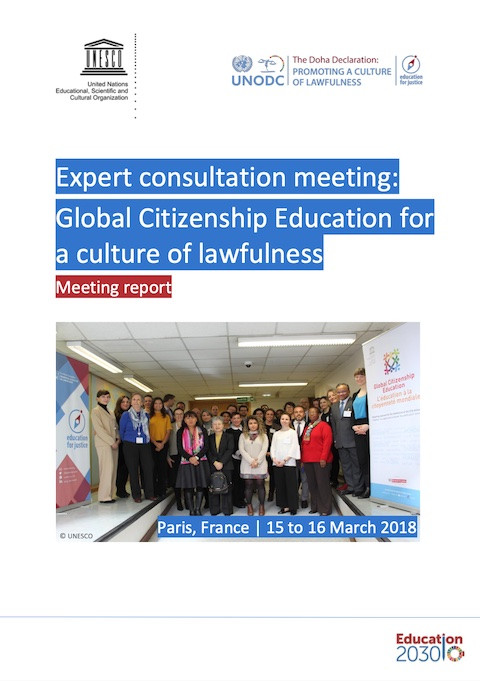 Expert Consultation Meeting: Global Citizenship Education for a Culture of Lawfulness; Meeting Report Año de publicación: 2018 Autor corporativo: UNESCO | UN. Office on Drugs and Crime (UNODC) In the context of a UNESCO/UNODC partnership on “Global Citizenship Education for a Culture of Lawfulness”, an expert consultation meeting was held in Paris on March 15 and 16 of 2018. The purpose of the partnership is to strengthen the capacities of educational systems to promote the rule of law. To this end, the partnership aims to empower and equip learners to act and engage in society as constructive and ethically responsible agents of change, supporting peace, justice, and strong institutions. This notably contributes to the achievement of the 2030 Agenda for Sustainable Development, and in particular Sustainable Development Goals 4 and 16. Additionally, the partnership intends to enable learners to be both motivated and capable to respond resiliently to crime and violence. The meeting had three broad objectives: To help clarify the conceptual foundation of the partnership; to identify the measures that can be taken in the education sector to promote a culture of lawfulness; and to identify effective educational approaches. Thus, the meeting is meant to elucidate core concepts and identify promising educational approaches in the promotion of a culture of lawfulness by asking fundamental questions, including: What constitutes the rule of law and a culture of lawfulness? How do we create demand for the rule of law? How do we ensure learners apply these principles? How do we ensure they survive in a context where there is no rule of law?
  Promoting Media and Information Literacy in Uzbekistan Año de publicación: 2015 Autor corporativo: UNESCO The manual presents in popular visual form the fundamentals of Media and Information Literacy (MIL), using UNESCO's teacher education programs and other materials from the organization. This manual was developed within the framework of the joint program of the UN and the Government of the Republic of Kazakhstan "Improving the well-being and quality of life in the Kyzylorda region through the introduction of innovative approaches to the provision of economic, social and environmental services to the local population, including the most vulnerable", carried out jointly by the Government of the Republic Kazakhstan and UN agencies in Kazakhstan: UNESCO, UNDP, UNFPA, UN Women, WHO and UNICEF until December 2016. Узбекистан по пути развития медиаобразования Año de publicación: 2015 Autor corporativo: Организация Объединенных Наций по вопросам образования, науки и культуры (UNESCO) Пособие представляет в популярной визуальной форме основы медийной и информационной грамотности (МИГ), используя программы обучения ЮНЕСКО для педагогов, а также другие материалы организации. Данное пособие разработано в рамках совместной программы ООН и Правительства Республики Казахстан «Повышение благосостояния и качества жизни в Кызылординской области через внедрение иннова-ционных подходов к оказанию экономических, социальных и экологи-ческих услуг местному населению, включая наиболее уязвимые слои», выполняемого совместно Правительством республики Казахстан и агентствами ООН в РК: ЮНЕСКО, ПРООН, ЮНФПА, ООН Женщины, ВОЗ и ЮНИСЕФ до декабря 2016 года.
  Media and Information Literacy: Training Materials Año de publicación: 2015 Autor corporativo: UNESCO This compendium contains the reports of four studies on religion and democracy conducted by the International Alert project "Constructive Dialogues on Religion and Democracy". The studies were carried out by young professionals trained in the framework of the project in 2017 and 2018. Медийная и информационная грамотность Año de publicación: 2015 Autor corporativo: Организация Объединенных Наций по вопросам образования, науки и культуры (UNESCO) Данный сборник содержит отчеты четырех исследований по вопросам религии и демократии, проведенных в рамках проекта International Alert "Конструктивные диалоги по религии и демократии". Исследования были проведены молодыми специалистами, обученными в рамках деятельности проекта в 2017 и 2018 гг.
  Медиа- и информационная грамотность в обществах знания Año de publicación: 2013 Autor corporativo: Interregional Library Cooperation Centre | UNESCO Издание подготовлено на основе материалов Международной конференции «Медиа- и информационная грамотность в обществах знания», состоявшейся в Москве 24–28 июня 2012 г. в рамках председательства России в Межправительственном совете Программы ЮНЕСКО «Информация для всех».