
Recursos
Exploren una amplia gama de recursos valiosos en GCED para profundizar su comprensión y promover su búsqueda, incidencia, enseñanza y aprendizaje.
1,443 resultados encontrados
 Rapport préparatoire du BIE-UNESCO pour la 48e CIE sur l'éducation inclusive Año de publicación: 2007 Autor corporativo: UNESCO International Bureau of Education (IBE) La Conférence Internationale sur l'Éducation (CIE) est un important forum international pour le dialogue sur les politiques éducatives entre les Ministres de l'Éducation et d'autres parties prenantes (chercheurs, praticiens, représentants d'organisations intergouvernementales et ONG). CIE est organisé par le Bureau International d'Éducation (BIE), l'Institut de l'UNESCO spécialisé pour aider les États membres dans l'élaboration des programmes pour atteindre une éducation de qualité pour tous. Le Conseil du BIE, composé de 28 États membres de l'UNESCO, a proposé en Janvier 2007 que la session de la CIE 48e, qui se tiendra à Genève en Novembre 2008, devrait se concentrer sur le thème «Education pour l'inclusion: la voie de l'avenir». La 48e CIE mettra l'aCECnt sur l'élargissement de la compréhension de la théorie et la pratique de l'éducation inclusive, tout en discutant comment les gouvernements peuvent élaborer et mettre en œuvre des politiques sur l'éducation inclusive. Le BIE organise une série d'ateliers préparatoires régionaux dédiés à l'exploration et de faire progresser l'éducation inclusive dans la préparation de la CIE 2008. L'Atelier régional préparatoire "Atelier international sur l'éducation inclusive, des Andes et les régions du Cône Sud» a eu lieu à Buenos Aires, Argentine sur la 11-14 Septembre 2007. Cet événement a été organisé par le Bureau International d'Éducation (BIE / UNESCO), la Division de la promotion de l'Éducation de Base (ED / BAS, UNESCO Paris), le Bureau Régional de l'Éducation pour l'Amérique latine et les Caraïbes (OREALC / UNESCO); Université de de San Andrés, Ministère de la Science, de la Technologie et de l'Éducation, en collaboration avec la Communauté de Pratique - Cône Sud et les régions andines;. il y avait la participation de dix pays du Cône Sud et les régions andines Cette rapport est basé sur les rapports et les présentations des pays de l'atelier sur la conception et le statut de l'éducation inclusive dans les pays participants, ainsi que sur les idées proposées par les participants sur les prochaines étapes devraient être sur la façon de faire progresser la politique de l'éducation inclusive et la mise en œuvre dans la région.
 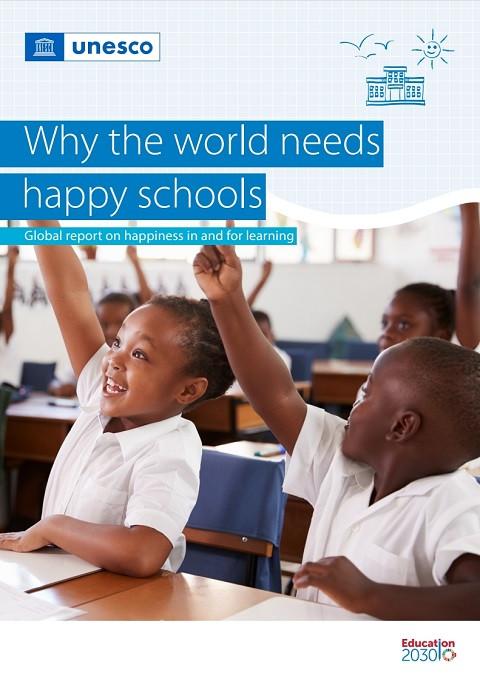 Why the World Needs Happy Schools: Global Report on Happiness In and For Learning Año de publicación: 2024 Autor corporativo: UNESCO Seeing a teacher smile. Hearing students laugh. Feeling a hug from a friend. Smelling fresh air. Tasting a nutritious school meal. These five senses can stimulate happiness at school and improve the learning experiences, outcomes and well-being of students. Through the ‘Happy Schools’ initiative, UNESCO is placing happiness at the core of the transformation of education. It encourages education systems to recognize happiness as both a means to and a goal of quality learning. The initiative is informed by a growing evidence base linking happiness with better learning, teaching, well-being and overall system resilience. This report presents the UNESCO global Happy Schools framework consisting of 4 pillars – people, process, place and principles – and 12 high-level criteria to guide the transformation of learning. It offers a holistic model for embedding happiness into education policies and cultivating it in schools through systemic changes. The report illustrates how the ‘Happy Schools’ initiative aims to create top-down and bottom-up transformation, encouraging governments to recognize happiness as a core objective of education. It supports the scaling of promising practices of joyful learning from the school to the policy level.
 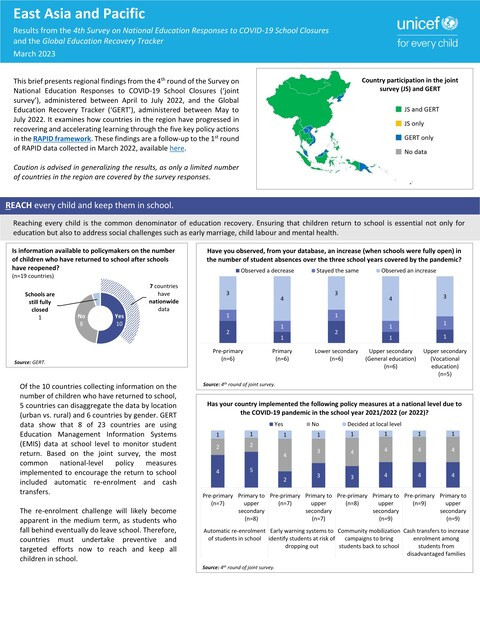 Education in a Post-COVID World: Towards a Rapid Transformation; East Asia and Pacific Regional Brief Año de publicación: 2023 Autor corporativo: United Nations Children's Fund (UNICEF) On March 11, 2020, the World Health Organization declared COVID-19 a global pandemic, resulting in disruptions to education at an unprecedented scale. In response to the urgent need to recover learning losses, countries worldwide have taken RAPID actions to: Reach every child and keep them in school; Assess learning levels regularly; Prioritize teaching the fundamentals; Increase the efficiency of instruction; and Develop psychosocial health and wellbeing. This brief presents regional findings from the 4th round of the Survey on National Education Responses to COVID-19 School Closures (‘joint survey’), administered between April to July 2022, and the Global Education Recovery Tracker (‘GERT’), administered between May to July 2022. It examines how countries in the region have progressed in recovering and accelerating learning through the five key policy actions in the RAPID framework. These findings are a follow-up to the 1st round of RAPID data collected in March 2022.
 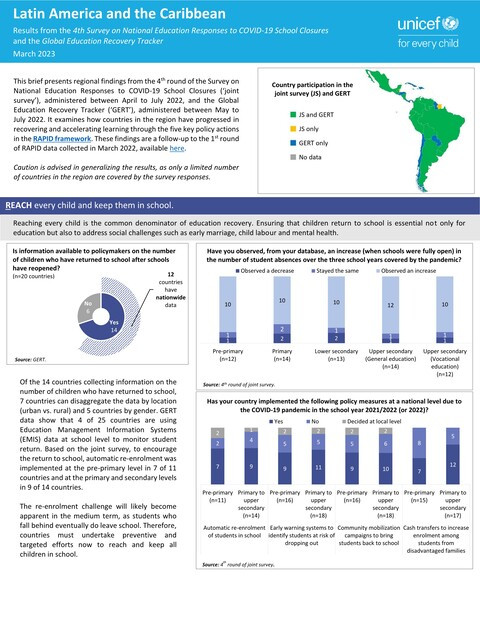 Education in a Post-COVID World: Towards a Rapid Transformation; Latin America and the Caribbean Regional Brief Año de publicación: 2023 Autor corporativo: United Nations Children's Fund (UNICEF) On March 11, 2020, the World Health Organization declared COVID-19 a global pandemic, resulting in disruptions to education at an unprecedented scale. In response to the urgent need to recover learning losses, countries worldwide have taken RAPID actions to: Reach every child and keep them in school; Assess learning levels regularly; Prioritize teaching the fundamentals; Increase the efficiency of instruction; and Develop psychosocial health and wellbeing. This brief presents regional findings from the 4th round of the Survey on National Education Responses to COVID-19 School Closures (‘joint survey’), administered between April to July 2022, and the Global Education Recovery Tracker (‘GERT’), administered between May to July 2022. It examines how countries in the region have progressed in recovering and accelerating learning through the five key policy actions in the RAPID framework. These findings are a follow-up to the 1st round of RAPID data collected in March 2022.
 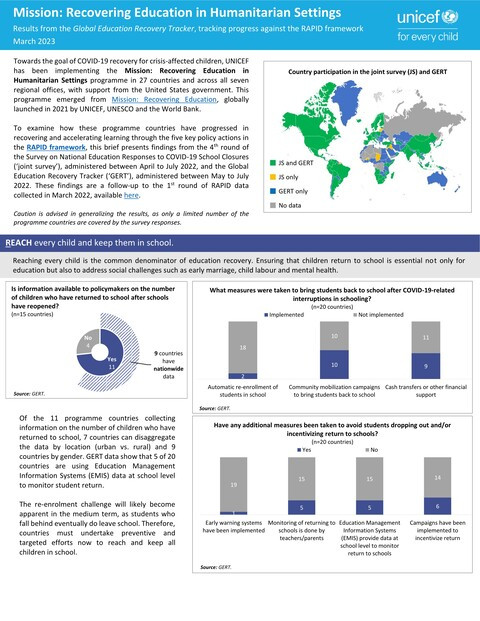 Education in a Post-COVID World: Towards a Rapid Transformation; Mission Recovering Education in Humanitarian Settings Brief Año de publicación: 2023 Autor corporativo: United Nations Children's Fund (UNICEF) Towards the goal of COVID-19 recovery for crisis-affected children, UNICEF has been implementing the Mission: Recovering Education in Humanitarian Settings programme in 27 countries and across all seven regional offices, with support from the United States government. This programme emerged from Mission: Recovering Education, globally launched in 2021 by UNICEF, UNESCO and the World Bank. To examine how these programme countries have progressed in recovering and accelerating learning through the five key policy actions in the RAPID framework, this brief presents findings from the 4th round of the Survey on National Education Responses to COVID-19 School Closures (‘joint survey’), administered between April to July 2022, and the Global Education Recovery Tracker (‘GERT’), administered between May to July 2022. These findings are a follow-up to the 1st round of RAPID data collected in March 2022.
 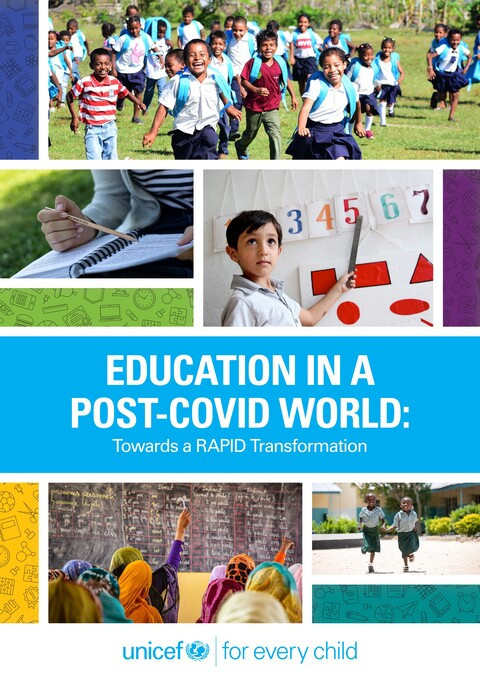 Education in a Post-COVID World: Towards a Rapid Transformation; Main Report Año de publicación: 2023 Autor corporativo: United Nations Children's Fund (UNICEF) On March 11, 2020, the World Health Organization declared COVID-19 a global pandemic, resulting in disruptions to education at an unprecedented scale. In response to the urgent need to recover learning losses, countries worldwide have taken RAPID actions to: Reach every child and keep them in school; Assess learning levels regularly; Prioritize teaching the fundamentals; Increase the efficiency of instruction; and Develop psychosocial health and wellbeing. Marking three years since the onset of the pandemic, this report looks back at policy measures taken during school closures and reopening based on country survey data, initiatives implemented by countries and regions to recover and accelerate learning, and their emerging lessons within each RAPID action. With schools now reopened worldwide, this report also looks ahead to longer-term education transformation, offering policy recommendations to build more resilient, effective and equitable education systems.
 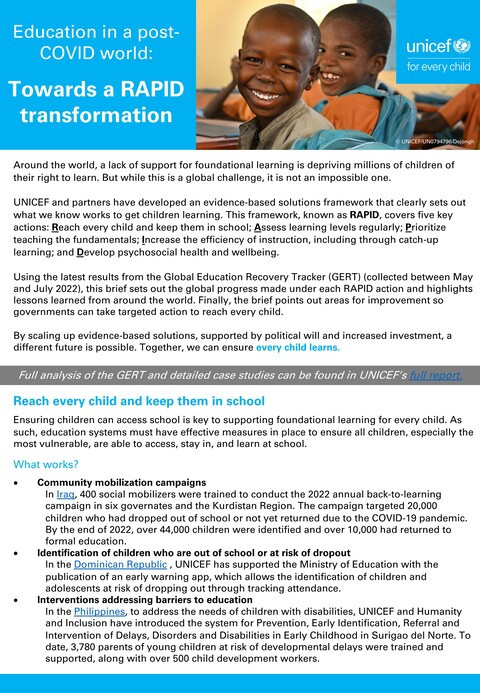 Education in a Post-COVID World: Towards a Rapid Transformation; Advocacy Brief Año de publicación: 2023 Autor corporativo: United Nations Children's Fund (UNICEF) Around the world, a lack of support for foundational learning is depriving millions of children of their right to learn. But while this is a global challenge, it is not an impossible one. UNICEF and partners have developed an evidence-based solutions framework that clearly sets out what we know works to get children learning. This framework, known as RAPID, covers five key actions: Reach every child and keep them in school; Assess learning levels regularly; Prioritize teaching the fundamentals; Increase the efficiency of instruction, including through catch-up learning; and Develop psychosocial health and wellbeing. Using the latest results from the Global Education Recovery Tracker (GERT) (collected between May and July 2022), this brief sets out the global progress made under each RAPID action and highlights lessons learned from around the world. Finally, the brief points out areas for improvement so governments can take targeted action to reach every child.
 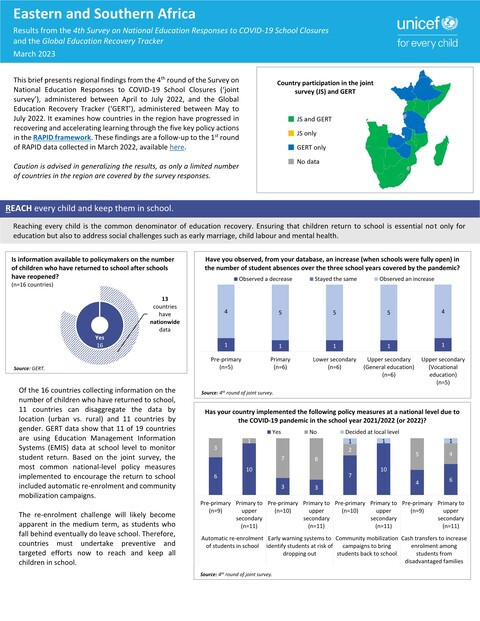 Education in a Post-COVID World: Towards a Rapid Transformation; Eastern and Southern Africa Regional Brief Año de publicación: 2023 Autor corporativo: United Nations Children's Fund (UNICEF) On March 11, 2020, the World Health Organization declared COVID-19 a global pandemic, resulting in disruptions to education at an unprecedented scale. In response to the urgent need to recover learning losses, countries worldwide have taken RAPID actions to: Reach every child and keep them in school; Assess learning levels regularly; Prioritize teaching the fundamentals; Increase the efficiency of instruction; and Develop psychosocial health and wellbeing. This brief presents regional findings from the 4th round of the Survey on National Education Responses to COVID-19 School Closures (‘joint survey’), administered between April to July 2022, and the Global Education Recovery Tracker (‘GERT’), administered between May to July 2022. It examines how countries in the region have progressed in recovering and accelerating learning through the five key policy actions in the RAPID framework. These findings are a follow-up to the 1st roundof RAPID data collected in March 2022.
 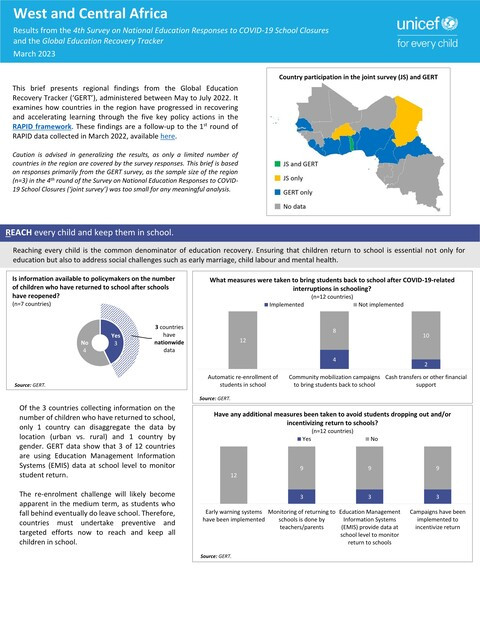 Education in a Post-COVID World: Towards a Rapid Transformation West and Central Africa Regional Brief Año de publicación: 2023 Autor corporativo: United Nations Children's Fund (UNICEF) On March 11, 2020, the World Health Organization declared COVID-19 a global pandemic, resulting in disruptions to education at an unprecedented scale. In response to the urgent need to recover learning losses, countries worldwide have taken RAPID actions to: Reach every child and keep them in school; Assess learning levels regularly; Prioritize teaching the fundamentals; Increase the efficiency of instruction; and Develop psychosocial health and wellbeing. This brief presents regional findings from the Global Education Recovery Tracker (‘GERT’), administered between May to July 2022. It examines how countries in the region have progressed in recovering and accelerating learning through the five key policy actions in the RAPID framework. These findings are a follow-up to the 1st round of RAPID data collected in March 2022.
 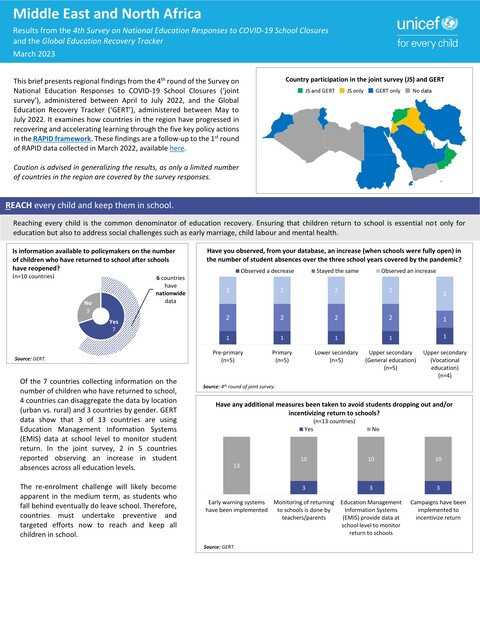 Education in a Post-COVID World: Towards a Rapid Transformation; Middle East and North Africa; Regional Brief Año de publicación: 2023 Autor corporativo: United Nations Children's Fund (UNICEF) On March 11, 2020, the World Health Organization declared COVID-19 a global pandemic, resulting in disruptions to education at an unprecedented scale. In response to the urgent need to recover learning losses, countries worldwide have taken RAPID actions to: Reach every child and keep them in school; Assess learning levels regularly; Prioritize teaching the fundamentals; Increase the efficiency of instruction; and Develop psychosocial health and wellbeing. This brief presents regional findings from the 4th round of the Survey on National Education Responses to COVID-19 School Closures (‘joint survey’), administered between April to July 2022, and the Global Education Recovery Tracker (‘GERT’), administered between May to July 2022. It examines how countries in the region have progressed in recovering and accelerating learning through the five key policy actions in the RAPID framework. These findings are a follow-up to the 1st round of RAPID data collected in March 2022.