
Recursos
Exploren una amplia gama de recursos valiosos en GCED para profundizar su comprensión y promover su búsqueda, incidencia, enseñanza y aprendizaje.
1,182 resultados encontrados
 L'éducation transforme la vie: autonomiser les individus et assurer l'inclusion et l'égalité Año de publicación: 2019 Autor corporativo: UNESCO Cette brochure rassemble les principaux éléments des progrès accomplis dans la réalisation de l'objectif 4 du développement durable (ODD 4) mis en évidence dans la communicationprésentée par l'UNESCO, au nom du Comité directeur de l'ODD-Éducation 2030, au Bureau du Secrétaire général adjoint aux affaires économiques et sociales (DESA) à l'occasion du Forum politique de haut niveau (HLPF) 2019 –Donner aux populations les moyens d'agir et assurer l'intégration. La educación transforma vidas: empoderar a las personas y garantizar la inclusión y la igualdad Año de publicación: 2019 Autor corporativo: UNESCO Este folleto recopila los principales elementos de progreso en relación con el Objetivo de Desarrollo Sostenible 4 (ODS 4) destacados en la presentación de la UNESCO, en nombre del Comité Directivo del ODS-Educación 2030, a la Oficina del Secretario General Adjunto del Departamento de Asuntos Económicos y Sociales (DESA) con motivo del Foro Político de Alto Nivel (HLPF) 2019 - Empoderar a las personas y garantizar la inclusión y la igualdad.
  The Big conversation: handbook to address violence against women in and through the media Año de publicación: 2019 Autor corporativo: UNESCO This handbook provides guidance, tools and promising practices from countries across the globe for those working with and within media. It is our intention that this handbook provides entry points for accelerating progress towards gender equality in the systems and structures of organizations. We hope that it leverages what we know works in order to promote the values of diversity, equality and non-violence in the content that media produces.
  The promise of large-scale learning assessments Año de publicación: 2019 Autor corporativo: UNESCO The benefits and advantages of Large-scale learning assessments(LSLAs) have been extensively reviewed in specialized literature, and there is growing recognition of the potential of assessment data to inform policy in a variety of ways. As a result, increasingly higher expectations have been placed on LSLAs as drivers of policy change over the past few decades. They are indeed expected to serve a range of uses, including monitoring, accountability, agenda-setting and analysis. The potential of such tools reaches far beyond reporting purposes. They can provide insight into areas in need of improvement and help pinpoint the most appropriate, promising and effective policy interventions. However, both national and cross-national learning assessments have raised some concerns. A growing volume of evidence calls attention to a range of unexpected and even negative effects resulting from such exercises. Drawing on a diverse body of evidence, including scholarly literature and the experience of a range of international organizations, development partners and assessment specialists, this publication reflects on the possible unintended consequences of LSLAs. Some concerns stem directly from the characteristics inherent to their design while others centre around the (mis)uses of data to inform agenda-setting and policy formulation.
 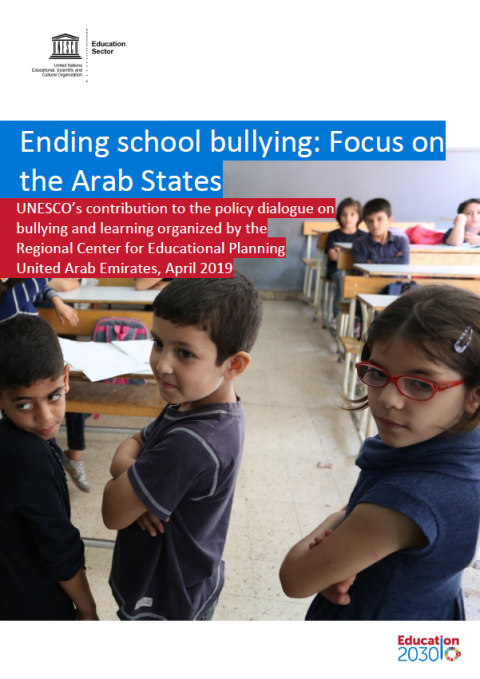 Ending school bullying: Focus on the Arab States and North Africa UNESCO’s contribution to the policy dialogue on bullying and learning organized by the Regional Center for Educational Planning United Arab Emirates Año de publicación: 2019 Autor corporativo: UNESCO Bullying is a form of school violence. According to an agreed international definition, bullying is characterised by aggressive behaviour that involves unwanted, negative actions and an imbalance of power or strength between the perpetrator or perpetrators and the victim. Unlike isolated incidents of school violence, bullying is also characterised by repetition over time. The number of repetitions may vary and, for example, major surveys that collect data on bullying measure the frequency of bullying in different ways. The international Sustainable Development Goal Thematic Indicator 4.a.2 that measures the ‘percentage of students who experienced bullying during the past 12 months, by sex’, which was adopted in 2018, defines that the frequency of aggressions should be at least once or twice a month or more for a student to be considered a victim of bullying. It is important to note that here is no standard definition of bullying across the six international surveys that collect data on the prevalence of bullying. Some of them do not even provide a definition. These surveys are the following:Two international surveys that measure the health behaviours of students as well as protective factors including school climate: the WHO Global School-based Student Health Survey (GSHS) and the Health Behaviours in School-aged Child survey (HBSC) conducted by the HBSC Consortium.Four international surveys that focus mostly on the measurement of learning outcomes of students but also ask questions on the school climate including bullying: the Regional Comparative and Explanatory Study in Latin America (Estudio Regional Comparativo y Explicativo, ERCE in Spanish); theProgress in International Reading Literacy Study (PIRLS); the Programme for International Students Assessment (PISA); and the Trends in Mathematics and Science Study (TIMSS).
  School, Identity and Discrimination Año de publicación: 2011 Autor: Néstor López Autor corporativo: UNESCO IIEP Office for Latin America and the Caribbean Education, identity and school is just one more link, within the many wills that work for full equality of opportunities. As in other publications of the Institute, the wealth of perspectives is added, which give shape to sometimes pressing realities with a demand for urgent action. The publication is a new opportunity for the voices of different interlocutors to give an account, in their countries and contexts, both of the construction of identity processes, and of their recognition and respect. This also implies raising the obstacles, the contributions and the advances, to face the challenges still pending. In each work presented here, the authors-whose participation and effort we deeply appreciate-offer sharp insights on various tasks and contexts. We wish, to conclude, that this text also contributes to the reflection on the possible courses that have been adopted or that require a deepening of the educational policies, specifically in the agendas related to the themes of this publication. Escuela, identidad y discriminación Año de publicación: 2011 Autor: Néstor López Autor corporativo: UNESCO IIEP Oficina para América Latina y el Caribe Educación, identidad y escuela es solo un eslabón más, dentro de las muchas voluntades que trabajan por la plena igualdad de oportunidades. Como en otras publicaciones del Instituto, se suma la riqueza de perspectivas, que dan forma a realidades en ocasiones acuciantes con demanda de urgente acción. La publicación supone una nueva oportunidad para que las voces de distintos interlocutores den cuenta, en sus países y contextos, tanto de la construcción de procesos identitarios, como de su reconocimiento y respeto. Ello implica también plantear los obstáculos, los aportes y los avances, para afrontar los desafíos aún pendientes. En cada trabajo que aquí se presenta, los autores –cuya participación y esfuerzo agradecemos profundamente– ofrecen agudas miradas sobre diversos quehaceres y contextos. Deseamos, para concluir, que este texto también contribuya a la reflexión sobre los posibles rumbos que se han adoptado o que requieren profundización en las políticas educativas, específicamente en las agendas vinculadas con las temáticas de esta publicación.
  Youth and changing realities: rethinking secondary education in Latin America Año de publicación: 2017 Autor: López.Néstor, Opertti.Renato, Vargas Tamez.Carlos Autor corporativo: UNESCO International Bureau of Education (IBE) | UNESCO IIEP Office for Latin America and the Caribbean Youth are central to UNESCO’s mandate. The more than one billion youth and adolescents in the world today hold the key to our shared future and to global sustainable development. With a focus on Latin America, this publication addresses the need to regain young learners’ trust in education and to arrive at more positive social constructions of youth among educators, parents and education authorities. In so doing, this study looks at educational experiences as meaning makers that shape youth cultures and identities as well as their attitudes toward education and its potential to improve individual and collective well-being. Adolescentes y jóvenes en realidades cambiantes: notas para repensar la educación secundaria en América Latina Año de publicación: 2017 Autor: López.Néstor, Opertti.Renato, Vargas Tamez.Carlos Autor corporativo: UNESCO International Bureau of Education (IBE) | UNESCO IIEP Oficina para América Latina y el Caribe La juventud es un tema central dentro del mandato de la UNESCO. Más de mil millones de jóvenes y adolescentes en el mundo actual tienen la llave de nuestro futuro en común y del desarrollo sostenible, justo e inclusivo a nivel mundial. Con el foco puesto en América Latina, la publicación aborda la necesidad de recuperar la confianza de las y los jóvenes y adolescentes en la educación y de llegar a construcciones sociales de la juventud más completas y positivas entre las y los educadores, los padres y madres, las comunidades y las autoridades educativas. De este modo, el estudio analiza las experiencias educativas en cuanto productoras de significado que configuran las culturas e identidades de la juventud, al igual que sus actitudes hacia la educación y su potencial para mejorar y sostener el bienestar individual y colectivo.
  Literacy for Empowerment and Transformation: Report of the Secretary-General Año de publicación: 2024 Autor corporativo: United Nations | UNESCO The present report is submitted in fulfilment of the request made by the General Assembly, in its resolution 77/192, that the Secretary-General, in cooperation with the Director General of the United Nations Educational, Scientific and Cultural Organization (UNESCO), submit to the Assembly at its seventy-ninth session a report on the implementation of the resolution. The Assembly also invited UNESCO to continue its mandated role to lead and coordinate the Education 2030 Agenda and requested UNESCO to continue its coordinating and catalysing role through the implementation of the strategy of the Global Alliance for Liter acy and by continuing to provide support to Member States. The present report provides an overview of the global literacy landscape, highlighting progress, key challenges and recommendations for further promotion of literacy as part of the 2030 Agenda for Sustainable Development, the follow-up to the Transforming Education Summit and beyond.