
Recursos
Exploren una amplia gama de recursos valiosos en GCED para profundizar su comprensión y promover su búsqueda, incidencia, enseñanza y aprendizaje.
1,405 resultados encontrados
 Recommendation on Adult Learning and Education, 2015 Año de publicación: 2016 Autor corporativo: UNESCO | UNESCO Institute for Lifelong Learning (UIL) The Recommendation on Adult Learning and Education was adopted at the 38th Session of the UNESCO General Conference in November 2015. The Recommendation supports the Education 2030 Framework for Action, reflects global trends, and will guide the transformation and expansion of equitable learning opportunities for youth and adults. The 2015 Recommendation takes a comprehensive and systematic approach to ALE, defining three key domains of learning and skills: literacy and basic skills; continuing education and vocational skills; as well as liberal, popular and community education and citizenship skills.It also describes five transversal areas of action: policy; governance; financing; participation, inclusion and equity; and quality. These areas of action were already introduced to the international community in the Belém Framework for Action, adopted at CONFINTEA in 2009 as a means of guiding Member States in improving ALE. This integrative and consistent approach to ALE will help Member States to ensure inclusive and equitable quality education and promote lifelong learning opportunities for all (Sustainable Development Goal 4).
 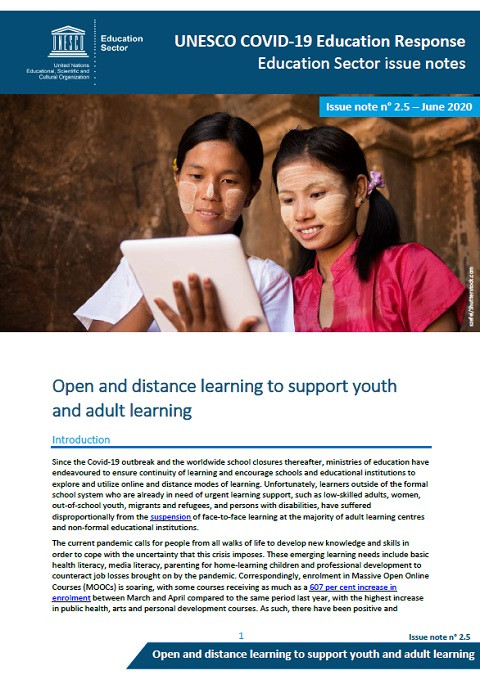 UNESCO COVID-19 Education Response: Open and Distance Learning to Support Youth and Adult Learning (Education Sector Issue Note; No. 2.5 – June 2020) Año de publicación: 2020 Autor corporativo: UNESCO Institute for Lifelong Learning (UIL) A new UNESCO issue note, produced by the UNESCO Institute for Lifelong Learning (UIL), aims to support education policy-makers and planners in ensuring open and distance learning to support youth and adult learning in the context of the current pandemic, now and in its aftermath.Since the COVID-19 outbreak and the worldwide school closures that followed, ministries of education have endeavoured to ensure continuity of learning and encourage schools and educational institutions to explore and utilize online and distance modes of learning. Unfortunately, learners outside of the formal school system who are already in need of urgent learning support, such as low-skilled adults, women, out-of-school youth, migrants and refugees, and persons with disabilities, have suffered disproportionally from the suspension of face-to-face learning at the majority of adult learning centres and non-formal educational institutions.The current pandemic calls for people from people from all socio-economic backgrounds, wherever they live in the world, to develop new knowledge and skills in order to cope with the uncertainty that this crisis imposes. These learning needs include basic health literacy, media literacy, parenting for home-schooling children and professional development to counteract job losses brought on by the pandemic. Correspondingly, enrolment in massive open online courses (MOOCs) is soaring. As such, there have been positive and demand-driven trends in exploring alternative options, such as open and distance learning (ODL), to ensure the continuity and expansion of non-formal education and adult learning.This issue note takes stock of opportunities and challenges in using ODL, both online and offline as defined in the UNESCO Issue Note on Distance Learning Strategies, for youth and adult learners outside the formal education system. After examining key issues and illustrating promising cases from public and private sectors, it provides key messages for policy interventions to support inclusive lifelong learning for youth and adults during and after the current pandemic.UNESCO Education Sector’s issue notes cover key topics related to the COVID-19 education response.
  World Heritage Forests: Carbon Sinks Under Pressure Año de publicación: 2021 Autor: Tales Carvalho Resende | David Gibbs | Nancy Harris | Elena Osipova Autor corporativo: UNESCO | International Union for Conservation of Nature (IUCN) | World Resources Institute This report provides the first global scientific assessment of greenhouse gas emissions and sequestration in forests found in UNESCO World Heritage sites.World Heritage forests, whose combined area of 69 million hectares is roughly twice the size of Germany, are some of the most biodiversity-rich habitats on Earth and play a crucial role in climate regulation by absorbing carbon dioxide (CO2) from the atmosphere. However, these forests are under increasing anthropogenic pressures, including climate change.By combining remote sensing data with site-level monitoring, this report has quantified the climate benefits of World Heritage forests for the first time, assessed the impacts on carbon of common threats to World Heritage forests and identified sites that are net carbon sources. It therefore provides information to facilitate dialogues between policymakers and local stakeholders for the development of effective solutions aimed at maintaining the continuing role of World Heritage forests as sinks and stable carbon stores for future generations.
 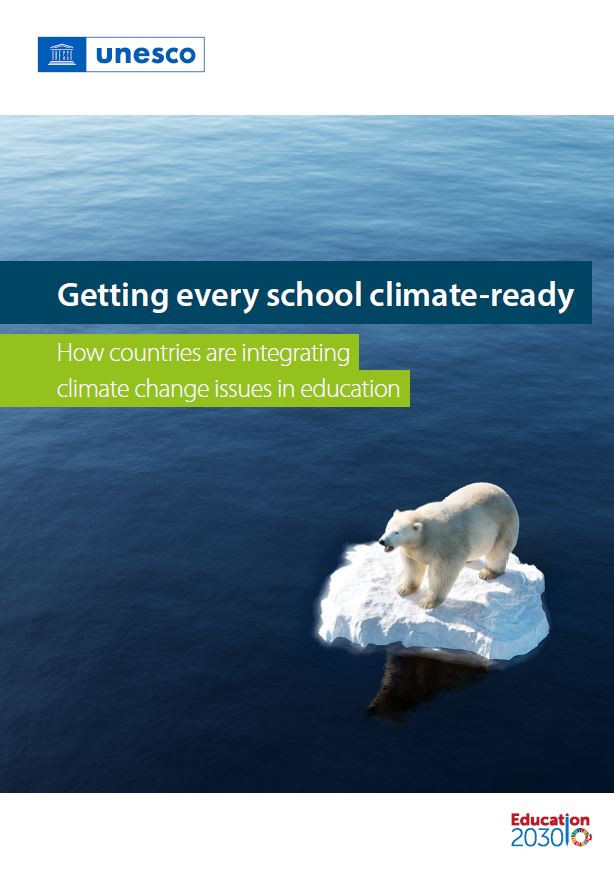 Getting Every School Climate-ready: How Countries are Integrating Climate Change Issues in Education Año de publicación: 2021 Autor corporativo: UNESCO This document summarizes the findings of selected studies by UNESCO and its partners on how climate change issues are integrated in education.These findings shed light on four key questions: where do we stand on climate change education; what do teachers say; what are the examples of country good practices on climate change education; and what does inter-ministerial collaboration on education for sustainable development look like?
  Media and Information Literate Citizens: Think Critically, Click Wisely! Año de publicación: 2021 Autor: Alton Grizzle | Carolyn Wilson | Ramon Tuazon | C.K. Cheung | Jesus Lau | Rachel Fischer | Dorothy Gordon | Kwame Akyempong | Jagtar Singh | Paul R. Carr | Kristine Stewart | Samy Tayie | Olunifesi Suraj | Maarit Jaakkola | Gina Thésée | Curmira Gulston Autor corporativo: UNESCO Content providers such as libraries, archives, museums, media and digital communications companies can enable inclusive and sustainable development. However, they do not always live up to these ideals, which creates challenges for the users of these services. Content providers of all types open up new opportunities for lifelong learning. But at the same time, they open up challenges such as misinformation and disinformation, hate speech, and infringement of online privacy, among others.Media and information literacy is a set of competencies that help people to maximize advantages and minimize harms. Media and information literacy covers competencies that enable people to critically and use of digital technologies. Capacities in these areas are indispensable for all citizens regardless of their ages or backgrounds.This pioneering curriculum presents a comprehensive competency framework of media and information pedagogical suggestions. It features various detailed modules covering the range of competencies needed to navigate today’s communications ecosystem. This resource links media and education, education for sustainable development, cultural literacy and the exponential information literacy curriculum, everyone can become media and information literate as well as peer-educators of media and information literacy.
  Citoyens éduqués aux médias et à l’information : penser de manière critique, cliquer à bon escient ! Año de publicación: 2023 Autor: Alton Grizzle | Carolyn Wilson | Ramon Tuazon | C.K. Cheung | Jesus Lau | Rachel Fischer | Dorothy Gordon | Kwame Akyempong | Jagtar Singh | Paul R. Carr | Kristine Stewart | Samy Tayie | Olunifesi Suraj | Maarit Jaakkola | Gina Thésée | Curmira Gulston Autor corporativo: UNESCO Pouvons-nous améliorer nos sociétés en cliquant à bon escient ?Les fournisseurs de contenus que sont les bibliothèques, les archives, les musées, les médias et les entreprises de communication numérique, entre autres, peuvent favoriser un développement inclusif et durable. Cependant, ils ne sont pas toujours à la hauteur de cet idéal, ce qui pose des difficultés aux utilisateurs de ces services.Les fournisseurs de contenus de tous types ouvrent de nouvelles opportunités d’apprentissage tout au long de la vie. Mais dans le même temps, ils ouvrent aussi la porte aux problèmes que sont la mésinformation, la désinformation, les discours de haine et la violation de la confidentialité en ligne, entre autres.L’éducation aux médias et à l’information est un ensemble de compétences qui permet d’optimiser les avantages et de minimiser les préjudices. L’éducation aux médias et à l’information couvre les compétences qui permettent à chacun d’interagir de façon critique et efficace avec le contenu des communications, les institutions qui fournissent ce contenu et les technologies numériques. Les capacités dans ces domaines sont indispensables pour tout citoyen, quel que soit son âge ou son origine.Ce programme novateur présente un cadre de compétences complet en matière d’éducation aux médias et à l’information, ainsi que des suggestions pédagogiques structurées pour les éducateurs et les apprenants. Il se compose de plusieurs modules détaillés couvrant l’éventail des compétences nécessaires pour évoluer dans l’écosystème des communications d’aujourd’hui. Cette ressource relie l’éducation aux médias et à l’information à des questions émergentes telles que l’intelligence artificielle, l’éducation à la citoyenneté numérique, l’éducation en vue du développement durable, l’éducation culturelle et l’augmentation exponentielle de la mésinformation et de la désinformation. En utilisant ce programme d’éducation aux médias et à l’information de façon efficace, chacun peut s’éduquer aux médias et à l’information, voire devenir pair éducateur dans ce domaine.
  미디어 정보 리터러시 갖춘 시민 되기: 비판적으로 사고하고 현명하게 클릭하기! Año de publicación: 2022 Autor: Alton Grizzle | Carolyn Wilson | Ramon Tuazon | C.K. Cheung | Jesus Lau | Rachel Fischer | Dorothy Gordon | Kwame Akyempong | Jagtar Singh | Paul R. Carr | Kristine Stewart | Samy Tayie | Olunifesi Suraj | Maarit Jaakkola | Gina Thésée | Curmira Gulston Autor corporativo: 한국언론진흥재단 | 유네스코한국위원회 도서관을 비롯한 아카이브, 박물관, 미디어와 디지털 통신 회사 같은 콘텐츠 제공자는 모든 이를 포용하고 지속가능한 개발을 이루어낼 역량을 지니고 있다. 하지만, 콘텐츠 제공자가 그와 같은 이상에 근거해서만 움직이는 것은 아니기 때문에 서비스 사용자들은 어려움을 겪게된다. 모든 콘텐츠 제공자는 평생학습의 기회를 열어 주기도 하지만 동시에 잘못된 정보나 허위정보, 혐오 표현, 온라인 프라이버시 침해 등과 같은 과제도 안겨 준다.미디어 정보 리터러시란 사람들이 취할 수 있는 혜택은 최대로 얻고, 입을 수 있는 피해는 최소화할 수 있도록 하는 일련의 역량을 의미한다. 미디어 정보 리터러시는 커뮤니케이션 콘텐츠와 해당 콘텐츠를 제공하는 기관 및 디지털 기술을 비판적이고 효과적으로 이용할 수 있는 역량이다. 이는 나이, 배경과 관계없이 모든 시민이 필수적으로 갖추어야 하는 능력이다.이 선구적인 커리큘럼은 미디어․정보 리터러시 역량의 종합적인 프레임워크를 제공하며, 교육자와 학습자가 활용할 수 있는 체계적인 교육적 방안을 제안한다. 또한 다양한 모듈을 제시하여 오늘날의 커뮤니케이션 생태계를 이해하는 데 필수적인 역량 범위를 상세하게 다루고 있다. 이 자료에서 미디어․정보 리터러시는 지금 우리 사회에서 새롭게 부상하고 있는 문제들, 즉 인공 지능을 비롯해 디지털 시민 교육, 지속가능 발전 교육, 문화 리터러시 및 허위정보와 잘못된 정보의 급증 등과 연계하여 다루어진다. 본 컴리큘럼을 효과적으로 활용한다면 누구나 미디어 정보 리터러시를 갖춘 시민은 물론, 미디어․정보 리터러시의 동료 교육자도 될 수 있을 것이다.
 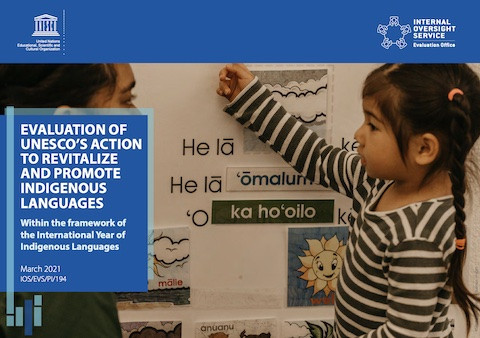 Evaluation of UNESCO’s Action to Revitalize and Promote Indigenous Languages: Within the Framework of the International Year of Indigenous Languages Año de publicación: 2021 Autor: Claire Thomas | Lydia van de Fliert | Oliver Loode | Silvia Quattrini | Mihaela Cojocaru Autor corporativo: UNESCO To draw attention to the critical loss of indigenous languages and the urgent need to preserve, revitalize and promote them and to take further urgent steps at the national and international levels, in 2016 the United Nations General Assembly in its resolution 71/178 proclaimed the year beginning on 1 January 2019 the International Year of Indigenous Languages (hereafter the IYIL2019). UNESCO was invited to serve as the lead agency for the Year and the coordination role was internally assigned to the Communication and Information Sector. UNESCO requested an evaluation of its action within the IYIL2019 with a view to learning from its experience during 2019 and further strengthening its coordination and implementation role during the upcoming Decade of Indigenous Languages (2022-2032).As the lead agency for the IYIL2019, UNESCO played a key role raising awareness of not only the critical loss of indigenous languages, but also the positive value and meanings that indigenous languages provide to Indigenous Peoples and humanity at large. The evaluation found that UNESCO led the development of an ambitious and relevant Action Plan for the Year. It also succeeded in setting up an 18-member Steering Committee composed of representatives of Member States, Indigenous Peoples and the UN three-party indigenous mechanisms. UNESCO staff implemented more than 80 activities around the world, with three-quarters of these at the global level and the majority of national events in Latin America and the Caribbean region. It also maintained an interactive website, which registered more than 880 events around the world.Leading and coordinating the IYIL2019 was not without its challenges, particularly as UNESCO was asked to lead this effort within existing resources and relying on a very small core team. Its programme sectors found creative solutions for indigenous language programming, but without a budget for intersectoral activities, collaboration between sectors was limited to information sharing and activities in Africa and the Arab States were few. The evaluation also found that the Action Plan lacked a meaningful results framework and thereby did not facilitate the monitoring of the IYIL2019. Partnerships with UNESCO networks and the wider UN system were underutilized and many opportunities for future collaboration have been highlighted for the upcoming Decade.
  The World in 2030: Public Survey Report Año de publicación: 2021 Autor corporativo: UNESCO This report presents the results of the World in 2030 Survey, launched by UNESCO in May 2020 to provide a platform for people to share their views on our world’s most pressing challenges, including what specifically they are worried about, and, most importantly, what solutions they feel are mostneeded. The results of this survey present a clear and systematic framework for action, one that can enrich global reflection over the coming decade as part of a renewed push to achieve the Sustainable Development Goals of the UN 2030 Agenda.Over 15,000 respondents from all regions of the world responded to the survey, providing a clear snapshot of global per- spectives. This survey received particular participation from women and young people. A majority of respondents had a university education, and the top region from which participants hailed was Latin America and the Caribbean.Responses to the World in 2030 Survey indicate clear trends in the concerns felt by global citizens. According to survey respondents, the top challenge facing peaceful societies in the lead up to 2030 was, by far, climate change and loss of biodiversity, ranking in the top four challenges of 67% of respondents, and coming out on top for all regions and demographics. When examining this challenge, people were most concerned about increasing natural disasters and extreme weather, loss of biodiversity and its impact on people, pollution of the ocean and rising sea levels, and risk of conflict or violence. The top proposed solutions were investing in green energy and sustainable economies, teaching sustainability through education, effective international cooperation, and building trust in science and science-based decisions.The next four most highlighted global challenges were violence and conflict (44%), discrimination and inequality (43%), lack of food, water and housing (42%), and health and disease (37%). There was some limited variation in the rankings of the relative importance of these four challenges across regions and demographics. For example, women and minority group respondents both ranked discrimination and inequality as the second most important global challenge, following climate change and biodiversity loss, rather than third, while respondents from indigenous communities and from Asia and the Pacific ranked health and disease as the second most important global challenge, rather than fifth. The World in 2030 survey was an open online questionnaire held from May to September 2020. It was made available in more than 25 languages. This report also analyses results along regional, gender, age and other demographic lines, presenting a complex and valuable portrait of global sentiment on these key issues.
  Freedom & Creativity: Defending Art, Defending Diversity; Special Edition Año de publicación: 2020 Autor: Laurence Cuny Autor corporativo: UNESCO In anticipation of the third edition of Re|Shaping Cultural Policies, this special edition of the Global Report series that monitors the implementation of the 2005 Convention on the Protection and Promotion of the Diversity of Cultural Expressions, focuses on one of the Convention’s overarching goals: the promotion of human rights and fundamental freedoms and, in particular, artistic freedom. Freedom of expression, information and communication, as well as the ability of individuals to choose cultural expressions is a prerequisite for the protection and promotion of the diversity of cultural expressions.Building on the recommendations put forth in the 2018 Global Report, this special edition provides an overview of current advances and challenges in the legal protection of artistic freedom, the protection of the social and economic rights of artists and cultural professionals and the monitoring of artistic freedom at the national, regional and international levels.By producing new evidence and valuable analysis, the 2005 Convention Global Report series is intended as a reference tool for cultural policymaking and advancing creativity for development.