
Recursos
Exploren una amplia gama de recursos valiosos en GCED para profundizar su comprensión y promover su búsqueda, incidencia, enseñanza y aprendizaje.
1,443 resultados encontrados
 Document final de la Consultation technique sur l’éducation à la citoyenneté mondiale: Éducation à la citoyenneté mondiale : Une nouvelle vision Año de publicación: 2013 Autor corporativo: UNESCO Le présent document s’inspire des contributions et des perspectives communes issues d’une Consultation technique sur l’éducation à la citoyenneté mondiale organisée par l’UNESCO et la République de Corée (à savoir, par les ministères des Affaires étrangères et de l’Éducation et le Centre Asie-Pacifique d'éducation pour la compréhension internationale) à Séoul, les 9 et 10 septembre 20131. Ce projet de document s’appuie sur : (a) les réponses des experts participants à un questionnaire envoyé par l’UNESCO avant la consultation ; (b) les présentations des experts durant la consultation; (c) les débats qui ont eu lieu pendant la consultation ; et sur (d) les documents de référence préparés pour la consultation. Le projet final du présent document a été préparé par la Division de l'éducation pour la paix et le développement durable, au Siège de l’UNESCO, à Paris, avec le soutien d’une équipe de rédaction. Documento Final de la Consulta técnica Sobre Educación para la Ciudadanía Mundial - Educación para la Ciudadanía Mundial: una Perspectiva Emergente Año de publicación: 2013 Autor corporativo: Organización de las Naciones Unidas para la Educación, la Ciencia y la Cultura (UNESCO) En el presente documento se toman como base los aportes y las perspectivas comunes que surgen de la consulta técnica sobre la educación para la ciudadanía mundial, organizada por la UNESCO y la República de Corea (los Ministerios de Relaciones Exteriores y de Educación y el Centro de Asia y el Pacífico de Educación para el Entendimiento Internacional) en Seúl los días 9 y 10 de septiembre de 2013.A lo largo de la elaboración del borrador de este documento se utilizaron: a) las respuestas de expertos a un cuestionario circulado por la UNESCO previo a la consulta; b) las ponencias realizadas por los expertos durante la consulta; c) las discusiones que se efectuaron durante la consulta; y d) el material de referencia que respaldó y fue preparado para la consulta. El borrador final del presente documento fue preparado por la División de la Educación para la Paz y el Desarrollo Sostenible en la sede de la UNESCO en París, con la asistencia de un equipo de redacción. En este documento se presentan las perspectivas comunes que emanaron de la consulta.
  UNESCO's role in promoting education as a tool to prevent violent extremism Año de publicación: 2015 Autor corporativo: UNESCO This item has been included in the provisional agenda of the 197th session of the Executive Board at the request of the United States of America and co-sponsored by Bosnia and Herzegovina, Bulgaria, Costa Rica, Côte d’Ivoire, Djibouti, Finland, France, Germany, Jordan, Kenya, Latvia, Nigeria, Norway, Pakistan, Philippines, Republic of Korea, Rwanda, Senegal, Slovenia, Suriname, Switzerland and Turkey
  Climate change education for sustainable development in small island developing states: report and recommendations Año de publicación: 2012 Autor corporativo: UNESCO This report summarizes the key outcomes of a three-day meeting of around one hundred climate change education (CCE) experts, primarily from Small Island Developing States (SIDS) in the Caribbean, the Pacific Ocean and the Indian Ocean, representing a multi-disciplinary and diverse group of stakeholders. The meeting discussed and reflected on the challenges that climate change poses to education systems in SIDS, and on the role that education must play in adaptation to climate change. It was held from 21 to 23 September 2011 in Nassau, with the support of the Commonwealth of the Bahamas, the Government of Denmark and the Government of Japan. SIDS in the Caribbean Sea, the Indian Ocean and the Pacific Ocean are among the most vulnerable countries with regard to climate change. SIDS are already confronted with the effects of climate change, including rising sea levels and changes in weather and climate extremes such as droughts, floods and tropical cyclones/hurricanes. With current and future impacts of climate change representing a real danger to SIDS communities and livelihoods – whether based on agriculture, fisheries, forestry, tourism or trade – the need for SIDS to reduce their vulnerability to climate change by strengthening their adaptive capacity is a matter of urgency. Moving further along the path to sustainable development and achieving sustainable development objectives will depend on the ability of SIDS to strengthen this adaptive capacity. Adaptation to climate change requires individuals to be aware of potential changes in the climate and to understand the implications of changes for their lives. It requires them to assess the risks such changes hold for their identity and future, and to make informed decisions on how to adapt their livelihoods, homes and communities. Education plays an essential role in increasing the adaptative capacity of communities and nations by enabling individuals to make informed decisions. In particular, the education of girls and women has proven to have a significant impact on the capacity of communities to adapt to climate change and develop sustainably. Quality education designed for the purpose of empowering people to address climate change and live sustainably improves the adaptation capacity at the community level. This implies educational programmes that explicitly prepare communities for natural disasters. Climate change education for sustainable development (CCESD) needs also to incorporate indigenous knowledge, and promote sustainable lifestyles in which the importance of heritage is recognised as an integral part of community identity and a key asset that can help build resilience. Finally, CCESD should stress the unique cultural and natural heritage of SIDS, which plays a major role in the building of community resilience. Le changement climatique éducation pour le développement durable dans les petits États insulaires en développement: rapport et recommandations Año de publicación: 2012 Autor corporativo: UNESCO Ce rapport résume les principaux résultats d'une réunion de trois jours d'une centaine éducation au changement climatique (ECC) experts, principalement des petits États insulaires en développement (PEID) dans les Caraïbes, l'océan Pacifique et l'océan Indien, ce qui représente un multi-disciplinaire et divers groupes d'intervenants. La réunion a discuté et réfléchi sur les défis que le changement climatique fait peser sur les systèmes éducatifs dans les PEID, et sur le rôle que l'éducation doit jouer dans l'adaptation au changement climatique. Il a eu lieu du 21 au 23 Septembre 2011 à Nassau, avec le soutien du Commonwealth des Bahamas, le gouvernement du Danemark et le Gouvernement du Japon. PEID dans la mer des Caraïbes, l'océan Indien et l'océan Pacifique sont parmi les pays les plus vulnérables en ce qui concerne le changement climatique. PEID sont déjà confrontés aux effets du changement climatique, y compris l'élévation du niveau de la mer et les changements météorologiques et climatiques extrêmes tels que les sécheresses, les inondations et les cyclones tropicaux / ouragans. Avec les impacts actuels et futurs des changements climatiques représentent un réel danger pour les communautés des PEID et des moyens de subsistance - qu'elle soit fondée sur l'agriculture, la pêche, la sylviculture, le tourisme ou le commerce - la nécessité pour les PEID afin de réduire leur vulnérabilité aux changements climatiques en renforçant leur capacité d'adaptation est une question d'urgence. Aller plus loin le long de la voie du développement durable et la réalisation des objectifs de développement durable dépendra de la capacité des PEID à renforcer cette capacité d'adaptation.Adaptation au changement climatique oblige les particuliers à être conscients des changements potentiels du climat et de comprendre les implications des changements pour leur vie. Il les oblige à évaluer les risques que ces changements tiennent pour leur identité et leur avenir, et de prendre des décisions éclairées sur la façon d'adapter leurs moyens de subsistance, les foyers et les communautés. L'éducation joue un rôle essentiel dans l'augmentation de la capacité d'adaptation des communautés et des nations en permettant aux individus de prendre des décisions éclairées. En particulier, l'éducation des filles et des femmes a prouvé avoir un impact significatif sur la capacité des communautés d'adaptation aux changements climatiques et à développer de manière durable. L'éducation de qualité conçu dans le but de permettre aux gens de faire face aux changements climatiques et à vivre de manière durable améliore la capacité d'adaptation au niveau communautaire. Cela implique des programmes éducatifs qui préparent explicitement les communautés aux catastrophes naturelles. Le changement climatique d’éducation pour le développement durable (CCEDD) doit également intégrer les connaissances autochtones, et de promouvoir des modes de vie durables dans laquelle l'importance du patrimoine est reconnue comme faisant partie intégrante de l'identité communautaire et un atout majeur qui peut aider à renforcer la résilience. Enfin, CECDD devrait insister sur le patrimoine culturel et naturel unique des PEID, qui joue un rôle majeur dans la construction de la résilience des communautés. Eleventh meeting of the working group on Education for All, 2-3 February 2011, Paris, France: summary report Año de publicación: 2011 Autor corporativo: UNESCO The eleventh meeting of the Working Group (WG) on Education for All (EFA) took place on 2 and 3 February 2011 at UNESCO headquarters in Paris. The meeting brought together people representing governments, bilateral and multilateral organizations, regional organizations, civil society organizations (CSOs), research institutes, foundations and the private sector. Consisting of seven sessions, the meeting aimed to review the world’s progress towards EFA and identify policy actions that can accelerate EFA progress, in particular as regards quality education, effective advocacy for education, violent conflicts and education and financing for education. The recommendations of the meeting were to be taken to the tenth meeting of the High Level Group (HLG) on EFA (Jomtien, Thailand, 22–24 March 2011). Eleventh meeting of the working group on Education for All, 2-3 February 2011, Paris, France: summary report Año de publicación: 2011 Autor corporativo: UNESCO La onzième réunion du Groupe de travail(GT) sur l'éducation pour tous(EPT) a eu lieu les 2 et 3 Février 2011 au Siège de l'UNESCO à Paris. La réunion a rassemblé des personnes représentant les gouvernements, les organisations bilatérales et multilatérales, les organisations régionales, les organisations de la société civile (OSC), les instituts de recherche, les fondations et le secteur privé. Composée de sept sessions, la réunion visait à examiner les progrès accomplis dans le monde pour l'EPT et identifier les actions politiques qui peuvent accélérer les progrès de l'EPT, en particulier que l'éducation concerne la qualité, le plaidoyer efficace pour l'éducation, les conflits violents et de l'éducation et le financement de l'éducation. Les recommandations de la réunion devaient être prises à la dixième réunion du Groupe de haut niveau (GHN) sur l'EPT (Jomtien, Thaïlande, 22-24 Mars 2011).
  Evaluation of UNESCO's Capacity Development for Education for All (CapEFA) Programme Año de publicación: 2016 Autor corporativo: UNESCO The main purpose of this evaluation is to determine the relevance and effectiveness of the Capacity Development for Education for All (CapEFA) programme’s overall contribution to progress towards the realization of the Education for All (EFA) goals in its target countries, and to provide actionable and timely recommendations to the United Nations Educational, Scientific and Cultural Organization (UNESCO) on the positioning of the Programme to meet future needs and challenges related to the adoption of the Sustainable Development Goals (SDG) in September 2015, and more specifically to the SDG 4 to ‘Ensure inclusive and equitable quality education and promote lifelong learning opportunities for all’. The focus of this evaluation is on assessing the CapEFA programme’s relevance, effectiveness, efficiency, and sustainability. This evaluation does not focus on how the programme impacts on the EFA goals, due to the challenge in assessing the causality between the programme’s goals and the EFA indicators. The focus of the assessment is on whether the right conditions at the systemic and institutional levels are created to have an impact on these EFA macro-indicators.
 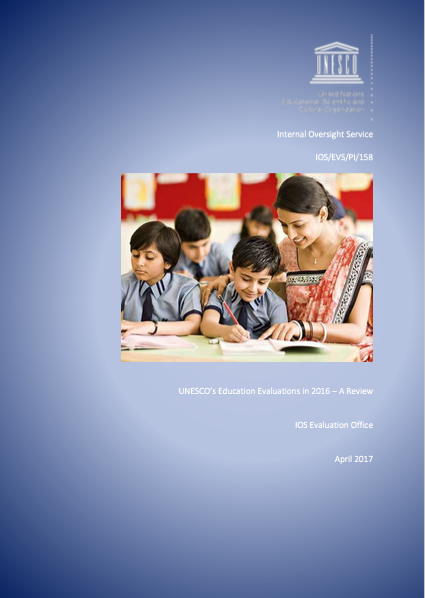 UNESCO's Education Evaluation in 2016: A Review Año de publicación: 2017 Autor corporativo: UNESCO UNESCO completed 12 education related evaluations in 2016. Part A of this review presents the key insights and lessons learned from those evaluations. These learnings are designed to help enhance UNESCO’s leadership and coordination of the SDG 4 – Education 2030 Agenda. Part B of the review provides an assessment of the quality and usefulness of these evaluations based on the UNEG and OECD quality standards for evaluation reports.
  UNESCO and Education Año de publicación: 2017 Autor corporativo: UNESCO Education is a fundamental human right and
a public good and, as such, has been at the core of UNESCO’s work since its inception.Education is also the path to sustainability – to poverty alleviation, better health, environmental protection and gender equality.As the only United Nations agency with a mandate to cover all aspects of education, UNESCO was entrusted in 2015 to lead the coordination and monitoring of Sustainable Development Goal 4, as part of the new Global Education 2030 Agenda.Goal 4 aims to “ensure inclusive and equitable quality education and promote lifelong learning opportunities for all,” and renewed UNESCO’s and Member States’ commitment to a vision of education that is holistic, inspirational and which leaves no one behind.This commitment is reflected in the size and scope of the Education Sector, the largest in UNESCO, with staff working at its Paris Headquarters and spread across a global network of field offices and specialized institutes and centres. With its close links with education ministries and other partners, UNESCO is strongly placed to press for action and change.UNESCO’s Education Sector supports Member States in developing education systems that foster high-quality and inclusive lifelong learning for all, empowering learners to be creative and responsible global citizens while leading the debate to help shape the future international education agenda.There is no stronger, no more lasting, investment a country can make than educating its citizens. The Education Sector exists to further this collective vision worldwide by transforming lives one by one.
UNESCO and Education Año de publicación: 2017 Autor corporativo: UNESCO Education is a fundamental human right and
a public good and, as such, has been at the core of UNESCO’s work since its inception.Education is also the path to sustainability – to poverty alleviation, better health, environmental protection and gender equality.As the only United Nations agency with a mandate to cover all aspects of education, UNESCO was entrusted in 2015 to lead the coordination and monitoring of Sustainable Development Goal 4, as part of the new Global Education 2030 Agenda.Goal 4 aims to “ensure inclusive and equitable quality education and promote lifelong learning opportunities for all,” and renewed UNESCO’s and Member States’ commitment to a vision of education that is holistic, inspirational and which leaves no one behind.This commitment is reflected in the size and scope of the Education Sector, the largest in UNESCO, with staff working at its Paris Headquarters and spread across a global network of field offices and specialized institutes and centres. With its close links with education ministries and other partners, UNESCO is strongly placed to press for action and change.UNESCO’s Education Sector supports Member States in developing education systems that foster high-quality and inclusive lifelong learning for all, empowering learners to be creative and responsible global citizens while leading the debate to help shape the future international education agenda.There is no stronger, no more lasting, investment a country can make than educating its citizens. The Education Sector exists to further this collective vision worldwide by transforming lives one by one.