
Recursos
Exploren una amplia gama de recursos valiosos en GCED para profundizar su comprensión y promover su búsqueda, incidencia, enseñanza y aprendizaje.
1,402 resultados encontrados
 Communication and Information Programme Año de publicación: 2021 Autor corporativo: UNESCO UNESCO is the UN specialized agency building peace in the minds of people through education, the sciences, culture, communication and information. Our mission is to foster intercultural dialogue and sustainable development, by promoting the free flow of ideas.By adopting a multi-disciplinary and inclusive approach, UNESCO works with both duty-bearers and rights-holders across the world to develop and implement targeted actions that are born out of local needs, which ensures a holistic and results-based approach for sustainable change.In the field of communication and information, UNESCO defends and promotes freedom of expression, media independence and pluralism, and the building of inclusive knowledge societies underpinned by universal access to information and the innovative use of digital technologies.Through capacity-building, policy advice, international cooperation, monitoring and foresight in the fields of freedom of expression, access to information, and digital transformation, UNESCO will continue to empower key actors with a view to ensuring that fundamental freedoms are guaranteed online and offline, in line with international standards.This is all the more relevant to ensure the ethical development and use of emerging technologies, which have a growing impact on all aspects of the world’s societies. Citizens will also be empowered to enjoy these fundamental freedoms through the development of 21st century skills and the fostering of enabling environments for media pluralism and diversity.
  Not Just Hot Air: Putting Climate Change Education Into Practice Año de publicación: 2015 Autor corporativo: UNESCO This publication presents UNESCO’s work on Climate Change Education for Sustainable Development in 2012/2013, and intends to serve as a reference for similar work in the future.It provides: National case studies on five CCESD country pilots conducted by UNESCO in 2012/2013 in: Dominican Republic, Guyana, Mauritius, South Africa and Tuvalu. The case studies include an analysis and assessment of the undertaken CCESD capacity-building work for policy makers and teacher educators, lessons learnt about the implementation of the programme, and conclusions. 16 short country profiles from around the world on policy development regarding ESD and Climate Change Education. Recommendations on Climate Change Education in the context of Education for Sustainable Development, developed by UNESCO in order to establish a common understanding of what needs to be done to enhance education responses to climate change. This publication is intended to provide policy makers and teacher educators with a compact source of information on how to mobilize education to address climate change.
  The Right to Education: What’s at Stake in Afghanistan?; A 20-Year Review Año de publicación: 2021 Autor corporativo: UNESCO This report takes stock of the achievements in education made by Afghanistan over the past 20 years and sets out immediate action to safeguard the right to education for all learners following deep political change in the country in 2021.Although Afghanistan lags far behind countries across South and West Asia on most development indicators, it has made impressive progress in education over two decades. Enrolment has increased ten-fold, with substantial gains for girls and female literacy. Female teachers have been hired. Steady efforts have been made to expand the school network across the country.The country has ratified key international normative instruments relating to the right to education; enshrined this right in the Constitution and adopted a wide range of policy measures to increase access, improve education quality and reduce gender, socio- economic and rural/urban disparities.But the challenges remain colossal, with half the primary school-aged children not enrolled in school and very low learning outcomes. The country is highly dependent on external aid to sustain its education system. It needs to uphold state obligations on the right to education without any discrimination and continue removing barriers that impede progress towards the Sustainable Development Goal on education to build the country’s future.
  Inclusion in Early Childhood Care and Education in High-Income Countries Año de publicación: 2021 Autor corporativo: Global Education Monitoring Report Team | UNESCO | Deloitte Access Economics This report reviews the international research and policy literature concerning approaches to inclusion in early childhood care and education (ECCE) in different high-income jurisdictions globally. Each chapter highlights examples of policies and practices which can foster inclusion in ECCE across the themes set out in the Global Education Monitoring (GEM) Report in 2020.As a critical period for children’s intellectual, emotional, social, physical and moral development, supporting inclusion in ECCE is of particular importance for supporting lifelong learning and equitable opportunities for all children. A number of key messages emerging from this review that are instructive to designing policies to promote inclusion in ECCE are summarised below. Inclusion in ECCE is fostered through complementary universal and targeted approaches to most aspects of ECCE governance, financing, policy and service delivery. The implementation of ECCE laws and policies is key to supporting inclusion. As the central actors delivering ECCE services, collaboration within the ECCE workforce is crucial to supporting a community of practice which leads and shares inclusion, while avoiding risks of specialisation. Finally, while many existing ECCE policies, resources and tools are grounded in a deficits-based approach to understanding need, inclusion may be better supported through an approach which focusses on child learning needs and strengths.
  Addressing Hate Speech on Social Media: Contemporary Challenges; Discussion Paper 01 Año de publicación: 2021 Autor corporativo: UNESCO | Oxford Internet Institute | European Union (EU) This paper is part of a collection of discussion papers, commissioned and produced by UNESCO and the United Nations Office of the Special Adviser on the Prevention of Genocide (OSAPG). The papers are a direct contribution to the United Nations Strategy and Plan of Action and are published in the context of the Multistakeholder Forum and Ministerial Conference on Addressing Hate Speech through Education in September and October 2021. The outbreak of the COVID-19 pandemic has highlighted the pertinence of the United Nations Strategy and Plan of Action, generating a wave of hate speech across the world –further exacerbating intolerance and discrimination towards particular groups and destabilizing societies and political systems. The discussion papers seek to unpack key issues related to this global challenge and propose possible responses and recommendations.
 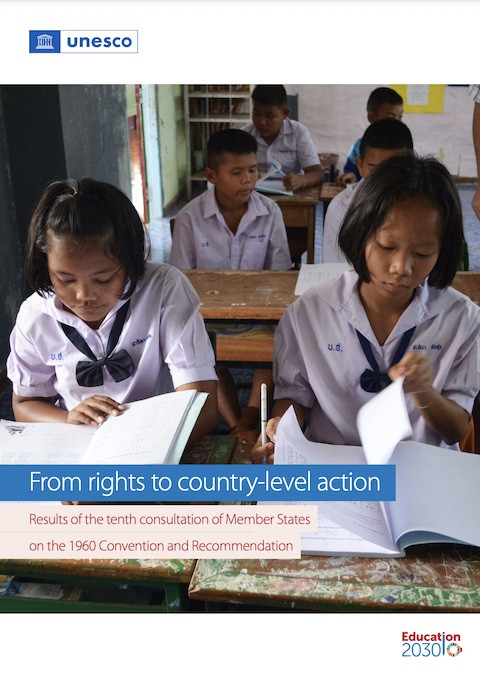 From Rights to Country-Level Action: Results of the Tenth Consultation of Member States on the 1960 Convention and Recommendation Año de publicación: 2022 Autor: Rolla Moumné | Sharlene Bianchi Autor corporativo: UNESCO The year 2020 marked a turning point for education worldwide. The impact of the COVID-19 pandemic not only amplified the difficulties and revealed existing weaknesses, but also brought the unpreparedness and lack of resilience of national education systems to the fore.The tenth consultation on the 1960 Convention against Discrimination in Education was conducted in precisely this context.Providing a valuable opportunity for States to take stock of the progress made in implementing Convention and sharing interesting national practices, the Consultation revealed continuous and new challenges the education sector faces. The unique timing of the consultation also created an opportunity to report on actions taken to faceadverse effects of the pandemic. This report analyzes and presents the Consultation findings, draws trends, and provides guidance for action. It shows how, by implementing the provisions of the Consultation, States can accelerate progress towards achieving Sustainable Development Goal 4, while invites a reflection on possibly reviewing the framework of the right to education to further respond to new challenges and put an end to increased inequalities worldwide.
  K-12 AI Curricula: A Mapping of Government-Endorsed AI Curricula Año de publicación: 2022 Autor corporativo: UNESCO Regulations on their own are insufficient to ensure AI as a common good for education and for humanity. All citizens need to be equipped with some level of AI literacy covering the values, knowledge and skills relating to AI. This report features key findings and recommendations of UNESCO’s global survey on AI curricula for K-12. It reveals that only 11 countries have developed and endorsed K-12 AI curricula and another four countries have AI curricula in development. This is a strong call for Member States to develop AI curricula for K-12 students, and to build stronger mechanisms to validate non-governmental AI curricula offered to balance the private-driven approach. The report also reveals that the learning outcomes of AI curricula need to be more focused on fostering creativity in crafting AI technologies and on contextual ethics. Teacher training is key to ensure the implementation of AI curricula, and teachers need to be trained on designing and facilitating project-based learning which is the most commonly used pedagogical methodology in existing AI curricula. The report also advises an ‘agnostic approach’ towards AI brands and products when introducing domain-specific AI technologies.
  Ethical Impact Assessment: A Tool of the Recommendation on the Ethics of Artificial Intelligence Año de publicación: 2023 Autor corporativo: UNESCO As stated in article 50 of UNESCO’s Recommendation on the Ethics of Artificial Intelligence (UNESCO, 2021), the goal of this instrument is to “identify and assess benefits, concerns and risks of AI systems, as well as appropriate risk prevention, mitigation, redressal and monitoring measures, among other assurance mechanisms. Such assessments should identify the impacts on human rights and fundamental freedoms, in particular but not limited to the rights of people in vulnerable and precarious situations, labour rights, the environment and ecosystems and ethical and social implications, and facilitate citizen participation in line with the values and principles set forth in this Recommendation”. This instrument is primarily designed to help government officials (individuals and teams) involved in the procurement of AI systems. The goal of the methodology is to equip procurement officers with the set of questions to ask in order to ensure that the AI systems they are purchasing are aligned with the ethical standards set out in the UNESCO Recommendation on the Ethics of AI.
  Son Atlas: Outil de plaidoyer interactif sur le droit à l’éducation des filles et des femmes Año de publicación: 2023 Autor corporativo: UNESCO De nombreuses filles et femmes ne peuvent pas exercer leur droit à l'éducation en raison des inégalités entre les genres et des pratiques discriminatoires. La pauvreté, les mariages précoces et les violences basées sur le genre ne sont que quelques-unes des nombreuses raisons qui expliquent le pourcentage élevé d'analphabétisme et de décrochage scolaire chez les filles et les femmes dans le monde. Le renforcement du droit des filles et des femmes pour une éducation de qualité est essentiel pour éliminer la discrimination et parvenir à l'égalité des droits entre les genres. Ceci ne peut être réalisé sans des cadres juridiques nationaux solides, basés sur les droits, sensibles au genre et inclusifs. C'est là qu'intervient SonAtlas. SonAtlas est un outil en ligne, le premier du genre, qui cartographie le droit à l'éducation des filles et des femmes. Il vise à améliorer les connaissances du public et à surveiller le statut des constitutions, législations et réglementations nationales relatives aux droits à l'éducation des filles et des femmes, afin d'encourager les pays à agir, à renforcer leurs lois et leurs politiques et à entraîner un changement à long terme. Des changements concrets sont déjà visibles. En 2019, 4 % des pays restreignaient explicitement le droit à l'éducation des filles mariées, enceintes et jeunes mères. Ce chiffre a chuté à 2 % en 2022, au profit de millions de filles qui peuvent désormais aller à l'école en toute légalité lorsqu'elles se marient ou sont enceintes ou jeunes mères.
  Protect Her Rights, Strengthen Your Laws: Her Atlas; Status Report on Girls’ and Women’s Right to Education Año de publicación: 2022 Autor corporativo: UNESCO UNESCO’s Her Education, our future initiative, Her Atlas was launched in 2019 with the aim to enhance public knowledge and monitor the status of national constitutions, legislation and regulations related to girls’ and women’s education rights in order to encourage countries to take actions to improve their legal frameworks. Three years after its launch, the research phase has been completed: overall, the legal frameworks of 196 countries have been thoroughly analyzed to evaluate the level of protection of girls’ and women’s right to education around the world. In an interactive world map format, Her Atlas uses a color-coded scoring system to monitor 12 indicators of legal progress towards gender equality in the right to education. This report marks the completion of the first research phase and intends to highlight some key trends outlined by the research work, and to emphasize examples of legal provisions regarding some aspects of girls’ and women’s right to education guaranteed by States’ domestic laws.