
Recursos
Exploren una amplia gama de recursos valiosos en GCED para profundizar su comprensión y promover su búsqueda, incidencia, enseñanza y aprendizaje.
1,402 resultados encontrados
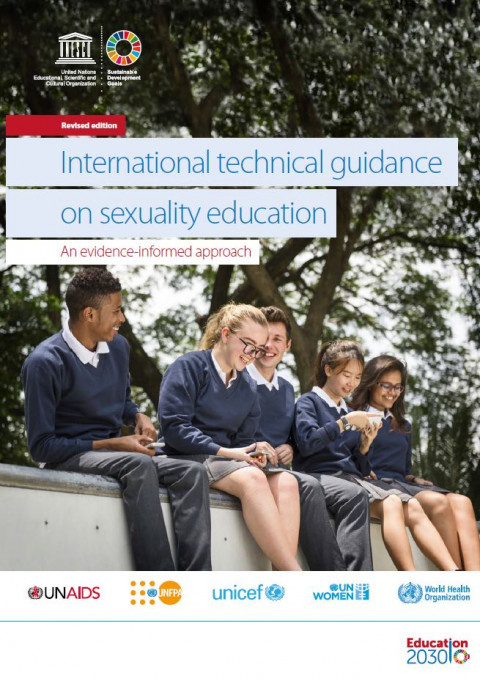 International Technical Guidance on Sexuality Education: An Evidence-Informed Approach Año de publicación: 2018 Autor corporativo: Joint United Nations Programme on HIV/AIDS (UNAIDS) | United Nations Population Fund (UNFPA) | United Nations Children's Fund (UNICEF) | United Nations Entity for Gender Equality and the Empowerment of Women (UN Women) | World Health Organization (WHO) The UN International technical guidance on sexuality education was first published in 2009 as an evidence-informed approach for schools, teachers and health educators.Recognizing the dynamic shifts in the field of sexuality education that have occurred since then, an expanded group of UN co-publishing partners has reviewed and updated the content to respond appropriately to the contemporary needs of young learners, and to provide support for education systems and practitioners seeking to address those needs. The International technical guidance on sexuality education (revised edition) provides sound technical advice on the characteristics of effective comprehensive sexuality education (CSE) programmes; a recommended set of topics and learning objectives that should be covered in comprehensive sexuality education; and, recommendations for planning, delivering and monitoring effective CSE programmes. This revised edition of the Guidance reaffirms the position of sexuality education within a framework of human rights and gender equality, and promotes structured learning about sex and relationships in a manner that is positive, affirming, and centred on the best interests of the young person. It is based on a review of the latest evidence and lessons-learned from implementing CSE programmes across the globe. The revised Guidance reflects the contribution of sexuality education to the realization of multiple Sustainable Development Goals, notably Goal 3 on good health and well-being for all, Goal 4 on quality education for all, and Goal 5 to achieve gender equality.
 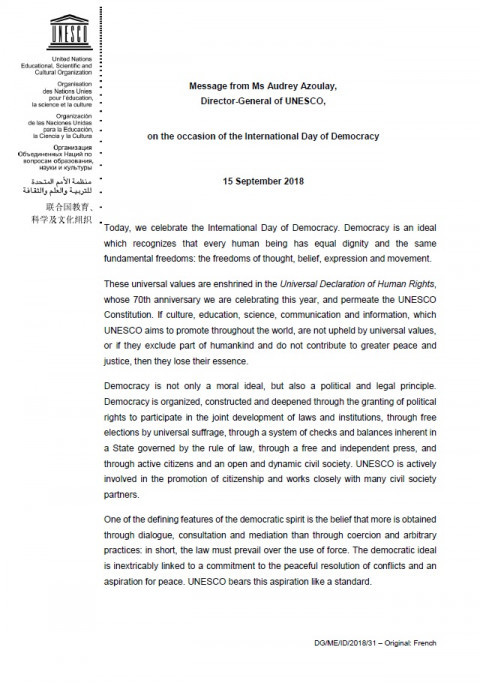 Message from Ms Audrey Azoulay, Director-General of UNESCO, on the occasion of International Day of Democracy, 15 September 2018 Año de publicación: 2018 Autor corporativo: UNESCO. Director-General, 2017-2025 (Azoulay, A.) This message was delivered by Audrey Azoulay, Director-General of UNESCO, on the occasion of the International Day of Democracy, on 15 September 2018. 联合国教科文组织总干事奥德蕾·阿祖莱 国际民主日致辞 Año de publicación: 2018 Autor corporativo: UNESCO. Director-General, 2017-2025 (Azoulay, A.) 2018年9月15日,联合国教科文组织总干事奥德蕾·阿祖莱国际民主日致辞
  Nuestra diversidad creativa: informe de la comisión mundial de cultura y desarrollo Año de publicación: 1996 Autor corporativo: World Commission on Culture and Development This report is designed to address a diversified audience across the world that ranges from community activists, field workers, artists and scholars to government officials and politicians. We want it to inform the world’s opinion leaders and to guide its policy-makers. We want it to capture the attention of the world’s intellectual and artistic communities, as well as the general public. We aim to have shown them how culture shapes all our thinking, imagining and behaviour. It is the transmission of behaviour as well as a dynamic source for change, creativity, freedom and the awakening of innovative opportunities. For groups and societies, culture is energy, inspiration and empowerment, as well as the knowledge and acknowledgment of diversity: if cultural diversity is ‘behind us, around us and before us”, as Claude L&i-Strauss put it, we must learn how to let it lead not to the clash of cultures, but to their fruitful coexistence and to intercultural harmony. Just as in the tasks of building peace and consolidating democratic values, an indivisible set of goals, so too economic and political rights cannot be realized separately from social and cultural rights. The challenge to humanity is to adopt new ways of thinking, new ways of acting, new ways of organizing itself in society, in short, new ways of living. The challenge is also to promote different paths of development, informed by a recognition of how cultural factors shape the way in which societies conceive their own futures and choose the means to attain these futures. I have for some time been concerned with the “culture of peace”. There is now considerable evidence that neglect of human development has been one of the principal causes of wars and internal armed conflicts, and that these, in turn, retard human development. With government complicity and with the intention of raising export receipts, private businesses continue to sell advanced military technology, nuclear materials and equipment for the production of bacteriological and chemical warfare. The concept of state sovereignty which still prevails today has increasingly come under scrutiny. In the area of peace-keeping, the distinction between external aggression and internal oppression is often unrealistic. The predominant threat to stability are violent conflicts within countries and not between them. There is an urgent need to strengthen international human rights law. Many of the most serious troubles come from within states – either because of ethnic strife or repressive measures by governments. Conditions that lead to tyranny and large-scale violations of human rights at home sooner or later are likely to spill over into a search for enemies abroad. The temptation of repressive states to export internal difficulties is great. Consider the Soviet Union’s invasion of Hungary and Czechoslovakia after it had used domestic oppression and the persistent refusal - for many years - of the previous South African governments to grant independence to Namibia. An ounce of prevention is better than a ton of punishment. Notre diversité créatrice: rapport de la commission mondiale de la culture et du développement Año de publicación: 1996 Autor corporativo: World Commission on Culture and Development This report is designed to address a diversified audience across the world that ranges from community activists, field workers, artists and scholars to government officials and politicians. We want it to inform the world’s opinion leaders and to guide its policy-makers. We want it to capture the attention of the world’s intellectual and artistic communities, as well as the general public. We aim to have shown them how culture shapes all our thinking, imagining and behaviour. It is the transmission of behaviour as well as a dynamic source for change, creativity, freedom and the awakening of innovative opportunities. For groups and societies, culture is energy, inspiration and empowerment, as well as the knowledge and acknowledgment of diversity: if cultural diversity is ‘behind us, around us and before us”, as Claude L&i-Strauss put it, we must learn how to let it lead not to the clash of cultures, but to their fruitful coexistence and to intercultural harmony. Just as in the tasks of building peace and consolidating democratic values, an indivisible set of goals, so too economic and political rights cannot be realized separately from social and cultural rights. The challenge to humanity is to adopt new ways of thinking, new ways of acting, new ways of organizing itself in society, in short, new ways of living. The challenge is also to promote different paths of development, informed by a recognition of how cultural factors shape the way in which societies conceive their own futures and choose the means to attain these futures. I have for some time been concerned with the “culture of peace”. There is now considerable evidence that neglect of human development has been one of the principal causes of wars and internal armed conflicts, and that these, in turn, retard human development. With government complicity and with the intention of raising export receipts, private businesses continue to sell advanced military technology, nuclear materials and equipment for the production of bacteriological and chemical warfare. The concept of state sovereignty which still prevails today has increasingly come under scrutiny. In the area of peace-keeping, the distinction between external aggression and internal oppression is often unrealistic. The predominant threat to stability are violent conflicts within countries and not between them. There is an urgent need to strengthen international human rights law. Many of the most serious troubles come from within states – either because of ethnic strife or repressive measures by governments. Conditions that lead to tyranny and large-scale violations of human rights at home sooner or later are likely to spill over into a search for enemies abroad. The temptation of repressive states to export internal difficulties is great. Consider the Soviet Union’s invasion of Hungary and Czechoslovakia after it had used domestic oppression and the persistent refusal - for many years - of the previous South African governments to grant independence to Namibia. An ounce of prevention is better than a ton of punishment. Наше творч разно: Доклад Всемирной комиссии по культуре и развитию; сокращенный вариант Año de publicación: 1996 Autor corporativo: World Commission on Culture and Development This report is designed to address a diversified audience across the world that ranges from community activists, field workers, artists and scholars to government officials and politicians. We want it to inform the world’s opinion leaders and to guide its policy-makers. We want it to capture the attention of the world’s intellectual and artistic communities, as well as the general public. We aim to have shown them how culture shapes all our thinking, imagining and behaviour. It is the transmission of behaviour as well as a dynamic source for change, creativity, freedom and the awakening of innovative opportunities. For groups and societies, culture is energy, inspiration and empowerment, as well as the knowledge and acknowledgment of diversity: if cultural diversity is ‘behind us, around us and before us”, as Claude L&i-Strauss put it, we must learn how to let it lead not to the clash of cultures, but to their fruitful coexistence and to intercultural harmony. Just as in the tasks of building peace and consolidating democratic values, an indivisible set of goals, so too economic and political rights cannot be realized separately from social and cultural rights. The challenge to humanity is to adopt new ways of thinking, new ways of acting, new ways of organizing itself in society, in short, new ways of living. The challenge is also to promote different paths of development, informed by a recognition of how cultural factors shape the way in which societies conceive their own futures and choose the means to attain these futures. I have for some time been concerned with the “culture of peace”. There is now considerable evidence that neglect of human development has been one of the principal causes of wars and internal armed conflicts, and that these, in turn, retard human development. With government complicity and with the intention of raising export receipts, private businesses continue to sell advanced military technology, nuclear materials and equipment for the production of bacteriological and chemical warfare. The concept of state sovereignty which still prevails today has increasingly come under scrutiny. In the area of peace-keeping, the distinction between external aggression and internal oppression is often unrealistic. The predominant threat to stability are violent conflicts within countries and not between them. There is an urgent need to strengthen international human rights law. Many of the most serious troubles come from within states – either because of ethnic strife or repressive measures by governments. Conditions that lead to tyranny and large-scale violations of human rights at home sooner or later are likely to spill over into a search for enemies abroad. The temptation of repressive states to export internal difficulties is great. Consider the Soviet Union’s invasion of Hungary and Czechoslovakia after it had used domestic oppression and the persistent refusal - for many years - of the previous South African governments to grant independence to Namibia. An ounce of prevention is better than a ton of punishment. Notre diversité créatrice: rapport de la commission mondiale de la culture et du développement, version condensée Año de publicación: 1996 Autor corporativo: World Commission on Culture and Development This report is designed to address a diversified audience across the world that ranges from community activists, field workers, artists and scholars to government officials and politicians. We want it to inform the world’s opinion leaders and to guide its policy-makers. We want it to capture the attention of the world’s intellectual and artistic communities, as well as the general public. We aim to have shown them how culture shapes all our thinking, imagining and behaviour. It is the transmission of behaviour as well as a dynamic source for change, creativity, freedom and the awakening of innovative opportunities. For groups and societies, culture is energy, inspiration and empowerment, as well as the knowledge and acknowledgment of diversity: if cultural diversity is ‘behind us, around us and before us”, as Claude L&i-Strauss put it, we must learn how to let it lead not to the clash of cultures, but to their fruitful coexistence and to intercultural harmony. Just as in the tasks of building peace and consolidating democratic values, an indivisible set of goals, so too economic and political rights cannot be realized separately from social and cultural rights. The challenge to humanity is to adopt new ways of thinking, new ways of acting, new ways of organizing itself in society, in short, new ways of living. The challenge is also to promote different paths of development, informed by a recognition of how cultural factors shape the way in which societies conceive their own futures and choose the means to attain these futures. I have for some time been concerned with the “culture of peace”. There is now considerable evidence that neglect of human development has been one of the principal causes of wars and internal armed conflicts, and that these, in turn, retard human development. With government complicity and with the intention of raising export receipts, private businesses continue to sell advanced military technology, nuclear materials and equipment for the production of bacteriological and chemical warfare. The concept of state sovereignty which still prevails today has increasingly come under scrutiny. In the area of peace-keeping, the distinction between external aggression and internal oppression is often unrealistic. The predominant threat to stability are violent conflicts within countries and not between them. There is an urgent need to strengthen international human rights law. Many of the most serious troubles come from within states – either because of ethnic strife or repressive measures by governments. Conditions that lead to tyranny and large-scale violations of human rights at home sooner or later are likely to spill over into a search for enemies abroad. The temptation of repressive states to export internal difficulties is great. Consider the Soviet Union’s invasion of Hungary and Czechoslovakia after it had used domestic oppression and the persistent refusal - for many years - of the previous South African governments to grant independence to Namibia. An ounce of prevention is better than a ton of punishment.
  Our creative diversity: report of the world commission on culture and development; summary version Año de publicación: 1996 Autor corporativo: World Commission on Culture and Development This report is designed to address a diversified audience across the world that ranges from community activists, field workers, artists and scholars to government officials and politicians. We want it to inform the world’s opinion leaders and to guide its policy-makers. We want it to capture the attention of the world’s intellectual and artistic communities, as well as the general public. We aim to have shown them how culture shapes all our thinking, imagining and behaviour. It is the transmission of behaviour as well as a dynamic source for change, creativity, freedom and the awakening of innovative opportunities. For groups and societies, culture is energy, inspiration and empowerment, as well as the knowledge and acknowledgment of diversity: if cultural diversity is ‘behind us, around us and before us”, as Claude L&i-Strauss put it, we must learn how to let it lead not to the clash of cultures, but to their fruitful coexistence and to intercultural harmony. Just as in the tasks of building peace and consolidating democratic values, an indivisible set of goals, so too economic and political rights cannot be realized separately from social and cultural rights. The challenge to humanity is to adopt new ways of thinking, new ways of acting, new ways of organizing itself in society, in short, new ways of living. The challenge is also to promote different paths of development, informed by a recognition of how cultural factors shape the way in which societies conceive their own futures and choose the means to attain these futures. I have for some time been concerned with the “culture of peace”. There is now considerable evidence that neglect of human development has been one of the principal causes of wars and internal armed conflicts, and that these, in turn, retard human development. With government complicity and with the intention of raising export receipts, private businesses continue to sell advanced military technology, nuclear materials and equipment for the production of bacteriological and chemical warfare. The concept of state sovereignty which still prevails today has increasingly come under scrutiny. In the area of peace-keeping, the distinction between external aggression and internal oppression is often unrealistic. The predominant threat to stability are violent conflicts within countries and not between them. There is an urgent need to strengthen international human rights law. Many of the most serious troubles come from within states – either because of ethnic strife or repressive measures by governments. Conditions that lead to tyranny and large-scale violations of human rights at home sooner or later are likely to spill over into a search for enemies abroad. The temptation of repressive states to export internal difficulties is great. Consider the Soviet Union’s invasion of Hungary and Czechoslovakia after it had used domestic oppression and the persistent refusal - for many years - of the previous South African governments to grant independence to Namibia. An ounce of prevention is better than a ton of punishment. Notre diversité créatrice: rapport de la Commission mondiale sur la culture et le développement; version résumée Año de publicación: 1996 Autor corporativo: World Commission on Culture and Development Ce rapport est conçu pour répondre à un public diversifié à travers le monde qui va de militants communautaires, les travailleurs sur le terrain, des artistes et des chercheurs à des fonctionnaires et les hommes politiques. Nous voulons informer les leaders d'opinion du monde et pour guider ses décideurs. Nous voulons capter l'attention des communautés intellectuelles et artistiques du monde, ainsi que le grand public. Nous visons à leur ont montré comment la culture façonne toute notre pensée, d'imaginer et de comportement. Il est la transmission du comportement ainsi qu'une source dynamique pour le changement, la créativité, la liberté et l'éveil des possibilités novatrices. Pour les groupes et les sociétés, la culture est l'énergie, l'inspiration et l'autonomisation, ainsi que la connaissance et la reconnaissance de la diversité: si la diversité culturelle est «derrière nous, autour de nous et devant nous», comme Claude L & i-Strauss l'a dit, nous devons apprendre de le laisser conduire à ne pas le choc des cultures, mais à leur coexistence fructueuse et à l'harmonie interculturelle. Tout comme dans les tâches de consolidation de la paix et de la consolidation des valeurs démocratiques, un ensemble indivisible de buts, donc aussi des droits économiques et politiques ne peuvent pas être réalisés séparément des droits sociaux et culturels. Le défi pour l'humanité est d'adopter de nouvelles façons de penser, de nouvelles façons d'agir, de nouvelles façons de s'organiser dans la société, en bref, de nouvelles façons de vivre. Le défi est aussi de promouvoir différentes voies de développement, informés par une reconnaissance de la façon dont les facteurs culturels façonnent la manière dont les sociétés conçoivent leur propre avenir et de choisir les moyens d'atteindre ces contrats à terme. Je l'ai depuis un certain temps été concernés par la "culture de la paix". Il y a maintenant des preuves considérables que la négligence du développement humain a été l'une des causes principales des guerres et des conflits armés internes, et que ceux-ci, à son tour, retarder le développement humain. Avec la complicité du gouvernement et avec l'intention d'augmenter les recettes d'exportation, les entreprises privées continuent de vendre de la technologie militaire de pointe, les matières nucléaires et de l'équipement pour la production de guerre bactériologique et chimique. Le concept de la souveraineté étatique qui prévaut encore aujourd'hui de plus en plus scruté. Dans le domaine de maintien de la paix, la distinction entre les agressions extérieures et de l'oppression interne est souvent irréaliste. La principale menace à la stabilité sont des conflits violents au sein des pays et non pas entre eux. Il y a un besoin urgent de renforcer le droit international des droits humains. Beaucoup de troubles les plus graves proviennent de l'intérieur des Etats - soit en raison de conflits ethniques ou des mesures répressives par les gouvernements. Les conditions qui conduisent à la tyrannie et de violations massives des droits de l'homme à la maison, tôt ou tard sont susceptibles de déborder dans une recherche d'ennemis à l'étranger. La tentation des États répressifs à exporter des difficultés internes est grande. Envisager l'invasion de la Hongrie et la Tchécoslovaquie de l'Union soviétique, après avoir utilisé l'oppression nationale et le refus persistant - depuis de nombreuses années - des gouvernements sud-africains précédents d'accorder l'indépendance à la Namibie. Une once de prévention vaut mieux qu'une tonne de punition.
  Bilan annuel 2024 de Human Rights Watch sur les droits humains dans le monde Año de publicación: 2024 Autor corporativo: Human Rights Watch L'ONG Human Rights Watch a constitué un rapport mondial sur les droits humains à travers le monde grâce à ses observations menées sur le terrain afin d'y voir plus clair quant aux exactions perpétrées tout au long de l'année 2023 et les défis que cela comporte pour les années à venir. Tirana Hassan, Directrice exécutive de l'organisation a tenu quelques mots sur la situation actuelle: « La reprise du conflit armé entre Israël et le Hamas, d’une part, et au Soudan d’autre part, ont causé des souffrances considérables, tout comme les guerres qui se poursuivent en Ukraine, au Myanmar, en Éthiopie et au Sahel. Les gouvernements ont dû faire face à l’année la plus chaude jamais enregistrée : une vague d’incendies de forêts, de sécheresses et de tempêtes a semé la dévastation pour des millions d’habitants au Bangladesh, en Libye et au Canada. Des décisions politiques ont, par ailleurs, creusé les inégalités partout dans le monde, suscitant la colère de millions de gens contraints à lutter pour leur survie. Les droits des femmes et des filles et des personnes lesbiennes, gays, bisexuelles et transgenres (LGBT) ont connu de durs revers en de nombreux pays, à l’exemple de la persécution basée sur le genre des talibans en Afghanistan.». The NGO Human Rights Watch has compiled a global report on human rights around the world, based on its observations in the field, to shed light on the abuses perpetrated throughout 2023 and the challenges it poses for the years to come. Tirana Hassan, the organization's Executive Director, expressed a few words to say about the current situation: "The resumption of armed conflict between Israel and Hamas, on the one hand, and in Sudan on the other, have caused considerable suffering, as have the ongoing wars in Ukraine, Myanmar, Ethiopia and the Sahel. Governments had to cope with the hottest year on record: a wave of forest fires, droughts and storms brought devastation to millions of people in Bangladesh, Libya and Canada. At the same time, political decisions have deepened inequalities around the world, angering millions of people forced to fight for survival. The rights of women and girls and of lesbian, gay, bisexual and transgender (LGBT) people have suffered severe setbacks in many countries, such as the gender-based persecution of the Taliban in Afghanistan".