
Recursos
Exploren una amplia gama de recursos valiosos en GCED para profundizar su comprensión y promover su búsqueda, incidencia, enseñanza y aprendizaje.
1,450 resultados encontrados
 Early Childhood Development and Early Learning for Children in Crisis and Conflict Año de publicación: 2018 Autor: Kolleen Bouchane Autor corporativo: Global Education Monitoring Report Team There is an urgent need for a comprehensive response, including early learning and family support programs, to the rapidly growing population of young children worldwide living in crisis and conflict. Substantial evidence from neuroscience to economics indicates that the early years of a child’s life lay the foundation for long-term health, learning and behavior. The first months and years are not only a critical period in an individual child’s lifelong capacity for learning, but weak learning foundations of children can compromise the long-term development of nations. Yet a review of Refugee and Humanitarian Response Plans conducted for this paper revealed that only 9 percent of plans included the essential elements of early learning. Relative to health and nutrition programming, early education and parenting interventions were more likely to be omitted from the Response Plans.The rationale for focusing new attention on the educational needs of young children living in fragile conditions is strong: there is a broad body of scientific evidence; the international legal framework of the United Nations Convention of the Rights of the Child asserts that all children have the right to health, education, legal registration, and protection from violence and separation from parents, beginning at birth; and the Sustainable Development Goals for all will be not reached without a focus on the earliest years of life in crisis and conflict situations. This background paper presents the case for increased attention and investment in early childhood in conflict and crisis contexts, with focused attention on early learning and family support. The scale of the problem, current science and evidence, current global standards and principles, and case studies are all discussed and priority recommendations are offered.
 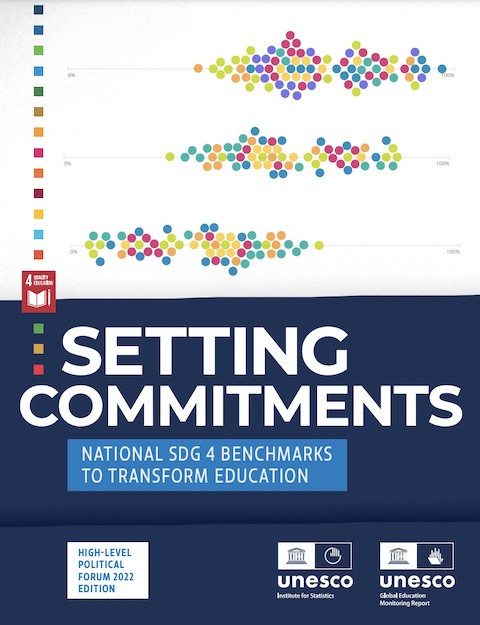 Setting Commitments: National SDG 4 Benchmarks to Transform Education Año de publicación: 2022 Autor corporativo: Global Education Monitoring Report Team | UNESCO Institute for Statistics (UIS) This publication provides an overview of the transformative agenda being established by countries, as they set SDG 4 benchmarks for education progress to take ownership of the 2030 Agenda for Sustainable Development. Inspired by the UN Secretary-General’s 2014 call for countries to embrace ‘a culture of shared responsibility’ based on ‘benchmarking for progress’, paragraph 28 of the Education 2030 Framework for Action also called on countries to establish ‘appropriate intermediate benchmarks for addressing the accountability deficit associated with longer-term targets’. This report outlines the steps taken by countries to set these commitments for 2025 and 2030 against seven indicators and is timed to feed into the second review of SDG 4 at the High-level Political Forum.The SDG 4 benchmark values now defined for almost nine in ten countries lay out their nationally determined contributions to the common education goal, using a concept embraced by the climate change sector. Twelve countries’ experiences of approaching the challenge of setting benchmarks based on their education sector plans are included, serving as inspiration for other countries to reflect on their own contributions and the task of developing appropriate policy responses in line with their own ambitions for the next decade, especially in the context of recovery from COVID-19.This publication proposes a way forward for monitoring progress towards the national SDG 4 benchmarks. This way of monitoring will be context-specific, recognizing countries’ starting points, helping link their national with regional and global education agendas.The benchmarks could be a basis for a compact in which countries commit to increasing their ambition, and, in return, the international community offers a program of support. In other words, a system of political accountability associated to political commitments with a support mechanism to accomplish the task.
 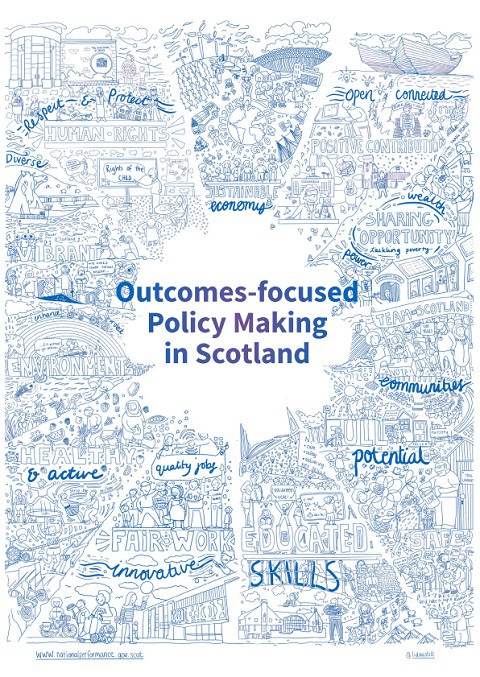 Outcomes-Focused Policy Making in Scotland Año de publicación: 2021 Autor corporativo: Government of Scotland | Scotland's International Development Alliance | SDG Network Scotland | Oxfam Scotland | International Development Education Association Scotland (IDEAS) | Bridge 47 Scotland’s International Development Alliance has co-created a new Scottish policy making guide focused on the Sustainable Development Goals (SDGs) and the National Performance Framework (NPF). The guide supports holistic policy making that reflects our interconnected world & addresses the need to better navigate its complexities.The resource is the result of a partnership between the Scottish Government’s National Performance Framework team, the International Development Education Association of Scotland (IDEAS) Network, Scotland’s International Development Alliance, the SDG Network Scotland and Oxfam Scotland. The partnership was initiated, supported and funded by the Bridge 47 – Building Global Citizenship project and special thanks go to Northern Star Associates for their work developing the content.What is the resource?The National Performance Framework (NPF) is Scotland’s way of localising the Sustainable Development Goals (SDGs). The 17 different goals and 11 NPF National Outcomes are key measures of how Scotland can move towards a more just and sustainable future. The resource has two main parts. The first half features a general overview of the United Nations Sustainable Development Goals (SDGs), Scotland’s National Performance Framework (NPF) and how the two are interlinked. The second half provides practical, interactive activities to explore how to apply the NPF and SDGs in the policy making process.Why is this resource important?Policy is a mechanism for creating change. Ensuring that the policy produced in Scotland is inclusive and takes a holistic view of systemic problems will have a positive impact for both people and planet.This resource comes at a critical juncture. The Covid-19 pandemic has emphasised local-global interconnections and the difficulties posed by complex global problems. They require us to be holistic in our policy making and understand we are part of a bigger system, where the decisions we make and the actions we take have an impact on others locally and globally, now and in the future.How was the resource created?The guide was co-created by a partnership between the NPF team at the Scottish Government and civil society stakeholders including the SDG Network Scotland, Scotland’s International Development Alliance and the EU project, Bridge 47. The development of the resource was funded through the Bridge 47 – Building Global Citizenship project, which is based at the International Development Education Association of Scotland (IDEAS) network. As a project, Bridge 47 supports building partnerships across different sectors with the aim of raising awareness of the SDGs and the transformative power of education as outlined in SDG Target 4.7.
 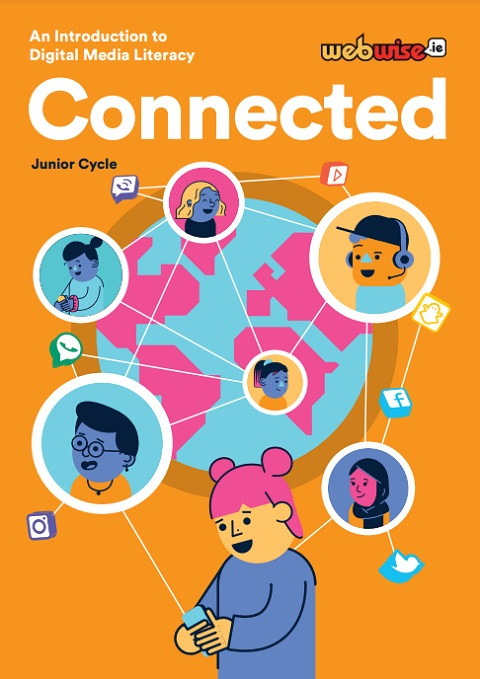 Connected: An Introduction to Digital Media Literacy Año de publicación: 2020 Autor corporativo: Webwise | Professional Development Service for Teachers (PDST) Connected comprises five modules exploring young people’s rights and responsibilities online, emerging digital technologies and topics including big data and the data economy, deep fakes, false information and online wellbeing. The five modules are:1. My Online Wellbeing2. News, Information and Problems of False Information3. Big Data & the Data Economy4. My Rights Online5. Publishing Online - Group ProjectThe programme is mapped to the Junior Cycle Digital Media Literacy Short Course and will give students an understanding of the role of digital technologies and will help students develop key digital media literacy skills to responsibly navigate the online environment.
  Media Literacy: Implementation Toolkit Año de publicación: 2019 Autor corporativo: Regional Educational Media Center (REMC) Association of Michigan This toolkit has been designed to support educators as they introduce students to the process of finding, organizing, using, producing, evaluating, and distributing information in a variety of media formats.The toolkit contains resources organized into six sections:Organizations Supporting Media Literacy EducationEducator ToolkitsCurriculum ResourcesInteractive Student Apps, Experiences, and ChallengesProfessional Development for Media LiteracyTools to Support Media Literacy
  Mapping of Media Literacy Practices and Actions in EU-28 Año de publicación: 2016 Autor corporativo: European Audiovisual Observatory | Council of Europe A project conducted by the European Audiovisual Observatory and financed by the European Commission This study aims at analysing the various media literacy initiatives on a national or regional level in order to provide an overview of what is currently being undertaken. This is the first major mapping exercise to survey the field in Europe. Although this study does not aim at covering the entire media literacy initiatives, it provides a detailed overview of the main trends, coming out of a selection of 547 featured projects involving 939 stakeholders across the European Union, which were identified through a questionnaire addressed at national experts from the different EU-28 member states. So what is Europe doing to encourage our media literacy? What measures are being taken at national and European levels to foster our critical appreciation and understanding of the mass media? The results of this study can be found in a general report accompanied by 4 annexes: Annex 1 provides national summaries showing the findings of the responses concerning each of the 28 EU member states; Annex 2 contains the list of the 547 featured projects; Annex 3 summarises the 145 case-study projects; Annex 4 contains the original responses from the 29 national experts, which are accessible in separate files available on the website of the European Commission.
  The United Nations Matters: Teacher’s Handbook Año de publicación: 2012 Autor corporativo: United Nations Association - UK (UNA-UK) | United Kingdom National Commission for UNESCO This resource pack has been created to support Key Stage 3 and 4 Citizenship (England) and Education for Sustainable Development and Global Citizenship (Wales). It is also relevant to Learning for Life and Work (Northern Ireland), One Planet and Sustainable Development (Scotland), as well as Geography; History; Local and Global Citizens; Personal, Social, Health and Economic Education; Politics; and Religious and Moral Education. The pack supports the ‘Global Dimension’ in all parts of the UK.This resource aims to develop students’ awareness and understanding of the United Nations (UN) system and the global issues it tackles. It encompasses five lessons that can either be run as a full scheme of work or used independently.
  The White Paper of EKOME on Media & Information Literacy Año de publicación: 2018 Autor corporativo: EKOME S.A. EKOME is concluding 2018 Global UNESCO Media and Information Literacy Week celebrations with the launch of the White Paper on Media & Information Literacy available in Greek & English.The White Paper is EKOME’s viewpoint on the third pillar, Education, setting out a paradigm for a national infrastructure on media and information literacy. By highlighting the main priorities in the field, the White Paper of EKOME aims to contribute to a national strategic plan and build a constructive relationship with the creative industry.
 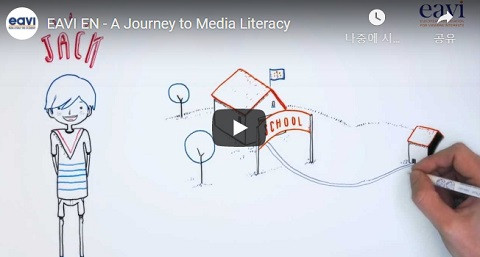 A Journey to Media Literacy Año de publicación: 2013 Autor: Paolo Celot | Susie Jones Autor corporativo: European Association for Viewers Interests (ENVI) “A Journey to Media Literacy” is EAVI’s seven minute cartoon, designed to explain, in a fun and simple way, what Media Literacy is all about and why it is essential in order to live freely and participate fully in society. It was born thanks to a suggestion by Paolo's 3 kids, who being unable to understand what their father did at work, came up with the idea of making an adventure cartoon to explain ML. Un voyage dans l'éducation aux médias Año de publicación: 2013 Autor: Paolo Celot | Susie Jones Autor corporativo: European Association for Viewers Interests (ENVI) Le dessin animé de EAVI « Un voyage dans l'éducation aux media » a été créé à fin d'expliquer de façon simple et amusante ce qu'est l'éducation aux medias, une notion importante que pour vivre plus librement et de participer pleinement à la société. Notre héro Jack est né grâce à la suggestion des enfants de Paolo, qui, ne comprenant pas ce que leur père faisait au travail, lui ont donné l'idée de créer un dessin animé pour expliquer à eux ce que c'est l'éducation aux medias.