
Recursos
Exploren una amplia gama de recursos valiosos en GCED para profundizar su comprensión y promover su búsqueda, incidencia, enseñanza y aprendizaje.
2,772 resultados encontrados
 Le chemin vers les objectifs de developpement durable Año de publicación: 2015 Autor corporativo: United Nations Children's Fund (UNICEF) Animated video to help children learn about important concepts for people and planet as covered in the Sustainable Development Goals (SDGs) El camino hacia los Objetivos de Desarrollo Sostenible Año de publicación: 2015 Autor corporativo: United Nations Children's Fund (UNICEF) Animated video to help children learn about important concepts for people and planet as covered in the Sustainable Development Goals (SDGs)
  Address by Irina Bokova, Director-General of UNESCO, on the occasion of the Conference: Victims of ethnic and religious violence in the Middle East, Protecting and promoting plurality and diversity; Madrid, 24 May 2017 Año de publicación: 2017 Autor corporativo: UNESCO. Director-General, 2009-2017 (Bokova, I.G.) This address was presented by Irina Bokova, Director-General of UNESCO, on the occasion of the Victims of Ethnic and Religious Violence conference in the Middle East for protecting and promoting plurality and diversity
 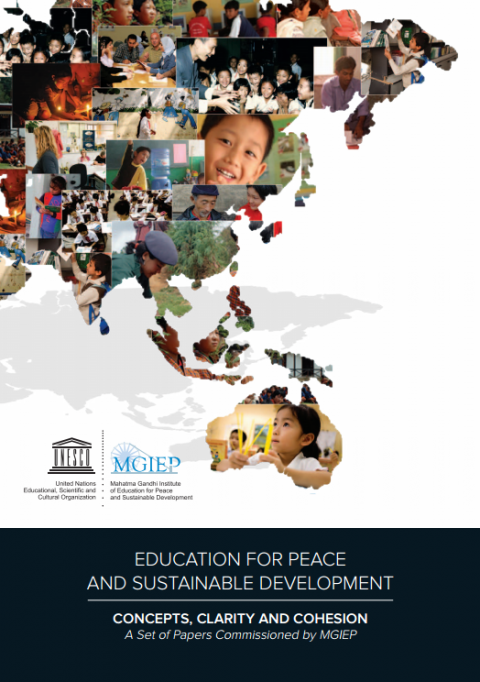 Education for peace and sustainable development: concepts, clarity and cohesion Año de publicación: 2013 Autor corporativo: Mahatma Gandhi Institute of Education for Peace and Sustainable Development (MGIEP) UNESCO MGIEP's focus lies in exploring and engaging with the strong interlinkages between peace and sustainable development and making interventions in the education systems to impart these principles. The first publication from the Institute Education for Peace and Sustainable Development: Concepts, Clarity and Cohesion explores the interlinkages and interdependencies of Education for Peace and Education for Sustainable Development. The monograph contains four concept papers which elaborate on the interlinkages between education, peace and sustainable development, define the gaps in the current approach to education for peace and sustainable development and argue for a comprehensive approach to issues of peace and sustainability to be incorporated in education systems. UNESCO MGIEP aims to develop a theoretical framework to look at the interlinkages between peace and sustainability in a holistic manner and this monograph is the first exercise towards building this discourse. L'éducation pour la paix et le développement durable: concepts, la clarté et la cohésion Año de publicación: 2013 Autor corporativo: Mahatma Gandhi Institute of Education for Peace and Sustainable Development (MGIEP) La mise au point de l'UNESCO MGIEP réside dans l'exploration et la collaboration avec les liens étroits entre la paix et le développement durable et faire des interventions dans les systèmes éducatifs pour communiquer ces principes. La première publication de «L'éducation pour la paix et le développement durable: concepts, la clarté et la cohésion de l'Institut explore les liens et les interdépendances de l'éducation pour la paix et l'éducation pour le développement durable. La monographie contient quatre documents de réflexion qui élaborent sur les liens entre l'éducation, la paix et le développement durable, définissent les lacunes dans l'approche actuelle de l'éducation pour la paix et le développement durable et plaident en faveur d'une approche globale des questions de paix et de développement durable à incorporer dans l'éducation systèmes. UNESCO MGIEP vise à développer un cadre théorique pour examiner les liens entre la paix et le développement durable d'une manière holistique et cette monographie est le premier exercice à la construction de ce discours. The heart of education: learning to live together; selected papers presented at the 16th UNESCO-APEID international conference Año de publicación: 2014 Autor corporativo: UNESCO Bangkok To help frame current thinking on education in a changing world, UNESCO Bangkok, the Ministry of Education in Thailand, the Asian-Pacific Network for International Education and Values (APNIEVE), Pearson Thailand and J.P. Morgan co-organized the 16th UNESCO-APEID International Conference, The Heart of Education: Learning to Live Together in November 2012 in Bangkok, Thailand. The Conference provided a forum for participants to share their knowledge and experiences, raise critical questions, provide constructive feedback and, most of all, express their commitment to imbue and translate the essence of learning to live together in their respective educational efforts. This report contains selected papers presented at the Conference to reflect the linkages between learning and social development, showcase approaches and tools, and identify enabling policies and instruments to promote learning to live together. Le cœur de l'éducation: apprendre à vivre ensemble; articles sélectionnés présentés à la 16e Conférence internationale UNESCO-APEID Año de publicación: 2014 Autor corporativo: UNESCO Bangkok Pour aider à encadrer la réflexion actuelle sur l'éducation dans un monde en mutation, l'UNESCO à Bangkok, le Ministère de l'éducation en Thaïlande, le Réseau Asie-Pacifique pour l'éducation et les valeurs internationales (APNIEVE), Pearson Thaïlande et JP Morgan co-organisé le 16 UNESCO-APEID internationale Conférence, The Heart of Education: Apprendre à vivre ensemble en Novembre 2012 à Bangkok, Thaïlande. La conférence a fourni un forum pour les participants de partager leurs connaissances et expériences, soulèvent des questions critiques, fournir une rétroaction constructive et, surtout, expriment leur engagement à imprégner et de traduire l'essence de l'apprentissage à vivre ensemble dans leurs efforts éducatifs respectifs. Ce rapport contient des documents présentés à la conférence afin de refléter les liens entre l'apprentissage et le développement social, les approches de la vitrine et des outils, et d'identifier des politiques favorables et des instruments pour promouvoir l'apprentissage à vivre ensemble sélectionné. Address by Irina Bokova, Director-General of UNESCO, on the occasion of Seminar on Global Citizenship Education, UNHQ; New York, 6 March 2015 Año de publicación: 2015 Autor corporativo: UNESCO. Director-General, 2009-2017 (Bokova, I.G.) This document is an address by Irina Bokova, Director-General of UNESCO on the occasion of "Seminar on Global Citizenship Education" in New York, 6 March 2015. She highlights the importance of GCED for education in the 21st century. جهانی شدن و ضرورت آموزشهای شهروندی جهانی Año de publicación: 2012 Autor: Yousef Keshavarz Autor corporativo: Center for Strategic Studies of the Presidency Today, due to “Globalization”, the fate of all individuals, organizations and governments are more tied together and effects of this process in all areas of human activity is undeniable. By looking at the concept of “Global Citizenship” new expectations of education as a meaningful factor to people’s lives and a tool to develop human character and supplying the social needs, is formed. This paper aims to examine and discuss the characteristics and components of global citizenship, the role, importance and necessity of global citizenship education. If we accept that the current use of existing resources in the world is unfair and unacceptable and the gap between rich and poor (in all aspects) wide and widens, should ponder choice. Training and education of global citizens (especially children and young people) who wish the world as a place full of justice, equality, peace and sustainable development, respect and protection of racial diversity, religious etc… and also possess other characteristic features addressed in this paper seems to be a powerful tool and solution. In this frame work, poverty and identity crisis of Iranian youth and in the other hand being attracted to the Globalization culture of outsiders, are two points that reveal the necessity for paying more attention to the training of global citizens, to adopt a broad and enormous prospective to the global issues. Therefore, according to the valuable Islamic texts and outlined prominent place for human beings and human values, also with consideration to the rich Iranian culture and civilization in direction with an active role in global co-management, living such training in formal and informal education system and also establishment of a center as such in partnership and cooperation with other educational institutions in the country is suggested. جهانی شدن و ضرورت آموزشهای شهروندی جهانی Año de publicación: 2012 Autor: Yousef Keshavarz Autor corporativo: Center for Strategic Studies of the Presidency Aujourd'hui, en raison de «mondialisation», le sort de tous les individus, les organisations et les gouvernements sont plus attachés ensemble et les effets de ce processus dans tous les domaines de l'activité humaine est indéniable. En regardant le concept de "citoyenneté mondiale" nouvelles attentes de l'éducation comme facteur significatif pour la vie des gens et un outil pour développer le caractère humain et de fournir les besoins sociaux, est formé. Ce document vise à examiner et discuter des caractéristiques et des composantes de la citoyenneté mondiale, le rôle, l'importance et la nécessité de l'éducation à la citoyenneté mondiale.Si nous aCECptons que l'utilisation actuelle des ressources existantes dans le monde est injuste et inaCECptable, et l'écart entre les riches et les pauvres (dans tous les aspects) de large et élargit, devraient méditer choix. La formation et l'éducation des citoyens du monde (en particulier les enfants et les jeunes) qui souhaitent le monde comme un lieu plein de la justice, l'égalité, la paix et le développement durable, le respect et la protection de la diversité raciale, religieuse, etc ... et aussi possèdent d'autres caractéristiques abordées dans le présent papier semble être un outil et une solution puissante. Dans ce cadre de travail, la pauvreté et la crise de la jeunesse iranienne et dans l'autre main identité étant attirés par la culture de la mondialisation de l'extérieur, sont deux points qui révèlent la nécessité d'accorder plus d'attention à la formation des citoyens du monde, d'adopter une vaste et énorme prospective aux enjeux mondiaux. Par conséquent, selon les textes islamiques et une grande place de premier plan décrit pour les êtres humains et les valeurs humaines, également avec considération à la culture iranienne riche et la civilisation dans le sens d'un rôle actif dans la co-gestion globale, vivant une telle formation dans le système éducatif formel et informel et également la création d'un centre en tant que tel en partenariat et de coopération avec d'autres établissements d'enseignement dans le pays est suggéré.