
Recursos
Exploren una amplia gama de recursos valiosos en GCED para profundizar su comprensión y promover su búsqueda, incidencia, enseñanza y aprendizaje.
2,199 resultados encontrados
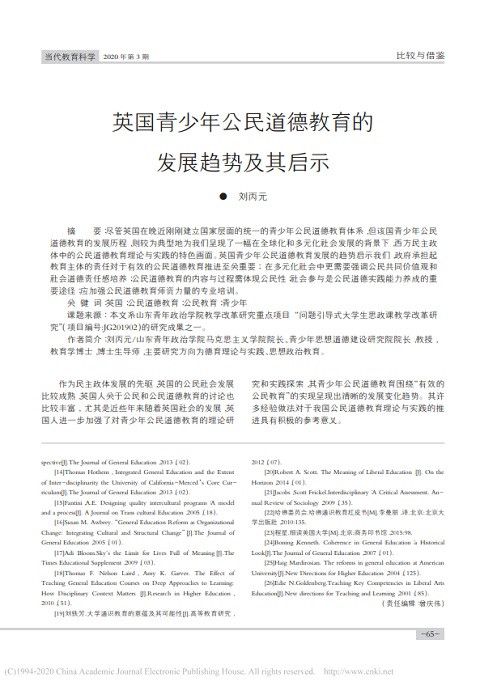 英国青少年公民道德教育的发展趋势及其启示 Año de publicación: 2020 Autor: Liu Bingyuan Autor corporativo: Contemporary Education Sciences 尽管英国在晚近刚刚建立国家层面的统一的青少年公民道德教育体系,但该国青少年公民 道德教育的发展历程,则较为典型地为我们呈现了一幅在全球化和多元化社会发展的背景下,西方民主政 体中的公民道德教育理论与实践的特色画面。英国青少年公民道德教育发展的趋势启示我们,政府承担起 教育主体的责任对于有效的公民道德教育推进至关重要;在多元化社会中更需要强调公民共同价值观和 社会道德责任感培养;公民道德教育的内容与过程需体现公民性;社会参与是公民道德实践能力养成的重 要途径;应加强公民道德教育师资力量的专业培训。
 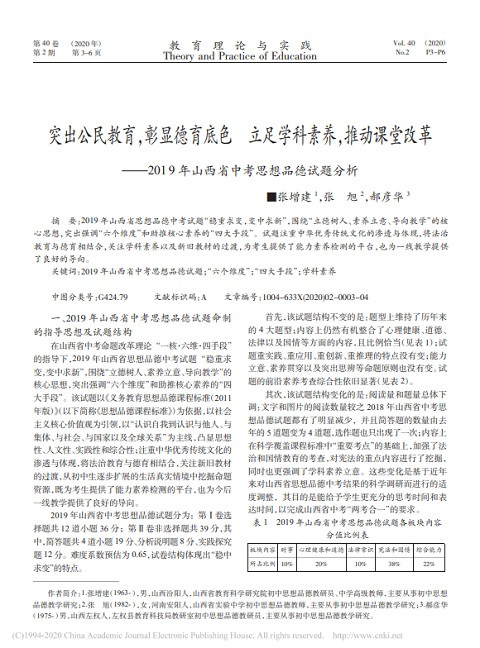 Emphasizing Civic Education, Highlighting Moral Education Background Based on the Subject Quality, Promoting Classroom Reform: Analysis of The Ideological and Moral Tests of Shanxi High School Entrance Examination in 2019 (Vol. 40, No. 2) Año de publicación: 2020 Autor: Zhang Zengjian | Zhangxu | Hao Yanhua Autor corporativo: Theory and Practice of Education The 2019 Shanxi Province Ideological and Moral examination questions “seek change steadily, seek new through change”, centered on the core idea of “cultivating people with moral integrity, cultivating people with accomplishment and guiding teaching”, highlighted the “six dimensions” and the “four means” to boost the core quality. The test focuses on the penetration and embodiment of excellent traditional Chinese culture, combines the rule of law education with moral education, pays attention to the subject accomplishment and the transition of old and new textbooks, and provides a platform for students to test their ability and accomplishment, as well as a good guidance for front-line teaching. 突出公民教育,彰显德育底色 立足学科素养,推动课堂改革: 2019年山西省中考思想品德试题分析 (第40卷,第2期) Año de publicación: 2020 Autor: Zhang Zengjian | Zhangxu | Hao Yanhua Autor corporativo: Theory and Practice of Education 2019 年山西省思想品德中考试题“稳重求变,变中求新”,围绕“立德树人、素养立意、导向教学”的核心思想,突出强调“六个维度”和助推核心素养的“四大手段”。试题注重中华优秀传统文化的渗透与体现,将法治教育与德育相结合,关注学科素养以及新旧教材的过渡,为考生提供了能力素养检测的平台,也为一线教学提供了良好的导向。
 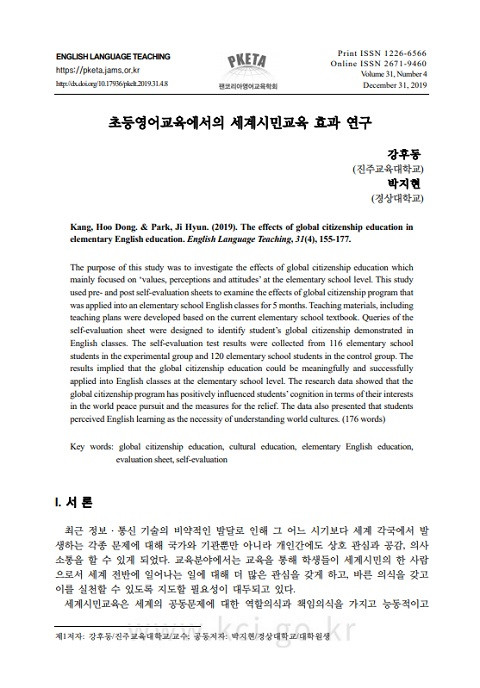 The Effects of Global Citizenship Education in Elementary English Education (English Language Teaching; Vol. 31, No.4) Año de publicación: 2019 Autor: Hoodong Kang | Jihyun Park Autor corporativo: Pan-Korea English Teachers Association (PKETA) The purpose of this study was to investigate the effects of global citizenship education which mainly focused on 'values, perceptions and attitudes' at the elementary school level. This study used pre- and post self-evaluation sheets to examine the effects of global citizenship program that was applied into an elementary school English classes for 5 months. Teaching materials, including teaching plans were developed based on the current elementary school textbook. Queries of the self-evaluation sheet were designed to identify student's global citizenship demonstrated in English classes. The self-evaluation test results were collected from 116 elementary school students in the experimental group and 120 elementary school students in the control group. The results implied that the global citizenship education could be meaningfully and successfully applied into English classes at the elementary school level. The research data showed that the global citizenship program has positively influenced students' cognition in terms of their interests in the world peace pursuit and the measures for the relief. The data also presented that students perceived English learning as the necessity of understanding world cultures. 초등영어교육에서의 세계시민교육 효과 연구 (영어교육연구; Vol. 31, No. 4) Año de publicación: 2019 Autor: 강후동 | 박지현 Autor corporativo: 팬코리아영어교육학회 이 연구는 초등학교 영어수업에서의 세계시민교육 활동을 개발 및 실시하고 학생들의 가치와 이에 대한 인식, 그리고 태도에 끼친 영향을 알아보고자 한다. 세계시민교육이 초등영어에서 실현 가능한지, 실제 수업의 방향을 점검하고 활성화할 수 있는지를 알아보고자 한다.
 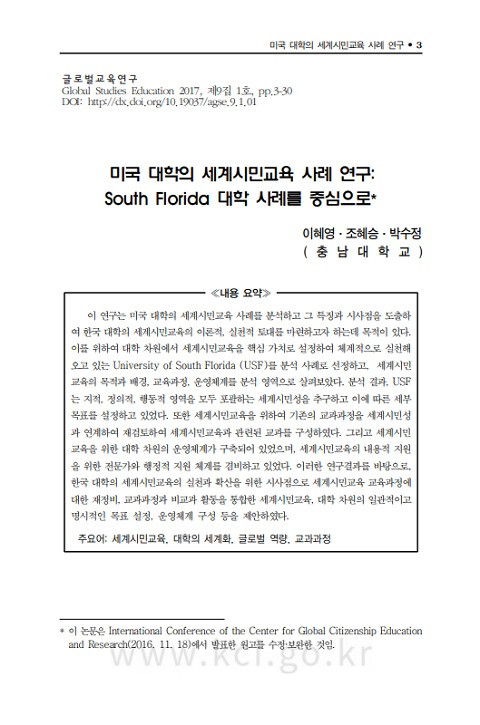 A Case Study on Global Citizenship Education of University of South Florida (Global Studies Education; Vol. 9, No. 1) Año de publicación: 2017 Autor: Hyeyoung Lee | Hyeseung Cho | Soojung Park Autor corporativo: Global Studeis Education Association This study investigates the issues for the practice of global citizenship education in universities and analyses a case study of the university in US. The University of South Florida (USF), which defines global citizen education as one of the core strategic plans of the university, is selected. Global citizenship education at USF is aimed at strengthening students' global competencies; global awareness, responsibility and participation. The goals of the practice are globalization of the undergraduate general education curriculum, extra-curricular activities in connection with the curriculum, globalized curriculum leading to graduate courses, and enhancing global competencies of all university members. It is reported that USF dedicated special organizations and systematic operation to support these goals. Based on our investigation and analysis, a reform of the global citizen education curriculum, a global citizenship education that integrates the curriculum and the extra-curricular activities, a coherent and explicit goal setting at the university level, and an operating system structure are required for universities in Korea to promote global citizenship education. 미국 대학의 세계시민교육 사례 연구: South Florida 대학 사례를 중심으로 (글로벌교육연구; Vol. 9. No. 1) Año de publicación: 2017 Autor: 이혜영 | 조혜승 | 박수정 Autor corporativo: Global Studeis Education Association 이 연구는 미국 대학의 세계시민교육 사례를 분석하고 그 특징과 시사점을 도출하여 한국 대학의 세계시민교육의 이론적, 실천적 토대를 마련하고자 하는데 목적이 있다. 이를 위하여 대학 차원에서 세계시민교육을 핵심 가치로 설정하여 체계적으로 실천해오고 있는 University of South Florida (USF)를 분석 사례로 선정하고, 세계시민교육의 목적과 배경, 교육과정, 운영체계를 분석 영역으로 살펴보았다. 분석 결과, USF는 지적, 정의적, 행동적 영역을 모두 포괄하는 세계시민성을 추구하고 이에 따른 세부 목표를 설정하고 있었다. 또한 세계시민교육을 위하여 기존의 교과과정을 세계시민성과 연계하여 재검토하여 세계시민교육과 관련된 교과를 구성하였다. 그리고 세계시민교육을 위한 대학 차원의 운영체계가 구축되어 있었으며, 세계시민교육의 내용적 지원을 위한 전문가와 행정적 지원 체계를 겸비하고 있었다. 이러한 연구결과를 바탕으로, 한국 대학의 세계시민교육의 실천과 확산을 위한 시사점으로 세계시민교육 교육과정에 대한 재정비, 교과과정과 비교과 활동을 통합한 세계시민교육, 대학 차원의 일관적이고 명시적인 목표 설정, 운영체계 구성 등을 제안하였다.
  Global Citizenship Education in the Primary Geography Curriculum of the Republic of Korea: Content Analysis Focusing on the Semantic Structure of 2009 Revised School Curriculum (Journal of the Korean Geographical Society; Vol. 49, No. 6) Año de publicación: 2014 Autor: Dongmin Lee Autor corporativo: Korean Geographical Society The purpose of this study is to analyze the share of global citizenship education in the 2009 Revised Social Studies (geography area) School Curriculum of the Republic of Korea. I selected the achievement standards of the geography domain in the fifth and sixth grades as the subjects of analysis. The chosen subjects were examined using content analysis: I used KrKwic, a Korean language content analysis tool, to analyze the content and drew a semantic network of the analysis results using UciNet/NetDraw. I found that the geography domain of the 2009 Revised Primary School Curriculum included the concepts of and factors of global citizenship education. However, global citizenship education did not account for a major portion of the curriculum, and the curriculum achievement standards were noticeably nation-state centered. Global citizenship education factors were not closely associated with to other related factors in fact, they even revealed a isolated pattern. These findings suggest that the inclusion of global citizenship education in primary geography education is limited, because the connections between global citizenship education and related contents, such as the environment, sustainable development, conflict, and cooperation, are probably impeded. Globalization accompanies the transformation of territories, identities, and the relations between nation-states and the world, although nation-states continue to play a significant role in the globalized worlds. Therefore global citizenship education, a educational trend focusing on the global community, is particularly important and is required in the geography curriculum of the global era. I expect that the examination undertaken in this study to contribute to future curriculum revisions regarding globalizatin and global citizenship. 초등지리 교육과정에 반영된 세계시민교육 관련 요소의 구조적 특성에 관한 연구: 2009 개정 교육과정 성취기준에 대한 내용분석을 중심으로 (대한지리학회지; Vol. 49, No. 6) Año de publicación: 2014 Autor: 이동민 Autor corporativo: 대한지리학회 본 연구의 목적은 현행 2009 개정 초등사회과 지리영역 교육과정에 반영된 세계시민교육 관련 요소의 구조적 특성을 분석하는데 있다. 분석대상으로는 세계에 관한 부분을 다룬 5~6학년군 지리영역 교육과정의 성취기준을 선정하였으며, 한글 텍스트의 내용분석을 위한 소프트웨어인 KrKwic 및 의미연결망 분석도구인 UciNet/NetDraw를 활용하여 관련 개념의 출현빈도 및 의미연결망, 연결중심성을 분석하였다. 분석 결과 2009 개정 초등사회과 지리영역 교육과정은 세계시민성 함양 등 세계시민교육의 이상과 요소를 반영하고는 있지만, 교육과정상의 세계에 대한 단원들은 세계나 세계공동체 등 세계시민교육 관련 요소보다는 주로 국가를 중심으로 구성되는 특성을 보이고 있었다. 세계시민교육 관련 요소는 교육과정 성취기준상에서의 출현빈도가 낮았을 뿐만 아니라, 세계와 관련된 주요 개념들과 밀접한 관계를 맺지 못한채 사실상 고립되다시피한 특성을 나타내었다. 이로 인해 환경 및 지속가능개발, 갈등, 협력 등 세계시민교육적으로 접근할 필요성이 높은 개념들 역시 세계시민교육적인 관점과 연결될 수 있는 가능성이 제한될 수 있다는 문제점도 지적된다. 세계화 시대에는 국가도 중요한 역할을 하지만, 기존의 국가 경계가 투과적인 형태로 변화하고 국경을 넘어선 세계공동체적 관점이 중요시되는만큼 지리교육 역시 이러한 현실을 감안하여 세계시민교육적 요소를 보다 적극적으로 반영할 필요성이 제기된다. 이러한 논의를 향후 교육과정 개정에 반영함으로써, 국가뿐만 아니라 세계공동체 또한 중요시되는 세계화 시대에 보다 높은 적합성을 갖는 교육과정을 구성할 수 있으리라고 기대된다.
 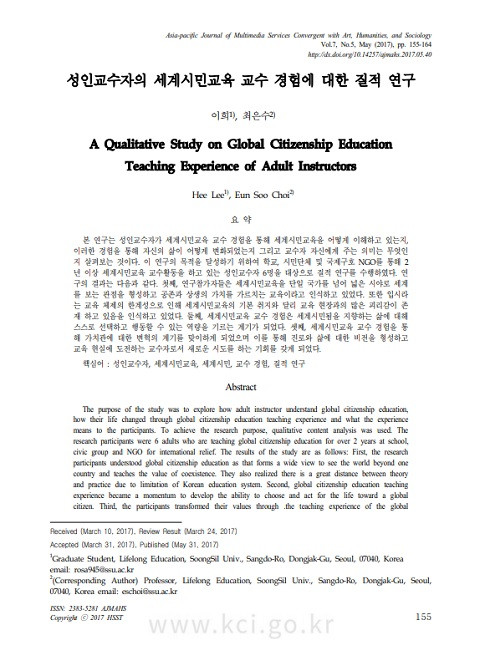 A Qualitative Study on Global Citizenship Education Teaching Experience of Adult Instructors (Asia-pacific Journal of Multimedia Services Convergent with Art, Humanities, and Sociology; Vol. 7, No.5) Año de publicación: 2017 Autor: Hee Lee | Eunsoo Choi Autor corporativo: Convergent Research Society Among Humanities, Sociology, Science, and Technology The purpose of the study was to explore how adult instructor understand global citizenship education, how their life changed through global citizenship education teaching experience and what the experience means to the participants. To achieve the research purpose, qualitative content analysis was used. The research participants were 6 adults who are teaching global citizenship education for over 2 years at school, civic group and NGO for international relief. The results of the study are as follows: First, the research participants understood global citizenship education as that forms a wide view to see the world beyond one country and teaches the value of coexistence. They also realized there is a great distance between theory and practice due to limitation of Korean education system. Second, global citizenship education teaching experience became a momentum to develop the ability to choose and act for the life toward a global citizen. Third, the participants transformed their values through .the teaching experience of the global citizenship education. They turned themselves into a teacher who challenges educational obstacles and had an opportunity to form a vision for career and life through global citizenship education teaching experience.