
Recursos
Exploren una amplia gama de recursos valiosos en GCED para profundizar su comprensión y promover su búsqueda, incidencia, enseñanza y aprendizaje.
1,451 resultados encontrados
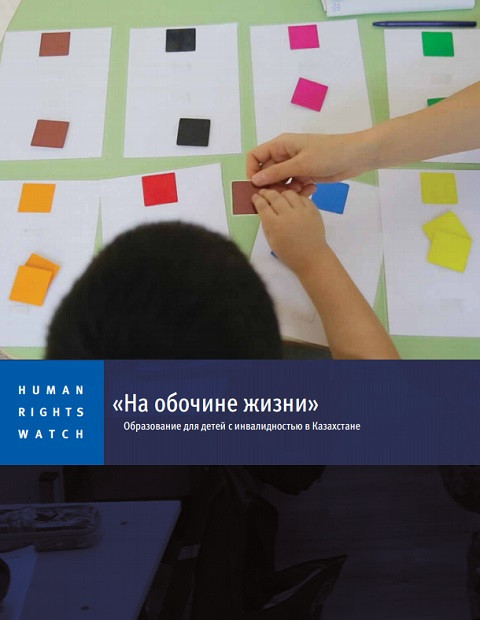 On the Margins: Education for Children With Disabilities in Kazakhstan Año de publicación: 2019 Autor corporativo: Human Rights Watch This report is intended to analyze the situation with inclusive education in Kazakhstan for children with disabilities, government initiatives in this area, the reasons and factors of insufficient implementation of inclusive education. It also contains recommendations to the government of the Republic of Kazakhstan and international partners and proposals for improving the situation. На обочине жизни: Образование для детей с инвалидностью в Казахстане Año de publicación: 2019 Autor corporativo: Human Rights Watch Данный отчет призван проанализировать ситуацию с инклюзивном образованием в Казахстане для детей с инвалидностью, государственные инициативы в данной сфере, причины и факторы недостаточного внедрения инклюзивного образования. В нем также содержатся рекомендации правительству Республики Казахстан и международным партнерам и предложения по улучшению ситуации.
  Policy Recommendations on Global Citizenship Education (GCE): Boosting Global Citizenship Education Using Digital Storytelling Año de publicación: 2018 Autor: Alessandra Accogli | Barbara Quarta Autor corporativo: Brights Project | European Union (EU) | European Commission This document summarizes the experience gained from implementing the BRIGHTS methodology and curriculum for GCE and provides policy recommendations for their adoption in formal and non-formal educational contexts.
  Brights: Fostering Social Cohesion and Promoting Intercultural Dialogue and Democratic Values in Europe Año de publicación: 2017 Autor corporativo: Brights Project | European Union (EU) | European Commission This leaflet presents brief information on an EU-funded project “BRIGHTS Project” implemented in Belgium, Croatia, Greece and Italy. The project aims to promote Global Citizenship Education (GCE) in formal and non-formal Educational contexts with the help of Digital Storytelling (DS) techniques, leading to more socially inclusive education and training policies and practices in Europe. BRIGHTS: Favoriser la cohésion sociale et promouvoir le dialogue interculturel et les valeurs démocratiques en Europe Año de publicación: 2017 Autor corporativo: Brights Project | European Union (EU) | European Commission Cette brochure présente des informations succinctes sur « BRIGHTS », un projet financé par l’UE mis en œuvre en Belgique, en Croatie, en Grèce et en Italie. Ce projet vise à renforcer l’éducation à la citoyenneté mondiale (ECM) dans l’éducation formelle et non formelle à l’aide des techniques du digital storytelling (DS), ce qui mènera vers plus d’inclusion sociale dans l’enseignement et la formation en Europe.
  Youth Participation and Global Citizenship: Challenges and Recommendations for Future Youth School Forums Año de publicación: 2016 Autor: Anna Jarkiewicz | Joanna Leek Autor corporativo: Oxfam GB | University of S odz (Poland) The overall purpose of this report is to identify the needs of the Future School Youth Forums on youth participation and global citizenship education. The study synthesizes information from Cyprus, Italy, Lithuania, Poland and the United Kingdom in order to understand similarities and differences, and compare them with wider European trends to understand transversal needs across Europe. It discusses in greater detail the current application of global citizenship youth forums and global citizenship/youth participation in each of the 5 countries – and therefore across 7 national systems (as Wales and Scotland have their own systems), and also transversally across Europe. The report will help Partners to better understand the project’s needs, so that they can design project outputs more effectively.
 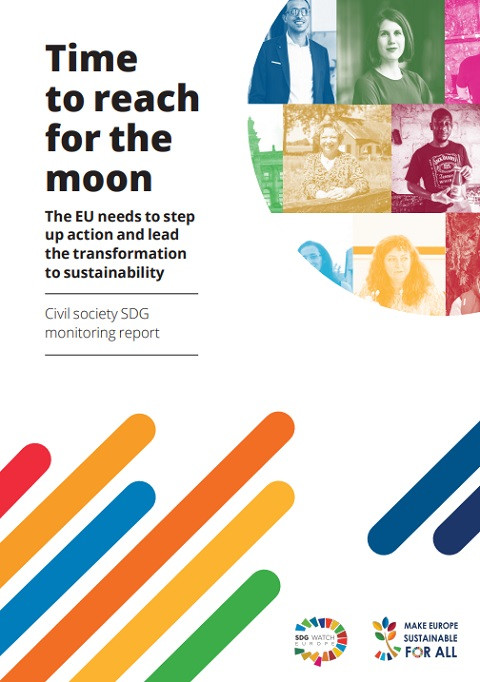 Time to Reach for the Moon: The EU Needs to Step up Action and Lead the Transformation to Sustainability; Civil Society SDG Monitoring Report Año de publicación: 2020 Autor: Sylvia Beales | George Gelber Autor corporativo: SDG Watch Europe | Make Europe Sustainable for All This report explains why the EU’s SDG reporting creates an illusion of sustainability and makes concrete proposals for meaningful monitoring to become a stronger foundation for transformative policies. The report flags up serious gaps, bringing them to life with 17 individual stories. It also offers 17 solutions, real-life examples of progressive policies, innovative initiatives and truly sustainable business models.
 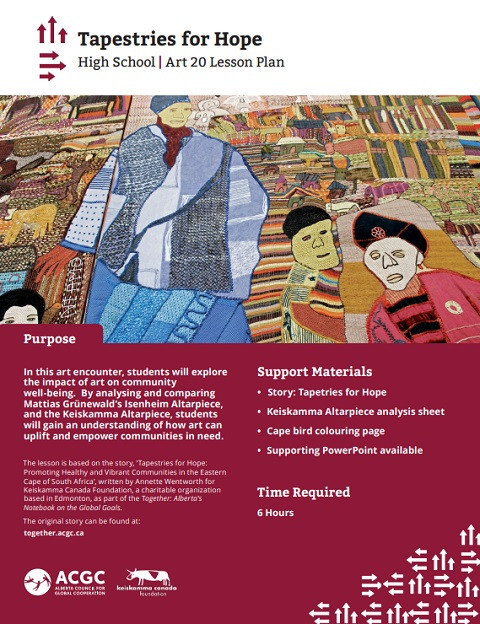 Tapestries for Hope: High School Art 20 Lesson Plan Año de publicación: 2018 Autor corporativo: Alberta Council for Global Cooperation (ACGC) | Keiskamma Canada Foundation In this art encounter, students will explore the impact of art on community well-being. By analysing and comparing Mattias Grünewald’s Isenheim Altarpiece, and the Keiskamma Altarpiece, students will gain an understanding of how art can uplift and empower communities in need. The lesson is based on the story, ‘Tapestries for Hope: Promoting Healthy and Vibrant Communities in the Eastern Cape of South Africa’, written by Annette Wentworth for Keiskamma Canada Foundation, a charitable organization based in Edmonton, as part of the Together: Alberta’s Notebook on the Global Goals.
 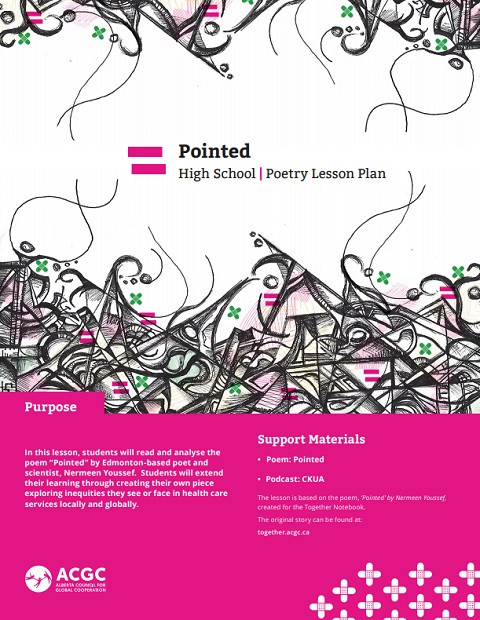 Pointed: High School Poetry Lesson Plan Año de publicación: 2019 Autor corporativo: Alberta Council for Global Cooperation (ACGC) In this lesson, students will read and analyse the poem “Pointed” by Edmonton-based poet and scientist, Nermeen Youssef. Students will extend their learning through creating their own piece exploring inequities they see or face in health care services locally and globally.
 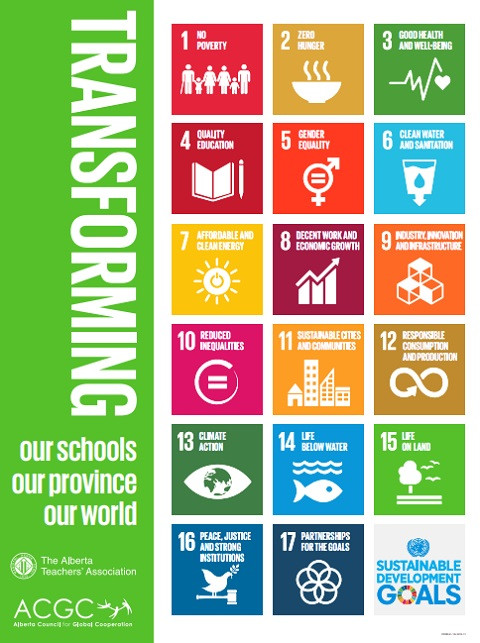 Transforming Our Schools, Our Province, Our World Año de publicación: 2015 Autor corporativo: Alberta Council for Global Cooperation (ACGC) | The Alberta Teachers' Association (ATA) This is a poster about the SDGs for classrooms, made by ACGC and the Alberta Teachers’ Association.