
Recursos
Exploren una amplia gama de recursos valiosos en GCED para profundizar su comprensión y promover su búsqueda, incidencia, enseñanza y aprendizaje.
1,402 resultados encontrados
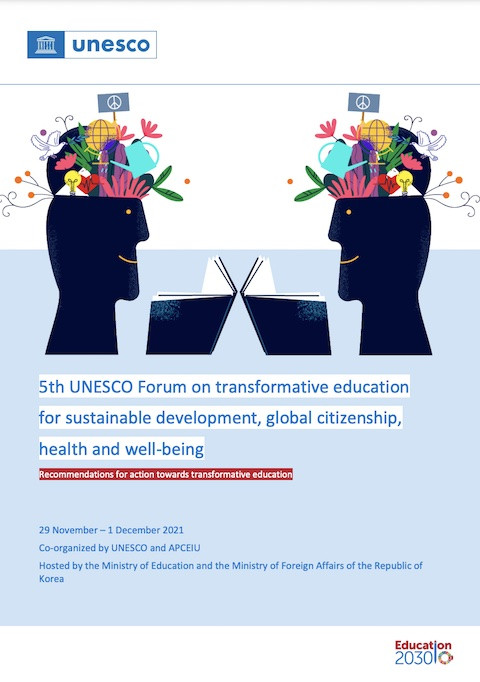 5ème Forum de l’UNESCO sur l’éducation transformatrice pour le développement durable, la citoyenneté mondiale, la santé et le bien-être: Recommandations pour l’action en vue d’une éducation transformatrice Año de publicación: 2022 Autor corporativo: UNESCO À la lumière des défis contemporains et émergents tels que le changement climatique, les idéologies violentes et haineuses, les conflits et les risques de pandémies mondiales, l'éducation doit enseigner aux jeunes les connaissances, les compétences, les valeurs et les attitudes nécessaires pour vivre en coopération, être flexibles, penser de manière critique, respecter la diversité, prendre soin de l'environnement et participer activement à la recherche de solutions, tant au niveau local que mondial.L'éducation transformatrice - telle qu'énoncée dans la cible 4.7 de l'objectif de développement durable 4 - est essentielle pour aider les individus à développer ces compétences. L'éducation transformatrice implique un enseignement et un apprentissage qui motivent et habilitent les apprenants à prendre des décisions et des actions éclairées aux niveaux individuel, communautaire et mondial. En mettant l'accent sur la durabilité, la citoyenneté mondiale, la santé et le bien-être pour tous, l'éducation transformatrice implique de veiller à ce que les programmes, la pédagogie, le matériel d'apprentissage, les écoles et les environnements d'apprentissage soient significatifs pour les contextes social, politique, économique, culturel et environnemental.Pour mieux comprendre les progrès concrets de l'éducation transformatrice, l'UNESCO et le Centre Asie-Pacifique d'éducation pour la compréhension internationale (APCEIU) ont co-organisé le 5e Forum de l'UNESCO sur l'éducation transformatrice pour le développement durable, la citoyenneté mondiale, la santé et le bien-être (29 novembre - 1er décembre 2021).La conférence a permis un dialogue productif entre un large éventail d'acteurs des domaines de l'éducation au développement durable (EDD), de l'éducation à la citoyenneté mondiale (ECM), de l'éducation pour la santé et le bien-être sous la « bannière » plus large de l'éducation transformatrice.
  Citizenship Education in the Global Digital Age: Thematic Paper Año de publicación: 2022 Autor corporativo: UNESCO This document, prepared by UNESCO Section on Global Citizenship and Peace Education with the contribution of Laura Engel and Evelyne Koumtingue, is part of several thematic papers developed by UNESCO to inform the Revision of the 1974 Recommendation concerning education for international understanding, co-operation and peace. These papers focus on topics that are not currently covered in the Recommendation but that require greater attention in the revised version in view of ensuring it addresses contemporary challenges to lasting peace.
  The Concept of Sustainability and Its Contribution Towards Quality Transformative Education: Thematic Paper Año de publicación: 2022 Autor corporativo: UNESCO This thematic paper explores the concept of sustainability and its contribution towards quality transformative education, and serves as a background document to clarify the scope and depth of the revised 1974 Recommendation. Specifically, this document presents the need to update and broaden the scope of the 1974 Recommendation by introducing the concept of sustainable development, and discussing the role of education in addressing contemporary global challenges in particular climate change and climate justice, peace, biodiversity loss, poverty and inequality, and discriminations and human rights.
 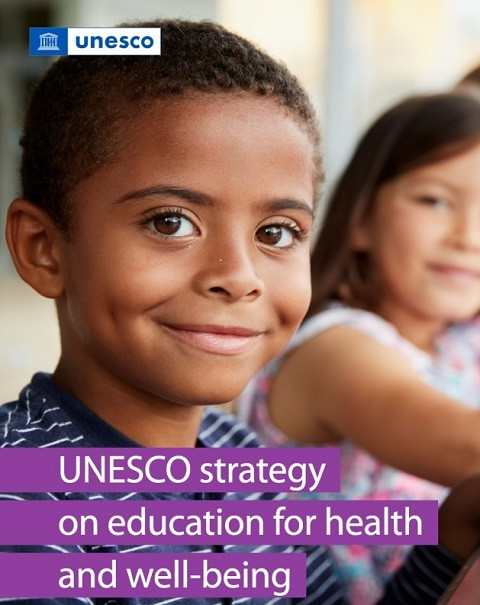 UNESCO Strategy on Education for Health and Well-being Año de publicación: 2022 Autor corporativo: UNESCO This strategy guides UNESCO to promote the physical and mental health and well-being of learners. By reducing health-related barriers to learning, such as malnutrition, early and unintended pregnancy, HIV and sexually transmitted infections (STIs) and violence and discrimination, UNESCO, governments and school systems can unlock the potential of all learners. The evidence for increased focus on the link between education and health is strong. Education strongly impacts health outcomes and health is equally fundamental to education. This calls for a more comprehensive approach to school health and more coordinated action across sectors.This revised and updated strategy is a roadmap for UNESCO to promote comprehensive sexuality education (CSE) and safe and inclusive learning environments, and place more emphasis on the role of schools and education systems in promoting health and well-being.
  Freedom of Expression, Media and Information Literacy and Digital Competencies to Support Peace and Human Rights: Thematic Paper Año de publicación: 2022 Autor corporativo: UNESCO This document is part of the thematic papers developed by UNESCO to inform the Revision of the 1974 Recommendation concerning education for international understanding, co-operation and peace. It focuses on Freedom of Expression, Media and Information Literacy and Digital Competencies that are not currently covered in the Recommendation but that require greater attention in the revised version in view of ensuring it addresses contemporary challenges to lasting peace.
  The Relevance and Contributions of Education for Health and Well-Being to the Advancement of Human Rights, Sustainable Development & Peace: Thematic Paper Año de publicación: 2022 Autor corporativo: UNESCO This document is part of the thematic papers developed by UNESCO to inform the Revision of the 1974 Recommendation concerning education for international understanding, co-operation and peace. This paper aims to provide a few recommendations for revising the 1974 Recommendation.
 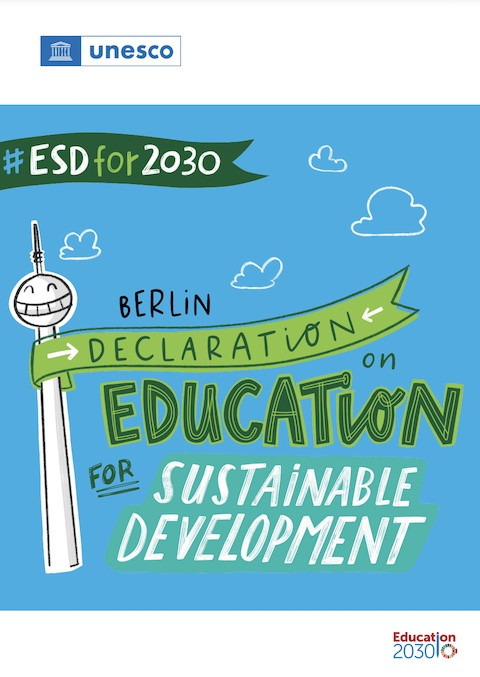 Berlin Declaration on Education for Sustainable Development Año de publicación: 2022 Autor corporativo: 유네스코 In light of the dramatic challenges the world is facing today there is urgent need to transform learning and redesign our societies for the survival of our planet. Education for Sustainable Development (ESD) is key in achieving this change. In May 2021 Ministers of Education from around the world, youth, teachers, scientists and civil society, came together virtually at the UNESCO World Conference on Education for Sustainable Development. They adopted the Berlin Declaration for Sustainable Development, expressing their commitment to harness the power of ESD to build a more just, equal, equitable and sustainable world.The purpose of this online publication is to contextualize the promises made in the Berlin Declaration and explain complex terms and concepts contained in the document, thus rendering its content easily accessible to the wider public. The main body of the text presents the Declaration itself, while the explanatory boxes provide practical background information about sustainable development, Sustainable Development Goal target 4.7 as well as interesting links to find more information about ESD, climate change, green technologies and other related issues.
 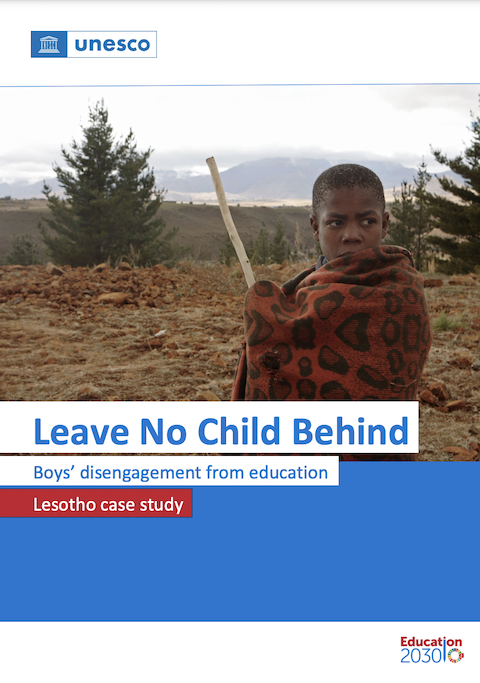 Leave No Child Behind: Boys’ Disengagement From Education; Lesotho Case Study Año de publicación: 2022 Autor: Paseka A. Mosia Autor corporativo: 유네스코 In the framework of its work gender equality in and through education better understand boys’ disengagement from education, UNESCO commissioned five country case studies to inform the publication “Leave no child behind: Global report on boys’ disengagement from education”. National research teams examined the situation in five countries – Fiji, Kuwait, Lesotho, Peru and the United Arab Emirates.This case study presents the results from Lesotho.
 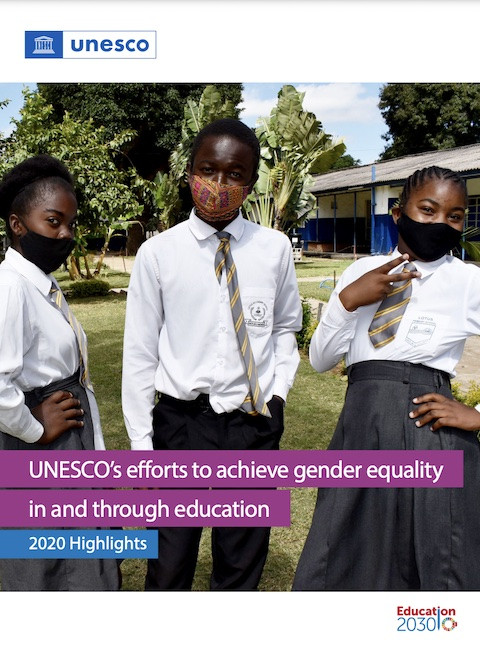 UNESCO’s Efforts to Achieve Gender Equality in and Through Education: 2020 Highlights Año de publicación: 2022 Autor corporativo: UNESCO This report presents highlights of UNESCO’s work in 2020 to advance gender equality in and through education.UNESCO's work in this area is guided by the UNESCO strategy for gender equality in and through education 2019–2025, and supported by Her Education, Our Future, which was launched in parallel with the strategy, to leverage political and financial commitments, cooperation and joint action for girls’ and women’s education.
  UNESCO in Action for Gender Equality: 2020-2021 Año de publicación: 2022 Autor corporativo: 유네스코 UNESCO’s global priority gender equality took on new meaning over the past biennium. The years 2020 and 2021 have been marked by dramatic social, political, environmental, and economic changes across countries resulting from an unprecedented pandemic: COVID-19. The COVID-19 pandemic magnified deep rooted structural gender inequalities across societies and forced the world to question the degree to which advances towards achieving gender equality had been made since the first UN World Conference on Women held in Beijing. This publication shows how a collective work by all structures of UNESCO has mobilized an extraordinary effort to go beyond a necessary adaptation to a multi-faceted crisis and counter backlashes and strengthen the resilience of women and girls and the systems which protect and empower them around the world through education, sciences, culture, communication, and information.