
Recursos
Exploren una amplia gama de recursos valiosos en GCED para profundizar su comprensión y promover su búsqueda, incidencia, enseñanza y aprendizaje.
2,668 resultados encontrados
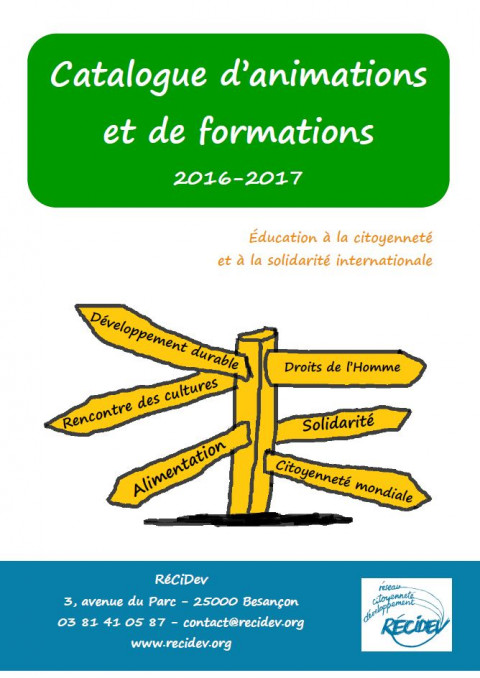 Catalogue d’animations et de formations 2016-2017 : Éducation à la citoyenneté et à la solidarité internationale Año de publicación: 2016 Autor corporativo: Réseau Citoyenneté Développement (RéCiDev) « L’éducation à la citoyenneté et à la solidarité internationale (ECSI) est une démarche sociale et politique dont la finalité est de favoriser la contribution individuelle et collective à la construction d’un monde juste, solidaire et durable. Elle s’appuie sur un processus pédagogique qui se déroule tout au long de la vie.Son objectif est de permettre à chacun de comprendre les mécanismes d’interdépendance et d’exclusion dans le monde ; de prendre conscience de l’importance d’une démarche citoyenne ayant pour but de favoriser une solidarité entre les territoires, les générations, les groupes sociaux… et d’agir pour la construction d’un monde solidaire. L’ECSI contribue à donner à tous des clés pour développer un esprit critique face à un modèle de développement dominant producteur d’inégalités et d’exclusions. Elle vise à une transformation sociale et à la construction collective d’autres modes de développement, respectueux des droits humains et de l’environnement. Elle valorise des alternatives en cours partout dans le monde. Elle favorise le vivre ensemble et l’épanouissement personnel.Parce qu’elle bénéficie au plus grand nombre et qu’elle répond aux enjeux du monde actuel, l’ECSI sert l’intérêt général. À ce titre, la promouvoir et la garantir est un devoir des Etats en cohérence avec l’ensemble des politiques publiques. »
  Impact of Radical Islamisation of Education on Pakistani Society Año de publicación: 2012 Autor: Muhammad Safeer Awan This article traces the history, rather briefly, of how the national educational policies and curricula in social sciences and humanities have been changed to serve the jihadist ideology in Pakistani society. The crumbling social order in Pakistan is not only an indication of the bad governance but also the systemic inculcation of ideologies of hatred and extremism among a whole generation of schoolchildren and college graduates. It is a society where extremism, not only of the radical Islamists but also of the average person, is on the rise. Impact of Radical Islamisation of Educaion on Pakistani Society Año de publicación: 2012 Autor: Muhammad Safeer Awan Cet article revient brièvement sur la façon dont les politiques éducatives nationales et les programmes scolaires en sciences sociales et en sciences humaines ont été modifiés au profit de l'idéologie djihadiste présente au sein de la société pakistanaise. Au Pakistan, le délitement de l'ordre social n'est pas seulement révélateur de la mauvaise gouvernance, il dénonce également de l’enseignement systématique d'idéologies haineuses et extrémistes auprès d'une génération entière d'élèves et d'étudiants. C'est une société où l'extrémisme, pas seulement celui porté par les islamistes radicaux mais aussi celui provenant de n'importe quel individu moyen, ne cesse de croître.
  Die Bedeutung des Holocaust und der Gedenkstättenpädagogik im Unterricht. Ein historisch-pädagogischer Vergleich zwischen Österreich und Bayern In the centre of this research project is a content-oriented comparison based on categories regarding the thematization of the Holocaust in 46 history textbooks for the first stage of secondary education since the beginning of the Second Republic and the new foundation of the Free State of Bavaria in the year of 1945. Based on this thematic constraint, three research questions emerge: 1.How has the representation of the Holocaust in the textbooks changed since the beginning of the Second Republic? What has changed? What has remained the same? 2. What can be deduced from the textbooks concerning the political discourse about the Holocaust? 3. To what extent are the content and the pedagogical-didactical concepts prescribed by the curricula implemented in the textbooks? (By the publisher)
  Powerful and Authentic Digital Media and Strategies for Teaching about Genocide and the Holocaust The continued prominence of genocide and Holocaust education, along with the movement toward the affective in social studies curricula, the advent of the Internet, and continued scholarship in the field, has led to the availability of a staggering array of digital resources for teachers (D. S. Symer 2001). These resources have the potential to enhance genocide and Holocaust education by providing robust content resources and interactive opportunities for students to develop new skills and understanding. In this article, the authors identify new digital media resources and strategies that engage students in authentic learning experiences about genocide and the Holocaust. They use F. W. Newmann and G. G. Wehlage's (1993) framework for "authentic instruction." Using this framework, the authors identify digital media that engage students in moral and ethical valuing, emphasize historical inquiry, and are relevant to the world outside of school. (By the author)
  Promoting the culture of dialogue between cultures in the Arab world Año de publicación: 2013 Autor: Selim El Sayegh Autor corporativo: UNESCO Beirut The major challenge of the Arab uprisings resides in the youth drive. Accounting for 60 per cent of the Arab population, Youth have been calling for political and economic reforms. During the revolts, these claims have become more radical seeking a fundamental change. This gradual evolution, from a relatively partial change to a more absolute comprehensive one, ushers in a new era with a different intellectual construct. With the ousting of dictatorships, all civil society forces are unleashed with huge actual and potential resources mobilized to contribute to building up the new order. Groups of solidarity, communities, parties, associations, and organizations of all nature among many others put forward new ideas and adequate action plans. Liberty thus acclaimed becomes the outcry for dignity, honor and pride. Never before in the Arab world has the individual had such a central place as it does today. An individual fully grasping the possibilities of restored liberty and recognized dignity gives birth to a new citizen acting in a new paradigm; a new citizen that seeks a transcendence of the ego to relate the individual to the common good. This fresh paradigm empowers the individual as a citizen in the name of equality, while simultaneously recognizing the right of difference of each citizen when it comes to belonging to a culture or sub‐culture. The right to be different involves more than the right to differ and to dispute and by the same token, the obligation of peaceful settlement. The right to be different, by belonging to a culture or a sub‐culture means in a new era of liberty and dignity, the obligation to conduct a transformation of the patterns generating disputes and conflicts among cultures. Henceforth, the issue of promoting the culture of intercultural dialogue in the aftermath of the Arab revolts represents major characteristics that will be reflected hereafter. Promouvoir la culture du dialogue entre les cultures dans le monde Arabe Año de publicación: 2013 Autor: Selim El Sayegh Autor corporativo: UNESCO Beirut Le défi majeur des soulèvements arabes réside dans le lecteur de la jeunesse. Comptabilisation de 60 pour cent de la population arabe, de la jeunesse ont été réclame des réformes politiques et économiques. Pendant les révoltes, ces créances sont devenues plus radicales à la recherche d'un changement fondamental. Cette évolution progressive, d'un changement relativement partielle à l'une complète plus absolue, ouvre la voie à une nouvelle ère avec une construction intellectuelle différente. Avec l'éviction des dictatures, toutes les forces de la société civile se déchaînent avec d'énormes ressources réelles et potentielles mobilisées pour contribuer à l'édification du nouvel ordre. Des groupes de solidarité, les communautés, les partis, les associations et organisations de toute nature parmi beaucoup d'autres mettent en avant de nouvelles idées et plans d'action adéquats. Liberté ainsi acclamé devient le cri de la dignité, l'honneur et la fierté. Jamais auparavant dans le monde arabe a l'individu avait une telle place centrale comme il le fait aujourd'hui. Un individu de saisir pleinement les possibilités de la liberté restaurée et reconnue la dignité donne naissance à un nouveau citoyen agissant dans un nouveau paradigme; un nouveau citoyen qui cherche une transcendance de l'ego de relier l'individu au bien commun. Ce nouveau paradigme permet l'individu en tant que citoyen au nom de l'égalité, tout en reconnaissant en même temps le droit à la différence de chaque citoyen en ce qui concerne l'appartenance à une culture ou sous-culture. Le droit d'être différent implique plus que le droit à la différence et à contester et par le fait même, l'obligation de règlement pacifique. Le droit à la différence, par l'appartenance à une culture ou d'une sous-culture signifie une nouvelle ère de liberté et de dignité, l'obligation de procéder à une transformation des modèles de génération de différends et les conflits entre les cultures. Dès lors, la question de la promotion de la culture du dialogue interculturel dans la foulée des révoltes arabes représente les principales caractéristiques qui seront reflétées ci-après.
 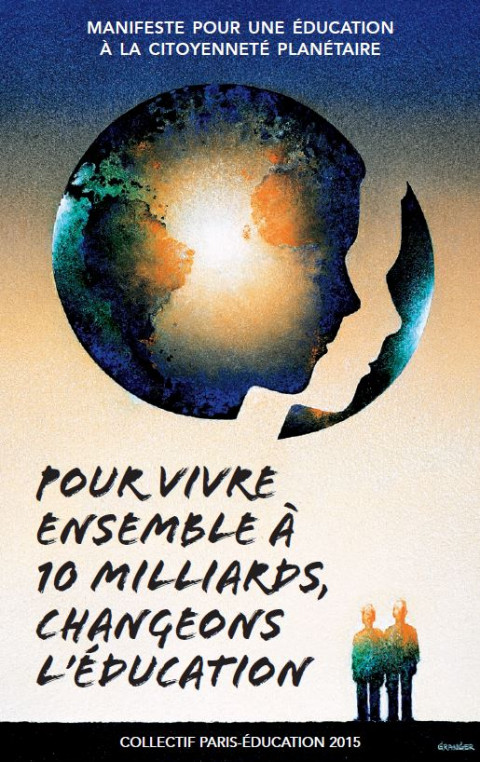 Manifeste pour une éducation à la citoyenneté planétaire: Pour vivre ensemble à 10 milliards, changeons l'éducation Año de publicación: 2015 Autor corporativo: Collectif Paris-Education 2015 Face à l’ampleur, l’urgence, la diversité et la complexité des problématiques engendrées par le modèle de développement de nos sociétés contemporaines, nous sommes donc obligés, dans l’urgence, de nous pencher sur les questions d’éducation et de formation des générations futures qui devront affronter des réalités biophysiques, économiques et politiques inédites, dont nous commençons à peine à entrevoir l’ampleur. Ce qui est dès lors en jeu, avec l’avenir de l’homme et de la Terre, c’est l’humain, ce qu’il deviendra, ce qu’il sera capable de porter comme projet pour l’humanité.Quelles qualités d’humains devons-nous faire advenir pour que ces réalités inédites puissent être rencontrées demain, sans que l’humanité bascule dans la violence et le dépeçage égoïste de la planète? Quels enfants voulons-nous laisser à notre Terre?Cette urgence impose un changement d’échelle dans la transformation des systèmes éducatifs, des contenus et des méthodes d’enseignement. Malgré la volonté et la compétence de nombreux acteurs de l’école, force est de constater que les actions menées pour une éducation plus en cohérence avec les enjeux climatiques et, plus largement, sociétaux restent à la marge. Elles sont réalisées par des individus clairvoyants. Il est temps d’enclencher la vitesse supérieure.
  Que valent les apprentissages en histoire, géographie et éducation à la citoyenneté ? : Colloque international des didactiques de l'histoire, de la géographie et de l'éducation à la citoyenneté Año de publicación: 2014 Autor: Caroline Leininger | Angelina Ogier | Sylvain Genevois Autor corporativo: Institut national de recherche pédagogique L’histoire et la géographie scolaires, de même que l’éducation à la citoyenneté, sont des domaines sensibles, liés au politique et au contexte social et sociétal dans lequel ils s’inscrivent. Si les recherches en didactique ont constaté dans les années 1990 une grande stabilité de l’histoire et la géographie scolaires, elles interrogent aujourd’hui plus spécifiquement les changements curriculaires et les recompositions qu’ils entraînent (thèmes des deux dernières éditions du colloque (Nantes, 2008, Lausanne 2009). Ces changements découlent de choix politiques et de savoirs universitaires, et redéfinissent le projet de ces disciplines et ses finalités. L'élève devient ainsi à l'issue de sa scolarité : un acteur de la société, un citoyen, un acteur économique, membre de communautés culturelles et politiques, un individu épanoui etc.Ce choix de finalités est aussi un choix de valeurs, explicites ou non dans les prescriptions, assumées ou non par les enseignants, par les élèves, les parents. Ce constat amène à questionner les articulations entre les apprentissages disciplinaires d’une part, et les apprentissages sociaux et politiques d’autre part. Les définitions de ces apprentissages, leur légitimité et leurs évaluations posent également question. Enseignants, décideurs, formateurs, didacticiens peuvent ainsi se demander ce que valent les apprentissages en histoire, en géographie et en éducation à la citoyenneté, tant du point de vue de leur reconnaissance disciplinaire et sociale que du point de vue des valeurs qui leur sont associées. Cet ouvrage cherche à questionner les articulations entre les apprentissages disciplinaires et les apprentissages sociaux et politiques.
 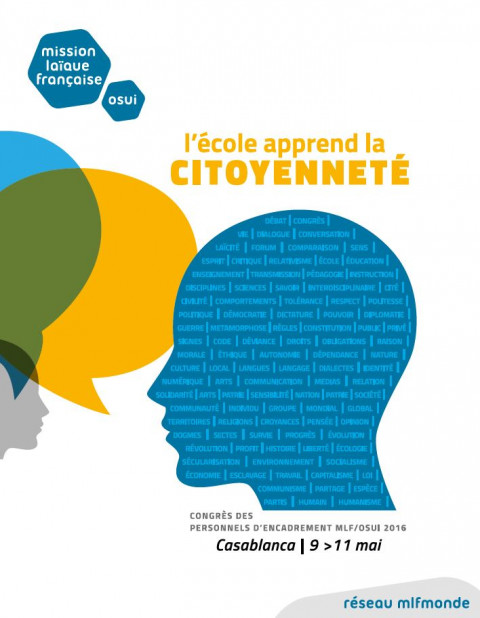 L’école apprend la citoyenneté (Congrès des personnels d’encadrement MLF/OSUI 2016) Año de publicación: 2017 Autor corporativo: Mission laïque française Le groupe scolaire Louis-Massignon à Bouskoura (Casablanca, Maroc) a accueilli du 9 au 11 mai 2016 près de 300 acteurs de l’enseignement français, représentants des établissements du réseau mlfmonde, du réseau de l’AFLEC, des académiespartenaires (Dijon, Paris, Poitiers et Reims), des représentants du MAEDI, du MENESR, de la DNE, de la DGESCO et de l’AEFE, des grands établissements de l’Éducation nationale (CNED, Canopé, ESENESR, CIEP), des représentants de l’organisation du baccalauréat international, de l’Unesco et de la société civile.Les mesures qui entrent en vigueur sur l’éducation à la citoyenneté concernent les «valeurs de la République».Parce que l’enseignement moral et civique est conçu et établi pour et dans un contexte strictement national, se pose dès lors la question d’une adaptation à l’usage de l’enseignement français à l’étranger qui ne soit pas en contradiction avec l’intention et l’esprit de cette partie du programme.