
Recursos
Exploren una amplia gama de recursos valiosos en GCED para profundizar su comprensión y promover su búsqueda, incidencia, enseñanza y aprendizaje.
1,402 resultados encontrados
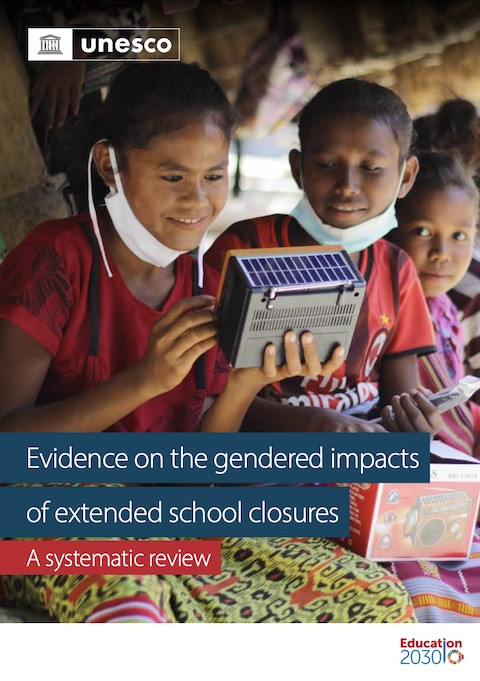 Evidence on the Gendered Impacts of Extended School Closures: A Systematic Review Año de publicación: 2022 Autor corporativo: UNESCO School closures to mitigate the spread of COVID-19 have affected nearly 1.6 billion learners across the globe. While the scale of these closures is unprecedented, in recent decades children in many contexts have been out of school for long periods due to other pandemics, disruptions and disasters such as floods, earthquake and conflicts – with marked gender effects.Building on the findings of 154 studies from every region of the world, this study investigates the evidence on the gendered impacts of extended school closures and periods out of school. Through a systematic review of the evidence, it highlights how these can deepen gendered exclusions and vulnerabilities – with the poorest children being the most affected.Undertaken by a team of leading academic experts on gender equality and education, Evidence on the gendered impacts of extended school closures: A systematic review aims to prevent and mitigate adverse outcomes arising from extended periods of time out of school, by ensuring that responses to current and future crises are informed by a solid understanding of their effects on children’s education, health, well-being and protection.
  Los actores no estatales en la educación superior: ¿Una visión compartida de la calidad y la asequibilidad? (Policy Paper 47) Año de publicación: 2022 Autor corporativo: UNESCO Los actores no estatales acogen a más de un tercio del alumnado de educación superior en todo el mundo, un porcentaje considerablemente más elevado que en la educación primaria o secundaria. Los proveedores son diversos y responden a una variedad de necesidades, y a menudo no hay una división clara entre los sectores estatal y no estatal. Los actores no estatales son además protagonistas importantes en la financiación de la educación superior a través de los hogares, los mecanismos de mercado y las alianzas público-privadas. A raíz de ello, estos actores desempeñan un papel significativo e influyen en la elaboración de normativas y políticas, así como en la configuración del sistema de educación superior en su conjunto. Los gobiernos deben garantizar la calidad y equidad —las dimensiones clave de la meta 4.3 de los Objetivos de Desarrollo Sostenible (ODS)—, independientemente del modo en que los actores estatales y no estatales compartan responsabilidades.
  Transforming Education Summit 2022: Futures of Education Briefing Notes Año de publicación: 2022 Autor corporativo: UNESCO National consultations that aim at developing a shared vision, commitment, and alignment of action across constituencies are one of the key TES workstreams. The Reimagining our futures together report is proposed as a framework for examining how education systems need to change to better serve learners and societies into the future.A series of briefing notes have been prepared in alignment with the summit's five action tracks:o Inclusive, equitable, safe and healthy schoolso Learning and skills for life, work and sustainable developmento Teachers, teaching and the teaching professiono Digital learning and transformationo Financing of education Cumbre 2022 sobre la Transformación de la Educación: Notas sinópticas sobre los Futuros de la Educación Año de publicación: 2022 Autor corporativo: UNESCO Las consultas nacionales que apuntan a desarrollar una visión compartida, un compromiso y una alineación de la acción entre los grupos constituyen uno de los flujos de trabajo clave de TES. El informe Reimaginando juntos nuestro futuro se propone como un marco para examinar cómo deben cambiar los sistemas educativos para servir mejor a los estudiantes y las sociedades en el futuro. Se ha preparado una serie de notas informativas en consonancia con las cinco vías de acción de la cumbre: o Escuelas inclusivas, equitativas, seguras y saludableso Aprendizaje y habilidades para la vida, el trabajo y el desarrollo sostenibleo Docentes, docencia y profesión docenteo Aprendizaje y transformación digitalo Financiamiento de la educación Sommet 2022 sur la Transformation de l’Education: Notes de synthèse sur Les futurs de l’éducation Año de publicación: 2022 Autor corporativo: Organisation des Nations Unies pour l'éducation, la science et la culture (UNESCO) Les consultations nationales qui visent à développer une vision, un engagement et un alignement des actions partagés entre les groupes constitutifs sont l'un des principaux axes de travail de la TES. Le rapport Reimagining our futures together est proposé comme un cadre pour examiner comment les systèmes éducatifs doivent changer pour mieux servir les apprenants et les sociétés à l'avenir. Une série de notes d'information a été préparée conformément aux cinq pistes d'action du sommet : o Des écoles inclusives, équitables, sûres et saineso Apprentissage et compétences pour la vie, le travail et le développement durableo Enseignants, enseignement et profession enseignanteo Apprentissage et transformation numériqueso Financement de l'éducation
 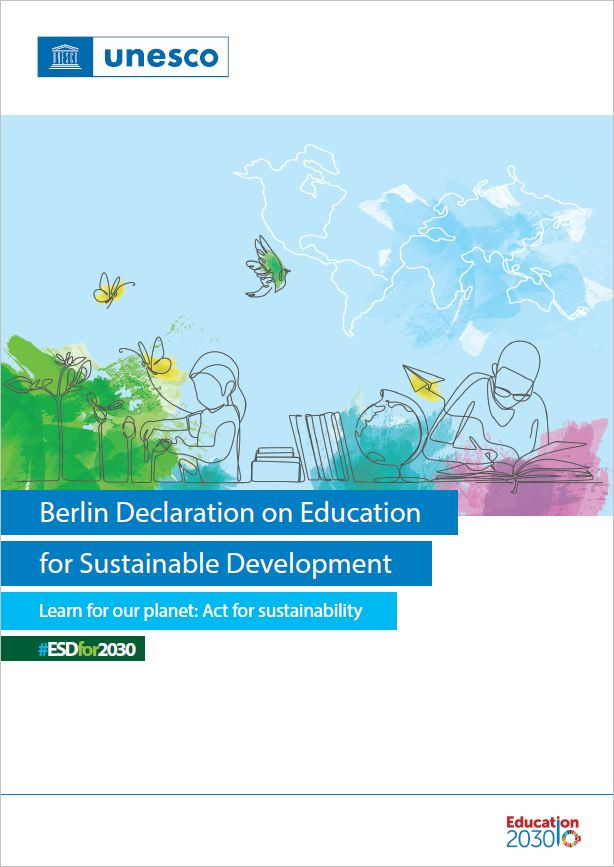 Berlin Declaration on Education for Sustainable Development; Learn for Our Planet: Act for Sustainability Año de publicación: 2022 Autor corporativo: UNESCO From 17 May to 19 May 2021 around 2800 people – politicians, business people, youth leaders, scientists, Non-governmental organizations, and many more - from 160 countries came together virtually at the UNESCO World Conference on Education for Sustainable Development (ESD) 2021. During the conference, they expressed their commitment to use the transformative power of education in order to address the global challenges we face. The Berlin Declaration was the main result of the conference.The Berlin Declaration on Education for Sustainable Development is an important document that emphasizes the significance of ESD for each and every one of us. It identifies concrete challenges the global community is facing and calls for changes that are urgently needed in order to fully integrate and strengthen ESD in all educational contexts.
  Youth Demands for Quality Climate Change Education Año de publicación: 2022 Autor corporativo: Organización de las Naciones Unidas para la Educación, la Ciencia y la Cultura (UNESCO) This document summarizes the findings of a global survey and focus group discussions on young people’s learning experiences and demands on quality climate change education, based on responses from about 17,500 young people across 166 countries. The findings shed light on how young people are currently experiencing climate change education and what they want to see differently in the future around five key aspects: learning content, ways of teaching and learning, the learning environment, school management and learning partnerships.
  [Resumen] Informe de seguimiento de la educación en el mundo 2021/2: Los actores no estatales en la educación; ¿quién elige? ¿quién pierde? Año de publicación: 2022 Autor corporativo: UNESCO El papel de los actores no estatales se extiende más allá de la escolarización a las intervenciones en diferentes niveles educativos y esferas de influencia. Junto con su revisión del progreso hacia el ODS 4, incluida la evidencia emergente sobre el impacto de la pandemia de COVID-19, el Informe de Seguimiento de la Educación en el Mundo 2021/2 insta a los gobiernos a considerar a todas las instituciones, estudiantes y docentes como parte de un solo sistema. Los estándares, la información, los incentivos y la rendición de cuentas deberían ayudar a los gobiernos a proteger, respetar y cumplir el derecho a la educación para todos, sin apartar la vista de los privilegios o la explotación. La educación financiada por el estado no tiene que ser proporcionada por el estado, pero se debe abordar la disparidad en los procesos educativos, los resultados de los estudiantes y las condiciones de trabajo de los maestros. La eficiencia y la innovación, en lugar de ser secretos comerciales, deben ser compartidos y practicados por todos. Con este fin, se debe mantener la transparencia e integridad del proceso de formulación de políticas de educación pública para bloquear los intereses creados. El grito de guerra del informe: ¿Quién elige? ¿Quién pierde? – invita a los responsables de la toma de decisiones políticas a cuestionar las relaciones con los actores no estatales en términos de elecciones fundamentales: entre equidad y libertad de elección; entre fomentar la iniciativa y establecer estándares; entre grupos de diferentes medios y necesidades; entre los compromisos inmediatos bajo el ODS 4 y los que se lograrán gradualmente (por ejemplo, educación postsecundaria); y entre la educación y otros sectores sociales. [Résumé] Rapport mondial de suivi sur l’éducation, 2021-2022: Les acteurs non étatiques dans l’éducation; Qui décide? qui est perdant? Año de publicación: 2022 Autor corporativo: UNESCO Le rôle des acteurs non étatiques s'étend au-delà de la scolarisation à des interventions à différents niveaux d'éducation et sphères d'influence. Parallèlement à son examen des progrès vers l'ODD 4, y compris les preuves émergentes sur l'impact de la pandémie de COVID-19, le Rapport mondial de suivi sur l'éducation 2021/2 exhorte les gouvernements à considérer tous les établissements, étudiants et enseignants comme faisant partie d'un système unique. Les normes, l'information, les incitations et la responsabilité devraient aider les gouvernements à protéger, respecter et réaliser le droit à l'éducation de tous, sans détourner les yeux des privilèges ou de l'exploitation. L'éducation financée par l'État n'a pas à être fournie par l'État, mais la disparité dans les processus éducatifs, les résultats des élèves et les conditions de travail des enseignants doit être abordée. L'efficacité et l'innovation, plutôt que d'être des secrets commerciaux, doivent être diffusées et pratiquées par tous. À cette fin, la transparence et l'intégrité du processus d'élaboration des politiques d'éducation publique doivent être maintenues pour bloquer les intérêts acquis. Le cri de ralliement du rapport – Qui choisit ? Qui perd ? – invite les décideurs politiques à questionner les relations avec les acteurs non étatiques en termes de choix fondamentaux : entre équité et liberté de choix ; entre l'incitation à l'initiative et l'établissement de normes ; entre des groupes aux moyens et aux besoins variés ; entre les engagements immédiats au titre de l'ODD 4 et ceux à concrétiser progressivement (par exemple, l'enseignement postsecondaire) ; et entre l'éducation et les autres secteurs sociaux. [요약본] 세계 교육 현황 보고서 2021/2: 비국가 행위자의 교육 참여; 누가 선택을 하는가? 누가 손해를 보는가? Año de publicación: 2022 Autor corporativo: 유네스코 비국가 행위자는 학교 교육 제공을 넘어 다양한 교육단계 및 영향력 있는 영역에까지 그 역할을 확장하고 있다. 2021/2022 『세계 교육 현황 보고서』는 SDG4의 진행 상황을 검토하고 더불어 코로나19 팬데믹의 영향에 대한 새로운 증거를 포함하고 있다. 본 보고서는 정부가 모든 교육기관, 학생 및 교사를 하나의 시스템으로 인식해야 한다고 촉구하고 있다. 표준, 정보, 인센티브 및 책무성은 정부가 특권이나 착취로부터 눈을 돌리지 않으면서 모든 사람의 교육권을 보호, 존중, 이행하는 데 도움이 되어야 한다. 공적 자금을 지원받은 교육이 반드시 공교육일 필요는 없지만, 교육 과정과 학업 성취도, 교사 근무 여건의 불균형은 해결되어야 한다. 효율성과 혁신은 상업적인 비밀이 되어서는 안 되고, 오히려 모든 사람이 공유하고 실행해야 한다. 이를 달성하기 위해서는 공교육 정책 과정의 투명성과 청렴성을 유지해야 한다.이 보고서가 외치고 있는 구호인 “누가 선택을 하는가? 누가 손해를 보는가?”는 정책 입안자가 선택의 자유와 형평성 사이, 이니셔티브 장려와 표준 설정 사이, 수단과 요구가 다른 인구 집단 사이, 즉각적인 약속과 점진적으로 실현되어야 할 약속 사이, 교육부문과 다른 사회부문 사이에서의 기본적인 선택의 관점에서 비국가 행위자와의 관계에 대해 의문을 제기할 것을 요청한다.