
Recursos
Exploren una amplia gama de recursos valiosos en GCED para profundizar su comprensión y promover su búsqueda, incidencia, enseñanza y aprendizaje.
1,443 resultados encontrados
 Report on Roundtable for Advocating Global Citizenship Education and Climate Change Education Año de publicación: 2023 Autor corporativo: APCEIU This report shares the overview of the Roundtable for Advocating Global Citizenship Education and Climate Change Education, held on Saturday, 11 November 2023. The event was co-organized by the Permanent Delegation of the Republic of Korea to UNESCO, Office for Climate Education, Asia-Pacific Centre of Education for International Understanding (APCEIU) in partnership with the Group of Friends for Solidarity and Inclusion with GCED (Afghanistan, Armenia, Austria, Bangladesh, Canada, Colombia, Italy, Jordan, Kenya, Kuwait, Philippines, Republic of Korea, Saudi Arabia, Senegal, Serbia, Nigeria and Oman), in support of the Korean National Commission for UNESCO and the French National Commission for UNESCO. This report shares the summary of the event, particularly the presentations on GCED activities and Climate Change Education by experts from Uganda, the Republic of Korea, and France to promote the values and initiatives of GCED and CCE.
  국제이해교육 사진교실 개선 방안 연구 Año de publicación: 2020 Autor: 박순용 | 김종훈 Autor corporativo: 유네스코 아시아태평양 국제이해교육원 본 연구는 아태교육원이 운영한 국제이해교육 사진교실 (EIU Photo Class)의 역사와 기록들을 되짚어보며 청소년의 세계시민교육 함양 및 글로벌 역량 강화를 위해 나아갈 방향과 개선점을 모색하는데 그 목적이 있다. 본 연구에서는 관련 아카이브 자료를 검토 및 분석하고, 그동안 사진교실에 참가하였던 아시아·태평양 지역의 학생, 작가, 주최·협력기관 관계자들과의 면담을 실시하였으며, 사진교실을 통해 세계시민교육의 취지가 어떻게 구현되었는가와 앞으로의 진행방향을 청소년 및 교육관계자들의 관점에서 점검하였다.
  Second Annual Meeting of the Global Citizenship Education Actors’ Platform: Meeting Report Año de publicación: 2020 Autor corporativo: APCEIU This meeting report provides readers with an overview of the sharing and discussion points during the “Second Annual Meeting of the GCED Actors’ Platform” held on 19 November 2020 virtually. The meeting was attended by regional coordinators and key representatives from the five Regional GCED Network (Arab States, Asia-Pacific, Europa and North America, Latin America and the Caribbean and Sub-Saharan Africa) and a representative from the GCED Youth Network. The meeting provided a space for discussion on the current implementation of GCED in each region, with focus on research, and suggestions on how to further strengthen the GCED promotion and collaboration across different regions amid the pandemic.
 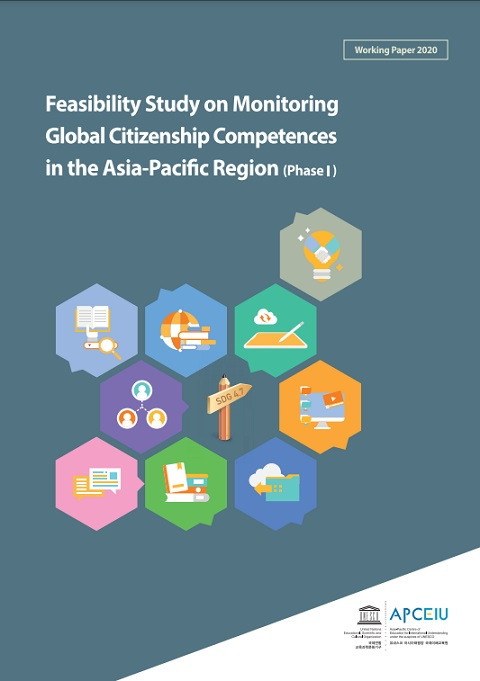 Feasibility Study on Monitoring Global Citizenship Competences in the Asia-Pacific Region (Phase I) Año de publicación: 2020 Autor: Aaron Benavot Autor corporativo: APCEIU In accordance with SDG 4.7, countries are promoting GCED and other aspects of Target 4.7. It is necessary to measure learner levels and progress in global citizenship competencies to assess the extent to which learners are acquiring knowledge, attitudes, and skills related to global citizenship.This report is organized into three substantive sections. Section II discusses existing definitions and conceptualization of GCED and GCC drawing on different sources. Section III describes which Asia-Pacific countries are included in this feasibility study and how relevant policy and curriculum documents are identified and analyzed. This section also discusses some common and share features of GCED that emerge from an analysis of country documents. Section IV briefly reviews existing measurement approaches of GCED or related concepts and then proposes a Measurement Framework of GCC for possible use in the A-P region. Section V of the report provides some forward-looking suggestions.
 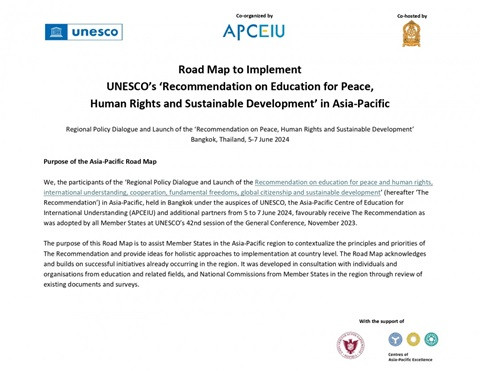 Road Map to Implement UNESCO’s ‘Recommendation on Education for Peace, Human Rights and Sustainable Development’ in Asia-Pacific Año de publicación: 2024 Autor corporativo: UNESCO Bangkok | APCEIU The Road Map is a product of the Regional Policy Dialogue and the Launch of the Recommendation on Education for Peace, Human Rights, and Sustainable Development (hereafter referred to as the 2023 Recommendation), held in Bangkok in June 2024. This document aims to promote the regional implementation of the 2023 Recommendation and outlines the challenges and priorities within the Asia-Pacific educational landscape, making it a valuable resource for policymakers, researchers, and practitioners.
 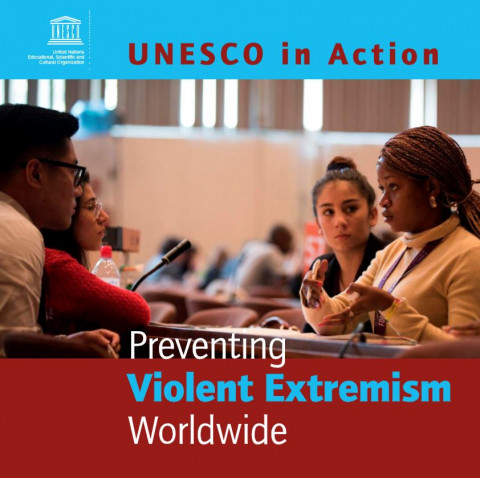 UNESCO in action: preventing violent extremism worldwide Año de publicación: 2018 Autor corporativo: UNESCO UNESCO supports countries in crafting education programmes that build young people’s resilience to violent extremist messaging and foster a positive sense of identity and belonging. From this angle, the role of education is not to intercept violent extremists or identify individuals who may potentially become violent extremists, but to create conditions to build the defences of peace within learners through values, skills and behaviours that reject violent extremism, and by strengthening their commitment to non-violence and peace. This work is undertaken within the broader framework of Global Citizenship Education, where UNESCO leads implementation of Target 4.7 of the Sustainable Development Goal 4 on Education. The work undertaken in the field of Global Citizenship Education also embraces activities pertaining to human rights and peace education, Holocaust and genocide education, and activities to combat all forms of intolerance, racism and anti-Semitism.
  Inclusive early childhood care and education: background paper prepared for the International Forum on inclusion and equity in education, every learner matters Año de publicación: 2019 Autor: Sheldon Shaeffer Autor corporativo: UNESCO | Open Society Foundation Experiences around the world show that it is necessary to respond to the specific needs of each category of exclusion (sex, poverty, remoteness, ethnicity, language, legal status,and developmental delay anddisability) and to each excluded child–without further marginalizing or labelling them. The overall focus should be on inclusive ECCE policies, strategies, and practicesto remove all barriers, and promote optimal development and learning for all children, build ramps for participation and inclusion, and thereby help all relevant ministriesto become fully inclusive, both in vision and in practices. Only then can we really achieve the goal of good quality education for all. Educación y atención inclusiva para la primera infancia: documento de referencia para el Foro Internacional sobre Inclusión y Equidad en la Educación «Todas y todos los estudiantes cuentan» Año de publicación: 2019 Autor: Sheldon Shaeffer Autor corporativo: Organización de las Naciones Unidas para la Educación, la Ciencia y la Cultura (UNESCO) | Open Society Foundation Las experiencias en todo el mundo demuestran que es necesario responder a las necesidades específicas de cada categoría de exclusión (sexo, pobreza, lejanía, etnia, idioma, condición jurídica, retraso en el desarrollo y discapacidad) y de cada niño o niña excluido, sin marginarlos ni etiquetarlos más. La atención debe centrarse en políticas, estrategias y prácticas de AEPI inclusivas para eliminar todos los obstáculos y promover el desarrollo y el aprendizaje óptimos de todos los niños, construir rampas para la participación y la inclusión y, de ese modo, ayudar a todos los ministerios pertinentes a ser plenamente integradores, tanto en la visión como en la práctica. Sólo entonces podremos alcanzar realmente el objetivo de una educación de buena calidad para todos.
 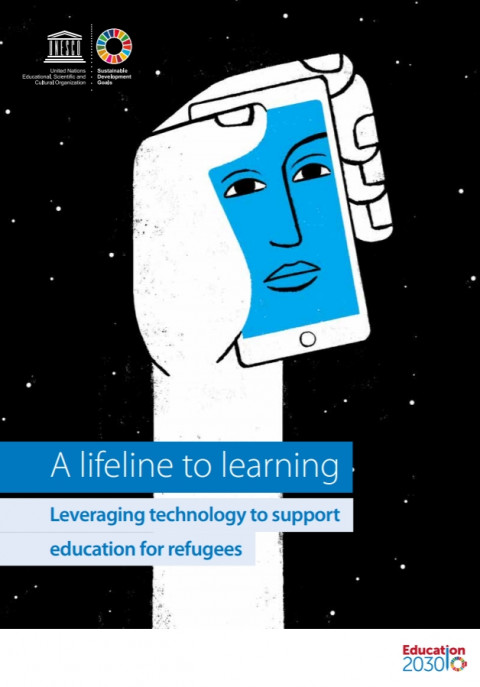 A Lifeline to Learning: Leveraging Mobile Technology to Support Education for Refugees Año de publicación: 2018 Autor corporativo: UNESCO This publication examines the evidence base for key assumptions on using mobile technology to address individual refugees’ learning challenges, broader education system challenges, and challenges to providing refugees with specific levels and types of education. The report presents findings from a review of 117 relevant papers and reports, and lessons drawn from the implementation of 52 projects that use mobile learning for refugees and the actual use of 35 digital apps or platforms. While acknowledging a limited reach, the report identifies effective mobile solutions and organizational strategies that should be scaled up.
  Strengthening accountability in the implementation of SDG4 - Education 2030 Año de publicación: 2017 Autor corporativo: UNESCO SDG4-Education 2030 is a renewed commitment to ensure the right to quality education and the promotion of lifelong learning opportunities, as the foundation for sustainable development. As outlined in the 2015 Incheon Declaration and the 2030 Framework for Action (FfA), strengthened governance, partnerships and accountability are essential in translating global education targets and commitments into effective policy and practice at the national level. The range of partners engaged in education - whether government, schools and teachers, families and communities, civil society organizations, or the business sector – have important roles in this collective societal endeavor. They also each have important responsibilities for which they must be accountable in the collective effort to realize the global commitment to ensure the right to quality education for all. As duty bearers, governments have the primary responsibility to deliver on the right to education, and a central role as custodians of efficient, equitable and effective management and financing of public education.