
Recursos
Exploren una amplia gama de recursos valiosos en GCED para profundizar su comprensión y promover su búsqueda, incidencia, enseñanza y aprendizaje.
1,451 resultados encontrados
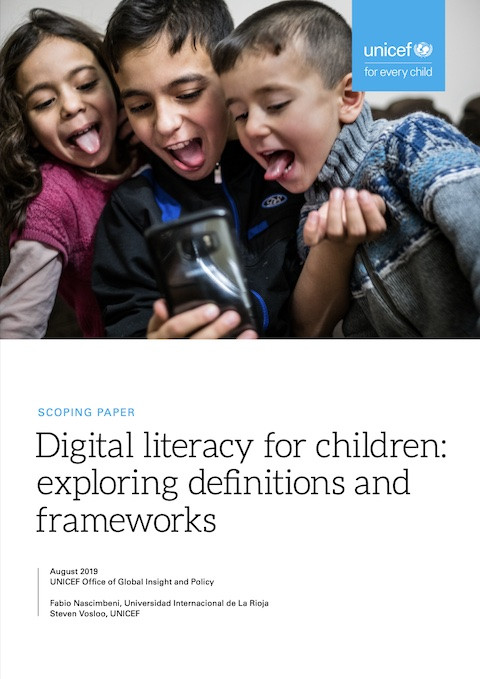 Digital Literacy for Children: Exploring Definitions and Frameworks Año de publicación: 2019 Autor: Fabio Nascimbeni Autor corporativo: United Nations Children's Fund (UNICEF) This paper presents the results of a scoping exercise on children’s digital literacy that has been undertaken with the following objectives:To understand the current digital literacy policy and practice landscape;To highlight existing competence frameworks and how they can be adapted to UNICEF’s needs;To analyze the needs and efforts of UNICEF country offices; andTo reflect on policy and programme recommendations, including a definition of digital literacy for UNICEF
  Critical Media Literacy and Popular Culture in ELA Classrooms Año de publicación: 2021 Autor: Jamila Lyiscott | Nicole Mirra | Antero Garcia Autor corporativo: National Council of Teachers of English (NCTE) This publication explores key issues on the Media Literacy impacting literacy educators and their students and articulate student-centered policy recommendations.
  Racial Literacy Año de publicación: 2021 Autor: Yolanda Sealey-Ruiz Autor corporativo: National Council of Teachers of English (NCTE) This paper gives a clear definition of the racial literacy connected to the concepts of democracy and equity and presents racial literacy development model for teaching and learning.
  Political Leadership for Sustainable Development: Why Do the Global Goals Matter to Local Councillors, and Why Do Local Councillors Matter for the Global Goals?; Training Manual Año de publicación: 2021 Autor: Maeve Bateman | Jihyun Kim Autor corporativo: Irish Development Education Association (IDEA) | Bridge 47 Political Leadership for Sustainable Development: Why Do the Global Goals Matter to Local Councillors, and Why Do Local Councillors Matter for the Global Goals?; Training Manual
  Human Rights Storytelling: Manual For the Educators Año de publicación: 2018 Autor corporativo: Huristo Project Consortium Huristo project developed a methodology about awareness and advocacy about the European Human Rights Charter as a part of global citizenship education with low skilled adult learners (refugees and migrants living in the city and natives living in rural places). This methodology is based on digital storytelling: participants work on personal narratives illustrating different topics of the charter.The main result for the adult learners are increased digital skills, reading and writing skills, awareness about the Human Rights Charter and European citizenship. The work on the Charter and the personal narratives also improve participants’ analytic media literacy, interpersonal and intercultural skills, but also core skills for employability, such as teamwork, problem solving, learning to learn and communication. Additionally, the adult trainers who are involved increase their teaching skills using digital media and the methodology of digital storytelling in particular.
  The Role of Media Literacy in the Promotion Of Common Values and Social Inclusion: Position Paper Año de publicación: 2017 Autor corporativo: All Digital While we live in an increasingly digital society, a significant number of European citizens continue to lack basic digital skills. Media practices have changed, and now we are not only receiving information passively. Anyone can be active in content creation and (re-)produce (dis)information. For example, mobile technology and ubiquitous Internet access allow citizens to produce real time information, including content for mass media (newspapers, TV channels).The production of information and news thus no longer remains in the capacity of journalists, but something within everyone’s capacity. Without the necessary skills, however, the creation of information and news is not always done in a responsible or professional manner. This is only one example of many, highlighting why media literacy is more important than ever.This position paper talks about:the role for media literacy in promoting common values and social inclusion in several ways: resilience, content creation, dissemination, social inclusionthe role of non-formal education in teaching media literacy andgives examples of media literacy programmes and projects across Europeprovides policy recommendations in terms of funding, recognition and promotion.
 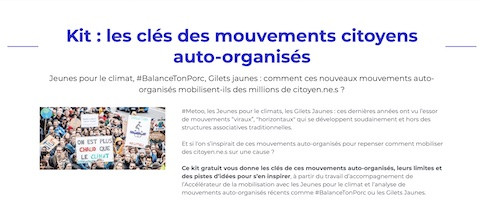 Kit: Les clés des mouvements citoyens auto-organisés Autor corporativo: L'accélérateur de la mobilisation (France) Ce kit gratuit vous donne les clés de ces mouvements auto-organisés, leurs limites et des pistes d’idées pour s’en inspirer, à partir du travail d’accompagnement de l’Accélérateur de la mobilisation avec les Jeunes pour le climat et l’analyse de mouvements auto-organisés récents comme #BalanceTonPorc ou les Gilets Jaunes.
 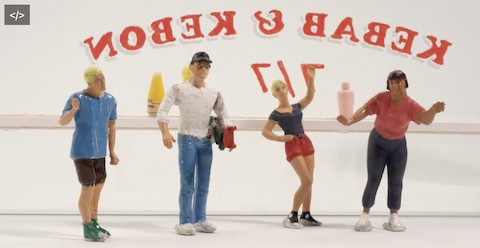 C'est quoi une information? Año de publicación: 2015 Autor: Olivier Marquézi | Mathieu Decarli Autor corporativo: Radio France | Réseau Canopé | France Télévisions | La Generale de Production Un film d’animation qui aborde des questions telles que « Qu’est-ce qu’un média », « Qu’est-ce qu’une information », « Qu’est-ce qu’une source ?... ». Autant de sujets pour amener les élèves à une pratique raisonnée autour des écrans, de l’information, du métier de journaliste.
 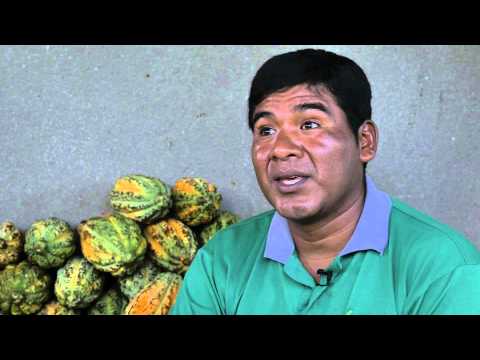 Changeons le commerce, pas le climat Año de publicación: 2015 Autor corporativo: Artisans du Monde Cette vidéo donne la parole aux producteurs, premières victimes des conséquences de la hausse des températures.Cette vidéo est un des supports: de la mallette pédagogique "Le grand voyage d'un chocolat équitable" du kit "Consommer responsable, l'alimentation" co-édité avec CANOPE
  Explained: What is False Information? Año de publicación: 2020 Autor corporativo: Dublin West Education Centre (DWEC) With so much information at our fingertips it can be easy to come across something online that isn’t quite as accurate or reliable as it should be. This kind of information is often called Fake News but a better description might be false information because it affects more than news stories. This animation, explaining false information, supports the education resource Connected - an introduction to digital media literacy.