
Recursos
Exploren una amplia gama de recursos valiosos en GCED para profundizar su comprensión y promover su búsqueda, incidencia, enseñanza y aprendizaje.
1,180 resultados encontrados
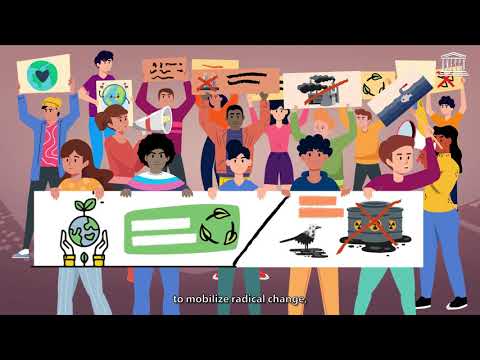 Comment l'éducation peut-elle réellement contribuer à résoudre la crise climatique? Año de publicación: 2020 Autor corporativo: Organisation des Nations Unies pour l'éducation, la science et la culture (UNESCO) « Débattre sur les futurs de l'éducation» est une série de vidéos produites par l'UNESCO, dans le cadre d'une initiative visant à réinventer les futurs de l'éducation. Cette vidéo a pour but de réfléchir à la manière dont l'éducation peut réellement contribuer à résoudre la crise climatique.
  UNESCO Green Citizens: A Global Voice for Local Actors of Change Año de publicación: 2020 Autor corporativo: UNESCO UNESCO launches the UNESCO Green Citizens Initiative, a flagship project to support citizen engagement for the planet. The UNESCO Green Citizens campaign echos the global voice of local actors of change, highlighting innovative citizen projects from around the world. UNESCO Green Citizens: Une voix globale pour des acteurs locaux du changement Año de publicación: 2020 Autor corporativo: Organisation des Nations Unies pour l'éducation, la science et la culture (UNESCO) L’UNESCO lance l’initiative UNESCO Green Citizens, un projet phare visant à soutenir l’engagement des citoyens pour la planète. La campagne offre une voix globale aux acteurs locaux du changement, en mettant en lumière des projets citoyens innovants du monde entier.
  Education for Sustainable Development: A Roadmap Año de publicación: 2022 Autor corporativo: UNESCO This roadmap sets out the urgent challenges facing the planet and underlines the implementation of the new Education for Sustainable Development: Towards achieving the SDGs (ESD for 2030) framework, which was adopted with the aim of increasing the contribution of education to building a more just and sustainable world. ESD for 2030 will step up actions on five priority action areas on policy, education environments, building capacities of educators, youth and local level action, stressing further ESD’s key role for the successful achievement of the 17 SDGs and the great individual and societal transformation required to address the urgent sustainability challenges. The roadmap also underlines the key areas of implementation of the ESD for 2030 framework. ESD is widely recognized as an integral element of Agenda 2030, in particular Sustainable Development Goal 4 (SDG 4), and a key enabler of all the other SDGs. 지속가능발전교육(ESD): 로드맵 Año de publicación: 2022 Autor corporativo: 유네스코 보다 공정하고 지속가능한 세상을 만드는 데 교육의 기여를 증진시키고자 채택한 이 로드맵은 세계가 직면한 긴급한 도전 과제를 설명하고, 새로이 수립된 체계인 ‘지속가능발전교육: 지속가능발전목표 달성을 향해’(Education for Sustainable Development: Towards achieving the SDGs), 즉 지속가능발전교육 2030의 이행을 강조한다. 지속가능발전교육 2030은 정책, 교육환경, 교육자 역량 구축, 청년 및 지역사회 차원의 실천이라는 5가지 우선 실천 영역에서의 이행을 강화시킬 것이다. 이들 활동은 17개 SDGs의 성공적인 달성과 더불어, 시급한 지속가능성 관련 도전과제들에 대응하는 데 필요한 개인과 사회의 큰 변혁을 위해 교육이 보다 핵심적인 역할을 담당할 것을 강조한다. 또한 이 로드맵은 지속가능발전교육 2030 체계 이행에서의 핵심 영역들을 강조한다. ESD는 2030 의제, 특히 SDG 4번 목표의 핵심요소이자 여타 SDGs의 핵심 추동력으로서 광범위하게 인식되고 있다.
  Humanistic Futures of Learning: Perspectives from UNESCO Chairs and UNITWIN Networks Año de publicación: 2020 Autor corporativo: UNESCO UNESCO’s Futures of Education initiative aims to rethink education and shape the future. The initiative is catalyzing a global debate on how knowledge, education and learning need to be reimagined in a world of increasing complexity, uncertainty and precarity. This publication presents the first curated input to the Futures of Education initiative from the UNITWIN/UNESCO Chairs Programme, which now represents an extensive global network of more than 800 higher education institutions in over 115 countries. It features think pieces that highlight key dimensions to be considered in re-visioning and re-purposing education for the future of humanity and the planet. The collection of the pieces calls for greater focus on a number of critical areas such as: The role of culture in strengthening social and environmental sustainability; the values and attitudes that are needed to shape future generations; the importance of both robust public education, as well as of other learning spaces; the need to strengthen human creativity and capability in the digital era, as well as the role of higher education in generating the knowledge and driving the innovation required to transform our world. Les futurs humanistes de l’apprentissage: Perspectives des chaires UNESCO et des réseaux UNITWIN Año de publicación: 2020 Autor corporativo: UNESCO L’initiative de l’UNESCO intitulée Les futurs de l’éducation vise à repenser l’éducation et à façonner l’avenir, en lançant un débat mondial sur la manière de réinventer le savoir, l’éducation et l’apprentissage dans un monde de plus en plus complexe, incertain et précaire. Le présent volume constitue la première collection de contributions soumises à l’initiative Les Futurs de l’éducation de l’UNESCO par le Programme des chaires UNESCO/UNITWIN, un vaste réseau mondial regroupant plus de 800 établissements d’enseignement supérieur dans plus de 115 pays. Les documents de réflexion qu’il contient mettent en évidence les dimensions essentielles à prendre en compte pour ré-imaginer et redéfinir l’éducation dans l’intérêt de l’avenir de l’humanité et de la planète. Cette collection appelle à insister davantage sur un certain nombre de domaines critiques tels que le rôle de la culture dans le renforcement de la durabilité sociale et environnementale, les valeurs et les attitudes nécessaires pour préparer les générations futures, l’importance d’une éducation publique et robuste, ainsi que d’autres espaces d’apprentissage, la nécessité de renforcer la créativité et les capacités humaines à l’ère numérique, ainsi que le rôle de l’enseignement supérieur concernant la génération des savoirs et la conduite de l’innovation nécessaire pour transformer notre monde. 학습의 인본주의적 미래: 유네스코 석좌와 유니트윈의 시각에서 Año de publicación: 2020 Autor corporativo: 유네스코 유네스코의 ‘교육의 미래’(Futures of Education) 이니셔티브는 교육을 다시 생각해보고 교육의 미래를 만들어가는 것을 목표로 한다. 이 이니셔티브는 복잡성, 불확실성, 불안정성이 증가하는 세계에서 지식, 교육, 학습은 어떻게 재구상되어야 하는가라는 문제에 대한 전세계적 논의를 촉진하고 있다. 이 책은 현재 115개 이상의 국가의 800개 이상의 고등교육기관으로 구성된 광범위한 글로벌 네트워크를 대표하는 유니트윈/유네스코 석좌프로그램(UNITWIN/UNESCO Chairs Programme)이 교육의 미래 이니셔티브에 제출한 글들을 일차적으로 정리해 엮은 것이다. 이 책은 인류와 지구의 미래를 위해 교육의 비전과 목적을 재설정할 때 고려해야 할 핵심적 차원들을 조명하는 글들을 담고 있다. 이 글들은 사회적·환경적 지속가능성 강화에 있어 문화의 역할; 미래 세대 육성에 필요한 가치와 태도; 건실한 공교육 및 기타 학습공간의 중요성; 디지털 시대에 인간의 창의력과 역량을 강화할 필요성과 지식을 창출하고 세상을 변화시키는 데 필요한 혁신을 주도하는 고등교육의 역할 등 중요 영역에 더욱 초점을 맞출 것을 촉구한다.
  Reopening Schools in Latin America and the Caribbean: Keys, Challenges, and Dilemmas to Plan for a Safe Return to in-Person Classes Año de publicación: 2021 Autor: Alejandro Vera | Martín Scasso | Alejandro Morduchowicz | Cecilia Berlanga Alessio Robles Autor corporativo: UNESCO Santiago | Inter-American Development Bank The suspension of in-person classes as a consequence of the COVID-19 pandemic profoundly affected the education systems in Latin America and the Caribbean (LAC) and compromised the achievements reached around the goals established in the SDG4-Education 2030 Agenda. The most vulnerable people have been the most affected by this situation, which widened the preexisting gaps. The countries of the region have carried out great efforts to guarantee the continuity of learning. However, these have been limited by the challenges that this unprecedented crisis brought, aggravated by unequal conditions in access to infrastructure and other resources that affect broad sectors of the population.This report analyzes the possibilities, restrictions and needs that the countries of the region will face during the process of returning to in-person classes, considering five dimensions: (i) safe schools (school infrastructure, access to water and sanitation); (ii) human resources (principals and teachers); (iii) access to ITC and connectivity; (iv) education financing and (v) information and planning. Reabrir las escuelas en América Latina y el Caribe: Claves, desafíos y dilemas para planificar el retorono seguro a las clases presenciales; Reporte Año de publicación: 2021 Autor: Alejandro Vera | Martín Scasso | Alejandro Morduchowicz | Cecilia Berlanga Alessio Robles Autor corporativo: UNESCO La suspensión de clases presenciales como consecuencia de la pandemia de COVID-19 afectó profundamente los sistemas educativos de América Latina y el Caribe, y puso en riesgo los avances alcanzados en torno al cumplimiento de las metas establecidas en la Agenda ODS 4-Educación 2030. Las poblaciones más vulnerables se han visto más afectadas por esta situación, lo cual acrecentó las brechas preexistentes. Los países de la región llevaron a cabo enormes esfuerzos para garantizar la continuidad de los aprendizajes. Sin embargo, se ven limitados por los desafíos que presenta este contexto inédito de crisis y agravados por las desiguales condiciones de acceso a infraestructura y otros recursos que afectan a vastos sectores de la población.El reporte analiza las posibilidades, restricciones y necesidades que enfrentarán los países de la región durante el proceso del regreso a las clases presenciales, considerando cinco dimensiones: (i) escuelas seguras (infraestructura escolar, acceso al agua y saneamiento); (ii) recursos humanos (directores y docentes); (iii) acceso a TIC y conectividad, (iv) financiamiento de la educación y (v) información y planificación.