
Recursos
Exploren una amplia gama de recursos valiosos en GCED para profundizar su comprensión y promover su búsqueda, incidencia, enseñanza y aprendizaje.
1,443 resultados encontrados
 Bringing it out in the open: Monitoring school violence based on sexual orientation, gender identity or gender expression in national and international surveys Año de publicación: 2019 Autor corporativo: UNESCO This technical brief has been developed by the United Nations Educational, Scientific and Cultural Organization (UNESCO) to strengthen the routine monitoring of school violence that is based on sexual orientation, gender identity or gender expression (SOGIE). It is informed by best practice from large institutional surveys that have been successfully conducted at the international or national level. The Brief provides recommendations on: • Questions to capture data on the sexual orientation or gender identity of students.• Questions to capture data on school violence that is specifically based on SOGIE. The Brief also gives guidance on: • The challenges in collecting data on school violence based on SOGIE• Identifying and fulfilling indicators on school violence based on SOGIE
  Intercultural dialogue and cultural diversity Año de publicación: 2007 Autor corporativo: UNESCO The collection of materials of the Central Asian round table is devoted to sharing best practices in intercultural dialogue and to the UNESCO Universal Declaration on Cultural Diversity.The work highlights issues on the exchange of best practices in the field of intercultural dialogue, popularization of the UNESCO Universal Declaration on cultural diversity, the creation of a “Central Asian platform to strengthen cultural cooperation and dialogue ”, to strengthen UNESCO Chairs in Central Asia. Межкультурный диалог и культурное разнообразие Año de publicación: 2007 Autor corporativo: Организация Объединенных Наций по вопросам образования, науки и культуры (UNESCO) Сборник материалов Центральноазиатского круглого стола посвящен обмену передовым опытом в области межкультурного диалога и попу- ляризации Всеобщей декларации ЮНЕСКО о культурном разнообразии.В работе освещаются вопросы по обмену передовым опытом в области межкультурного диалога, популяризации Всеобщей декларации ЮНЕСКО о культурном разнообразии, созданию “Центральноазиатской платформы для укрепления культурного сотрудничества и диалога”, укреплению сотрудничества кафедр ЮНЕСКО в Центральной Азии.
 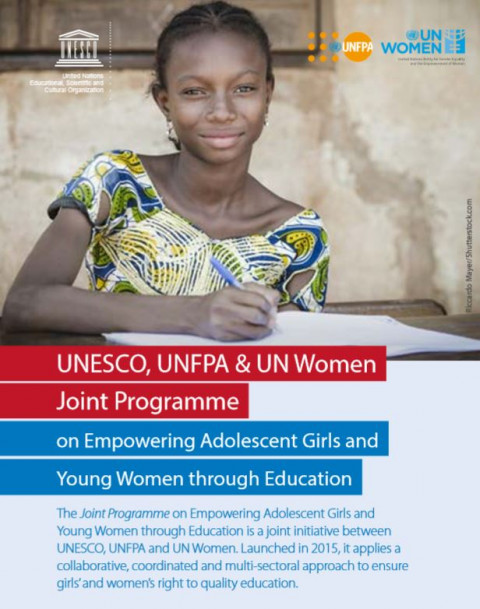 UNESCO, UNFPA & UN Women Joint Programme: on Empowering Adolescent Girls and Young Women through Education Año de publicación: 2019 Autor corporativo: UNESCO | United Nations Population Fund (UNFPA) The Joint Programme on Empowering Adolescent Girls and Young Women through Education leverages the collective expertise, experience and networks of three United Nations agencies – UNESCO, UNFPA and UN Women.It aims to empower adolescent girls and young women aged 10 to 24 to make successful and healthy transitions into adulthood, in and through quality education.Taking a lifecycle perspective and a holistic approach, the Joint Programme strengthens the links between education, health and gender equality.
 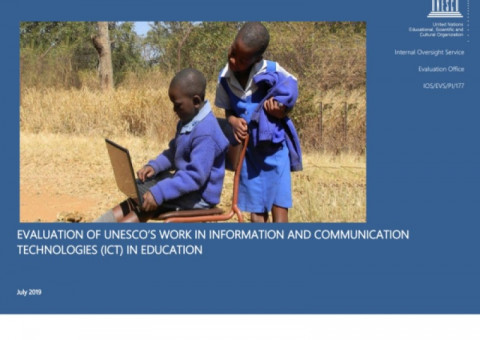 Evaluation of UNESCO's work in information and communication technologies (ICT) in education Año de publicación: 2019 Autor: Seán Ó Siochru and Graham Attwell Autor corporativo: UNESCO ICT in Education is a fast-growing area globally that offers many strategic opportunities. As the leader and coordinator of the SDG 4 – Education 2030 with the aim to “Ensure inclusive and equitable quality education and promote lifelong learning opportunities for all”, UNESCO has the mandate and expertise needed to strategically position itself as a world leader in this field. UNESCO’s work in ICT in Education aims at enhancing the quality and relevance of learning and at strengthening inclusion. While technology can facilitate wider access to education and bridge learning divides, can advance gender equality and inclusion as well as digital skills development, the rapidly changing technologies and work processes require the development of new pedagogies, both for the use of ICT for teaching and learning in the classroom and through open access and distance learning. Compared to other players, UNESCO leverages its comparative strengths in its ICT in Education interventions - especially its impartiality, convening power, and policy expertise - through an inclusive and humanistic approach to achieving quality education in coherence with Sustainable Development Agenda 2030. Its expertise across all levels of Education and its multidisciplinary potential of working across its Programme Sectors are also considered among UNESCO’s specific strengths. The evaluation revealed that UNESCO achieved important results, at the level of the learning environment, at the policy level and in institutional capacity building, but it also showed that UNESCO still needs to strengthen its positioning and visibility within the wider landscape of ICT in Education. For example, UNESCO has to continue positioning itself for producing forward-looking knowledge on ICT in Education and as a laboratory of ideas for future-oriented thinking. While the evaluation came across various specific interventions successfully addressing the needs of disadvantaged groups, the evaluation found that considerations of inclusion and gender equality were not consistently mainstreamed into policy-related and capacity building interventions. Other challenges are mainly linked to the current dispersion of resources and fragmentation of expertise across different entities within the Organization, which also leads to reduced visibility. While the key entities active in this area recognize that they are working within a common theme, collaboration and coordination still needs to be improved. The strategic measures proposed by the evaluation towards an overall organizational framework for ICT in Education aim at establishing an enabling environment for inter- and multidisciplinary approaches and greater coherence and collaboration.
  Facing the facts: the case for comprehensive sexuality education Año de publicación: 2019 Autor: Global Education Monitoring Report Team Autor corporativo: UNESCO Comprehensive sexuality education is an essential part of a good quality education that helps prepare young people for a fulfilling life in a changing world. It improves sexual and reproductive health outcomes, promotes safe and gender equitable learning environments, and improves education access and achievement. This paper, produced jointly with the Section for Health and Education at UNESCO, discusses how governments can overcome social resistance and operational constraints to scale up these programmes as part of their commitment to SDG 4, the global education goal. Regarder la réalité en face: pourquoi faut-il promouvoir l'éducation complète à la sexualité Año de publicación: 2019 Autor: Global Education Monitoring Report Team Autor corporativo: Organisation des Nations Unies pour l'éducation, la science et la culture (UNESCO) L'éducation complète à la sexualité est un élément indispensable d'une éducation de qualité qui aide les jeunes à s'épanouir dans un monde en mutation. Elle améliore les résultats en matière de santé sexuelle et reproductive, crée les conditions d'un apprentissage sûr et équitable du point de vue du genre, élargit l'accès à l'éducation et améliore les résultats scolaires. Ce document d'orientation, préparé avec la section de la santé et de l'éducation de l'UNESCO, explique comment les gouvernements peuvent surmonter les résistances sociales et les contraintes opérationnelles pour amplifier ces programmes, conformément à leur engagement envers l'ODD 4, l'objectif mondial d'éducation. Encarar los hechos: el caso de la educación integral en sexualidad Año de publicación: 2019 Autor: Global Education Monitoring Report Team Autor corporativo: Organización de las Naciones Unidas para la Educación, la Ciencia y la Cultura (UNESCO) La educación integral en sexualidad forma parte esencial de una educación de buena calidad que ayude a preparar a las y los jóvenes para llevar una vida plena en un mundo en evolución. Dicha educación mejora la salud sexual y reproductiva, promueve entornos de aprendizaje seguros y equitativos en cuanto al género y favorece el acceso a la educación y el rendimiento escolar. En este documento, elaborado conjuntamente con la Sección de la Salud y la Educación de la UNESCO, se analiza cómo los gobiernos pueden superar la resistencia social y las limitaciones operativas para ampliar estos programas en el marco de su compromiso con el ODS 4, el objetivo mundial relativo a la educación.
  4th Meeting of the SDG-Education 2030 Steering Committee, Paris, 28 February-02 March 2018: meeting report Año de publicación: 2018 Autor corporativo: UNESCO This report summarizes the deliberations, the main recommendations adopted, and the decisions made at the 4th meeting of the SDG-Education 2030 Steering Committee (Paris, 28 February - 2 March 2018).The objectives of the meeting were: To define positions and recommendations of the SDG-Education 2030 Steering Committee on key strategic areas. To agree on a strategy for global review, monitoring and reporting process, in view of HLPF 2018 and the 2019 Reviews. To refine the advocacy, communication and outreach strategy of the SDG-Education 2030 Steering Committee To define next steps for the SDG-Education 2030 Steering Committee (next meeting, rotation of members, and the Global Education Meeting 2018). Quatrième Réunion du Comité directeur ODD-Education 2030, Paris, 28 février-02 mars 2018: rapport de la reunion Año de publicación: 2018 Autor corporativo: Organisation des Nations Unies pour l'éducation, la science et la culture (UNESCO) Le présent rapport résume les débats qui ont eu lieu lors de la quatrième réunion du Comité directeur ODD – Éducation 2030 (Paris, 28 février – 2 mars 2018) et reprend les principales recommandations et décisions adoptées.La réunion s’était fixé les objectifs suivants : Définir les positions et les recommandations du Comité directeur ODD – Éducation 2030 dans des domaines stratégiques clés. Convenir d’une stratégie globale portant sur le processus d’examen, de suivi et d’établissement de rapports en vue de l’examen du HLPF 2018 et 2019. Affiner la stratégie du Comité directeur ODD – Éducation 2030 en matière de plaidoyer, de communication et de sensibilisation. Définir les prochaines étapes du Comité directeur ODD – Éducation 2030 (prochaine réunion, renouvellement des membres et Réunion mondiale sur l’éducation 2018).