
Recursos
Exploren una amplia gama de recursos valiosos en GCED para profundizar su comprensión y promover su búsqueda, incidencia, enseñanza y aprendizaje.
306 resultados encontrados
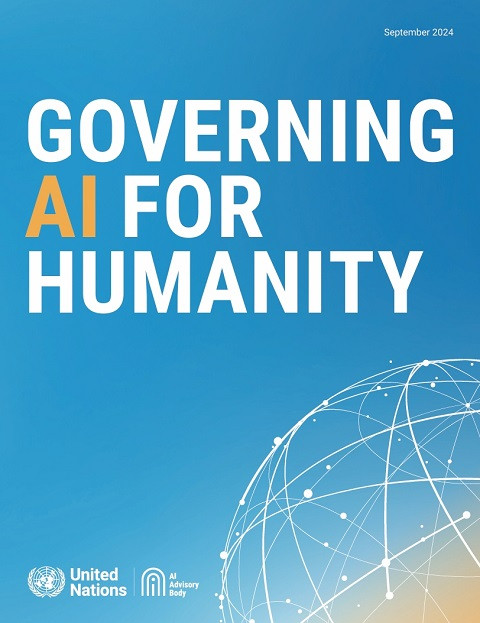 Governing AI for Humanity: Final Report Año de publicación: 2024 Autor corporativo: United Nations (UN) The United Nations Secretary-General’s High-level Advisory Body on AI’s Final Report, “Governing AI for Humanity,” builds on months of work, including extensive global consultations, and the publication of an interim report in December 2023. Proposals for Global Governance on AI This report outlines a blueprint for addressing AI-related risks and sharing its transformative potential globally, including by:• Urging the UN to lay the foundations of the first globally inclusive and distributed architecture for AI governance based on international cooperation;• Proposing seven recommendations to address gaps in current AI governance arrangements;• Calling on all governments and stakeholders to work together in governing AI to foster development and protection of all human rights. This includes light institutional mechanisms to complement existing efforts and foster inclusive global AI governance arrangements that are agile, adaptive and effective to keep pace with AI’s evolution. Extensive Global Consultations The report is the product of extensive consultations, involving more than 2,000 participants across all regions of the world, including via: • 18 deep-dive discussions on key issues with top experts• More than 50 consultation sessions across all regions• More than 250 written submissions from over 150 organizations and 100 individuals The Advisory Body also commissioned an AI Risk Global Pulse Check – the most comprehensive global horizon scanning exercise on AI risks to date – and an AI Opportunity Scan to crowdsource expert assessments of emerging AI trends.
 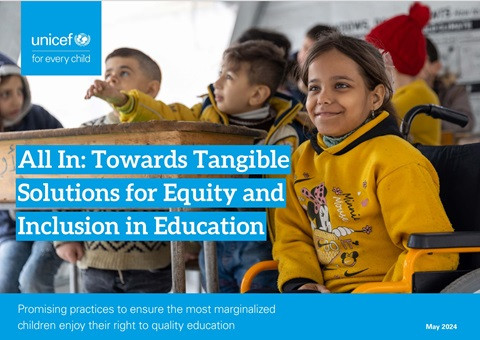 All In: Towards Tangible Solutions for Equity and Inclusion in Education Año de publicación: 2024 Autor corporativo: United Nations Children's Fund (UNICEF) All In: Towards Tangible Solutions for Equity and Inclusion in Education showcases promising practices that were successfully implemented to ensure that inclusive education really does include all children, so that the most marginalized learners – including children with disabilities, children who are out of school, children living in poverty, marginalized girls, and refugee children – have access to quality education. While many of the promising practices were initiated in response to the COVID-19 crisis, or draw upon the pandemic experience, they go beyond the immediate focus of pre- or post-COVID-19 education systems to an overall view of child well-being and the need to focus on skills for the 21st century. Many of these practices have the potential to be applied more widely within education systems and can be adapted and replicated by stakeholders in any context where innovative and inclusive approaches are needed to protect and promote children’s right to education. Ingenuity, flexibility and a commitment to true inclusion and forward-looking policies are the common thread of promising practices in this document. This publication is a complementary resource to the 2021 report: Reimagining Girls’ Education: Solutions to Keep Girls Learning in Emergencies.
  United Nations Strategy and Plan of Action on Hate Speech: Detailed Guidance on Implementation for United Nations Field Presences Año de publicación: 2020 Autor corporativo: United Nations (UN) The Strategy and Plan of Action acknowledges that hate speech has the potential to incite violence and undermine social unity. It recognizes that hate speech has been a precursor to atrocity crimes, including genocide, over the past 75 years. This approach to coordinating efforts across the UN system to identify, prevent and confront hate speech is grounded in international human rights standards, including the right to freedom of opinion and expression, principles of equality and non-discrimination, as well as other fundamental rights. The Strategy aims to give the United Nations the room and the resources to address hate speech, which poses a threat to UN principles, values and programmes. It guides the UN system on how to address hate speech and includes ways to support United Nations Resident Coordinators’ action in addressing and countering hate speech on the ground.
 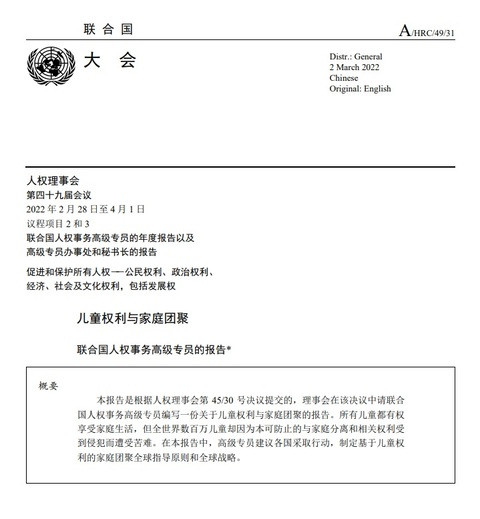 Report on the Rights of the Child and Family Reunification Año de publicación: 2022 Autor corporativo: UN Human Rights This document is a report by the UN Special Rapporteur on Human Rights on the issue of separation of children from their families, describing the different forms the issue takes, as well as addressing the relevant international legal framework, and making relevant recommendations for each situation. 关于儿童权利和家庭团聚的报告 Año de publicación: 2022 Autor corporativo: UN Human Rights 该文件是联合国人权事务特别报告员关于儿童与家庭分离问题的报告,介绍了该问题的不同形式,以及涉及相关国际法律框架,并针对各种情况提出相关建议。
  العمل الإنساني من أجل الأطفال 2019 Año de publicación: 2019 Autor corporativo: United Nations Children's Fund (UNICEF) إن هذا الإصدار الجديد من تقرير اليونيسف حول متطلبات العمل الإنساني يسلّط الضوء على حالات الطوارئ الرئيسية التي تؤثر على الأطفال والأسر في جميع أنحاء العالم، وعلى النتائج التي حققتها اليونيسف وشركاؤها استجابة لتلك الأزمات. يلحظ التقرير أن المزيد من الصراعات العنيفة تستعر اليوم أكثر من أي وقت مضى منذ إقرار اتفاقية حقوق الطفل قبل 30 عامًا، ويصف التقرير أيضًا مبادرات اليونيسف لتحسين نوعية استجابتها الإنسانية في عام 2019 — لا سيما في سياقات التهديد الشديد. UNICEF Humanitarian Action for Children 2019 Año de publicación: 2019 Autor corporativo: United Nations Children's Fund (UNICEF) This edition of UNICEF’s report on requirements for humanitarian action highlights major emergencies affecting children and families around the world, and the results achieved by UNICEF and partners in response to those crises. Noting that more violent conflicts are raging today than at any time since the adoption of the Convention on the Rights of the Child 30 years ago, the report also describes UNICEF initiatives to improve the quality of its humanitarian response in 2019 – particularly in high-threat contexts.
 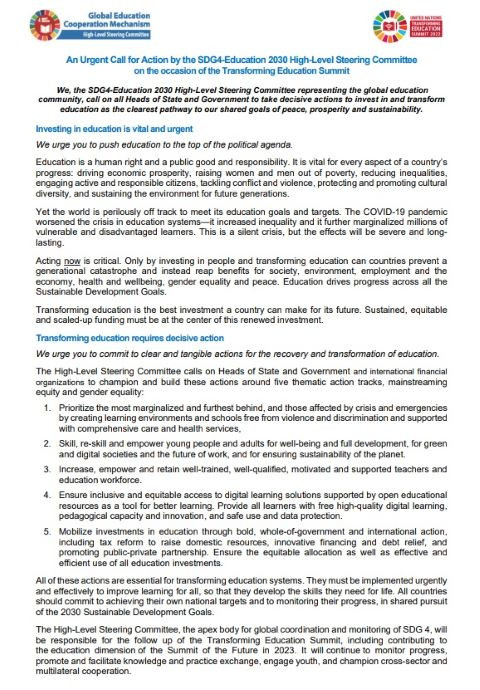 Срочный призыв к действиям Руководящего комитета высокого уровня по ЦУР 4 – «Образование-2030» по случаю Саммита по трансформации образования Año de publicación: 2022 Autor corporativo: United Nations (UN) Мы, Руководящий комитет высокого уровня ЦУР 4-Образование-2030, представляющий мировое образовательное сообщество, призываем всех глав государств и правительств предпринять решительные действия по инвестированию и преобразованию образования как наиболее четкого пути к нашим общим целям мира, процветания и устойчивости. 可持续发展目标 4—2030 年教育高级别指导委员会 在教育变革峰会之际的紧急行动呼吁 Año de publicación: 2022 Autor corporativo: United Nations (UN) 我们,代表全球教育界的 SDG4-Education 2030 高级别指导委员会,呼吁所有国家元首和政府首脑采取果断行动,对教育进行投资和改造,作为实现和平、繁荣和可持续发展这一共同目标的最清晰途径 .
 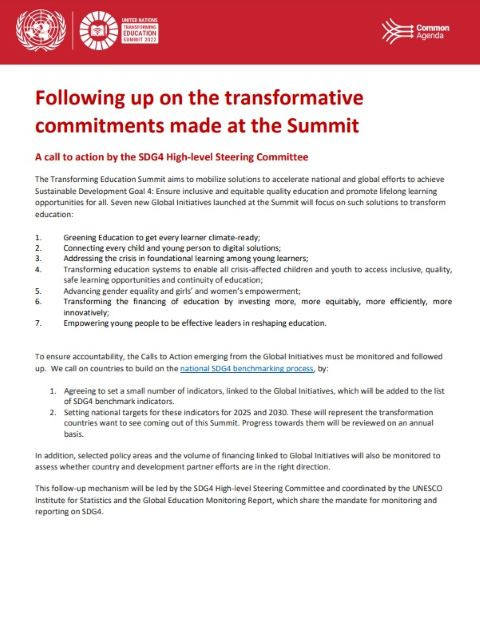 Following Up on the Transformative Commitments Made at the Summit: A Call to Action by the SDG4 High-level Steering Committee Año de publicación: 2022 Autor corporativo: United Nations (UN) The Transforming Education Summit aims to mobilize solutions to accelerate national and global efforts to achieve Sustainable Development Goal 4: Ensure inclusive and equitable quality education and promote lifelong learning opportunities for all. Seven new Global Initiatives launched at the Summit will focus on such solutions to transform education.