
Recursos
Exploren una amplia gama de recursos valiosos en GCED para profundizar su comprensión y promover su búsqueda, incidencia, enseñanza y aprendizaje.
1,300 resultados encontrados
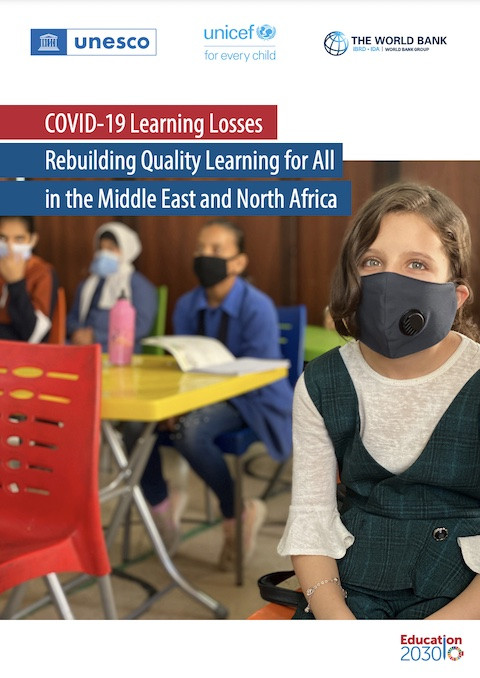 COVID-19 Learning Losses: Rebuilding Quality Learning for All in the Middle East and North Africa Año de publicación: 2021 Autor: Hana Yoshimoto | Jeannette Vogelaar | Brenda Haiplik Autor corporativo: UNESCO | United Nations Children's Fund (UNICEF) | World Bank An entire generation of children in the Middle East and North Africa (MENA) is estimated to be affected by the education crisis determined by the COVID-19 pandemic, with potential impacts that are going beyond the immediate/short term and also well beyond the education domain itself, with consequences on children’s socialisation, mental well-being, and future perspective of being active members of their society, including in the labor market. More information on the impact of the crisis would help countries to put in place strategies to mitigate the impacts. Timely investment and action to prevent extreme impacts of this crisis on education are of paramount importance in MENA, which already tackling a learning crisis before the COVID-19 outbreak.This publication delineates the overall education status in MENA after the breakout of COVID-19 pandemic, by presenting the education responses in MENA, and assessing the potential learning loss through a simulation analysis, recommendations are provided on how to build back better and enhance access and quality learning for all.
 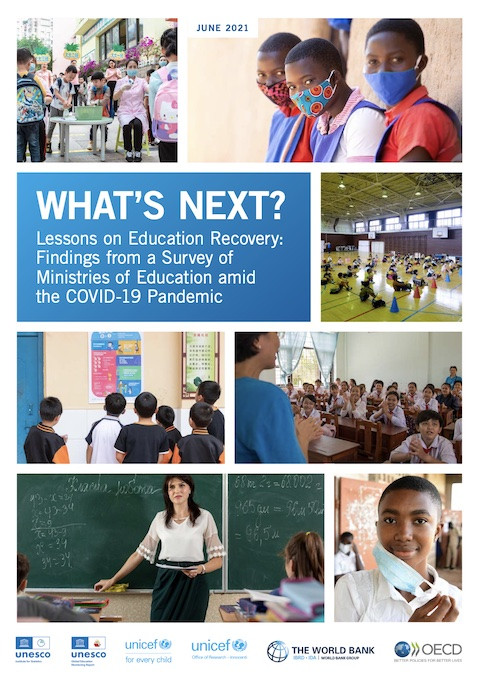 What’s Next? Lessons on Education Recovery: Findings From a Survey of Ministries of Education Amid the COVID-19 Pandemic Año de publicación: 2021 Autor corporativo: UNESCO | United Nations Children's Fund (UNICEF) | World Bank | Organisation for Economic Co-operation and Development (OECD) United Nations Educational, Scientific and Cultural Organization (UNESCO), the United Nations Children’s Fund (UNICEF), the World Bank and the Organisation for Economic Co-operation and Development (OECD) have collaborated in the third round of the Survey on National Education Responses to COVID-19 School Closures, administered by the UNESCO Institute for Statistics (UIS) and OECD to Ministry of Education officials. The questions covered four levels of education: preprimary, primary, lower secondary and upper secondary. While the first two rounds of the survey were implemented during the periods May–June and July–October 2020, respectively, the third round was implemented during the period February–June 2021. In total, 143 countries responded to the questionnaire. Thirty-one countries submitted responses to the OECD (“OECD survey”) and 112 countries responded to the UIS (“UIS survey”). Seven countries responded to both surveys. In these instances, the more complete set responses were used in analysis.
 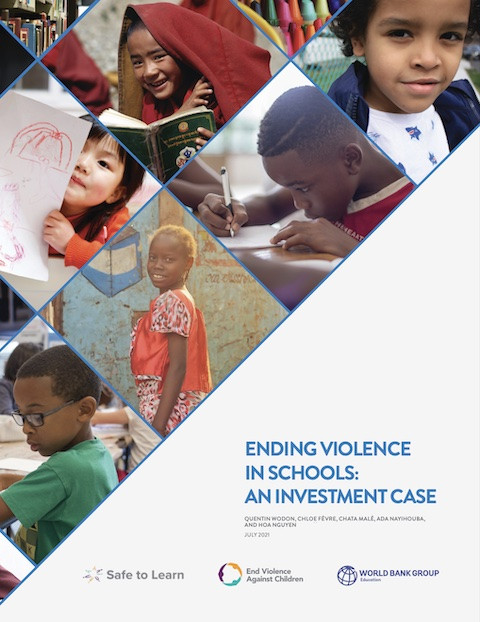 Ending Violence in Schools : An Investment Case Año de publicación: 2021 Autor: Quentin Wodon | Chloë Fèvre | Chata Malé | Ada Nayihouba | Hoa Nguyen Autor corporativo: World Bank Preventing violence in and through school is a prerequisite for girls and boys getting the education they need and deserve, and acquiring the skills, knowledge and values that provide the foundations for strong and inclusive societies. This report demonstrates that violence in and around schools negatively impacts educational outcomes, and society pays a heavy price as a result (with an estimate of $11 trillion in lost lifetime earnings). Cost-benefit analyses suggest that implementing interventions to prevent violence in and through schools from early childhood to secondary education is a smart economic investment. Rigorously evaluated programs and policies aimed at preventing violence at different levels of the education system show that action is feasible. The benefits of investing in preventing violence in and through schools is likely to far outweigh the costs.
 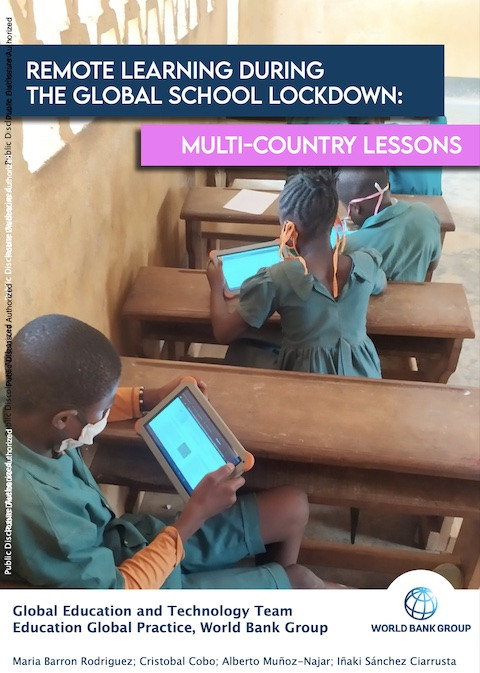 Remote Learning During the Global School Lockdown: Multi-Country Lessons Año de publicación: 2020 Autor: Maria Barron Rodriguez | Cristobal Cobo | Alberto Muñoz-Najar | Iñaki Sánchez Ciarrusta Autor corporativo: World Bank This study includes three main sections that have been organized in a chronological order within this report: the first one, “What can we learn from education emergency responses in low- and middle-income countries?” analyzes the emergency education responses to the COVID-19 pandemic of over 120 governments from April until May, 2020. The second section, “Is remote learning perceived as effective? An in-depth analysis across five countries” discusses the main national education responses deployed by Brazil, Kenya, Nigeria, Sierra Leone, and Peru, as well as the perceived effectiveness of these strategies conducted from May until August, 2020. The third section, “What works with remote and remedial strategies? an analysis across 13 countries” builds on key lessons learned during the analysis of the five multi-country experiences and presents global trends of remote learning implemented during school closures and the actions governments adopted to get ready for remedial learning, conducted from August until December 2020. The countries prioritized for the third section are IDA borrowing countries of which six are low-income countries: Afghanistan, Haiti, Malawi, Mozambique, Niger, and Rwanda; and five are lower-middle-income countries: Cambodia, Cameroon, Kenya, Nepal, and Pakistan. Additionally, two high-income countries, Estonia and Uruguay, have been included in the report. The main trends across this report are discussed below and have been grouped in five themes: (1) Adopt delivery systems with an inclusive approach; (2) Adjust the curriculum to ensure effectiveness; (3) Secure sustained teacher training and in-service support; (4) Leverage institutional capacities while ensuring sustained monitoring and evaluation; and (5) Consolidate national strategies to remediate learning losses.
 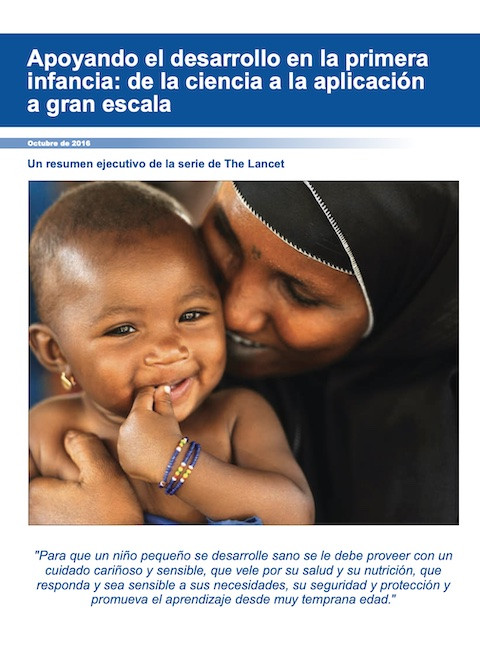 Supporting Early Childhood Development: From Science to Large-Scale Application Año de publicación: 2016 Autor: The Lancet Autor corporativo: United Nations Children's Fund (UNICEF) | World Bank | World Health Organization (WHO) This document summarizes the series of articles on Early Childhood Development published by The Lancet in 2016. It presents new scientific evidence that supports interventions and proposes measures to be applied in large-scale child development programs. The series emphasizes "loving care sensitive to the needs of the child", especially up to three years of age, as well as multisectoral interventions that, taking the health sector as a starting point, allow reaching many families and young children through health and nutrition. Apoyando el desarrollo en la primera infancia: De la ciencia a la aplicación a gran escala Año de publicación: 2016 Autor: The Lancet Autor corporativo: United Nations Children's Fund (UNICEF) | World Bank | World Health Organization (WHO) Este documento resume la serie de artículos sobre Desarrollo en la primera infancia que publicó The Lancet en 2016. Presenta nueva evidencia científica que fundamenta intervenciones y propone medidas a ser aplicadas en programas de desarrollo infantil a gran escala. La serie hace hincapié en el “cuidado cariñoso y sensible a las necesidades del niño”, sobre todo hasta los tres años de edad, así como en las intervenciones multisectoriales que, tomando el sector salud como punto de partida, permiten llegar a muchas familias y niños pequeños a través de la salud y la nutrición.
 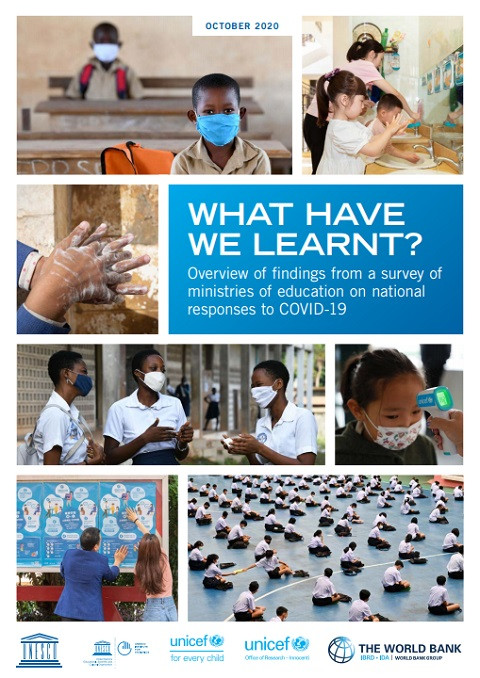 What Have We Learnt?: Overview of Findings From a Survey of Ministries of Education on National Responses to COVID-19 Año de publicación: 2020 Autor corporativo: UNESCO | United Nations Children's Fund (UNICEF) | World Bank As part of the coordinated global education response to the COVID-19 pandemic, UNESCO, UNICEF and the World Bank conducted a Survey on National Education Responses to COVID-19 School Closures. In this joint report, the results of the first two rounds of data collection administered by the UNESCO Institute for Statistics (UIS) were analysed. They cover government responses to school closures from pre-primary to secondary education.
  Global Guidance on Reopening Early Childhood Education Settings Año de publicación: 2020 Autor corporativo: United Nations Children's Fund (UNICEF) | World Bank | UNESCO This guidance note outlines key principles and practical measures for decision-makers to consider before, during and after the transition from closure to reopening. It focuses on safe operations in ECE settings, staff training and support, child well-being and development, and parental communication and support.
 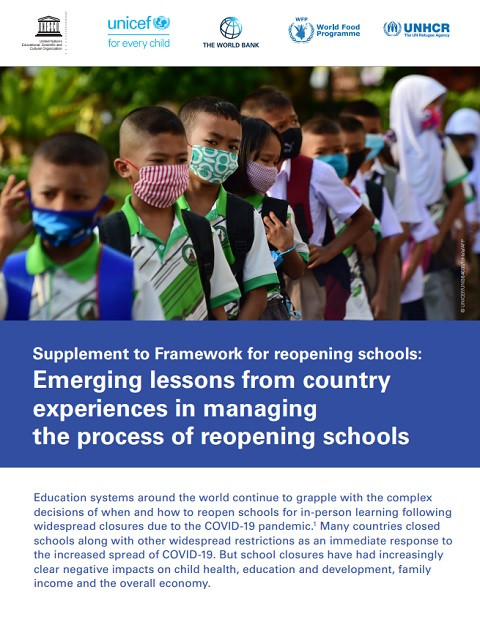 Supplement to Framework for Reopening Schools: Emerging Lessons From Country Experiences in Managing the Process of Reopening Schools Año de publicación: 2020 Autor corporativo: UNESCO | United Nations Children's Fund (UNICEF) | World Bank | World Food Programme | UN. Office of the United Nations High Commissioner for Refugees (UNHCR) Education systems around the world continue to grapple with the complex decisions of when and how to reopen schools for in-person learning following widespread closures due to the COVID 19 pandemic. This supplement to the Framework for reopening schools, originally published jointly by UNICEF, UNESCO, the World Bank, the World Food Programme, and the UN Refugee Agency (UNHCR) in April 2020, summarizes emerging lessons learnt over the past months.The supplement follows the four main dimensions of the Framework (safe operations, focus on learning, wellbeing & protection, and reaching the most marginalized) and highlighting a number of country examples.
 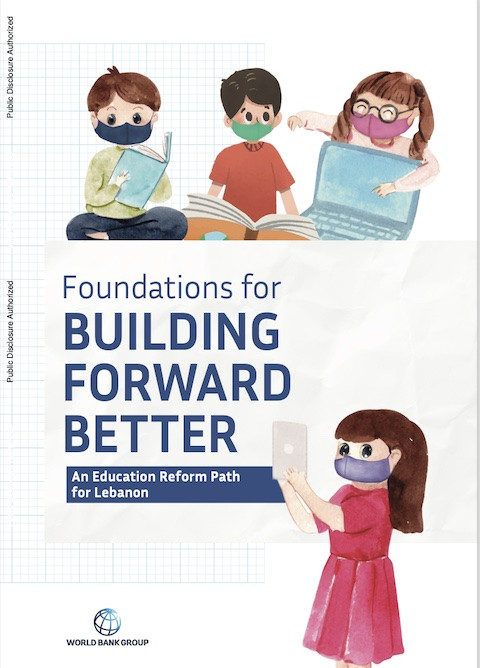 Foundations for Building Forward Better: An Education Reform Path for Lebanon Año de publicación: 2021 Autor corporativo: World Bank Human capital development is a critical determinant of economic growth, equity, and prosperity, but outcomes in this domain are worryingly low inLebanon, risking the future of generations of children. Lebanese children lag behind their peers in human capital development—measured accordingto the World Bank (2020c) Human Capital Index—suggesting that the future productivity of the labor force and the country’s trajectory for equitablegrowth is at risk (World Bank 2020b). The Human Capital Index indicates that children born in Lebanon today will reach, on average, only 52 percentof their potential productivity when they grow up. This is lower than the average estimates for the Middle East and North Africa (MENA) region(57 percent) and upper-middle-income countries (56 percent). Lebanon’s poor performance on the Human Capital Index is largely attributed to theeducation outcomes calculated for the index. If actual years of schooling, which average approximately 10.2 years in Lebanon, are adjusted for actual learning, effective years of schooling are 40 percent less—on average, only 6.3 years of actual learning (World Bank 2020b). The most recent school closures were due to the COVID-19 pandemic, with schools being closed over 75 percent of the school year between January 2020 and February 2021.1 This will likely lead to a further and significant decrease in learning: effectively, students are facing a lost year of learning (Azevedo et al. 2021).