
Recursos
Exploren una amplia gama de recursos valiosos en GCED para profundizar su comprensión y promover su búsqueda, incidencia, enseñanza y aprendizaje.
2,668 resultados encontrados
 Vancouver Holocaust Education Centre The Vancouver Holocaust Centre Society was founded in 1983 by survivors of the Holocaust. The founders’ goal was to leave a permanent legacy in the form of the Vancouver Holocaust Education Centre devoted to the Holocaust and based on anti-racism education. Online, teachers have access to practical guides for teachers and activities with discovery kits for primary and secondary pupils. Lesson Components from Echoes and Reflections Prepared by the Anti-Defamation League, the USC Shoah Foundation and Yad Vashem, Echoes and Reflections provides educators with the professional development and resources necessary to acquire the necessary knowledge, capacity, and practice to responsibly and effectively teach the Holocaust. The ten multipart lessons in the Teacher's Resource Guide, along with additional supplementary material provided here, can enhance both teachers' and students' experiences with Echoes and Reflections. Holocaust Educational Trust - Teaching Resources The Holocaust Educational Trust aim is to educate young people from every background about the Holocaust and the important lessons to be learned for today. The Trust works in schools, universities and in the community to raise awareness and understanding of the Holocaust, providing teacher training, an outreach programme for schools, teaching aids and resource material. The Teaching Resources section of the Trust’s website provides free, downloadable lesson plans, classroom resources and guidance documents for teachers. The access to the teaching resources is free, but you need to login to access the materials. The Holocaust, 1933-1945 : Educational Resources kit Autor corporativo: Simon Wiesenthal Center This educational kit released by the Simon Wiesenthal Center Library and Archives proposes numerous teaching materials educational staff can appropriate. It offers a timeline of the Holocaust, a glossary of terms, places and personalities, a History lesson under a "questions/answers" session, information about each Nazi camp (number of deaths, present status...) readings, resources and a list of associations working on this topic.
  Holocaust Education in Ontario High Schools: An antidote to racism? The premise underpinning this article is that if the Holocaust is taught well, it can help to promote anti-racist goals. The need to realize the Holocaust's anti-racist potential is self-evident, but is arguably greatest where conventional anti-racism (aimed at enhancing the life chances of visible minorities) is under threat. Such a situation currently exists in Ontario, where the right wing Progressive Conservative party was elected to office in June 1995. The uncertain future of anti-racism in the province provides the background to this article. It examines the teaching of the Holocaust in Ontario high schools and reports the findings of a survey carried out among history staff in May 1998. Various ways are suggested in which the teachers involved (and others elsewhere) might alter their approach to the Holocaust in order to strengthen its contribution to anti-racist education. (By the author)
 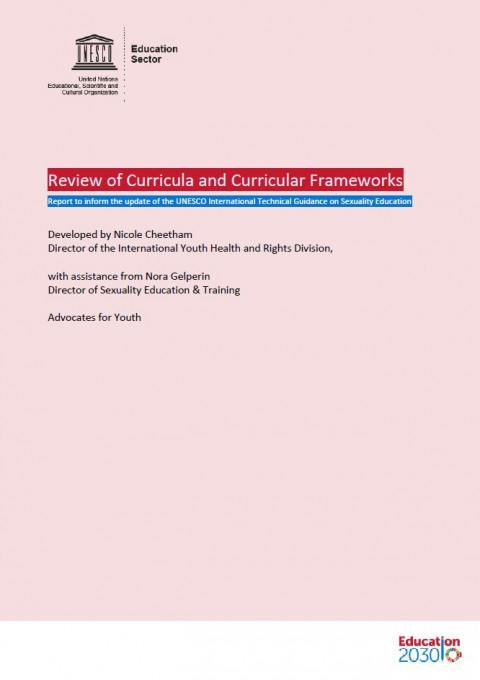 Review of Curricula and Curricular Frameworks: Report to Inform the Update of the UNESCO International Technical Guidance on Sexuality Education Año de publicación: 2018 Autor: Nicole Cheetham | Nora Gelperin Autor corporativo: Advocates for Youth In 2009, UNESCO published the International Technical Guidance on Sexuality Education (ITGSE): An evidence-informed approach for schools, teachers and health educators. The purpose of the ITGSE is to assist education, health and other relevant authorities in the development and implementation of school-based sexuality education programmes and materials (UNESCO, 2009). The publication was released in two volumes: Volume I, which focuses on the rationale for sexuality education and provides sound technical advice on the characteristics of effective programmes; and Volume II, which focuses on the topics and learning objectives to be covered in a ‘basic minimum package’ on sexuality education for children and young people from 5 to 18+ years of age, and includes a bibliography of useful resources.In 2016, UNESCO began a process to update the ITGSE, consisting of a literature review of the evidence and lessons learned since the release of the original publication; a stakeholder consultation on sexuality education held in October of 2016; an online user survey; and an expert, Comprehensive Sexuality Education (CSE) Advisory Group established to inform the process and its findings.This report summarizes evidence-informed conclusions, expert recommendations and current practice for curriculum-based sexuality education for ages 5-18+ and provides preliminary, overarching changes to Volume II of the ITGSE for consideration by the UNESCO CSE Advisory Group.
  The Holocaust by Bullets - A study guide for educators Año de publicación: 2015 Autor: Urszula Szczepinska This guide released by Yahad in Unum is the result of several years of research on mass shootings of Jews and Roma in the ex-Soviet Union. Using this guide, teachers can educate about the genocide in the eastern parts of Europe by killing squads, a part of istory that was long obscured. La Shoah par balles - Un guide d'étude pour les éducateurs Año de publicación: 2015 Autor: Urszula Szczepinska Ce guide publié par Yahad in Unum est le résultat de plusieurs années de recherche sur les fusillades de masse des Juifs et des Roms dans l'ex-Union soviétique. Utilisation de ce guide, les enseignants peuvent renseigner sur le génocide dans les régions orientales de l'Europe en tuant des escadrons, une partie de istoire qui a été longtemps occultée. L'Holocauste, 1933-1945: kit Ressources pédagogiques Autor corporativo: Simon Wiesenthal Center Ce kit éducatif publié par le Centre Simon Wiesenthal Bibliothèque et Archives propose de nombreux matériaux d'enseignement du personnel éducatif peut approprier. Il propose une chronologie de l'Holocauste, un glossaire des termes, des lieux et des personnalités, une leçon d'histoire sous une session "Questions / réponses", des informations sur chaque camp nazi (nombre de décès, le statut actuel ...) des lectures, des ressources et un liste des associations travaillant sur le sujet. One country, many cultures! Does Holocaust education have an impact on pupils' citizenship values and attitudes? The Holocaust has been regarded as the defining moment of modern history and perhaps of all time. For most people it still evokes the ultimate in barbarism and inhumanity. The focus of this paper is to examine the impact that Holocaust education has on citizenship values in the primary and secondary stages of schooling. Previous research on teaching the Holocaust, primarily case studies in either the primary or the secondary sectors, suggests that the contribution of Holocaust education to citizenship includes developing pupils' understanding of the notion of justice, tolerance and the many forms of racism and discrimination, and provides opportunities for developing the positive values of empathy, awareness of antiracism, and an understanding that the individual can make a difference. Further, it can make a significant contribution to citizenship in developing pupils' awareness of human rights issues and genocides, the concepts of stereotyping and scapegoating and the exercise of power in local, national and global contexts. Our ongoing longitudinal research (sponsored by the Scottish Executive Education Department and running from November 2003 until summer 2005) aims to examine the value of Holocaust education in achieving aspects of citizenship. It is concerned with the immediate and longer term effects of Holocaust education on pupils' values and attitudes. Initially focused on primary pupils aged 11-12 years, it will follow them into secondary and compare their values and attitudes with pupils in their year who did not study the Holocaust in their primary schools. The proposed paper, which will report on the first stages of this ongoing research, will concentrate on: the relevance of Holocaust education to citizenship; the research methodology; the first results of the understanding of pupils and the impact of Holocaust teaching; tentative conclusions. (By the author)