
Recursos
Exploren una amplia gama de recursos valiosos en GCED para profundizar su comprensión y promover su búsqueda, incidencia, enseñanza y aprendizaje.
2,668 resultados encontrados
 Arab Teachers and Holocaust Education: Arab Teachers Study Holocaust Education in Israel This paper examined whether change occurred in the attitudes of Arab teachers in Israel toward Holocaust education following an in-service study course. Survey and interview data indicated that after the course, teachers had a better understanding of what occurred during the Holocaust, and their willingness to know about its effects on Jewish people increased. However, the Israeli-Palestinian conflict impacted participants' views. (By the author) Teaching and Learning about the Holocaust through Visiting an Exhibition This article evaluates a teaching initiative that aimed to teach about the Holocaust through a traveling exhibit on Anne Frank. Data from 10 case study schools show the success of the approach and some ways in which the teaching relevance might have been strengthened. (By the author)
  Situational Analysis on the Status of Sexual and Reproductive Health of Students and Gender-based Violence in Technical and Vocational Colleges in Malawi (STEP Research Series No. 2) Año de publicación: 2017 Autor corporativo: Skills and Technical Education Programme (STEP) Funded by the EU and implemented by UNESCO in collaboration with the Government of Malawi, the Skills and Technical Education Programme (STEP) is dedicated to reinforcing Technical, Entrepreneurial and Vocational Education and Training (TEVET) in Malawi.The programme will run from 2016-2020 and aims to improve TEVET at post-secondary level with a focus on equal access to enrolment, with particular emphasis on female learners; improving quality in the sector; and the establishment of clear governance structures. The STEP Research Series presents the highlights of the research undertaken by the programme.The situational analysis on the status of sexual and reproductive health of students and gender-based violence in technical and vocational colleges in Malawi is the second report in the STEP Research Series.
  One Voice for All: Education Pack Año de publicación: 2013 Autor corporativo: British Council One Voice for All is a set of resources designed to help teachers work on the Connecting Classrooms themes of Rights and Responsibilities and Fairness and Equality through an exploration of human rights and street children. Its focus is the UN Convention on the Rights of the Child and it aims to allow learners to develop understanding of the key concepts of global citizenship, universal rights and justice.This resource aims to give young people the opportunity to understand the complexity of the wider world in which they live by exploring inequality and steps to address it.
  The Critical Thinking Workbook: Games and Activities for Developing Critical Thinking Skills Autor corporativo: Global Digital Citizen Foundation Critical thinking is clear, rational, logical, and independent thinking. It’s about improving thinking by analyzing, assessing, and reconstructing how we think. It also means thinking in a self-regulated and self-corrective manner. It’s thinking on purpose!The Critical Thinking Workbook helps you and your students develop mindful communication and problem-solving skills with exciting games and activities. It has activities that are adaptable to any grade level you want.The activity pages in the Critical Thinking Workbook are meant to be shared and explored. Use it as an electronic document or as worksheets.You can either print off the pages and use them as activity sheets, or you can edit them directly right in the document on your computer.There are also Answer Keys for the activities that need them provided at the back of the book. Enseigner l'histoire et la prévention des génocides - Peut on prévenir les crimes contre l'humanité ? The question of barbarism dominates remembrance issues. The study of the prevention of crimes against humanity constitutes another major challenge. But these sensitive and complex debates are problematic. All fields are concerned : history, memory, law, philosophy, politics. How can schools tackle them ? Two solutions : opting for a comparative study of genocides, particularly the Holocaust and the Tutsis in Rwanda; and using the "universal/particular" dialectic, institutions and individuals. Recollections of the past and edification of the future, this book gives meaning to education and presents a sensitive reflection of the challenges of history and the contemporary world. (By the author - Translation) Enseigner l'histoire et la prévention des génocides - Peut on prévenir les crimes contre l'humanité ? La question de la barbarie domine les questions commémoratives. L'étude de la prévention des crimes contre l'humanité constitue un autre défi majeur. Mais ces débats délicats et complexes sont problématiques. Tous les champs sont concernés: l'histoire, la mémoire, le droit, la philosophie, la politique. Comment les écoles peuvent les aborder? Deux solutions: opter pour une étude comparative des génocides, en particulier l'Holocauste et les Tutsis au Rwanda; et en utilisant les « particuliers/universels» dialectiques, les institutions et les individus. Recollections du passé et de l'édification de l'avenir, ce livre donne un sens à l'éducation et présente une réflexion sensible des défis de l'histoire et le monde contemporain. (Par l'auteur - traduction)
  Discussion Papers Journal (Vol 1) In Volume I, students are introduced to the subject of the Holocaust and its implications through the writings of experts in this field of study and testimonies from survivors. German Professor Monika Richarz provides the reader with historical context and insight into Jewish culture before the war and French-born Holocaust survivor Simone Veil gives a first-hand account of experiencing the Holocaust as a Jew. Hungarian writer László Teleki talks about the Roma experience and how this group was similarly targeted by the Nazis. Historian and Professor Yehuda Bauer (Israel) explains how the Holocaust evolved from a utopian ideology that involved hatred of Jews, while Nobel Laureate and Holocaust survivor Elie Wiesel (USA) challenges the reader with the question “Why hate?” Other contributors include Professor Xu Xin (China), Professor Ben Kiernan (Australia), Professor Edward Kissi (South Africa), and Francis Deng (former Special Adviser to the United Nations Secretary-General on the Prevention of Genocide and today Permanent Representative of South Sudan to the United Nations). (By the publisher) Discussion Papers Journal (Vol 1) Dans le volume I, les élèves sont initiés au sujet de l'Holocauste et de ses implications à travers les écrits d'experts dans ce domaine d'étude et des témoignages de survivants. Professeur allemand Monika Richarz fournit au lecteur le contexte historique et un aperçu de la culture juive avant la guerre et survivant de l'Holocauste d'origine française Simone Veil donne un compte rendu de première main de l'expérience de l'Holocauste en tant que Juif. L’ écrivain hongrois László Teleki parle de l'expérience des Roms et la façon dont ce groupe a été ciblé de façon similaire par les nazis. Professeur Yehuda Bauer (Israël), historien, explique comment l'Holocauste a évolué à partir d'une idéologie utopiste qui a impliqué la haine des Juifs, alors que le prix Nobel et survivant de l'Holocauste Elie Wiesel (USA) défie le lecteur avec la question «Pourquoi la haine? » Parmi les autres contributeurs Professeur Xu Xin (Chine), le professeur Ben Kiernan (Australie), le professeur Edward Kissi (Afrique du Sud), et Francis Deng (ancien Conseiller spécial du Secrétaire général des Nations Unies sur la prévention du génocide et aujourd'hui Représentant permanent du Soudan du Sud auprès des Nations Unies ). (Par l'éditeur)
 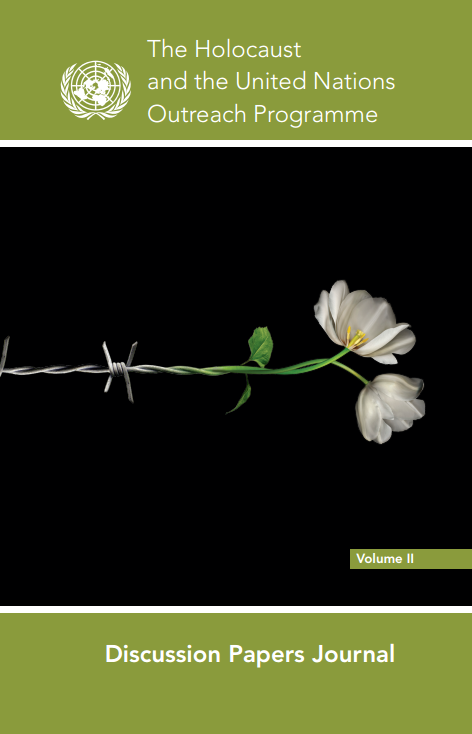 Discussion Papers Journal (Vol 2) In Volume II, Chinese author Pan Guang delivers a gripping account of how Jews made their way to Shanghai during the Second World War while Polish writer Andrzej Mirga details the Nazi persecution of Roma and Sinti during the same period. Argentine professor Juan E. Méndez bring us to the 21st century with a discussion of the 2011 arrest and pending trial of accused Serbian war criminal Ratko Mladic. And the timeless value of Holocaust education is explored as South African Tali Nates shows how education is helping to heal the divisions wrought by apartheid in South Africa and Russian scholar Ilya Altman lays out Holocaust remembrance and education in contemporary Russia. Other contributors are Edward Mortimer and Kaja Shonick Glahn (UK / Germany), David Matas (Canada), Lenore Weitzman (USA), and Robert Krell (Canada). (By the publisher)